
- A Snapshot of Grilled Chicken Nutrition Facts
- A Complete Nutritional Profile of Different Chicken Cuts
- The Hidden Health Benefits of Chicken's Micronutrients
- Grilled Chicken for Weight Management and Heart Health
- How Marinades and Grilling Methods Alter Nutrition
- Frequently Asked Questions About Grilled Chicken
Grilled chicken is a cornerstone of healthy eating for a good reason. It’s lean, packed with protein, and incredibly versatile. But when you’re tracking your macros and calories, knowing the precise numbers is what really counts. The skinless chicken breast, in particular, is the gold standard for a reason.
A Snapshot of Grilled Chicken Nutrition Facts
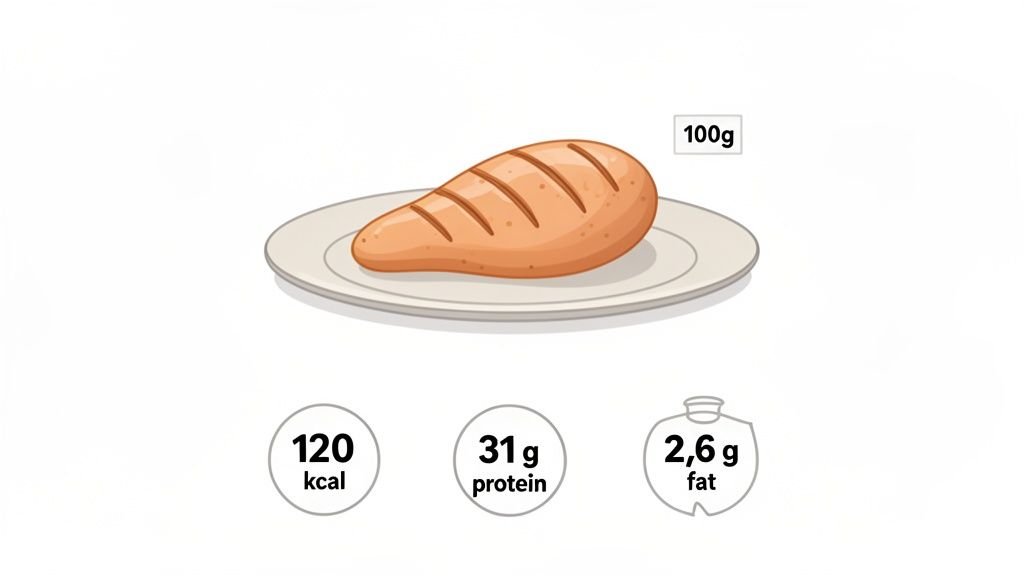
If you need a quick, reliable number for your food log, this is it. A standard 100-gram (about 3.5 ounces) portion of skinless grilled chicken breast consistently delivers more protein for fewer calories than almost any other cut of meat.
This is why it's a fixture in so many diet and fitness plans. For that 100g serving, you're looking at around 165 calories. The real star of the show, though, is the 31 grams of complete protein. That’s a massive amount, making up about 62% of the daily value for an average adult. All this comes with just 3.6 grams of fat. This incredible protein-to-calorie ratio is what makes it a top choice for building and repairing muscle without adding a lot of extra calories to your day.
Nutrition for Grilled Chicken Breast (100g Skinless)
To give you the core numbers at a glance, this table breaks down the nutritional profile for a standard 100g serving of skinless grilled chicken breast. Think of this as your quick reference for accurate logging.
| Nutrient | Amount | Daily Value (DV) % |
|---|---|---|
| Calories | 165 kcal | ~8% |
| Protein | 31 g | 62% |
| Total Fat | 3.6 g | ~5% |
| Saturated Fat | 1 g | 5% |
| Carbohydrates | 0 g | 0% |
| Sodium | 74 mg | 3% |
| Niacin (B3) | 14.8 mg | 92% |
| Vitamin B6 | 1.1 mg | 65% |
| Phosphorus | 254 mg | 20% |
| Selenium | 27.6 mcg | 50% |
These foundational values give you a solid starting point. If you want to get better at interpreting this kind of data for all your foods, it's worth taking a moment to learn how to read nutrition labels effectively. It’s a skill that pays off every single day.
A Complete Nutritional Profile of Different Chicken Cuts
When it comes to grilled chicken, most of us know it's a fantastic source of protein. But if you're serious about your nutrition, you've probably wondered just how much of a difference your choice of cut really makes. The truth is, it makes a huge difference. The part of the chicken you eat—and whether you leave the skin on—can dramatically change the calories, fat, and even protein on your plate.
The undisputed champion of lean protein is, of course, the chicken breast. It's the go-to for a reason, packing a ton of protein with very little fat. On the other hand, dark meat like thighs and drumsticks comes from muscles that did more work, so they naturally store more intramuscular fat for energy. This gives them more flavor and moisture, but also more calories.
And then you have wings, which are really in a league of their own. Because they have so much more skin relative to meat, their fat and calorie numbers shoot way up. Getting a handle on these details is the first step to truly mastering your diet. You can see how chicken stacks up against other protein sources in our comprehensive protein quality chart.
Comparing Grilled Chicken Cuts With and Without Skin (per 100g)
To really see the numbers side-by-side, let's break it down. This table gives you a clear comparison of the most common cuts, both with and without skin. All the nutrition facts are for a standard cooked 100-gram (about 3.5 ounces) portion, which makes it easy to compare apples to apples (or in this case, breasts to thighs).
| Chicken Cut | Skin | Calories | Protein (g) | Total Fat (g) | Saturated Fat (g) |
|---|---|---|---|---|---|
| Breast | Skinless | 165 | 31 | 3.6 | 1.0 |
| Breast | Skin-on | 220 | 29 | 11 | 3.1 |
| Thigh | Skinless | 209 | 26 | 10.9 | 3.0 |
| Thigh | Skin-on | 254 | 24 | 16.5 | 4.6 |
| Drumstick | Skinless | 172 | 28 | 5.7 | 1.5 |
| Drumstick | Skin-on | 216 | 27 | 11.2 | 3.1 |
| Wing | Skinless | 203 | 30 | 8.1 | 2.3 |
| Wing | Skin-on | 290 | 27 | 19.5 | 5.5 |
As you can see, the differences are significant. Choosing a skinless breast over a skin-on wing means you're getting more protein for far fewer calories and a fraction of the fat, which is critical depending on your specific health goals.
Why Skin Makes Such a Big Difference
Looking at the table, one thing becomes incredibly clear: skin is a game-changer. Since chicken skin is mostly fat, leaving it on adds a surprising amount of calories and nearly doubles the fat content of any cut.
Just look at the chicken breast. A skinless portion has a lean 3.6 grams of fat. Keep the skin on, and that number skyrockets to 11 grams. The same story plays out with dark meat. A skin-on thigh has a hefty 16.5 grams of fat, but take the skin off, and you’re down to a more manageable 10.9 grams.
Key Takeaway: If you want to maximize protein while keeping calories and fat low, always go skinless. Simply peeling the skin off before you eat is one of the easiest and most impactful tweaks you can make for a healthier meal.
Choosing the Right Cut for Your Goals
So, what does this all mean for your next meal? Your "best" cut of chicken really comes down to your personal goals and what you value most—be it lean protein, flavor, or something in between.
Here’s a quick guide to help you decide:
- For Maximum Protein and Lean Mass: The skinless chicken breast is your workhorse. It offers the best protein-to-calorie ratio, period. It's the ideal choice when you're focused on building muscle, losing fat, or just need to hit your macro targets precisely.
- For Flavor and Juiciness: Skinless chicken thighs are a fantastic compromise. Their higher fat content makes them more flavorful and forgiving on the grill than breasts, and they still deliver an impressive 26 grams of protein per 100g.
- For a Balanced Option: Don't sleep on the skinless drumstick. It’s a surprisingly lean option that offers a great texture—almost as lean as a breast but with the tenderness of dark meat.
- For an Occasional Indulgence: Think of wings as a treat. With their high fat and calorie count (especially with skin), they're perfect for game day but aren't the best choice for a daily protein staple.
By understanding the distinct grilled chicken nutrition facts for each cut, you can stop guessing and start making informed choices that perfectly align with your health and fitness journey.
If you’ve ever been serious about fitness, you know that grilled chicken is the undisputed king of muscle-building foods. This isn't just gym-talk; it's backed by solid science. The reason it’s a staple for athletes and bodybuilders is simple: it’s a powerhouse of high-quality, "complete" protein.
What that means is grilled chicken delivers all nine essential amino acids—the ones your body can't make on its own. Think of these amino acids as the raw materials your body needs to repair and build new muscle, especially after you've pushed yourself in a workout.
How Protein Builds and Repairs Muscle
One amino acid, in particular, gets the spotlight: leucine. It acts like a key in an ignition, turning on the engine for muscle protein synthesis (MPS). This is the biological process that literally builds bigger, stronger muscle fibers. So, when you eat grilled chicken after a workout, you're giving your body the exact trigger it needs to start the recovery and growth process.
The Metabolic Edge of Eating Chicken
There’s another cool benefit to all that protein. It comes from something called the thermic effect of food (TEF). Simply put, your body has to work—and burn calories—just to digest the food you eat. Protein has a much higher TEF than carbs or fat.
In fact, your body can burn up to 30% of the calories from protein just by processing it. That’s a nice little metabolic kick. With 25.8-31g of protein per 100g, grilled chicken doesn't just help you build muscle; it helps you stay lean while doing it. This is why it’s a go-to for anyone looking to optimize their body composition.
This chart gives you a quick visual on how different cuts stack up in the protein department.
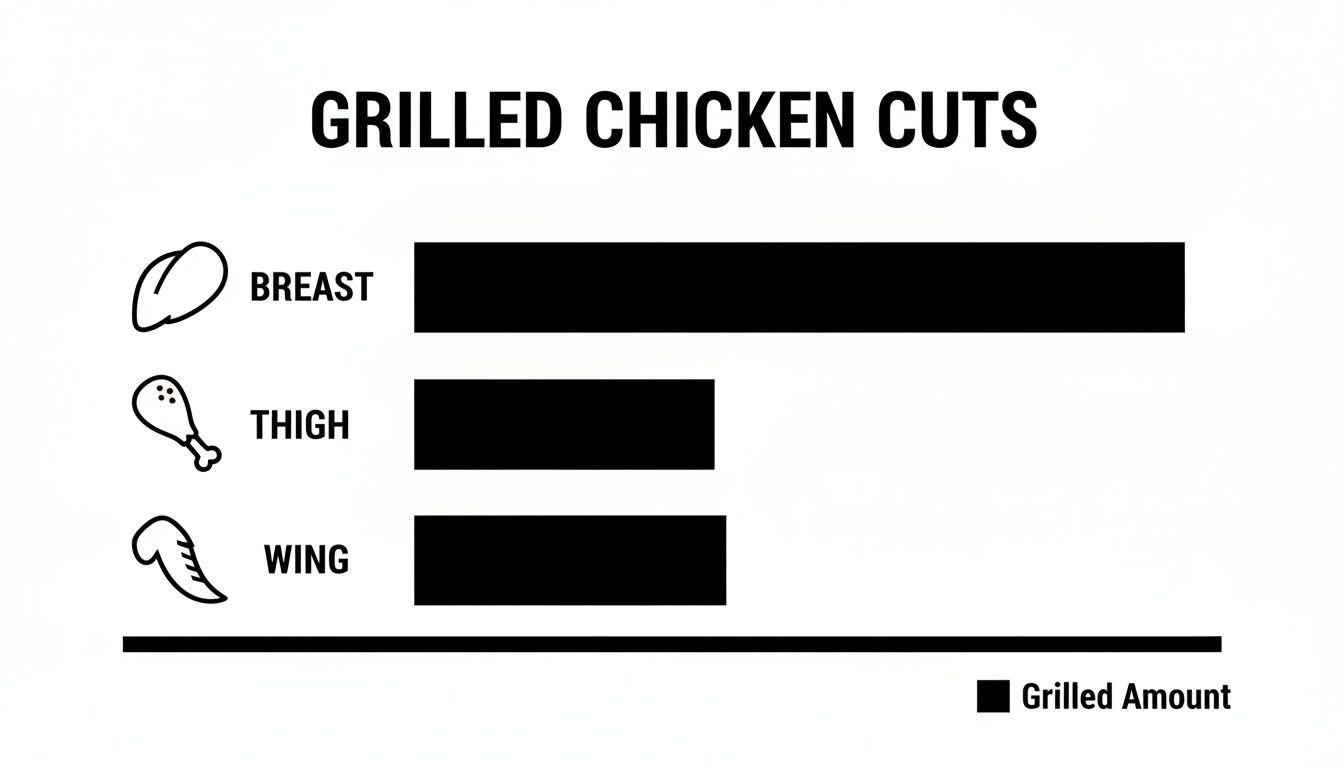
As you can see, the breast is the leanest and most protein-dense option, which is why it's a favorite for those aiming to maximize muscle gain without adding extra fat.
When to Eat Your Protein for the Best Results
To really get the most out of your chicken, timing matters. It’s not just about what you eat, but when you eat it. Giving your muscles protein when they’re most ready to absorb it can make a huge difference.
Here’s a practical way to think about it:
- Before Your Workout: A small meal with grilled chicken about an hour or two beforehand can fuel your session and help protect your muscles from breaking down.
- After Your Workout: This is the big one. The 30-60 minutes after you train is often called the "anabolic window." Your muscles are primed for repair, and feeding them protein then kick-starts recovery in a major way.
Fitting grilled chicken into a well-structured high-protein meal plan is the key to unlocking your full potential for growth and recovery.
PlateBird Tip: Don’t get bogged down with complicated tracking after a tough workout. With PlateBird, you can just type in your meal, like "grilled chicken and sweet potato," and let the app do the rest. It instantly calculates the macros, so you know you've hit your protein goals for recovery without any of the guesswork.
The Hidden Health Benefits of Chicken's Micronutrients
When we talk about grilled chicken, the conversation almost always starts and ends with protein. It's the star of the show, but looking at the complete grilled chicken nutrition facts shows there's so much more going on under the surface. Chicken is loaded with essential vitamins and minerals, the "micronutrients" that quietly work in the background to keep your body running like a well-oiled machine.
Think of them as the skilled support crew for the headliner (protein). They're crucial for everything from turning food into energy to keeping your mind sharp and your immune system ready for action.
A Powerhouse of B Vitamins for Energy
You'll find that grilled chicken is an incredible source of B vitamins, especially Niacin (Vitamin B3) and Vitamin B6. In fact, a single 100-gram serving of chicken breast can knock out a huge chunk of your daily needs—often over 90% of the Daily Value for Niacin alone.
So, what do they actually do for you?
- Niacin (B3): This is your energy-unlocking vitamin. It’s a key player in metabolism, helping your body tap into the energy stored in the fats, carbs, and protein you eat. This is fundamental for everything your cells do, and it also helps maintain healthy skin and nerves.
- Vitamin B6: Absolutely critical for your body, B6 is involved in over 100 different enzyme reactions. It helps you process amino acids (making that protein useful!), produces key neurotransmitters like serotonin, and keeps your immune function strong.
If you’re feeling wiped out and sluggish, a lack of these B vitamins could be the culprit, even if your calorie intake seems fine.
Essential Minerals for Bones and Immunity
Moving beyond the vitamins, grilled chicken also provides a healthy dose of critical minerals. Two of the big ones are Phosphorus and Selenium, and they're a vital part of the total grilled chicken nutrition facts for good reason.
You might be surprised to learn that Phosphorus is the second most abundant mineral in your body, right after calcium. Its main job is building strong bones and teeth, where it works side-by-side with calcium to create and maintain your entire skeletal structure.
Then there's Selenium, a potent antioxidant that acts as a bodyguard for your cells, protecting them from damage. This helps dial down inflammation and gives your immune system a serious boost, making you better prepared to fend off sickness. Just one 100g serving of chicken breast can cover about 50% of your daily selenium needs. It’s clear that these micronutrients make grilled chicken a true nutritional heavyweight, not just a simple source of protein.
Grilled Chicken for Weight Management and Heart Health
When you're trying to manage your weight or look after your heart, grilled chicken is one of the best foods you can put on your plate. It's not just a popular meal; its nutritional makeup makes it a genuinely smart choice for hitting long-term health goals. The magic is in its high-protein, low-fat profile, which tackles both weight and heart health in one go.
For anyone focused on weight management, the high protein in grilled chicken is your secret weapon. Protein helps you feel full and satisfied long after you've finished eating. This feeling of satiety is what helps you sidestep the temptation to snack on empty calories between meals, making it easier to stick to your daily calorie targets.
And because it has zero carbohydrates, grilled chicken won't send your blood sugar on a rollercoaster ride. You get to avoid the energy spikes and crashes that often lead to cravings, which is a huge win for maintaining stable energy and hunger levels throughout the day.
Protecting Your Heart with Lean Protein
Looking beyond weight, the grilled chicken nutrition facts point to some serious heart-health benefits. Skinless cuts are incredibly low in saturated fat, containing just 1g of saturated fat per 100g serving with zero trans fats. This makes it a perfect fit for any heart-healthy eating plan.
This lean profile is incredibly important. According to the WHO, cardiovascular diseases are a massive global problem, responsible for 17.9 million deaths every year. You can see more details on grilled chicken's nutritional benefits on FatSecret to understand just how powerful this food can be.
The combination of low saturated fat and high-quality protein is what makes grilled chicken a far better option than most red and processed meats, which are often tied to a higher risk of heart problems.
Key Insight: Simply swapping higher-fat meats for lean proteins like grilled chicken is one of the most effective changes you can make. It's a direct way to help lower your "bad" cholesterol (LDL) and support your overall cardiovascular system.
How to Maximize the Health Benefits
To get the most out of your grilled chicken, a few simple habits can make all the difference.
- Always Choose Skinless: We've seen the numbers—the skin is where the extra saturated fat hides. Taking it off before you cook is the single easiest way to keep your meal lean.
- Opt for Breasts: While all skinless cuts are great, chicken breast gives you the absolute best protein-to-fat ratio.
- Mind Your Marinades: Watch out for pre-made marinades and sauces loaded with sugar and sodium. Instead, make your own with herbs, spices, a splash of lemon juice, and a little olive oil to pack in flavor without the baggage.
Of course, knowing how these choices fit into your overall diet is key. If you're trying to get a handle on your daily targets, our guide on what your daily macros should be can help you connect the dots. When you pair smart food choices with the right knowledge, you can use something as simple as grilled chicken to build a healthier you.
How Marinades and Grilling Methods Alter Nutrition
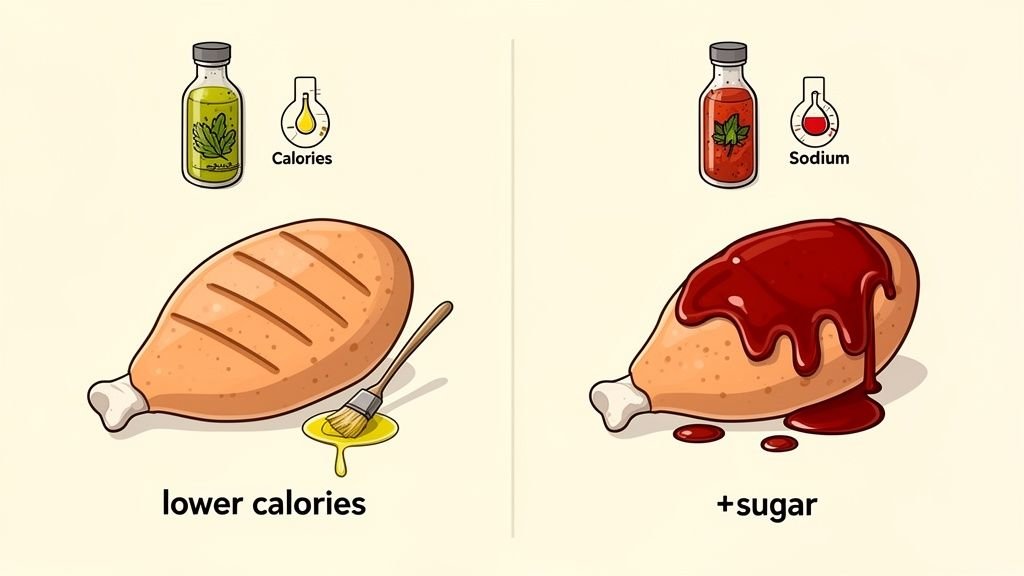
The baseline grilled chicken nutrition facts give you a fantastic starting point, but they don't tell the whole story. The real numbers that end up on your plate are shaped by what you do before and during the cooking process. Your choices in marinades and even your grilling technique can dramatically shift the calories, fat, and sodium.
Think of the cooking process itself as your first chance to influence the outcome. Grilling is a great method because it lets excess fat render and drip away from the meat, which is a natural way to lower the fat content compared to, say, pan-frying. At the same time, the high heat of the grill can create some undesirable compounds if you aren't careful.
The Hidden Impact of Marinades
Marinades are where the flavor magic happens, but they're also a primary source of hidden calories, sugar, and salt. The type of marinade you reach for can completely change the nutritional profile of your meal, for better or worse.
Sugary Sauces: Be careful with thick, sweet sauces like BBQ or teriyaki. They can pile on the calories fast. Just two tablespoons of a standard BBQ sauce can contribute 50-70 calories and more than 12 grams of sugar. When you slather that all over the chicken, those sugars can also caramelize and burn, leading to more char.
Oily Marinades: While some fats are healthy, the amount always matters. Oil-heavy marinades get absorbed directly into the chicken, bumping up the total fat and calorie count. To put it in perspective, adding just a quarter-cup of olive oil to a marinade brings along nearly 500 calories.
Sodium-Heavy Brines: Salty brines and marinades built on soy sauce can send the sodium content soaring. This is a common trick for making chicken extra juicy, but it's a critical detail to watch if you're keeping an eye on your blood pressure.
Your best bet is often the simplest. A light marinade made from fresh herbs, spices, and an acid like lemon juice or vinegar adds a ton of flavor with almost no calories. It also has the added benefit of helping to reduce the formation of unwanted compounds while grilling.
Your Grilling Technique and Your Health
How you manage the grill is just as important as what you put on it. When meat is cooked at very high temperatures, it can form compounds known as Heterocyclic Amines (HCAs) and Polycyclic Aromatic Hydrocarbons (PAHs), which some research has linked to health risks.
Key Insight: Simply marinating your chicken for at least 30 minutes before it hits the grill can slash the formation of HCAs. The acidic ingredients and antioxidants from herbs create a protective shield against the intense heat.
Here are a few grilling habits that can make your chicken healthier:
- Keep the Heat Moderate: Cook your chicken over a medium flame instead of blasting it with high heat. This helps prevent the outside from getting scorched before the inside is fully cooked.
- Trim Visible Fat: Before you start, take a moment to trim off any large pieces of fat. This simple step reduces flare-ups caused by dripping fat, which in turn reduces the smoke that deposits PAHs onto your food.
- Flip It Often: Don't just let your chicken sit there. Flipping it frequently promotes even cooking and minimizes the char on any one side.
- Cut Away the Char: If some spots do get a little too blackened, just trim those bits off before you eat.
By being mindful of your marinades and adopting a few smarter grilling techniques, you can ensure your grilled chicken stays the lean, healthy, and delicious meal you intended it to be.
Frequently Asked Questions About Grilled Chicken
When you're focused on healthy eating, grilled chicken is bound to be on your mind—and so are a lot of questions. Getting straight, simple answers is the key to making the best choices. Let's cut through the noise and talk about what really matters when it comes to grilled chicken.
Is Grilled Chicken Healthier Than Baked?
I hear this one all the time. The short answer is that grilling can be a little healthier. As the chicken cooks over the grates, fat renders and drips away, which can slightly lower the final fat and calorie count.
But honestly, the difference is pretty small. Baking is also an incredibly healthy way to cook chicken, especially if you place it on a rack so it isn't sitting in its own drippings. The real game-changer isn't the cooking method itself, but what you put on the chicken. Sugary sauces and oily marinades will add far more calories than the tiny difference between grilling and baking. The choice of what you season it with is huge; for a deep dive into that, check out this great resource: A Guide to Barbecue Rubs for Chicken.
How Much Chicken Can I Eat for Weight Loss?
There's no single magic number here. The "right" amount of chicken is whatever fits into your personal calorie and protein goals. For weight loss to happen, you just need to be in a consistent calorie deficit.
A great starting point for many people is a 4-6 ounce (113-170g) portion of skinless grilled chicken breast with their main meals. That amount gives you a solid hit of protein to keep you feeling full and help maintain muscle, all without breaking the calorie bank. Ultimately, you have to look at your total daily numbers and adjust your chicken portion to fit your plan.
Is Eating Grilled Chicken Every Day Unhealthy?
For most people, digging into a plate of lean grilled chicken every day is completely fine. It's a powerhouse of high-quality protein and other important nutrients. That said, variety is always the best long-term strategy for your health.
Think of it this way: no single food has every nutrient your body needs. Eating a wide array of foods ensures you're getting a broader mix of vitamins, minerals, and antioxidants. While grilled chicken is a fantastic and healthy staple, try to work in other proteins like fish, beans, lentils, and tofu, and always load up your plate with fruits and vegetables.
Key Takeaway: Grilled chicken can absolutely be a daily part of a healthy diet, but it shouldn't be the only part. A balanced, diverse plate is always the best bet for good nutrition.
Is Organic Chicken More Nutritious?
If you line up the grilled chicken nutrition facts side-by-side, you'll find there’s almost no difference between organic and conventional chicken. The protein, fat, calories, and most of the vitamins and minerals are practically identical.
While some studies point to tiny variations, like a slightly different fatty acid profile in organic chicken, the difference isn't big enough to really affect your overall health. People usually choose organic because of other factors—things like farming practices, the absence of antibiotics, and animal welfare—not because it offers a major nutritional upgrade.
Tracking your food shouldn't feel like a full-time job. PlateBird is an AI-powered app that makes logging meals as simple as sending a text. Just type what you ate or snap a picture of your plate, and the app instantly figures out your calories and macros. Download PlateBird for free and start hitting your goals without the headache at https://platebird.com.