- Rethinking Your Post Workout Meal for Weight Loss
- Start With Protein: The Golden Rule of Post-Workout Meals
- Choosing Smart Carbs and Fats to Fuel Recovery
- Should Men and Women Eat Differently After a Workout?
- Effortless Meal Tracking From Plate to Phone
- Quick and Easy Post-Workout Meal Ideas
- Answering Your Post-Workout Meal Questions
The best post-workout meal for weight loss isn’t a giant pasta bowl or a massive "recovery" shake. It’s actually much simpler: a meal built around 20-40 grams of lean protein that fits neatly within your daily calorie goals.
Getting this right turns your post-exercise window into a powerful tool for fat loss, helping your body repair muscle and ramp up your metabolism without accidentally undoing all your hard work.
Rethinking Your Post Workout Meal for Weight Loss
You just crushed a tough workout. You’re sweaty, tired, and feeling that satisfying muscle burn. The first thought that often pops into your head is, "I've earned a huge meal!"
This is the classic reward mindset, and honestly, it’s one of the biggest reasons people get stuck. We treat a great workout like a free pass to eat whatever we want, but that can easily erase the calorie deficit we just worked so hard to create. The old idea that you need to immediately slam a massive, carb-heavy meal after the gym is a myth that derails countless weight loss journeys.
It’s time for a mindset shift. Instead of a free-for-all, think of your post-workout meal as a strategic move. Right after exercise, your body is incredibly receptive to nutrients. Giving it the right fuel—not just a flood of calories—is what truly amplifies your results.
Your post-workout meal isn't a dietary chore or a reward. It's one of the most effective tools in your weight loss arsenal, giving your body precisely what it needs to repair muscle and continue burning fat.
This means we’re shifting our focus from sheer volume to smart, nutrient-dense choices. A well-built post workout meal will support muscle repair, give you back just enough energy, and keep you full—all without blowing your calorie budget for the day.
To really drive this point home, let's look at the old, outdated thinking versus a modern, weight-loss-focused approach.
Post-Workout Meal Mindset Shift
| Old Myth | New Strategy for Weight Loss |
|---|---|
| "You have to eat a huge meal to refuel." | Focus on a calorie-controlled meal. You only need to replenish a fraction of the calories you burned. |
| "The 'anabolic window' is only 30 minutes!" | The window is much larger, likely several hours. You don't need to panic and rush to eat immediately. |
| "Carb-loading is essential after every workout." | Prioritize protein first for muscle repair. Add a small portion of smart carbs, but protein is the star of the show. |
| "A workout gives me a free pass to eat whatever I want." | View the meal as a strategic tool to enhance workout benefits, not a reward that cancels them out. |
| "I'll just drink my calories in a sugary 'recovery' drink." | Opt for whole-food meals. They are more satiating and nutrient-dense, helping you stay full and on track with your goals. |
Embracing these new strategies is the key to making your workouts truly count toward your weight loss goals.
The Myth of Compensatory Eating
There’s a common fear that exercise just makes you ravenous, causing you to eat back every single calorie you burned (and then some). While that can happen, it’s far from a guarantee. For many people, the opposite is true—a good workout actually inspires healthier choices throughout the day.
I came across a fascinating study that looked at hundreds of post-exercise meals. The researchers found that, on the whole, people were actually less likely to choose an unhealthy meal after a workout compared to their non-exercise days.
Of course, the results varied a lot from person to person, which just goes to show that your mindset and planning matter most. You can learn more about how post-exercise eating behaviors vary and see how a conscious approach makes all the difference.
By having a strategic, satisfying post-workout meal ready to go, you take control of the situation. You sidestep the "compensatory eating" trap and ensure your time in the gym directly contributes to a leaner, stronger body.
Start With Protein: The Golden Rule of Post-Workout Meals
When you're trying to build a post-workout meal for weight loss, let's cut through the noise. There's one nutrient that should always be the star of your plate: protein. This isn't just a tip for bodybuilders; it’s the most important piece of the puzzle for anyone looking to get leaner and stronger.
Adopting a "protein-first" mindset is probably the single most effective change you can make. Why? Protein is your best friend when it comes to fat loss. It’s incredibly satiating, meaning it helps you feel full and satisfied. A protein-rich meal shuts down those nagging hunger cues that can lead to overeating later—a common trap that completely derails weight loss goals.
But it's not just about feeling full. Protein is the essential building block for repairing the muscle you just worked so hard to break down. After a workout, your muscles are screaming for it. Feeding them the protein they need helps them rebuild stronger, which in turn gives your metabolism a nice little boost. Remember, lean muscle burns more calories at rest than fat does.
This is a fundamental shift away from the old-school thinking about post-workout nutrition.
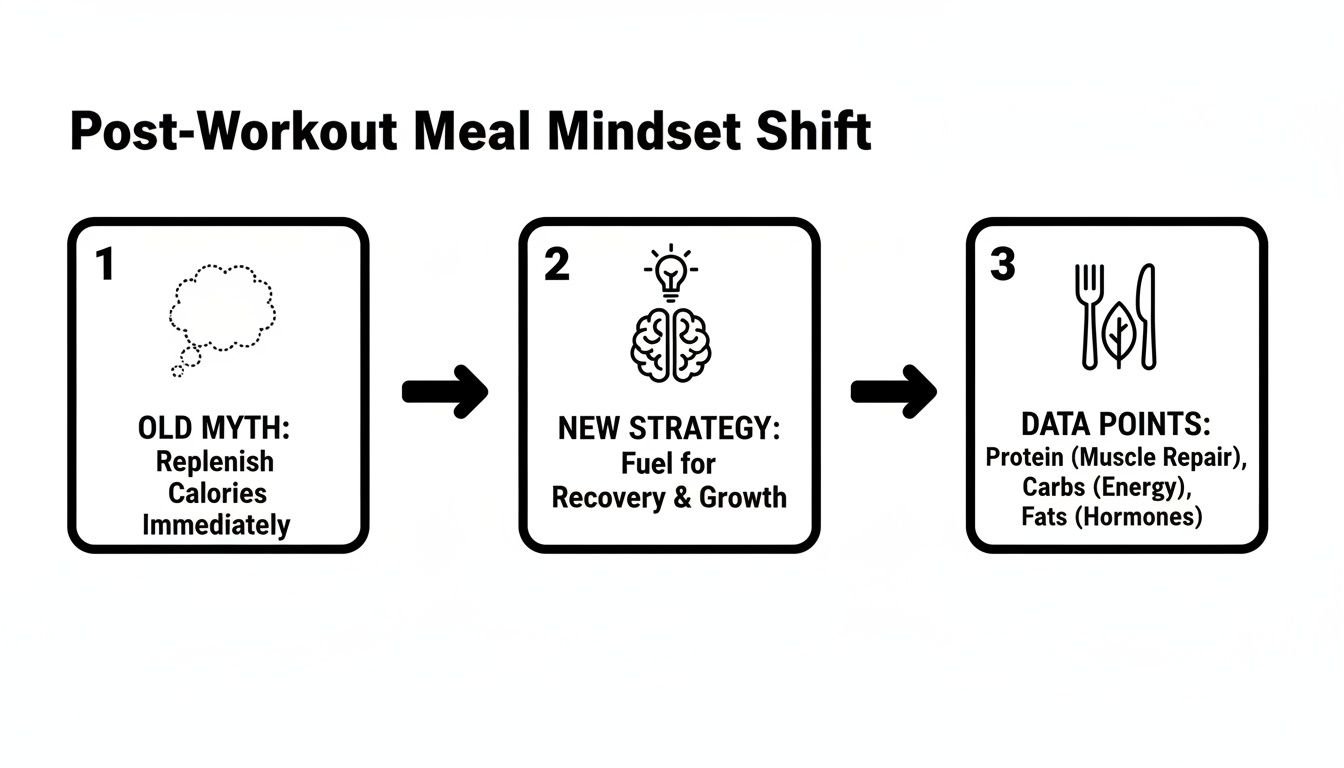
As you can see, it’s all about moving away from that carb-heavy "I earned this" mentality and toward a strategic, protein-forward meal that actually drives results.
Hitting Your Personal Protein Target
So, how much protein are we actually talking about? A great target to aim for in your post-workout meal is 20-40 grams. This is the sweet spot for kick-starting muscle protein synthesis—the scientific way of saying "muscle repair and growth"—without piling on unnecessary calories.
Let's translate that into real food. Here’s what 20-40 grams of protein actually looks like:
- 1 scoop of whey or casein protein powder: Usually lands you right in the 20-25 gram range.
- 1 cup (about 225g) of plain Greek yogurt: Packs a solid 23 grams.
- A palm-sized portion of grilled chicken breast (about 4 oz): Delivers a hefty 35 grams.
- 1 cup of cottage cheese: A powerhouse with about 28 grams.
These are fantastic choices because they're efficient, convenient, and easy to measure. If you really want to dive deep into the science, there are some great expert insights on protein timing and types that can help you fine-tune your approach even more.
Here’s what I tell all my clients: Making sure you get 20-40 grams of lean protein after you train is the best way to protect your hard-earned muscle while you’re in a calorie deficit. This ensures the weight you're losing is fat, not your strength.
Making It Easy on a Busy Schedule
Let’s be realistic. You just crushed a tough workout, you’re tired, and you don’t have time for complicated meal math.
Picture this: You finish a spin class and you're starving. Instead of grabbing the first thing you see, you open an app like PlateBird and just type in "grilled chicken salad." The app immediately shows you’ve nailed your protein goal with around 35 grams. Simple.
That’s the protein-first principle in action. It’s not about perfection; it’s about being intentional. A huge game-changer, especially when you’re starting out, is having your protein sources ready to go. Our guide on high-protein meal prep is packed with ideas to make this almost effortless.
Once you get into the habit of building your plate around a solid protein source, everything else just falls into place.
Choosing Smart Carbs and Fats to Fuel Recovery
Once you have your protein sorted, it’s time to think about the other key players on your plate: carbohydrates and fats. Carbs, in particular, get a really bad rap when it comes to weight loss, but that's a huge misunderstanding. Your post-workout window is precisely the time you should be eating them.
Think of it this way: your muscles are like sponges, ready to soak up nutrients to start the repair process. A strategic, lower-carb approach helps your body do this incredibly well. It’s not about eliminating carbs, but about choosing the right ones in the right amounts to improve your insulin sensitivity—a massive win for anyone trying to lose weight.
When your insulin sensitivity is high, your body becomes incredibly efficient at directing nutrients into your muscle cells for energy and repair, instead of just storing them as fat. It’s a powerful metabolic shift.
I always point my clients to the research here. A study in the Journal of Applied Physiology found that eating a low-carbohydrate meal after a workout boosted insulin sensitivity far more than other meal types. Discover more insights on how meal composition affects post-workout recovery. It just goes to show how much a little planning can pay off.
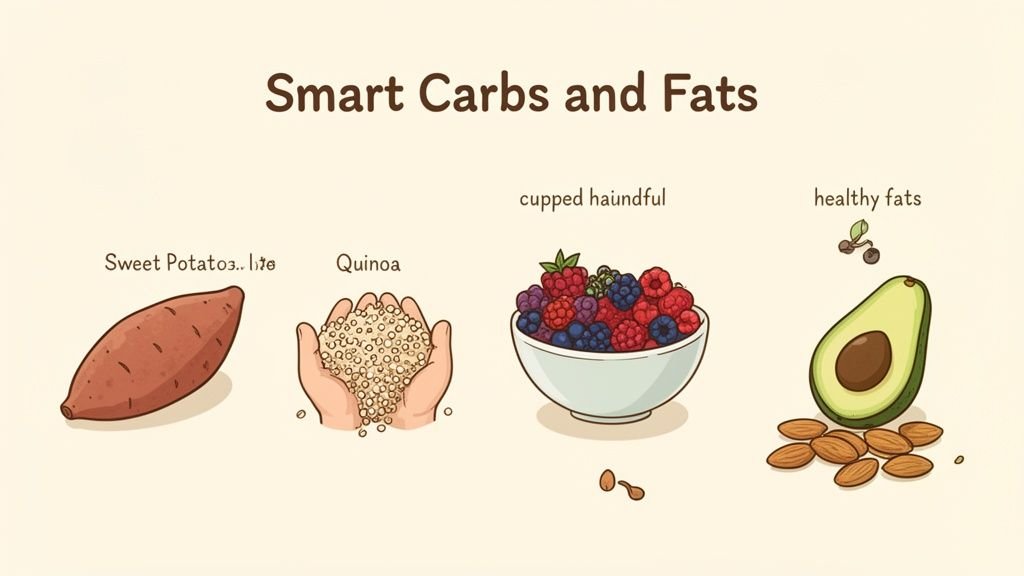
Nutrient-Dense Carb Choices for Weight Loss
So, what does a "smart" carb look like? We're looking for whole-food sources packed with fiber and nutrients. These are your complex carbs that provide a nice, steady stream of energy without sending your blood sugar on a rollercoaster.
The key is quality over quantity. You don't need a giant bowl of pasta to get the job done. A small, carefully chosen portion is all it takes to start refilling the muscle glycogen you used up during your training.
Here are some of my go-to choices for a post workout meal for weight loss:
- Berries: Just a handful of blueberries or raspberries gives you fiber and antioxidants with very little sugar.
- Sweet Potato: A small baked sweet potato is a powerhouse of vitamins and slow-digesting carbs.
- Quinoa: I love quinoa because it doubles as both a high-quality carb and a source of complete protein.
- Oats: A small serving of rolled oats is another fantastic, slow-release energy source.
For sizing, keep it simple. Your cupped hand is the perfect measuring tool. Aim for a portion that fits right in your palm—it’s just enough fuel without piling on extra calories.
The Role of Healthy Fats for Satiety
Now for the final piece of the puzzle: healthy fats. You don’t need a ton of fat right after a workout, since it can slow down digestion a bit. But including a small amount is crucial for one very important reason: it keeps you full.
This is where so many people get tripped up. A meal that doesn’t have staying power will leave you rummaging through the pantry an hour later. A little healthy fat makes your post-workout meal stick with you, crushing those cravings before they even start.
My top picks for healthy fats are:
- Avocado: Creamy and delicious, a quarter or half an avocado adds a dose of heart-healthy fats.
- Nuts and Seeds: A small handful of almonds or walnuts, or even a tablespoon of chia seeds, works wonders for satiety.
- Olive Oil: Simply drizzling a little extra virgin olive oil over your chicken and veggies is an easy win.
When you bring it all together—lean protein, a smart carb, and a healthy fat—you’ve built the perfect post-workout team. This combination repairs muscle, replenishes just enough energy, and keeps you feeling satisfied, making it so much easier to stick to your weight loss goals.
Should Men and Women Eat Differently After a Workout?
We’ve all heard the frantic advice about the "anabolic window." The idea that you have to slam a protein shake the second you drop your last dumbbell or you'll lose all your gains. It creates this frantic rush to eat something, anything, right after training.
But what if the real secret to a great post workout meal for weight loss isn't just about the clock? What if the best strategy is actually different for men and women? It turns out, your biology has a lot to say about it, and listening could be a game-changer for your results.
For years, we've all been handed the same one-size-fits-all advice. But we're starting to understand that's not the whole story, especially when it comes to how our bodies use fuel.
A New Way to Think About Your Post-Workout Carbs
There was a really interesting study out of the University of Surrey that totally caught my eye. It looked at how men and women burned fat differently based on when they ate their carbs relative to their workout. The results were pretty clear and a bit counterintuitive.
The researchers found that women who ate their carbohydrates before their workout actually burned more fat. For men, the opposite was true—they saw the best fat-burning results when they saved their carbs for after their workout. If you want to dive into the details, you can explore the research on how meal timing impacts weight loss differently for men and women.
This isn't about rigid rules, but about working with your body's natural tendencies.
Here’s the bottom line: Your biology might give you a fat-loss edge if you time your carbs right. Women seem to do better with pre-workout carbs, while men get more out of post-workout carbs.
So, how do we put this into practice? It's all about shifting your focus.
For Women:
- Before Your Workout: This is your ideal time for a smart carb. Think a small banana, a few dates, or a small bowl of oatmeal to fuel your session.
- After Your Workout: Make this meal all about protein and healthy fats. A simple protein shake with a scoop of almond butter, or some grilled chicken with a side of avocado, is perfect.
For Men:
- Before Your Workout: You might want to keep it light with just some protein (like a scoop of whey in water), or even try training fasted if that feels good for you and your energy levels.
- After Your Workout: Now's your time to bring in the carbs. Pair that crucial 20-40 grams of protein with a good carb source like a small sweet potato, quinoa, or a serving of rice.
By making this simple timing switch, you’re not fighting your metabolism—you’re giving it exactly what it needs to work more efficiently toward your weight loss goals.
Effortless Meal Tracking From Plate to Phone
Building the perfect post-workout meal is a huge win. But let’s be honest—if logging it feels like a second workout, you’re probably not going to stick with it. I’ve seen it countless times: people have the right meal plan but fall off track because the daily grind of counting calories and macros just becomes too much.
But what if you could track your entire meal in the time it takes to send a text or snap a picture? The friction that used to make meal logging so tedious is gone, and that changes everything for staying consistent.
Let's walk through a couple of real-world situations you’ll probably find yourself in.
The Quick Type Method in Action
Imagine you’ve just wrapped up a tough session at the gym. You get home and throw together a quick, effective recovery meal: a bowl of Greek yogurt topped with a handful of berries and some almonds. It’s simple, protein-packed, and perfect.
Instead of opening a spreadsheet or a clunky app to look up each ingredient, you just type what you ate into a tool like PlateBird. You literally type "Greek yogurt with berries and almonds."
In seconds, you get a full nutritional breakdown. You can see you’ve nailed your protein goal with about 25 grams, which gives you that instant feedback that you’re on the right track. The whole process takes less than 10 seconds, making it a sustainable habit instead of a chore.
The Photo Snap Method for Prepped Meals
Okay, now let's say you're a meal prepper. You've got your go-to post-workout meal ready to go: a beautiful plate of salmon, quinoa, and roasted broccoli. It looks amazing and you know it's good for you, but the thought of logging three separate items feels like a drag.
This is where it gets even easier. Before you even take a bite, you just snap a photo of your plate.
As you can see in the picture, AI does the heavy lifting. It identifies the salmon, the quinoa, and the broccoli, and instantly calculates the calories and macros for the entire plate. You didn't have to type a single word. This visual approach is not only ridiculously fast but also helps you get a better eye for portion sizes over time.
The goal of tracking isn't to be perfect; it's to be consistent. When you can log an entire meal in the time it takes to snap a photo, consistency becomes effortless.
This is the real secret to long-term success. By using tools that fit right into your life, tracking stops being that annoying task you dread and becomes a simple, powerful part of your daily routine.
If you're ready to make this a regular habit, our guide on how to count macros effectively is the perfect next step to turn this knowledge into consistent results.
Quick and Easy Post-Workout Meal Ideas
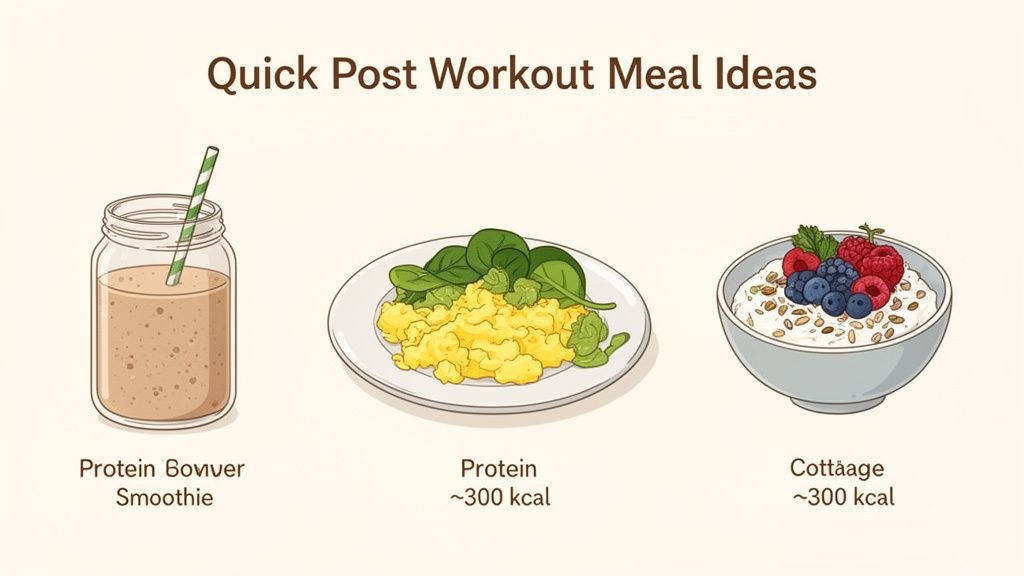
It’s one thing to know the science behind a good recovery meal, but it's another thing entirely to cook one when you’re hungry, tired, and just want to collapse on the couch. I get it.
That’s why I've put together my go-to list of quick, no-fuss meals that get the job done without any complicated prep. Think of these as your secret weapons. For even more great options, you can find some of the best post-workout recovery foods to keep on hand.
My Go-To Protein Power Smoothie
Honestly, this is my top choice on busy days. It’s fast, easy to digest, and gets protein into your system almost immediately.
- My Recipe: I just blend 1 scoop of a low-sugar vanilla protein powder with 1 cup of unsweetened almond milk. Then I’ll toss in a big handful of spinach (you'll never taste it, I promise) and a tablespoon of chia seeds for some healthy fats.
- The Payoff: You’re looking at 25-30g of protein for under 250 calories, plus fiber that actually helps you feel full. It’s a win-win.
The 2-Minute Scramble
Eggs are a nutritional powerhouse. They're packed with leucine, a specific amino acid that essentially flips the switch on muscle repair. This meal feels hearty but comes together in a flash.
Just whisk two or three whole eggs and toss them in a non-stick pan with a giant handful of spinach. Scramble for a couple of minutes, and you're done. It's that simple. If you want to get ahead, having some prepped components ready to go can be a lifesaver. Our guide on https://platebird.com/easy-meal-prep-ideas/ has tons of ideas for that.
My Pro Tip: I always keep a carton of liquid egg whites in the fridge. Pouring about a half-cup into the pan is even faster than cracking eggs and gives you a super lean protein source with zero fuss.
The Cottage Cheese Power Bowl
Don't sleep on cottage cheese! It’s loaded with casein, a slow-digesting protein that helps feed your muscles and keeps you feeling full for hours. It’s perfect for staving off those post-workout hunger pangs.
For a quick fix, just scoop a cup of low-fat cottage cheese into a bowl and top it with a half-cup of berries or some pineapple chunks. The fruit provides a natural touch of sweetness and helps restock your energy.
To give you a clearer picture, here’s a quick breakdown of these meal ideas and how they stack up.
Quick Post-Workout Meal Ideas for Weight Loss
| Meal Idea | Est. Calories | Est. Protein (g) | Primary Carb/Fat Source |
|---|---|---|---|
| Protein Power Smoothie | ~240 | 25-30 | Chia Seeds |
| 2-Egg Scramble w/ Spinach | ~220 | 16-18 | Egg Yolks |
| Cottage Cheese & Berries | ~230 | 28-30 | Berries, Milkfat |
| Greek Yogurt & Almonds | ~280 | 22-25 | Almonds, Milkfat |
This table is just a starting point. Feel free to swap ingredients based on what you have and what fits your calorie targets for the day. The goal is to make recovery easy, not another chore.
Answering Your Post-Workout Meal Questions
Even with a solid plan, a few questions always seem to pop up when you're trying to dial in your nutrition. I get these all the time, so let's clear up some of the common hurdles you might run into.
What If I'm a Late-Night Exerciser?
This is a classic dilemma: you finish your workout at 9 PM and wonder, "Should I really eat this late?" The answer is a definite yes. But you have to be smart about it.
Your muscles still need to recover, but the last thing you want is a heavy meal sitting in your stomach while you're trying to sleep. The key is to keep it light and protein-focused. Think of it as a recovery snack, not a fourth meal.
A simple protein shake, a small serving of Greek yogurt, or a scoop of cottage cheese are all perfect choices. They give your body the building blocks it needs for repair without derailing your calorie deficit for the day.
Is a Protein Shake Good Enough?
Absolutely. In fact, for most people, a protein shake is one of the best post-workout options when weight loss is the goal. It's fast, convenient, and delivers protein to your muscles right when they're primed to use it.
The real trick is what you don't put in it. Stick with a quality, low-sugar protein powder mixed with just water or maybe some unsweetened almond milk. Ditch the high-calorie add-ins like fruit juice, whole milk, or honey. Those can quickly turn your smart recovery tool into a sugar bomb.
How Fast Do I Really Need to Eat After a Workout?
Let's bust a myth. That frantic rush to eat within a 30-minute "anabolic window" isn't something you need to stress over, especially when fat loss is your main focus. That idea is a bit outdated.
You have plenty of time. Aim to get your protein-rich meal in within 1 to 2 hours after you finish your session. Honestly, what’s way more important is hitting your total daily protein and calorie goals consistently, day in and day out. Consistency will always win out over perfect timing.
Ready to stop guessing and start seeing results? PlateBird makes logging your meals almost effortless—just type what you ate or snap a photo. Download it for free from the App Store and start hitting your goals with confidence.