
So, what exactly is a macro calculator free of charge? It’s an online tool designed to give you a personalized roadmap for your nutrition—specifically, your daily targets for protein, carbohydrates, and fats. It takes your unique stats and goals to create a plan that goes way beyond just counting calories.
Your Blueprint for Smarter Nutrition

Think about it this way: you wouldn't build a house without a blueprint. You could have the best materials in the world, but without a clear plan, you'd end up with a mess. The same logic applies to your fitness goals. Just eating "healthy" isn't enough; you need a strategy. That's where macronutrients—or macros—come into play.
The Building Blocks of Your Body
Let’s imagine your body is a high-performance engine. To get the most out of it, you can't just throw any old fuel in the tank. You need the right blend. Macros are that fuel, and each one has a very specific job.
Protein: This is your repair crew. It’s essential for rebuilding tissue, growing lean muscle, and, as a bonus, it helps you feel full and satisfied after you eat.
Carbohydrates: Meet your primary energy source. Carbs give you that instant get-up-and-go power you need to crush a workout or just stay sharp throughout a busy day.
Fats: Healthy fats are far from the enemy. They’re critical for regulating hormones, absorbing essential vitamins, and providing a slow-burning, long-lasting energy reserve.
Hitting a goal like losing weight or building muscle isn't just about the number of calories you eat. It’s about getting the right balance of these three key nutrients.
A free macro calculator isn't a restrictive diet. It’s a GPS for your nutrition. It takes the guesswork out of the equation and turns a vague goal into a clear, actionable plan you can follow every single day.
This is precisely why so many people are moving toward this smarter way of eating. The global fitness app market, which includes macro-tracking tools like PlateBird, is on track to hit USD 25.9 billion by 2033. That’s a massive number, and it shows a huge shift in how we approach our health.
More and more, busy people are using a macro calculator free of charge to achieve their goals without the frustration of old-school dieting. You can find more details on these nutrition app statistics to see just how fast this trend is growing.
How to Manually Calculate Your Own Macros
While using an online macro calculator is undeniably quick, there's a real power in understanding the math behind the curtain. When you know how the engine works, you gain the confidence to tweak the numbers yourself and truly appreciate what a good automated tool does for you.
Let's walk through it together. We'll crunch the numbers for a hypothetical person, "Alex," to make everything crystal clear.
Step 1: Find Your Baseline Burn (BMR)
First up is the Basal Metabolic Rate, or BMR. Think of it as your body's "idle mode" fuel consumption. It's the minimum number of calories you need just to keep the lights on—powering your heart, lungs, and brain while you're completely at rest.
The most trusted formula for this is the Mifflin-St Jeor equation.
- For Men: (10 x weight in kg) + (6.25 x height in cm) – (5 x age) + 5
- For Women: (10 x weight in kg) + (6.25 x height in cm) – (5 x age) – 161
Let’s plug in Alex’s details. He's a 30-year-old male, weighs 180 lbs (which is 81.6 kg), and stands at 5'10" (178 cm).
His BMR looks like this: (10 x 81.6) + (6.25 x 178) – (5 x 30) + 5 = 1,781 calories. That’s the energy Alex burns just by being alive.
Step 2: Factor in Your Daily Activity (TDEE)
Of course, none of us spend all day at rest. We walk, work, and hit the gym. To get a realistic picture of your daily calorie needs, we multiply your BMR by an activity factor. This gives us your Total Daily Energy Expenditure (TDEE).
Here are the standard multipliers:
- Sedentary: BMR x 1.2 (desk job, little to no exercise)
- Lightly Active: BMR x 1.375 (light exercise 1-3 days/week)
- Moderately Active: BMR x 1.55 (moderate exercise 3-5 days/week)
- Very Active: BMR x 1.725 (hard exercise 6-7 days/week)
Alex has a desk job, but he’s consistent with lifting weights four times a week. That puts him squarely in the "Moderately Active" category.
Alex's TDEE Calculation:
1,781 (BMR) x 1.55 (Activity Factor) = 2,761 calories
This number, 2,761 calories, is what Alex needs to eat every day to maintain his current weight. From here, he can adjust for his goals. If he wants to lose fat, he’ll eat in a calorie deficit (like 2,261 calories). For muscle gain, he’d need a surplus (say, 3,061 calories).
Step 3: Divide Calories into Macros
Once you have your daily calorie target, the final step is splitting it among the three macronutrients: protein, carbs, and fat. It’s important to remember their calorie counts:
- Protein: 4 calories per gram
- Carbohydrates: 4 calories per gram
- Fat: 9 calories per gram
A common starting point for someone looking to build muscle is a 40% carb, 30% protein, 30% fat split. If you want to get even more specific, you can learn how to calculate your protein intake for muscle gain to really dial things in.
Let’s see how this plays out for Alex’s fat-loss goal of 2,261 calories.
To make this even clearer, here’s a step-by-step table showing exactly how we get Alex from a single calorie number to his specific macro targets.
| Calculation Step | Formula/Ratio | Alex's Example Result |
|---|---|---|
| 1. Set Daily Calories | TDEE – 500 (for fat loss) | 2,761 – 500 = 2,261 calories |
| 2. Calculate Protein Grams | (Total Calories x 0.30) / 4 | (2,261 x 0.30) / 4 = 170g |
| 3. Calculate Fat Grams | (Total Calories x 0.30) / 9 | (2,261 x 0.30) / 9 = 75g |
| 4. Calculate Carb Grams | (Total Calories x 0.40) / 4 | (2,261 x 0.40) / 4 = 226g |
And there you have it—Alex's daily targets are 170g of protein, 75g of fat, and 226g of carbs.
Seeing the full process really demystifies where these numbers come from. While it’s an empowering exercise, most people find doing this math daily is a bit tedious. If you’re curious to find the ideal ratios for your own goals without pulling out a calculator, our guide on what your macros should be can get you there much faster.
Choosing the Best Free Macro Calculator
With a ton of free apps and websites all claiming to be the best, picking the right macro calculator free of charge can feel like a shot in the dark. But not all of them are built the same. It’s a bit like choosing a navigation app for a road trip—you need one that's accurate, easy to read, and isn’t secretly selling your route data to the highest bidder.
It's the same deal when you're hunting for a good macro tool. The best ones get four things right: they're accurate, they're simple to use, they let you make adjustments, and they respect your privacy. That means they rely on proven formulas and verified food databases, make logging a meal a two-second job, and are upfront about how they handle your personal data.
Evaluating What Really Matters
When you're test-driving a new app, it helps to put on your detective hat and ask a few key questions:
- Is it accurate? Does the math check out? A solid calculator will use established formulas like the Mifflin-St Jeor equation. More importantly, is its food library reliable, or is it a free-for-all of user-added entries that could throw off your numbers?
- Is it actually easy? Seriously, how many taps does it take to log your lunch? If it feels clunky or slow, you’re just not going to stick with it. Life's too short.
- Can you make it yours? Your goals aren't set in stone. A great tool lets you easily tweak your weight, activity level, and macro splits as you make progress.
- So, what's the catch? Is the app plastered with annoying ads? Does it demand you sign up or share a bunch of personal info just to see your results? Those are usually big red flags.
Whether you're running the numbers yourself or using a calculator, the underlying logic is always the same. It’s a clear path from your body’s baseline needs to your daily macro targets.
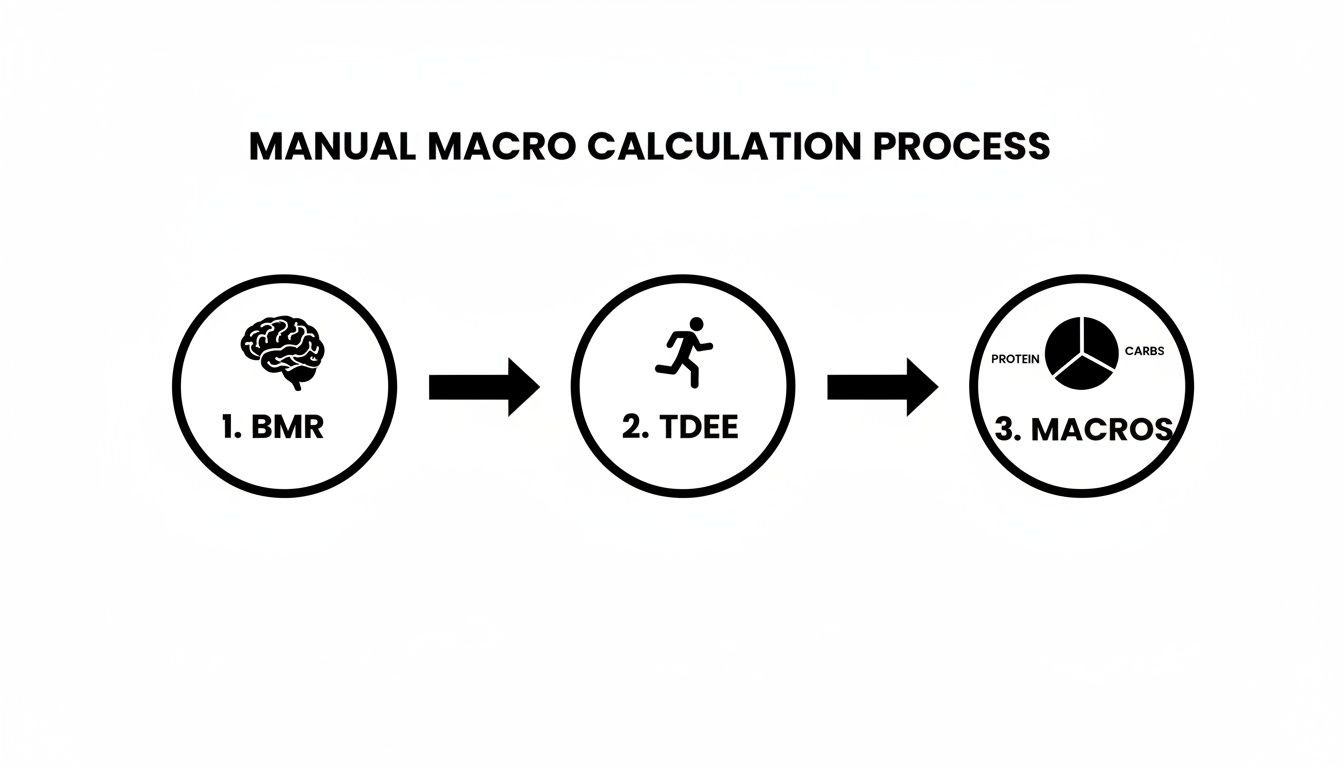
This flowchart breaks it down perfectly. You start with your Basal Metabolic Rate (BMR), factor in your activity to find your Total Daily Energy Expenditure (TDEE), and then slice that total calorie goal into your protein, carb, and fat targets.
The Business of "Free"
It helps to know what’s going on behind the scenes. The market for calorie counter apps is huge—it was valued at around USD 1.5 billion in 2025. That growth is fueled by a growing focus on health and the 6.8 billion of us with smartphones. This fierce competition is actually great for users, as it's driving real innovation, especially with things like AI-powered food recognition.
The real challenge isn't just finding a free tool. It's finding one that genuinely respects your time and privacy while giving you numbers you can trust. An app that hides its best features behind a paywall or makes logging a meal a chore is working against you, not for you.
At the end of the day, you want a tool that makes tracking feel like second nature, not another to-do list item. The less friction there is between you and logging a meal, the better your chances are of building a habit that sticks. For a deeper look at what separates the good from the great, check out our guide on the best macro tracking app where we compare the top players.
From Calculation to Daily Action
So you’ve run the numbers. You have your targets for protein, carbs, and fat staring back at you from the screen. But getting your macros is one thing; actually hitting them is a completely different ballgame.
This is where the rubber meets the road—and where so many of us get a flat tire. The initial excitement of a new plan can quickly wear off when you’re faced with the daily grind of logging every single thing you eat.
You know the drill. You find yourself scrolling through an endless food database or fighting with a barcode scanner that just won’t cooperate. This hassle, this friction, is the real enemy of staying consistent.
Overcoming Tracking Fatigue
Think about it this way: your motivation is like a battery. Every minute you spend searching for "chicken breast, boneless, skinless, grilled" drains a little bit of that power. Do that for every meal, every day, and you’ll be running on empty before the week is even over.
This "tracking fatigue" is a huge problem. It’s the gap between knowing what you’re supposed to do and having the mental energy to actually do it. Thankfully, this is exactly where technology is finally catching up, turning a chore into something you barely have to think about.
This frustration is so common that an entire industry has sprung up to solve it. The fitness app market, home to just about every macro calculator free to download, hit a global value of USD 12.91 billion in 2025 and is expected to rocket to USD 39.35 billion by 2034. Why the explosion? Because new tech is finally fixing the most annoying parts of tracking.
The Shift to Effortless Logging
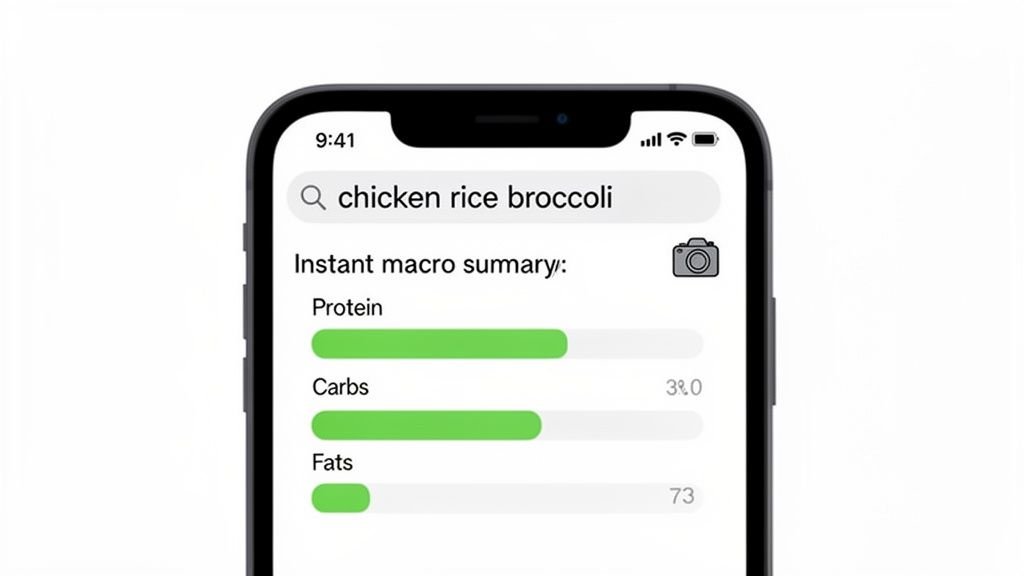
Picture a totally different experience. Instead of a frustrating search, you just type what you ate: “chicken rice broccoli.” Instantly, the app shows you the breakdown of calories and macros.
Or even better, you just snap a photo of your plate. The app’s AI identifies the salmon, the quinoa, and the asparagus, giving you a full nutritional report before you’ve even taken your first bite.
This isn't just about cool features; it's about removing the little annoyances that make you want to quit. The less effort it takes to log a meal, the more likely you are to do it day after day. That's how you build a habit that actually lasts.
These breakthroughs are what make macro tracking a sustainable practice for normal, busy people.
- AI Food Recognition: Just take a picture to skip the manual search entirely. It’s no surprise that 75% of users prefer photo logging when it can cut down their tracking time by up to 80%.
- Natural Language Input: Typing what you ate in plain English feels as natural as sending a text, making the whole process fast and intuitive.
- One-Tap Repeat Meals: If you’re a creature of habit or a meal prepper, a good app will learn your go-to meals, letting you log your usual breakfast with a single tap.
Of course, once you have your targets, you need to apply them to real-world foods. To do that, you'll want to master how to read nutrition labels. It’s a crucial skill for making sure the numbers you log are accurate.
When you pair a solid plan with tools that make it easy to follow through, you finally close that gap between knowing and doing. If you’re ready to see how it all works in practice, our guide on how to count macros will walk you through everything, step-by-step.
Common Macro Tracking Mistakes to Avoid

Getting your numbers from a macro calculator free of charge is the easy part. You’ve got a target and you’re ready to go. But the real challenge isn’t the plan itself—it’s sticking with it. Consistency is where the magic happens, and it’s also where most people, unfortunately, fall off track.
It’s not because the numbers are wrong. It’s because a few common, sneaky habits can turn tracking from a tool that helps you into a source of frustration. Let's walk through a few of these classic scenarios—you might even recognize yourself in one of them.
The Perfectionist
First up is 'The Perfectionist'. She’s flawless from Monday to Thursday, hitting her macros to the gram. But then Friday night happens. An unplanned dinner with friends throws her fat and carb goals way off, and she immediately feels like a failure. Convinced she’s ruined her progress, she stops tracking for the rest of the weekend, vowing to start over “perfectly” on Monday.
This all-or-nothing mindset is the quickest way to burn out. Your body doesn’t hit a reset button at midnight.
The goal is consistency, not perfection. Think of your macros as a weekly budget instead of a strict daily rule. If you go a little over one day, just pull back slightly the next. Focusing on the weekly average is a much healthier and more sustainable way to see real results.
The Guesstimator
Then we have 'The Guesstimator'. He’s great about logging his meals, but he eyeballs everything. That “handful” of nuts, the “dollop” of peanut butter, that “regular-sized” chicken breast… these little guesstimates can easily pile on hundreds of untracked calories, bringing his progress to a halt and leaving him wondering why the scale isn't moving.
You don't have to weigh your food forever, but it’s crucial to get a real sense of portion sizes at the start. When you don't have a food scale handy, your own hand is a surprisingly effective tool.
- A palm of protein: The size and thickness of your palm is a good stand-in for 3-4 ounces of cooked meat.
- A fist of carbs: A closed fist is about 1 cup of pasta, rice, or other starchy carbs.
- A thumb of fat: The length of your thumb is roughly 1 tablespoon of dense fats like oil or nut butter.
Using these visual cues makes a world of difference in your accuracy when you're eating out or on the go.
The Weekend Warrior
Finally, there’s 'The Weekend Warrior'. He’s incredibly disciplined all week long, crushing his goals from Monday to Friday. But the moment Saturday morning hits, the plan goes out the window. He tells himself a couple of "cheat days" won't make a difference, but the weekend’s high-calorie blowouts often undo all five days of hard work.
This cycle of being "on" all week and "off" all weekend is incredibly common. The secret is finding balance, not completely restricting yourself. Go ahead and enjoy that slice of pizza or glass of wine—just log it. By keeping track, you stay in the driver's seat, understand your total weekly intake, and can finally make progress that actually lasts.
Your Macro Tracking Questions Answered
So, you’ve run the numbers through a macro calculator free of charge and have your targets. Great! But now what? It’s completely normal to feel a little lost when it comes time to put those numbers into practice.
Getting your macros is one thing; actually living with them is another. Let's tackle the questions that almost everyone asks when they're just starting out.
How Often Should I Recalculate My Macros?
Your body is constantly adapting, which means your nutritional needs aren't static. Think of your macro targets less like a permanent tattoo and more like a prescription that needs adjusting as your "symptoms"—your weight, muscle mass, and activity—change.
You don't need to overthink it, but it’s smart to re-run the numbers in a few key scenarios:
- As a general check-in every 4-6 weeks.
- If you hit a stubborn weight loss plateau that doesn't budge for more than two weeks.
- When your activity level changes significantly, like starting a new job or a more intense workout program.
- After you’ve lost a good chunk of weight, usually around 10-15 pounds.
Recalculating keeps your targets dialed in with what your body actually needs right now, which is the secret to avoiding frustrating stalls in your progress.
Can I Trust the Food Databases in Free Apps?
This is a fantastic and incredibly important question. The quality of your tracking is only as good as the quality of the data you're logging. The most reliable apps pull their information from verified food databases, like the one maintained by the USDA. Think of these as the gold standard.
Here’s the catch with many free apps: they’re flooded with user-generated entries, which can be wildly inaccurate. A good rule of thumb is to always choose entries marked as "verified" or ones that clearly come from an official source.
The biggest trap I see people fall into is trusting a random "homemade lasagna" entry. Your recipe and their recipe could have completely different macros. When you can, it's always better to log the individual, verified ingredients yourself.
Do I Have to Hit My Macros Exactly Every Day?
Absolutely not. In fact, trying for perfection is probably the quickest way to get frustrated and quit. Chasing exact numbers every single day turns a helpful guide into a stressful chore.
Your daily targets are a destination, not a tightrope. The goal is to get close, not to be flawless.
- Try to land within 5-10 grams of your protein and fat goals.
- Carbs are more flexible; a window of 10-20 grams is perfectly fine.
Honestly, the two things that matter most are hitting your daily protein goal and staying in the ballpark of your overall calorie target. A much saner and more sustainable approach is to look at your weekly averages rather than stressing over daily perfection.
How Do I Track Alcohol?
Ah, alcohol. It's the fourth macro that isn't a macro. It has calories—7 per gram, to be exact—but it provides no real nutrition. So where do you log it?
The easiest way is to "borrow" the calories from your other macros. You can subtract them from either your daily carb or fat allowance. For instance, a 150-calorie beer could be accounted for by either cutting about 38 grams of carbs (150 / 4) or 17 grams of fat (150 / 9) from your day.
The good news? Most modern tracking apps have figured this out for you. They have huge alcohol databases and will automatically make the adjustment, so you don’t have to do the math on the fly.
Once these questions are cleared up, the last real hurdle is making tracking a habit that sticks. This is precisely why we built PlateBird. We wanted to eliminate the tedious part of logging. Instead of searching databases and scanning barcodes, you just type what you ate or snap a photo. It’s the most effortless way to turn your macro plan into real, consistent results.