- The Hidden Struggle of Calorie Counting
- How Calorie Scales Estimate Calories
- Assessing the True Accuracy of Food Scales
- Practical Tips for Everyday Use
- Calorie Scales Versus AI Trackers Like PlateBird
- How to Choose the Right Tool for Your Goals
- The Best Calorie Tracker Is the One You Use
- Frequently Asked Questions About Food Scales
You start with good intentions.
Breakfast is easy. You log the oats. You log the milk. Then lunch happens. A spoonful of peanut butter becomes “about a tablespoon.” Rice becomes “one bowl.” Olive oil becomes “a little drizzle.” By dinner, the app is asking questions you can’t answer, and you’re left choosing between guessing and giving up.
That’s where people start searching for calorie scales food and wondering if a kitchen scale is the fix. In one sense, it is. A scale gives you something your eyes can’t: a precise weight in grams. That removes a lot of the chaos from tracking.
But there’s a second problem that shows up after the novelty wears off. Precision takes effort. You have to place the bowl, tare it, add each ingredient, choose the right food entry, and log it all. For some people, that routine feels satisfying. For others, it feels like one more task they’ll stop doing by next week.
If you have bounced between wanting perfect numbers and wanting an easier system, you’re not the problem. The key question is which tool helps you stay consistent. A food scale helps with precision. Faster tracking tools help with follow-through. If you’re still figuring out the basics, this guide on how to count calories is a useful starting point.
The Hidden Struggle of Calorie Counting
You log breakfast carefully. Then real life starts.
Lunch is a sandwich you made, with mayo you did not measure and chips you grabbed by habit. Dinner is a rice bowl with chicken, vegetables, sauce, and a little oil from the pan. By the end of the day, calorie counting can feel less like math and more like trying to estimate the size of a room by standing in the doorway.
That frustration has less to do with effort and more to do with the limits of eyeballing food. A tablespoon of peanut butter can be flat, rounded, or heaped. A serving of cereal can look modest in a large bowl and generous in a small one. With foods that pack a lot of calories into a small amount, small visual errors can push your total further off than you expect.
Why eyeballing feels easy, then stops working
Your brain likes familiar shortcuts. If a portion looks similar to what you ate yesterday, it labels it “about the same.” That is useful for getting through a busy day. It is less useful when your goal depends on repeating portions with some consistency.
The foods that cause trouble are often the least dramatic ones:
- Dense spreads like peanut butter and cream cheese
- Pourable fats like olive oil and dressings
- Loose foods like rice, pasta, cereal, and granola
- Mixed meals like bowls, casseroles, stir-fries, and leftovers
A few extra bites here, a heavier pour there, and the gap adds up across the week. You can be disciplined and be off.
Inaccuracy is often a portion problem, not a motivation problem.
That is why people start looking for better tools. A food scale helps by replacing “looks about right” with grams. An AI tracker helps by cutting down the time and friction of logging. One tool improves precision. The other often improves adherence.
Why this feels like a bigger problem than it should
Calorie counting sounds simple from a distance. Eat food, log food, total calories. In practice, every meal asks a string of small questions. How much rice is that? How much oil stayed in the pan? Was that chicken entry cooked or raw? Was the serving size measured by volume or by weight?
A scale can answer one of those questions well. It tells you how much something weighs. That is a big improvement, and for many people it creates immediate relief. If you are still learning the basics, this step-by-step guide to counting calories accurately can help you build a system that makes sense before you add more tools.
Still, precision has a cost. Weighing ingredients, taring the bowl, searching the right database entry, and repeating that process for every meal can feel satisfying if you like detail. It can feel like brushing your teeth with a ruler. Accurate, yes. Fast, no.
That trade-off matters. The best tracking method is not the one that produces the most exact number on a perfect day. It is the one you can keep using on busy weekdays, tired evenings, and weekends when motivation drops.
How Calorie Scales Estimate Calories
You weigh a bowl of oats, and the screen says 60 grams. Helpful, yes. But the scale does not know whether that bowl holds dry oats, cooked oatmeal, or granola with nuts mixed in.
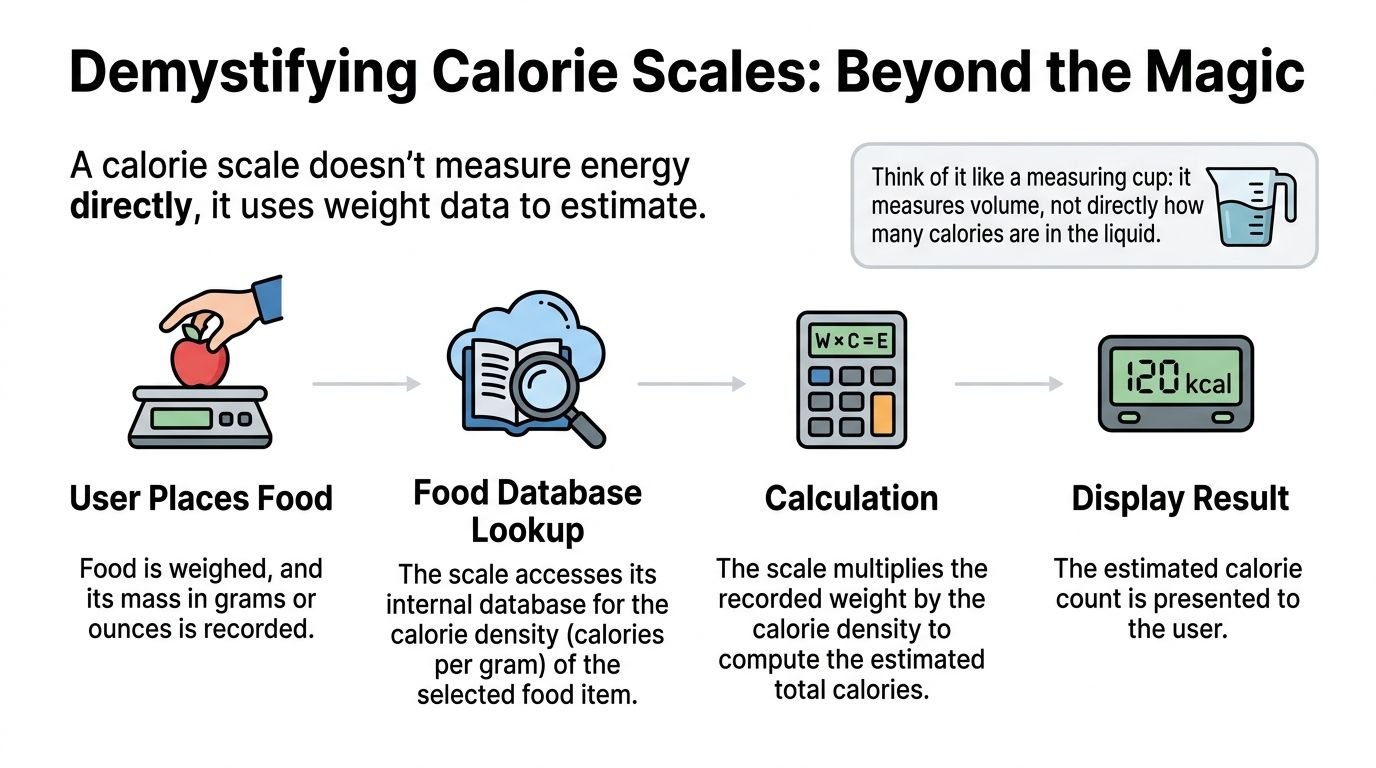
A calorie scale works like a measuring tool paired with a nutrition library. The scale provides the weight. Then a database, app, or built-in food list uses that weight to estimate calories and macros.
What the scale knows, and what it has to assume
A kitchen scale is good at one job. It measures how much something weighs.
Everything after that depends on matching the food to the right nutrition entry. That is why two people can weigh the same 150 grams of chicken and log different calories if one chooses raw chicken breast and the other chooses cooked chicken thigh.
A measuring cup is a useful comparison. It can tell you how much liquid is in the cup, but not whether that liquid is water, milk, or cream. A calorie scale has the same limit. Weight is the starting point, not the full answer.
The four-step process
Here’s what usually happens behind the scenes:
The scale measures the food
You place food on the platform, and the scale shows grams or ounces.You identify what the food is
With a basic scale, you do this in your tracking app. With a smart scale, the app may guide you through a built-in food list.The system pulls nutrition data
The app or device finds a database entry, such as calories per 100 grams or per serving.It calculates an estimate
The tool multiplies the weight by the nutrition data and gives you calories, protein, carbs, and fat.
If you cook a lot at home, this gets more complicated with mixed dishes like chili, casseroles, or pasta bakes. In that case, you need the weight of the finished dish plus the ingredients that went into it. This guide on how to calculate calories in homemade food walks through that process.
Why grams improve calorie estimates
Food labels and nutrition databases are built around measurable amounts. Weight is more reliable than eyeballing spoonfuls, handfuls, or cups, particularly for calorie-dense foods like oil, peanut butter, nuts, and cereal.
Calories also come from macronutrients. Fat contains more calories per gram than carbohydrate or protein, as explained in this YouTube overview of food scale calorie math. So a small weight difference in a high-fat food can change the calorie estimate more than people expect.
That is one reason scales feel precise. They reduce guessing at the measurement stage, though the final calorie number depends on choosing the right food entry.
Basic scales and smart scales
Different tools handle different parts of the job.
| Type | What it does | Best for |
|---|---|---|
| Basic kitchen scale | Measures weight only | People who are comfortable logging foods manually |
| Smart scale | Measures weight and connects to an app or database | People who want fewer steps between weighing and logging |
| Nutrition database scale | Uses an internal food list to show estimated nutrition | People who want calorie estimates directly on the device |
The trade-off is simple. A standard scale gives you strong measurement precision, but it asks you to do more manual work. A smart scale can reduce that work, but its calorie estimate is only as good as the database and food match behind it.
Practical rule: A scale measures weight. The calorie number comes from matching that weight to nutrition data.
This distinction is important for understanding why scales can be very accurate for portion size while still giving imperfect calorie totals.
Assessing the True Accuracy of Food Scales
You weigh 32 grams of peanut butter, log it, and feel confident. Then you wonder why your calories seem off by the end of the week.
That frustration comes from treating one number as if it answers two different questions. A food scale can be accurate at measuring weight, while the calorie estimate tied to that weight is still a close estimate rather than an exact reading.
Weight accuracy and calorie accuracy are different jobs
A scale handles the first job. It measures mass.
A food database handles the second job. It converts that mass into calories based on an entry such as "cooked white rice," "93% lean ground beef," or a branded product with a nutrition label.
That setup works like using a ruler and a map. The ruler can measure distance on the page correctly, but your final travel estimate still depends on whether you picked the right route. With food tracking, the scale may give you an exact weight, yet the calorie total can drift if the food entry is slightly off, the item was cooked differently, or the label itself is not perfectly exact.
The scale is often the most reliable part
For everyday use, decent kitchen scales are consistent enough to make portion tracking much better than eyeballing. If your chicken weighs 142 grams today, the scale is giving you a more dependable starting point than a measuring cup or a visual guess.
The bigger source of error tends to come later.
Database matching gets messy quickly with foods that vary a lot from one version to another. A large banana is not the same as a small one. Rice absorbs different amounts of water. Meat loses moisture during cooking. A homemade pasta bake can differ a lot from the closest app entry.
That is why scales improve accuracy without creating perfection.
Labels and databases have built-in wiggle room
Even official numbers are estimates. A 2013 NIH paper on measured versus stated energy content of snack foods found that the tested snacks, on average, contained more energy than their labels stated.
Food labels also are not expected to match laboratory values down to the calorie. The FDA explains in its nutrition labeling compliance guidance that declared values are evaluated within allowed tolerances. So a scale-linked calorie total should be treated as a useful estimate built from the best available data, not as a chemistry lab result.
A food scale can measure your portion very well and still inherit uncertainty from the nutrition data attached to it.
What accuracy means for daily life
The practical question is not, "Is this perfect?" It is, "Is this accurate enough to guide decisions week after week?"
For many, the answer is yes. A scale reduces one of the main tracking errors: portion-size guessing. That matters with calorie-dense foods, mixed dishes, and meals you cook yourself. If you want a repeatable way to log those meals, this guide on how to calculate calories in homemade food shows how to build the estimate from ingredients instead of relying on a rough database match.
Here is the trade-off to keep in mind. Scales often win on precision. Faster tools, including AI photo trackers, often win on speed and consistency. Long-term success depends on which tool gives you numbers that are accurate enough and easy enough to use often.
Practical Tips for Everyday Use
You make breakfast, your coffee is cooling off, and you just want to log the meal without turning the kitchen into a math class. This scenario presents the true test of any tracking tool. A scale only helps if it fits into a normal morning.
Learn the tare button first
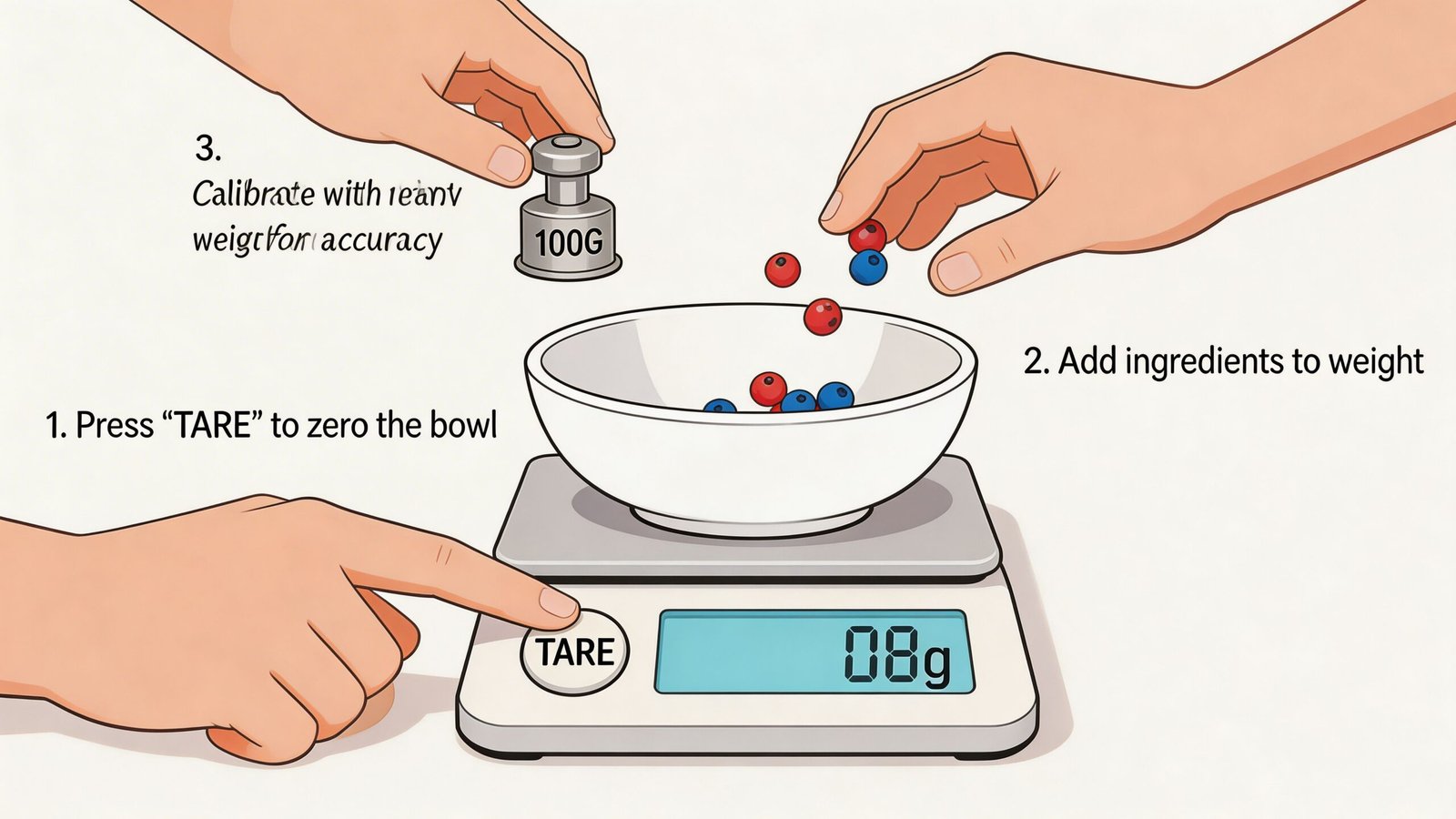
If you learn one feature, learn tare.
Tare resets the display to zero after you place a bowl, plate, or container on the scale. It works like resetting an odometer before a trip. You clear out the container weight so the next number only reflects the food you added.
A simple oatmeal routine looks like this:
- Step one Put the bowl on the scale and press tare.
- Step two Add oats and log the weight.
- Step three Press tare again, then add milk.
- Step four Press tare again, then add peanut butter, fruit, or honey.
That small habit makes weighing feel faster and less error-prone, especially when you build meals from several ingredients. If you want a tool that favors quick logging over repeated manual entry, this guide to the best macro tracking app can help you compare your options.
Weigh the foods that trick people
You do not need to weigh every item.
Start with the foods that create a significant gap between what looks small and what adds up quickly:
- Oils and dressings because a quick pour can add more than expected
- Nut butters because a spoonful is seldom a true serving
- Granola and cereal because the bowl fills up quickly
- Rice and pasta because scoops vary more than people realize
- Sauces because “just a little” is hard to judge by eye
These foods are like loose change in a budget. One coin does not seem like much, but several small misses can change the total by a lot over a week.
Small portions often cause big tracking errors.
Pick a raw or cooked system and stick with it
This aspect often causes confusion. Chicken loses water as it cooks. Rice absorbs water. The same food can weigh different amounts before and after cooking, though the calories came from the same ingredients.
The fix is consistency, not perfection.
| Situation | Best move |
|---|---|
| You meal prep from raw ingredients | Weigh raw and use raw entries |
| You eat leftovers or cooked portions | Weigh cooked and use cooked entries |
| You use recipes often | Save the full recipe and portion it the same way each time |
If you switch between raw and cooked entries without noticing, your log starts comparing apples to apple sauce. Both came from the same food, but the numbers will not line up.
Here’s a visual walkthrough if you want to see scale basics in action:
Keep the process low-stress
Precision helps. Friction hurts adherence.
That trade-off matters more in daily life than any feature list. A scale gives you better input, but only if you keep using it. If weighing every bite starts to feel annoying, the more precise tool can become the less useful one.
A few habits keep the process manageable:
- Leave the scale out so it is accessible
- Use one bowl when possible so tare does more of the work
- Repeat simple meals during busy weeks
- Save common portions in your app or notes
Use the scale where it gives you the most value. Let speed win when life gets messy. Long-term success often comes from a method that is accurate enough and easy enough to repeat.
Calorie Scales Versus AI Trackers Like PlateBird
This isn’t a fight between old and new tools. It’s a trade-off between precision and friction.
A food scale excels at one job: precise weight measurement. An AI tracker excels at a different job: helping you log food quickly so you’ll keep doing it.
Where a scale wins
A scale shines when the food is simple, separate, and easy to identify.
Think about a meal prep container with chicken, rice, and broccoli. Or oats, milk, and berries. Or a sandwich you build at home with ingredients you know. In those cases, the scale gives clean inputs and the logging process feels orderly.
It is particularly useful for:
- Meal preppers who portion meals ahead of time
- Bodybuilders and athletes who care about macro consistency
- Home cooks working from repeatable recipes
- People who enjoy structure and don’t mind a kitchen ritual
Where AI wins
AI tools are strongest when meals are messy, mixed, or fast-moving.
A restaurant plate, a lunch bowl with several toppings, family leftovers, or a quick snack at work aren’t ideal scale situations. You may not know every ingredient, and you may not want to dismantle your plate to weigh each part.
That’s where AI text or photo logging feels more practical. You log what you ate, get a practical estimate, and move on.
The weak spot in many smart scales
Many smart scales sound smarter than they feel in daily use because their databases struggle with the foods people eat.
Many built-in databases handle home-cooked meals, ethnic foods, and custom recipes poorly, which often forces manual overrides and can lead to 20 to 30% estimation errors, according to Men’s Health coverage of food scale database limitations.
That’s the moment many users get frustrated. The scale gave them a precise weight, but the app cannot recognize grandma’s lentil stew, a custom burrito bowl, or a regional dish.
Decision Matrix
| Factor | Calorie Scale | AI Tracker (e.g., PlateBird) |
|---|---|---|
| Best strength | Precise portion measurement | Fast logging |
| Works best with | Single ingredients and meal prep | Mixed meals and everyday eating |
| Main friction | Weighing and selecting entries | Accepting a less exact estimate |
| Database problem | Missing or generic custom foods | Depends on how well the AI learns your habits |
| Ideal user | Detail-oriented tracker | Busy person who needs convenience |
| Long-term risk | Stopping because it feels tedious | Inaccuracy if you never build consistent habits |
If you’re comparing app options, this overview of the best macro tracking app is a helpful place to sort through the trade-offs.
The best tracking method is seldom the most impressive one. It’s the one that still feels manageable on a tired Tuesday.
For many people, a hybrid approach works best. Use the scale when you control the meal. Use an AI tracker when real life gets messy.
How to Choose the Right Tool for Your Goals
The right tool depends less on the technology and more on your personality, schedule, and goal.
Choose a scale if precision motivates you
A scale makes sense if you like clear inputs and repeatable systems.
You will likely do well with one if you are:
- A meal prepper who cooks in batches
- A physique-focused gym-goer aiming for tighter macro control
- A coach or client following a structured nutrition phase
- Someone who enjoys routines and doesn’t mind weighing ingredients
For these people, the extra steps don’t feel annoying. They feel reassuring.
Choose an AI app if friction keeps knocking you off track
Some people don’t need more precision. They need less effort.
That is particularly true if you are:
- A busy professional eating on the go
- A parent making quick decisions around family meals
- New to tracking and overwhelmed by details
- Someone who has quit logging before
The reason this matters is simple. Lack of adherence is often the biggest predictor of failure in a nutrition plan, and many tracking app studies report dropout rates as high as 70% within two weeks due to logging friction, according to Qalzy’s discussion of tracking adherence.
That doesn’t mean precision is bad. It means precision only helps if you keep using it.
The hybrid option is often the smartest one
You don’t have to join one camp forever.
A practical setup looks like this:
- At home use a food scale for meal prep, staples, and foods that are simple to weigh
- At restaurants or during busy days use a faster logging method
- For repeat meals save them once and reuse them often
That gives you the best of both worlds. You get high precision where it’s easy and lower-friction tracking where life is less controlled.
Your goal isn’t to win at logging. Your goal is to support a nutrition habit you can maintain.
The Best Calorie Tracker Is the One You Use
A food scale is useful. For some people, it’s the missing piece.
It replaces guessing with measurable portions, helps with meal prep, and gives structure to foods that are often underestimated. If you enjoy that kind of precision, it can be a great tool.
But precision isn’t the whole story. A tracking method only works when it fits your daily life. If weighing every ingredient makes you stop tracking, the “better” tool becomes the worse choice.
That’s the heart of the calorie scales food debate. One side offers more exactness. The other offers more ease. Many individuals don’t need perfect data. They need a system they won’t abandon.
So choose the path with the least resistance. If that’s a scale, use it well. If that’s a faster app-based method, use it consistently. If it’s a blend of both, that is beneficial.
The strongest nutrition habit often isn’t the most technical one. It’s the one you can repeat without dread.
Frequently Asked Questions About Food Scales
Should I track foods raw or cooked
Either can work. The key is matching your weighing method to the right database entry.
If you weigh chicken raw, use a raw entry. If you weigh it after cooking, use a cooked entry. Problems start when people mix the two. Pick one system and stay consistent so your logs make sense over time.
Can I weigh liquids like milk or oil
Yes. In fact, weighing liquids is easier than estimating them by eye.
Many scales include an ml setting, but grams are a simpler option if your app or database supports weight-based entries. This is particularly helpful for oils, dressings, syrups, and milk, which are easy to overpour.
How do I clean a food scale safely
Keep it simple. Wipe the platform with a damp cloth and dry it.
Do not submerge the scale in water unless the manufacturer says it is safe. Also try to prevent liquid from running into the buttons or display area.
Do I need a smart scale or is a regular scale enough
A regular scale is enough for many. If you’re comfortable entering foods manually, you may not need app connectivity at all.
A smart scale is more useful if you want fewer steps during meal prep and you like having nutrition data tied directly to the weighing process.
What if I hate weighing every meal
Then don’t.
Use the scale for the foods that are difficult to estimate, such as oils, nut butters, cereal, rice, and pasta. You can weigh ingredients when meal prepping and be more flexible with simple repeat meals later.
If you want calorie and macro tracking to feel quick enough to stick with, PlateBird is worth a look. You can type what you ate or snap a photo, get an instant estimate, and keep moving without turning every meal into a measuring project. For many, that lower-friction approach is what makes tracking sustainable.