- Why Your Bulking Plan Might Be Failing You
- Establishing Your Caloric Foundation
- Calculating Your Personal Bulking Macros
- Adapting Your Macros for Your Unique Situation
- Turning Numbers into Muscle Through Tracking and Adjustment
- Avoiding Common Bulking Mistakes That Sabotage Gains
- Frequently Asked Questions About Bulking Macros
You’re probably in one of two spots right now.
You’ve been training hard, eating more than usual, and the scale barely moves. Or the scale is moving, but your waist is going with it and your shirts still don’t fit better in the shoulders. Both situations are common. Both usually come from the same problem. The bulk isn’t being managed.
A good macros for bulking calculator helps, but a calculator alone won’t save a sloppy process. Muscle gain works best when calories are set on purpose, macros are assigned with intent, and adjustments happen based on what your body does week to week. That’s where most bulks fall apart. People either guess, overeat, or cling to the first set of numbers long after those numbers stopped matching reality.
The fix is straightforward. Start with a solid calorie target. Build macros that support training and recovery. Then treat those numbers as a starting point, not a permanent truth.
Why Your Bulking Plan Might Be Failing You
A lot of lifters think they’re bulking when they’re really just eating more random food.
Breakfast gets bigger. Snacks get looser. Weekends turn into “I earned it.” Training stays serious, but nutrition becomes vague. After a few weeks, they’re frustrated because the outcome doesn’t match the effort.
The classic mistake is the dirty bulk. That approach sounds appealing because it feels easy. Eat everything, trust the heavy lifting, and assume size will come. Some size usually does come, but a lot of that extra bodyweight isn’t the kind you wanted.
The other mistake sits on the opposite end. Some people say they’re in a gaining phase, but they’re still eating like they’re afraid of carbs, fats, or scale weight. They train with intensity, but they never give the body enough raw material to build.
Most failed bulks aren’t failures in the gym. They’re failures in setup and follow-through.
A structured approach fixes both problems. Instead of eating blindly, you set a calorie target based on maintenance. Instead of “high protein” meaning whatever sounds healthy that day, you assign daily gram targets. Instead of reacting emotionally to a single weigh-in, you adjust based on trends.
What usually goes wrong
- Calories drift: Weekdays are controlled, weekends erase the plan.
- Protein is inconsistent: One day is solid, the next day is snack food and guesswork.
- Carbs are too low: Training quality drops, recovery lags, pumps disappear.
- No adjustment happens: The same macros stay in place even when progress stalls.
What works
The lifters who gain well usually do boring things well. They repeat meals. They monitor bodyweight under consistent conditions. They look at gym performance, appetite, recovery, and waistline together.
That’s why a macros for bulking calculator matters. Not because it gives you magic numbers, but because it gives you a clean starting framework. From there, the primary work is refining the plan so it matches your body, your training, and your rate of gain.
Establishing Your Caloric Foundation
Macros matter, but calories decide whether a bulk is happening at all.
If your calorie target is off, your macro split won’t rescue you. That’s why the first job is estimating how much energy your body uses in a day, then adding a surplus that supports growth without turning the bulk into a fat-gain phase.
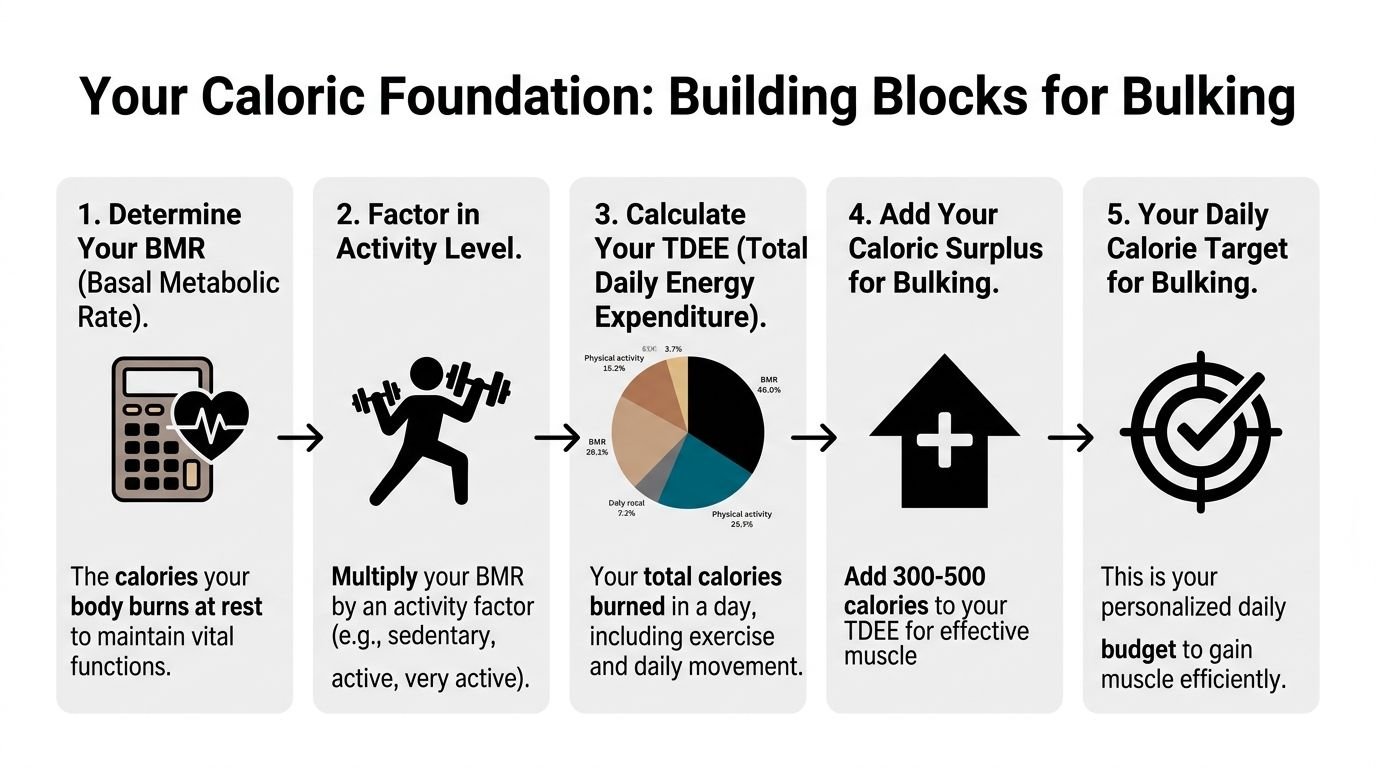
Start with BMR and TDEE
Your Basal Metabolic Rate, or BMR, is the energy your body uses at rest. It covers the basics: breathing, circulation, organ function, and staying alive. From there, you account for daily movement and training to estimate Total Daily Energy Expenditure, or TDEE.
A solid starting method uses the Mifflin-St Jeor equation, which Bodybuilding.com describes as the precise formula commonly used for BMR estimation, followed by an activity multiplier to estimate TDEE. For bulking, the usual starting principle is a controlled caloric surplus of 200 to 600 calories above maintenance (Bodybuilding.com).
If you want a more detailed walkthrough of the underlying math, this guide on how to calculate your BMR is a useful companion.
Use the activity multiplier accurately
People often sabotage the whole calculation here.
If you lift hard for an hour but sit most of the day, you’re not “extremely active” in any useful nutrition-planning sense. Inflating activity level gives you a fake maintenance number, which gives you a fake surplus, which leads to a plan that doesn’t work.
Common activity multipliers cover a range from sedentary to very active, as outlined in verified guidance tied to Mifflin-St Jeor. The math is simple, but the judgment call matters.
A practical rule is to choose the lower activity estimate if you’re unsure. It’s much easier to add food after two steady weeks of data than to spend a month undoing fat gain from an overly generous starting point.
Practical rule: Don’t choose your activity level based on how hard your workouts feel. Choose it based on how much you move across the entire day.
Pick a surplus that fits your goal
Not all bulks should be equally aggressive.
If you gain fat easily, stay closer to the conservative end of the surplus range. If you’ve struggled to gain bodyweight for a long time and training volume is high, you can usually tolerate a bigger push. The mistake is assuming more calories always means more muscle. They don’t. They often just mean faster cleanup later.
A clean starting process looks like this:
- Calculate BMR: Use Mifflin-St Jeor.
- Estimate TDEE: Multiply BMR by your realistic activity factor.
- Add your surplus: Stay within the controlled bulking range.
- Set a daily calorie target: This becomes your working intake.
- Track intake consistently: A calorie target only matters if you can hit it.
If you need help turning food into actual numbers, a practical next step is learning how to count calories.
Your calorie target is a starting number
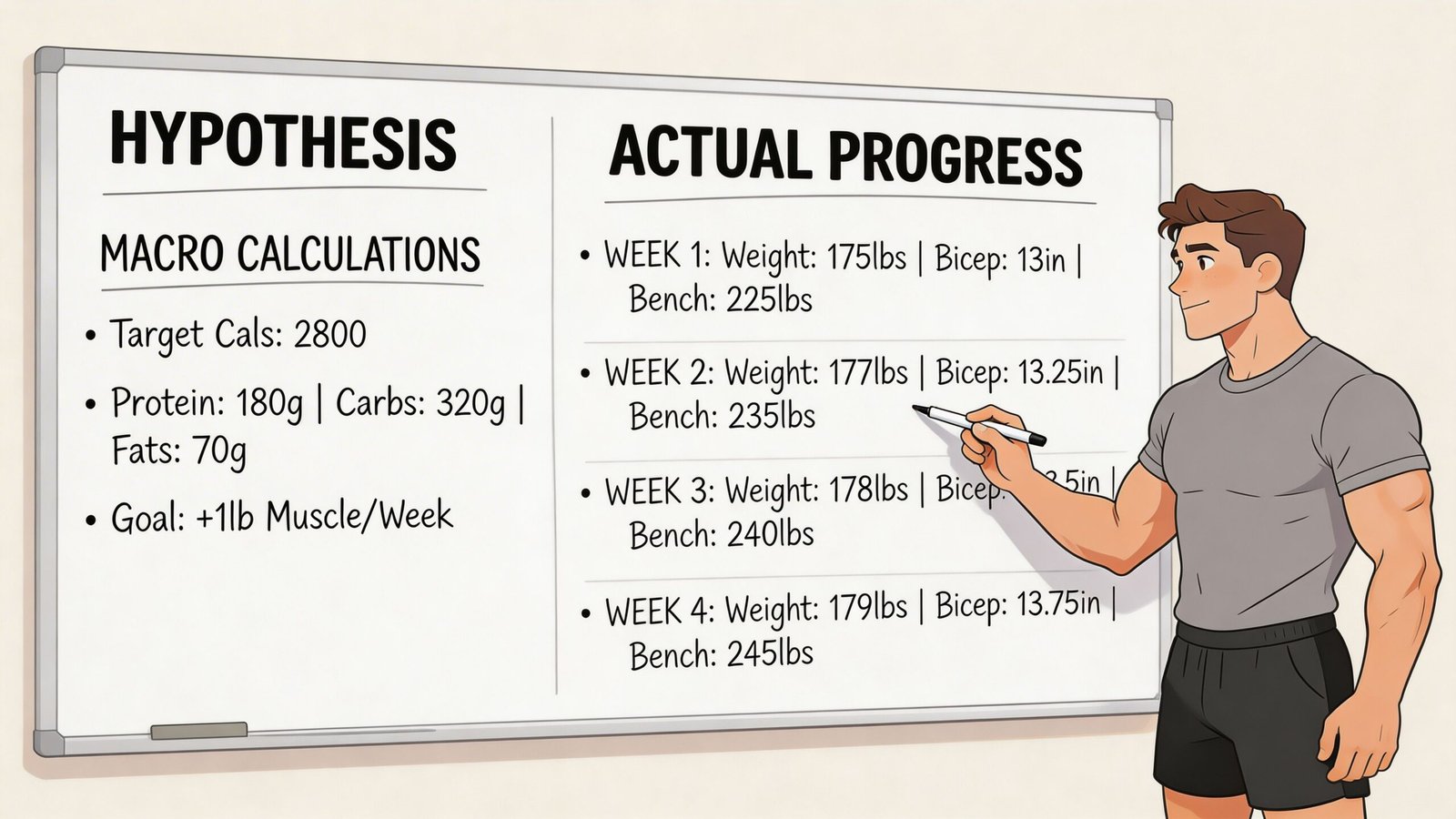
Treat your first calorie target like a hypothesis.
It should be informed and structured, but it isn’t final. Water retention, digestion, stress, sleep, training changes, and normal human inconsistency all affect what happens in the first couple of weeks. You’re not looking for perfection on day one. You’re looking for a strong baseline that you can test and refine.
That’s the right mindset for any useful macros for bulking calculator. It gets you close enough to begin. The results decide what happens next.
Calculating Your Personal Bulking Macros
Once calories are set, split them into protein, fats, and carbs in that order of importance.
Lifters often overcomplicate things here. They chase exotic ratios, copy an influencer’s plan, or bounce between calculators until one spits out a number they like. A better approach is to use a repeatable structure that supports muscle gain, training performance, and recovery.
Trifecta’s lean-bulk framework is simple: start with TDEE x 1.1 to 1.2, set fats at 20 to 30% of calories, set protein at 1.6 to 2.2 g per kg of body weight, and assign the remaining calories to carbohydrates. That same guidance notes that 40% of users have a TDEE accuracy error of ±500 kcal, which is why precision and later adjustment matter so much (Trifecta Nutrition).
Step 1 set fats first
Fats are not filler. They support hormones, satiety, and meal quality.
A practical bulking range for fats is a moderate percentage of total calories. If appetite is poor, pushing fats toward the higher end can make meals easier because they add calories without much volume. If you like eating bigger carb-heavy meals around training, keep fats lower and let carbs do more of the work.
Remember the conversion:
- Fat provides 9 calories per gram
Step 2 set protein with intent
Protein drives muscle repair and growth, but there’s no prize for setting it absurdly high and starving your carb budget.
A dependable target is 1.6 to 2.2 g per kg of body weight from the Trifecta framework above. In the broader verified guidance, bulking calculators also commonly aim for a sufficient amount of protein per pound of bodyweight.
Remember the conversion:
- Protein provides 4 calories per gram
Step 3 give carbs the remaining calories
Carbs are the performance macro in a gaining phase.
They help fuel hard sessions, support recovery, and make it easier to maintain training quality over time. Once protein and fats are accounted for, the rest of your calories typically go to carbohydrates.
Remember the conversion:
- Carbohydrates provide 4 calories per gram
Step 4 do the math on paper
Here’s a clean example using a verified sample structure. If someone has a certain TDEE and uses a surplus with a common macro split, that yields specific gram targets for protein, carbs, and fats, as shown in various calculator guidance.
You can also build it manually:
- Decide daily calories
- Assign fat grams based on calorie percentage
- Assign protein grams based on body weight
- Use remaining calories for carbs
For many readers, using a personal bulking macros calculator can speed up that first draft. Just don’t confuse speed with accuracy. The plan still needs to be checked against real outcomes.
Sample Daily Bulking Macro Targets
| Body Weight | Bulking Calories | Protein (g) | Carbs (g) | Fat (g) |
|---|---|---|---|---|
| 150 lb | 2200 | 165 | 220 | 73 |
| 200 lb | 3200 | 160 | 400-480 | 80-107 |
| 200 lb | 2200 | 165 | 220 | 73 |
| 200 lb | 2500 | 150 | 200 | 67 |
These rows use only verified example values from the provided data. They are examples, not prescriptions. Your numbers should come from your own calorie target and body weight.
What the table shows in real life
A lighter lifter doesn’t automatically need tiny carbs. A heavier lifter doesn’t automatically need massive protein. The right split depends on total intake, training demands, appetite, and how your body responds over time.
That’s why static macro templates can mislead people. Two lifters can weigh the same and still need different setups. One has a physically active job and recovers well on high carbs. The other sits all day, gets full easily, and does better with more calorie-dense meals.
If you want a broader overview of macro ranges before locking in your targets, this guide on what should my macros be is a useful reference.
If your training feels flat, recovery is poor, and your appetite is crashing, the issue often isn’t discipline. It’s that the macro split doesn’t fit how you live and train.
Adapting Your Macros for Your Unique Situation
The base calculation is the easy part. The useful part is knowing when to bend it.
Two people can start with the same calorie surplus and the same macro percentages, then get completely different results. One grows steadily. The other gets bloated, sluggish, and softer by the week. That doesn’t mean the formula is useless. It means the formula needs context.

What adaptation looks like
Good coaching changes the plan without changing the goal.
- If appetite is the limiter: Shift toward denser meals and easier digestion.
- If softness is rising too fast: Pull back the surplus and tighten food accuracy.
- If training performance is weak: Re-examine carb placement and total carbs.
- If a woman feels great one phase and awful the next: Adjust macro emphasis with the cycle instead of forcing the same setup every day.
No calculator can see all of that on day one. It can only give you a starting estimate. The rest comes from observation and adjustment.
Turning Numbers into Muscle Through Tracking and Adjustment
The first set of macros is not your answer. It’s your opening bid.
That point matters because a lot of lifters treat their calculator output like a contract. They hit the numbers for a couple of weeks, progress slows, and instead of adjusting, they blame genetics, age, or the program. In reality, the body adapts. Your plan has to adapt with it.
Verified guidance from ATHLEAN-X notes that metabolism adapts during a bulk, with energy needs rising 5 to 10%, requiring biweekly tweaks to calorie intake. The same source says a 20% surplus yields 60 to 70% muscle vs. fat gain in novices, and that fixed calculators can drift by ±15% over time if you never adjust them (ATHLEAN-X).
What to track each week
The scale matters, but it doesn’t tell the whole story.
A smart weekly check-in includes:
- Body weight: Measured under similar conditions each time
- Gym performance: Are lifts moving up, stalling, or dropping?
- Visual look: Are shoulders, chest, arms, and legs filling out better?
- Waist trend: Is the gain staying controlled?
- Recovery and hunger: Are you dragging through sessions or recovering well?
One weigh-in can be noise. A weekly trend tells you something useful.
How to decide when to change the plan
If body weight isn’t moving over a reasonable stretch and training is productive, the intake is probably too low. If bodyweight is climbing but your look is getting soft quickly and performance isn’t improving much, the surplus is probably too high.
Use small changes. That’s what keeps a bulk productive.
A practical adjustment process looks like this:
Hold the starting macros long enough to gather data
Don’t change the plan after two random days. Let the trend develop.
If gain is too slow
Add a small amount of food, usually from carbs first because they support training and are easy to scale.
If fat gain is too fast
Trim calories modestly, usually from carbs or fats, and keep protein stable.
Re-check after the adjustment
One change, then observe. Don’t change five things at once.
The lifter who makes calm, boring adjustments usually beats the lifter who keeps jumping to a brand-new plan.
Why manual tracking breaks down
This is the part people underestimate.
The problem usually isn’t knowing what to do. The problem is doing it every day without getting fed up. Manually entering every ingredient, scanning every barcode, and trying to remember yesterday’s lunch sounds manageable until real life kicks in. Work gets busy. Meals get repetitive. Accuracy drops because friction gets in the way.
That’s why simple systems win. If tracking is annoying, compliance fades. If compliance fades, the weekly data becomes useless. And if the data is useless, you can’t adjust with confidence.
For a practical breakdown of the day-to-day mechanics, how to count macros covers the basics cleanly.
The purpose of tracking
Tracking is not there to impress anyone.
It’s there to answer a few blunt questions:
- Are you eating enough to grow?
- Are you recovering from training?
- Are you gaining mostly muscle, or are you just gaining weight?
- Does this macro split fit your life well enough to repeat?
When you understand that, the macros for bulking calculator stops being the star of the show. The winning habit is adjustment. The calculator just gets you on the field.
Avoiding Common Bulking Mistakes That Sabotage Gains
Most bulking mistakes don’t look like mistakes at first.
They look like enthusiasm. They look like “eating big to get big.” They look like skipping details because you assume hard training will cover for them. Then a few months pass and the results are underwhelming.

Mistake one treating protein casually
A lot of people think they eat high protein because they have one shake and one chicken meal.
That usually isn’t enough. Verified guidance from Bony to Beastly recommends 0.8 grams of protein per pound of bodyweight daily to maximize muscle protein synthesis. The same guidance notes that pairing this with 50 to 60% carbohydrate intake can reduce fat gain by 50% compared to traditional, less precise bulking methods (Bony to Beastly).
If your protein target is vague, your bulk is vague.
Mistake two fearing carbs during a bulk
This one hurts performance fast.
Lifters cut carbs because they’re afraid of looking soft, then wonder why their sessions feel flat. In a gaining phase, carbs are often the macro that keeps training quality high enough to justify the extra calories. Pull them too low and the whole plan loses its engine.
Mistake three using the scale as the only scoreboard
Scale weight matters, but it can mislead you.
Water, sodium, meal timing, digestion, and training fatigue all affect the number. If strength is climbing, your physique is improving, and your waist is relatively controlled, a strange weigh-in doesn’t mean the bulk is broken.
Mistake four turning the bulk into a cheat season
People rarely call it that. They call it flexibility.
But the pattern is obvious. Meals are structured during the day, then evening extras and weekends turn the plan into guesswork. This is how someone says they’re on a macro-based bulk while getting results that look exactly like a dirty bulk.
Quick corrections that work
- Lock in protein first: Hit the daily target before worrying about meal variety.
- Keep carbs purposeful: Use them to support training, not just as random surplus calories.
- Watch trends, not isolated weigh-ins: Look at bodyweight, strength, mirror, and waist together.
- Stop rewarding every workout with junk: A bulk still needs structure.
A successful bulk should make you stronger, fuller, and better recovered. If it mostly makes you puffy and tired, the plan needs fixing.
Frequently Asked Questions About Bulking Macros
How long should a bulking phase last
Long enough to produce visible progress, short enough that you still like how you look and feel.
In practice, the right length depends on how lean you start, how aggressively you’re gaining, and how well you’re tolerating the surplus. A good bulk usually ends because progress quality drops, body fat climbs more than you want, or training momentum fades. Don’t lock yourself into an arbitrary timeline if the feedback says the phase needs to end sooner.
How do I transition out of a bulk
Don’t go straight from a surplus to a severe cut.
A better move is to bring calories back toward maintenance in a controlled way, keep protein high, and hold training performance steady. That gives your body time to settle and gives you cleaner feedback before deciding whether you need a dedicated fat-loss phase.
What if I miss my macros for a day
Nothing dramatic happens.
One missed day doesn’t ruin a productive bulk. What matters is the pattern across weeks. If you undershoot once, don’t panic and stuff food in late at night just to make the app look perfect. Get back on plan the next meal and keep the week solid.
Do I need protein powder
No. It’s convenient, not mandatory.
If whole foods cover your protein target, you’re fine. Protein powder is useful when appetite is low, time is tight, or hitting the target with regular meals is impractical. It’s a tool, not a requirement.
Do I need creatine
It can be a practical addition for many lifters, but your bulk doesn’t depend on it.
The basics still matter more. If calories, protein, carb intake, sleep, and training quality are inconsistent, supplements won’t fix the problem. Put your attention there first.
Can I drink alcohol while bulking
You can, but it usually makes execution worse.
Alcohol tends to lower food discipline, disrupt recovery, and muddy the quality of your calorie intake. If you choose to include it, track it accurately and keep it occasional. Most bulks go off the rails from the food decisions around drinking, not just the drinks themselves.
What if I’m gaining weight but not getting stronger
That’s a red flag.
It usually means one of three things. Training quality is poor, recovery is compromised, or the surplus is producing more body fat than productive muscle gain. Review exercise selection, progression, sleep, and macro quality before adding more calories.
Should I eat the same macros on rest days
Sometimes yes, sometimes no.
If consistency helps you comply, keeping intake stable across the week is often easiest. If appetite or activity changes a lot between training and rest days, a small shift can make sense. The key is keeping the weekly intake aligned with your goal rather than chasing perfection meal by meal.
Is a macros for bulking calculator enough on its own
No.
It gives you a starting framework. That’s useful, but it isn’t the whole job. Your rate of gain, training output, recovery, digestion, hunger, and physique changes decide whether the plan is working. The lifter who reviews that feedback and adjusts accordingly will usually outgrow the lifter who keeps worshipping the original numbers.
What matters most if I want a bulk that produces results
Three things.
Eat in a controlled surplus. Hit your protein target consistently. Adjust based on real-world results instead of emotion. If you do that for long enough, your bulk stops feeling random and starts producing predictable muscle gain.
If you want the tracking part to feel less like admin and more like something you’ll stick with, PlateBird is built for exactly that. You can type meals in plain English, log by photo, and keep calorie and macro tracking fast enough to use every day, which makes it much easier to run a bulk the right way and adjust when your results call for it.