Alright, let's cut through the confusion. If you've ever stared at a nutrition label, wondering how fiber fits into your daily calorie budget, you're not alone. The short answer is: Yes, fiber has calories, but it’s a completely different story than the calories you get from other carbs.
The Quick Answer to Fiber's Calorie Question
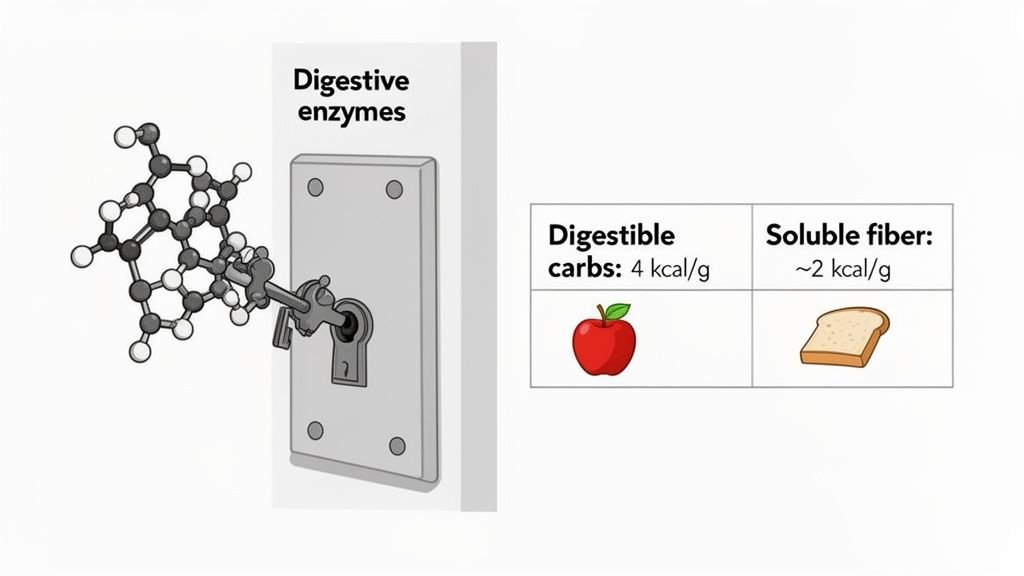
Think of your digestive system as a series of locks, and the nutrients you eat as keys. For sugars and starches, your body has the perfect key—enzymes that unlock their energy almost completely. But when fiber comes along, it's like a key that doesn't quite fit. Your body can't unlock its energy directly.
This is where the magic happens. Because we can't fully break it down, we don't absorb all of its potential calories. Instead of getting the standard 4 calories per gram like you do from other carbohydrates, a lot of the fiber you eat either passes right through or gets shared with your gut microbes.
Calorie Contribution at a Glance
So, how does the calorie count really stack up? This simple table breaks down the estimated energy you actually get from different types of carbs.
| Nutrient Type | Estimated Calories per Gram (kcal/g) | How Your Body Uses It |
|---|---|---|
| Sugars & Starches | 4 kcal/g | Directly digested and absorbed for immediate energy. |
| Soluble Fiber | ~2 kcal/g | Fermented by gut bacteria, providing a small amount of energy. |
| Insoluble Fiber | ~0 kcal/g | Passes through the digestive system mostly undigested, acting as "bulk." |
As you can see, the calories from fiber aren't zero across the board, but they are significantly lower than what you’d get from an equal amount of sugar or starch.
The big takeaway is that your body doesn't absorb every potential calorie from fiber. You either can't access them (insoluble) or you only get a fraction of the energy after your gut bacteria take their cut (soluble).
This is exactly why high-fiber foods are such a powerful tool for feeling full and managing weight. And here's the best part for those of us who track our intake: you don't need to do any special math. Nutrition labels and tracking apps like PlateBird already account for fiber's lower calorie value.
If you’re just getting started with tracking, our guide on how to count calories accurately can help you build a solid foundation. But when it comes to fiber, you can relax knowing the numbers on the label have already done the heavy lifting for you.
A Tale of Two Fibers: Soluble vs. Insoluble
When we talk about fiber, it's not really a single nutrient. It's more of a family, with two very different siblings who play completely different roles in your body: soluble fiber and insoluble fiber. Understanding how they work is the key to figuring out the whole fiber-and-calories puzzle.
First, let's look at soluble fiber. I like to think of it as the "gel-forming sponge" of the digestive world. When you eat it, it dissolves in water and forms a thick, gel-like substance in your gut. This gel is a game-changer; it slows everything down, which helps you feel full longer and can even moderate how quickly sugar hits your bloodstream after a meal.
You’re logging soluble fiber all the time in the PlateBird app, even if you don't realize it. It's the stuff that makes oatmeal creamy and what you find in beans, apples, and carrots.
The Gut's Favorite Snack
But here’s where the calorie part comes in. Soluble fiber’s most important job, for our purposes, is acting as a five-star meal for your gut bacteria. Your own digestive system can't break it down, so it arrives in your colon ready for the trillions of microbes waiting there. This fermentation process is exactly how a few calories are extracted from it—a topic we'll dig into next.
Then you have its counterpart, insoluble fiber. This one is the "intestinal broom." It doesn’t dissolve in water at all. Instead, it travels through your digestive system mostly intact, adding bulk to your stool and helping to sweep everything along. It’s fantastic for promoting regularity.
Think of it like this: Soluble fiber is a nutrient-dense sponge that gets broken down and used, while insoluble fiber is a sturdy scrub brush that cleans the pipes and exits without leaving much behind.
You'll get a good dose of this rugged fiber from foods like:
- Whole-wheat bread and bran cereals
- Nuts and seeds
- The skins of fruits and vegetables, like on potatoes and pears
Because neither your body nor your gut bacteria can really break down insoluble fiber, it contributes virtually zero calories. That's right. When you eat a handful of almonds or a slice of whole-wheat toast, the insoluble fiber helps you feel full without adding any energy to your daily total. Getting a handle on this distinction is what makes the rest of the fiber story click into place.
The Gut's Fermentation Factory: How Fiber Creates Calories
While our own digestive enzymes can't touch fiber, your gut is home to trillions of microscopic helpers ready to pick up the slack. Think of your large intestine as a bustling fermentation factory, staffed entirely by your gut bacteria. When soluble fiber arrives on the scene, these microbes get to work.
This is where the calories from fiber actually come from. The bacteria don't just "eat" the fiber; they ferment it. Through this fascinating process, they transform it into powerful compounds called short-chain fatty acids (SCFAs). The main ones—butyrate, propionate, and acetate—are the true "hidden" source of calories from fiber.
Once these SCFAs are created in your colon, your body can absorb and use them for energy. It's this incredible teamwork between you and your gut bacteria that explains why soluble fiber isn't a zero-calorie food.
The Calorie Conversion Process
So, how many calories are we actually talking about? Well, the process isn't perfectly efficient. Your gut bacteria use some of that energy for themselves, and not all of the SCFAs produced get absorbed by your body.
Because of this, scientists estimate that the energy you get from soluble fiber is roughly half that of a typical carbohydrate.
On average, you can expect to get about 1.5 to 2.5 calories per gram of soluble fiber you consume. That’s a significant drop from the 4 calories per gram you get from sugars and starches.
This flowchart breaks down the very different journeys that soluble and insoluble fiber take once they enter your body.
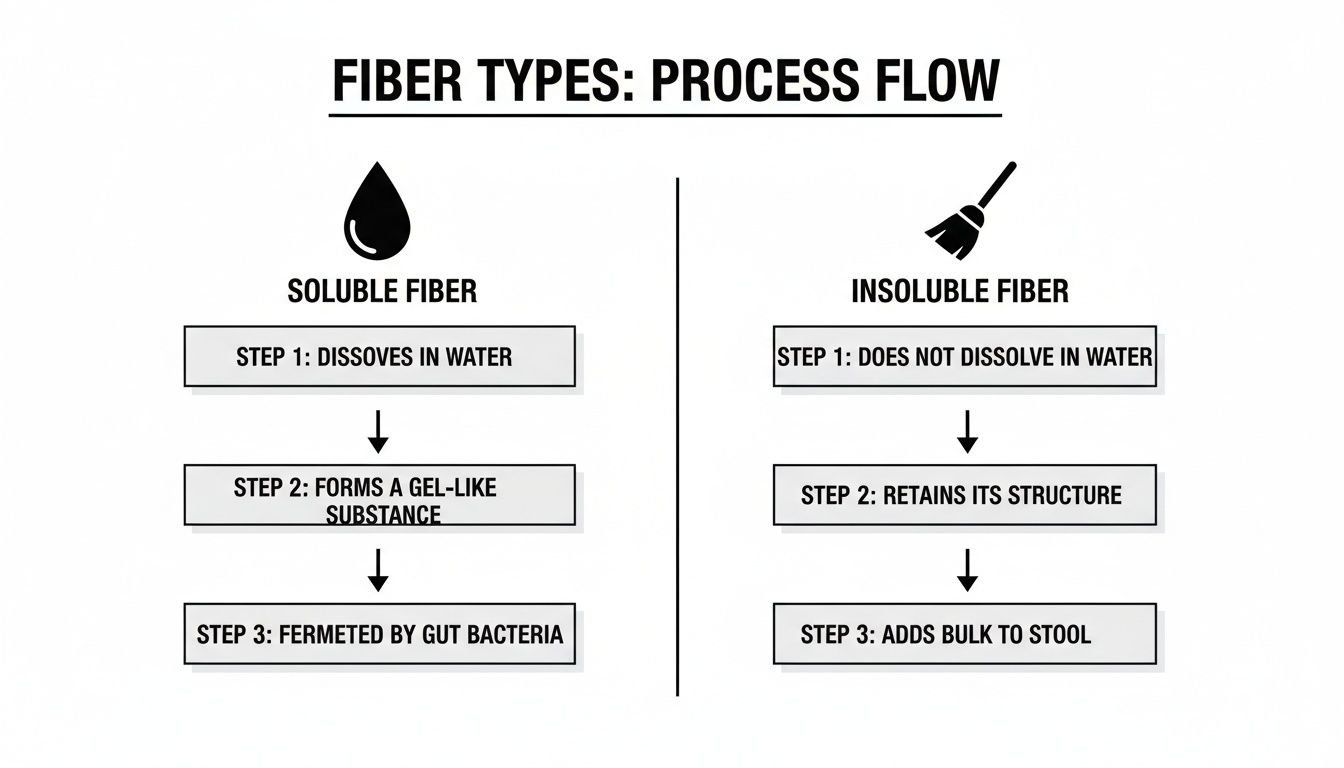
As you can see, soluble fiber becomes a feast for your gut bacteria, which leads to those calorie-yielding SCFAs. In contrast, insoluble fiber mostly acts like a broom, sweeping through your system with minimal changes.
Your Personal Fermentation Efficiency
It's also important to know that this internal "factory" operates a little differently in everyone. The exact number of calories you pull from fiber hinges on your unique gut microbiome—the specific types and amounts of bacteria living in your gut dictate how well you can ferment fiber.
This means two people could eat the exact same high-fiber meal and absorb a slightly different number of calories from it. Some of us have gut flora that are fermentation superstars, wringing out every last bit of energy. Others might have a less efficient crew, letting more of that potential fuel pass right on through.
This variability is a key reason why obsessing over the exact calorie count from fiber isn't nearly as important as focusing on its incredible health benefits. The small caloric contribution is just a byproduct of a process that profoundly supports your gut health and helps regulate your appetite. Think of it not as a caloric problem, but as proof that your internal ecosystem is thriving.
How to Read Food Labels and Understand Net Carbs
Staring at a nutrition label can feel a little like trying to read a foreign language, especially when you get to the carbohydrates section. It’s one of the first things people get tripped up on: why is Dietary Fiber indented right under Total Carbohydrates?
It's a great question, and the placement makes sense once you know the science. Fiber is technically a type of carbohydrate, but your body can't break it down and absorb it for energy the way it does with sugars and starches.
This leads to the next big question: what about the calories? On U.S. food labels, the total calorie count you see on the package has already done the math for you. Manufacturers use a standard estimate of about 2 calories per gram for soluble fiber, which is half the 4 calories per gram you get from other carbs.
You do not need to perform any special calculations yourself. The calories listed on the package have already done the math, factoring in the reduced energy you get from fiber.
Cracking the Code of Net Carbs
So, if the calories are already sorted, what’s all this talk about "net carbs"? You’ve probably seen the term splashed across keto-friendly snacks and low-carb breads. While it’s more of a marketing concept than an official FDA-regulated term, it’s built on a pretty straightforward idea.
The most common way to figure out net carbs is by simply subtracting the fiber from the total carbs.
- Formula: Total Carbohydrates – Dietary Fiber = Net Carbs
The thinking behind this is that since most fiber passes through you without being digested like other carbs, it doesn't cause a significant spike in blood sugar. For anyone following a diet like keto, tracking net carbs is a way to focus only on the carbohydrates that can impact their state of ketosis. If you want to dive deeper, our guide explaining what net carbs are and how to use them is a great resource.
How Tracking Apps Handle Fiber for You
Fortunately, you don't need to keep a calculator handy every time you eat. When you use a tracking app like PlateBird, all of this nutritional heavy lifting is done for you behind the scenes.
Let's say you log a high-fiber food like black beans.
As you can see in the screenshot, the app shows you the Total Carbs and Dietary Fiber, but the final calorie count for the meal is what's truly important—and it's already accurate. The app uses the official nutritional data, so you can just log your food and trust that the numbers are correct. This frees you up to focus on the big picture of your goals instead of getting bogged down in nutritional algebra.
How Fiber Impacts Your Weight and Health Goals
Alright, so we've figured out that fiber does have some calories, but the number is pretty small. The bigger question is, what does this actually mean for you and your health goals?
Honestly, my advice is to stop worrying about those few calories. Instead, you should start thinking of fiber as your secret weapon.
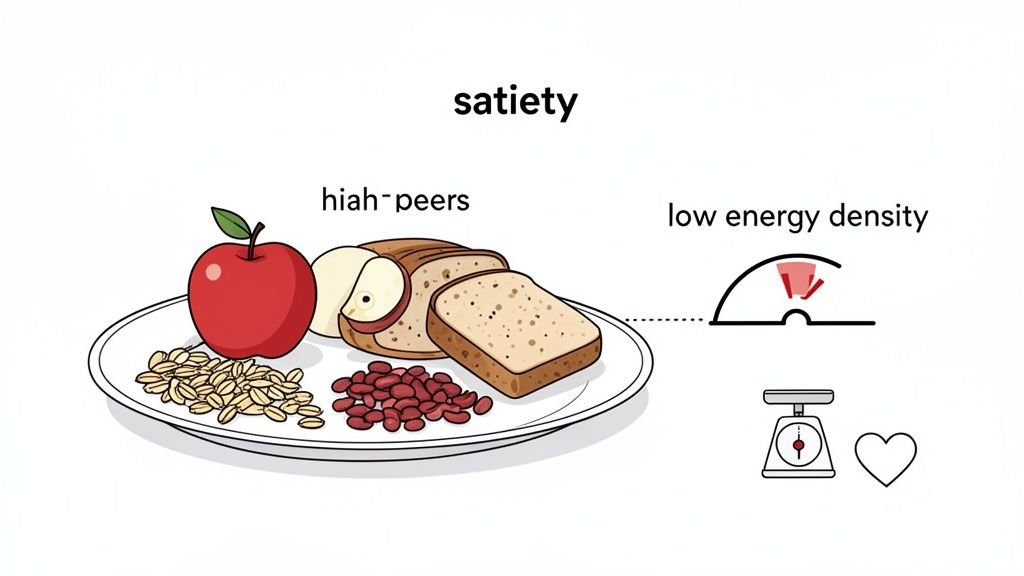
The real magic of fiber has nothing to do with its minor calorie count. It’s all about satiety—that feeling of being comfortably full and satisfied after you eat. Foods packed with fiber simply take up more room in your stomach and slow down digestion. Think about eating a whole apple versus chugging a glass of apple juice. The apple will keep you feeling full for much, much longer.
This slowing effect is a massive advantage, especially if weight management is on your mind. When you feel full, you're just not as tempted to overeat or grab mindless snacks. That makes it so much easier to stay in a consistent calorie deficit, which is the real key to losing weight effectively. If you want a refresher, we cover this in detail in our guide on what a calorie deficit is and how to make it work for you.
Beyond Just Feeling Full
While that feeling of fullness is a huge plus for your weight goals, fiber’s benefits go way beyond that. It really touches almost every part of your well-being. Making fiber-rich foods a priority is one of the best things you can do for your health in the long run.
Here’s what else it brings to the table:
- Blood Sugar Stability: Fiber slows down how quickly sugar enters your bloodstream. This helps you avoid those nasty energy spikes and crashes that often lead to brain fog and more cravings.
- Improved Heart Health: Soluble fiber, in particular, is a champ at helping lower LDL ("bad") cholesterol, which is a major win for reducing your risk of heart disease.
- A Happy Gut Microbiome: As we talked about, your good gut bacteria feast on soluble fiber. Keeping them well-fed is linked to everything from better digestion and a stronger immune system to even a better mood.
The conversation around fiber shouldn't be about its tiny calorie contribution. It should be about its incredible power to support your body, help you manage hunger, and make your entire health journey feel more sustainable and less like a struggle.
At the end of the day, the handful of calories you might get from fiber is an incredible bargain for all the good it does. When you focus on eating more whole foods—fruits, vegetables, beans, and whole grains—you’re not adding a problem to your calorie budget. You’re gaining a powerful partner that helps you crush your goals and feel fantastic while doing it.
Your Most Common Fiber Questions Answered
Okay, we’ve gone deep into the rabbit hole of fiber calories—from fermentation in your gut to deciphering nutrition labels. But I know there are probably a few nagging questions still bouncing around in your head. Let's tackle the ones I hear most often so you can walk away feeling completely confident.
Should I Manually Add Fiber Calories in My Tracking App?
I get this one all the time. The moment someone learns fiber has calories, they rush into their app to "fix" the numbers by manually adding them. Please don't do this! The short answer is a hard no.
You'll just end up over-tracking your calories. Every single time.
Here's why: food manufacturers and the nutritional databases that power apps like PlateBird are already on top of it. The total calorie count you see on a label or in your app has already been calculated using the Atwater system. This system assigns specific values:
- 4 calories per gram of protein
- 4 calories per gram of other carbohydrates
- 9 calories per gram of fat
- An adjusted value of roughly 2 calories per gram of fiber
So when you log that can of black beans, the calorie total already accounts for the fact that your body doesn't absorb all the energy from its fiber. Trying to add more calories on top of that is like paying for your groceries and then trying to pay for them a second time.
Trust the numbers. The calorie counts on labels and in good tracking apps have already done the math for you. Your job is simply to log the food, not become a nutritional accountant.
Does Cooking Change the Calories I Get from Fiber?
This is a fantastic question. After all, cooking absolutely changes food—sometimes dramatically. But when it comes to the calories you get from fiber, the effect is pretty much zero.
Cooking works its magic by altering the structure of food. Boiling a potato breaks down some of its complex starches, making them easier for you to digest. It also softens the tough cell walls in vegetables, unlocking other nutrients.
But cooking doesn't change how your body fundamentally deals with the fiber itself. That insoluble fiber is still going to act like a scrub brush for your digestive tract, and that soluble fiber is still heading to your gut bacteria for fermentation. The basic process of how you get—or don't get—calories from it stays the same.
So while you might absorb other nutrients a bit more easily from cooked foods, you don't need to sweat the fiber calories. Whether your spinach is raw in a salad or sautéed on your plate, its fiber contribution is a constant.
If I Eat a Lot of Fiber, Will I Gain Weight from Its Calories?
This might be the most important question of all, and I can tell you the answer is extremely unlikely. In fact, it's almost always the opposite. Worrying about gaining weight from fiber calories is like worrying you'll get soaked from the mist of a waterfall while standing a mile away.
The tiny number of calories from fiber is just one small part of a much bigger, more powerful story. Foods high in fiber are, by their very nature, incredibly filling and low in what we call energy density. They give you a huge sense of fullness for a very low caloric cost.
Think about it this way. Which snack will keep you going longer?
- A 200-calorie snack of a candy bar. It’s small, disappears in a few bites, and is loaded with sugar. You’ll be hungry again in an hour.
- A 200-calorie snack of a big apple and a handful of baby carrots. This is a much larger volume of food. It takes time to chew and digest, and you’ll feel satisfied for hours.
The powerful feeling of fullness you get from fiber-rich foods is your best ally in regulating your appetite and naturally reducing your overall calorie intake. That effect will always outweigh the minimal calories the fiber itself contributes. This makes fiber a powerhouse for weight management, not a secret cause of weight gain.
Once you understand these details, you can stop worrying about fiber calories and start using this nutrient to your advantage. PlateBird is built to handle all this complexity behind the scenes, so you can focus on the important stuff: eating well and feeling great.
Ready to track smarter, not harder? Download PlateBird for free and log your first meal in under a minute.