
A family meal planner sounds like just another chore, doesn't it? But what if it was less about rigid schedules and more about creating a simple, flexible system to end the nightly dinner panic? It’s a superpower for busy parents, built on a rotating list of meals your family actually likes, a smarter way to shop, and a real strategy for leftovers.
End the 5 PM Scramble With a Plan That Actually Works

We’ve all been there. The clock hits 5 PM, the kids start chanting "I'm hungry!", and you’re staring blankly into the fridge, hoping for inspiration to strike. That daily scramble isn't just an inconvenience—it's a constant drain on your patience and mental energy.
This guide is all about taking back your evenings. We're going to ditch the complicated spreadsheets and Pinterest-perfect meals that just don't fit into a real, messy family schedule. I’m sharing the sustainable framework I've refined over years of dealing with picky eaters, unpredictable weeknights, and a budget that needed to stretch.
The Philosophy: Smart Planning, Not Hard Planning
My whole approach boils down to one thing: plan smarter, not harder. The goal is to build a system that practically runs itself, cutting down on decision fatigue and making your entire week feel smoother. It all rests on three simple ideas that work together to bring some calm back to your kitchen.
- A Core Meal Rotation: We’ll build a "greatest hits" list of about 15-20 meals your family genuinely enjoys. No more guesswork.
- Strategic Shopping: You’ll learn to create a grocery list with purpose, which stops the overspending and curbs food waste.
- A Leftover Strategy: I'll show you how to use "planned-overs" to get a second (or even third) easy meal out of your cooking efforts.
This isn't just another task for your to-do list. Think of it as your secret weapon for a less stressful life. It’s a way to free up your mind and actually find some joy at the dinner table again.
A weekly plan, for instance, might not be a strict menu. Instead, it’s a flexible list of options. When you know you have all the ingredients for "Slow Cooker Peach Chicken" and "One-Pot Spaghetti," you can pick what to make based on how you feel that day.
Soccer practice ran late? Go with the quick pasta. Feeling a bit more ambitious? Start the chicken. That flexibility is what makes a meal plan you can actually stick with. It’s a reliable roadmap, not a rigid set of instructions.
Building Your Family's Core Meal Rotation
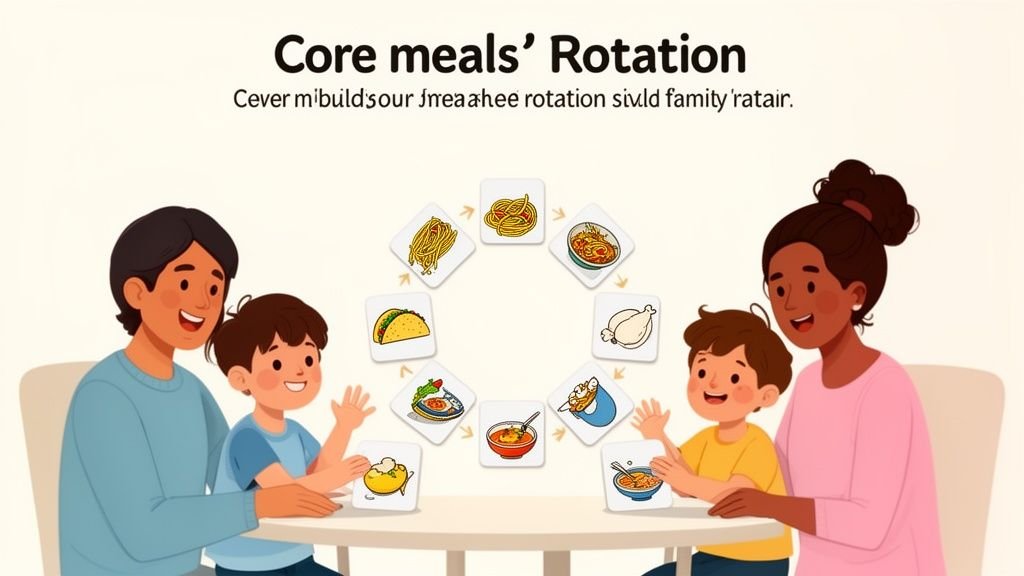
Here’s a secret that took me years to figure out: a truly simple meal plan isn't about finding new, exciting recipes every night. It's actually the opposite. The real magic comes from creating a core rotation of meals your family genuinely loves.
Think of it as your family's "Greatest Hits" album. This list becomes the foundation for everything.
Aim to brainstorm 15-20 tried-and-true meals. That range is the sweet spot—it gives you enough variety to keep things interesting but not so many options that you feel overwhelmed. The best way to start? Turn it into a family affair. Grab a notepad, gather everyone around the kitchen table, and ask them to shout out their favorite dinners.
You'll quickly find your guaranteed wins.
Organize Your Greatest Hits
With your list of family favorites in hand, the next move is to sort them into practical categories. This is what turns a simple list of meals into a powerful tool that works with the rhythm of your real life.
Here are the categories we use in our house:
- Quick Weeknight Wins: Meals that go from fridge to table in 30 minutes or less. Think one-pot spaghetti, sheet pan sausages, or skillet Boursin chicken.
- Comfort Food Classics: Perfect for those drizzly Sundays or tough days when you need a hug in a bowl. This is where our English-style pot roast and chili with cornbread live.
- Weekend Projects: These are the fun ones. Recipes that might take a little more time but are enjoyable to cook together, like homemade French bread pizza or a slow-simmered lasagna soup.
When you categorize your meals, you eliminate that last-minute panic. A chaotic Tuesday night means you just pull from the "Quick Wins" list. No debate, no stress.
An established meal rotation is your best defense against the 5 PM scramble. It’s not about restriction; it’s about creating a reliable framework that frees up your mental energy for more important things.
Add Variety Without the Work
A rotation doesn't have to mean boring and repetitive. The fun lies in making small tweaks that make an old standby feel fresh again. If "Tacos" is on your list, one week you can use ground beef, the next you can try shredded chicken, and the week after that, maybe some crispy fish. A simple swap, like a new kind of salsa or a different side, can completely change the experience.
Another fantastic way to build in structure is with themed nights. Creating a simple weekly theme gives your meal plan a predictable rhythm while still offering plenty of flexibility.
Here's a look at how that could work:
Sample Weekly Meal Theme Rotation
| Day of the Week | Theme | Example Meal Ideas |
|---|---|---|
| Monday | Meatless Monday | Black bean burgers, lentil soup, veggie stir-fry |
| Tuesday | Taco Tuesday | Ground beef tacos, chicken fajitas, fish taco bowls |
| Wednesday | Pasta Night | Spaghetti and meatballs, fettuccine alfredo, pesto pasta |
| Thursday | "Global" Night | Chicken curry, teriyaki salmon, Greek chicken pitas |
| Friday | Pizza/Fun Friday | Homemade pizza, build-your-own-burgers, nachos |
| Saturday | Comfort Classic | Pot roast, shepherd's pie, chicken and dumplings |
| Sunday | Leftovers/Flex | Repurpose leftovers, breakfast-for-dinner, grab a takeout |
"Pasta Friday" doesn't have to be the same dish every time. One week it could be fettuccine with ham and peas, and the next could be a simple pesto chicken bake. You get the perfect blend of consistency and creativity, which is the heart of any truly easy family meal planner.
For more ideas on building this kind of efficiency into your week, check out our guide on how to meal prep successfully.
Master Smart Shopping and Your Freezer Aisle
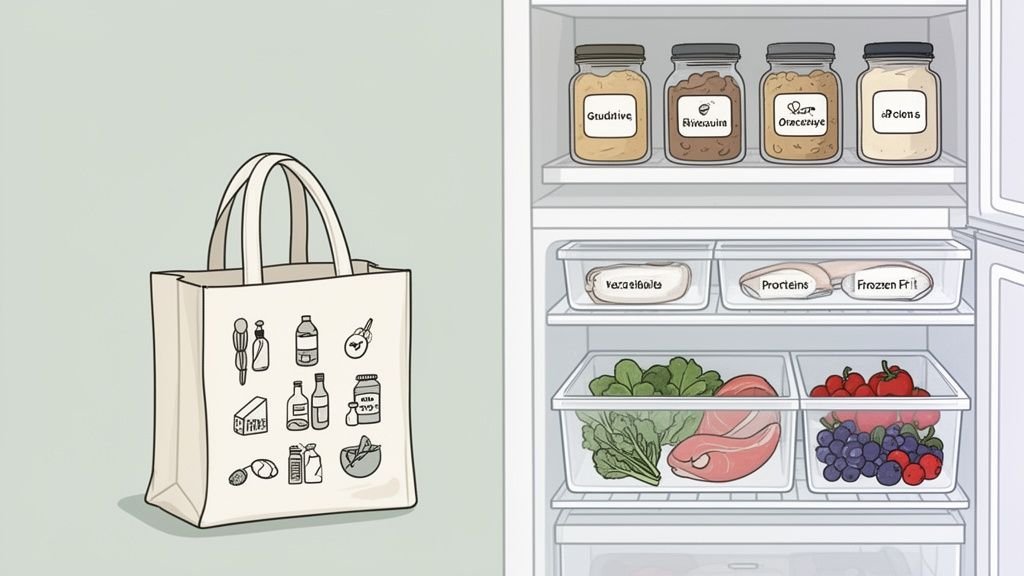
A great meal plan on paper is one thing, but it falls apart fast if your fridge is empty. I learned the hard way that the real secret to a successful family meal planner is getting out of the reactive, "what's-for-dinner-tonight?" grocery run cycle.
Instead, it’s all about one intentional, strategic shop per week. This single shift in habit has saved me more time, money, and food waste than any other trick I've tried. Your shopping list becomes your mission plan—every item has a purpose, tied directly to a meal you've already chosen. No more aimless wandering, grabbing things that look good but have no real plan.
The Art of the 'One Big Shop'
For my family, the most effective rhythm is one big shopping trip on the weekend. This single run stocks us up with everything we need for the week's planned meals. I might do a quick mid-week dash for delicate stuff like fresh berries or salad greens, but the heavy lifting is done.
This does take a little forethought, but the payoff is unbelievably calm weeknights. Before I even think about leaving the house, I “shop” my own kitchen. I take my list and cross-reference it with the fridge, freezer, and pantry. It’s a simple five-minute check that stops me from coming home with a third jar of mustard when two are already hiding in the back of the fridge.
My rule is simple: if it’s not on the list, it doesn’t go in the cart. This one discipline has done more to keep our food budget in check than anything else.
Build a Perpetual Pantry
Think of your pantry as your secret weapon for those nights when plans go sideways. I keep a “perpetual pantry,” which is just a core list of non-perishables that we never run out of. As soon as I use the last can of diced tomatoes or the last box of pasta, it goes on the shopping list for the next trip.
Our Perpetual Pantry Must-Haves:
- Canned Goods: Diced tomatoes, tomato sauce, beans (black, kidney, chickpeas), and corn are lifesavers.
- Grains & Pasta: Rice, quinoa, a few pasta shapes, and oats form the base of so many easy meals.
- Oils & Vinegars: Good olive oil, a neutral vegetable oil, apple cider vinegar, and balsamic vinegar.
- Broths & Stocks: Chicken, beef, and vegetable broths are essential for whipping up soups, stews, and sauces.
Having these staples on hand means you can always pull together a simple meal, like a quick pasta dish or a hearty bean soup, even when fresh groceries are running low. When you see these items on sale, stock up—it's how you make sales work for you, not the other way around.
Your Freezer Is Your Best Friend
Don’t treat your freezer like a graveyard for forgotten leftovers and ice cream. It's a time machine for your future self and an essential tool for any busy parent. Honestly, the freezer has become the cornerstone of my entire meal planning strategy.
I’m not the only one. It turns out 40% of shoppers now use frozen foods daily or every few days, which is a big jump from 35% in 2019. It makes sense—relying on frozen foods can slash a family's food waste by up to 37% and really stretch a budget. Of course, you still want to choose wisely. Take a second to scan the nutrition facts, and if you're not sure what you're looking at, getting a handle on how to read nutrition labels will help you pick options that are both convenient and healthy. The FMI's 2026 Power of Frozen report has some fascinating insights on this trend if you want to geek out on the data.
Plan Meals for Real-Life Budgets and Picky Eaters
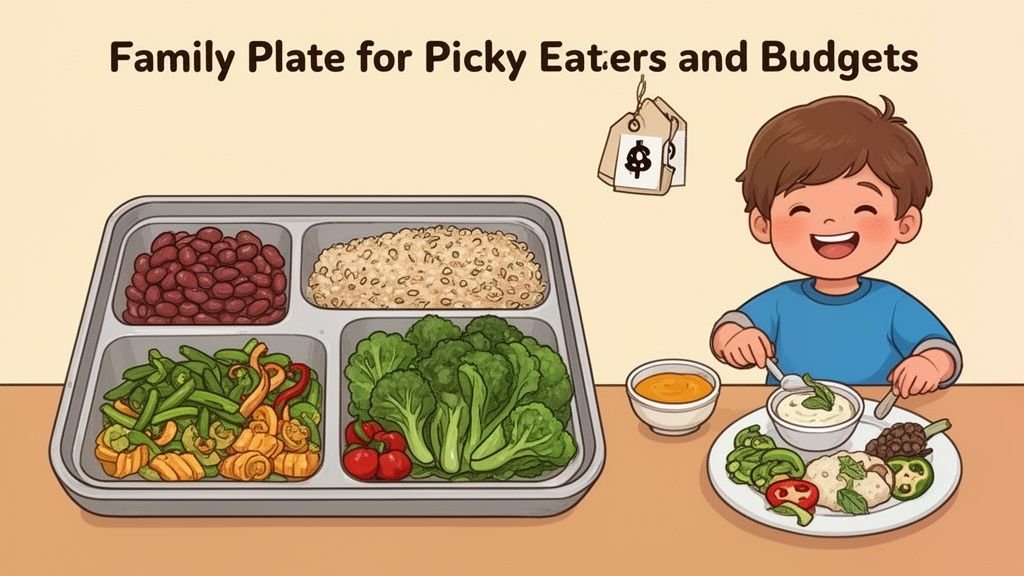
Let's be honest. A Pinterest-perfect meal plan means absolutely nothing if it can't survive contact with the two biggest forces in any family kitchen: a tight budget and an even tighter-lipped picky eater. These aren't just small hurdles; they are the main event. Getting a handle on them is what makes a meal plan actually work.
And it's not just our family feeling the pinch. With major cuts to food assistance programs and over 60% of people worldwide looking for cheaper food options, cooking at home has become more of a financial lifeline than a hobby. It's a massive shift you can see detailed in reports on things like global food aid insights.
Winning on a Budget
The secret to making your grocery budget work is to stop thinking about fancy recipes and start building your meals around affordable, powerhouse ingredients. It’s all about getting the most nutrition for your money.
I build at least three or four of our weekly dinners around these staples:
- Lentils and Beans: Absolute heroes for soups, chili, and making a little bit of meat go a long way.
- Seasonal Veggies: Whatever is in season is going to be cheaper, fresher, and taste a million times better.
- Eggs: The ultimate cheap protein. We do "brinner" (breakfast for dinner) at least once a week.
- Pasta and Rice: They're the perfect blank canvas for whatever you have on hand.
A pro tip I learned the hard way: always look at the unit price. That giant bag of rice might seem like a splurge, but it's often way cheaper per serving. This is how you win the long game, especially with pantry items you use all the time.
Navigating the Picky Eater Maze
Okay, on to the second—and sometimes louder—challenge: the picky eater. My biggest breakthrough came when I stopped trying to force my kids to eat my "perfect" meal and instead started giving them a little bit of control. It sounds almost too simple, but it completely changed our dinner dynamic.
My favorite tool in this fight is the deconstructed meal.
Instead of serving a finished plate of tacos, I just put out bowls of everything: seasoned ground turkey, shredded cheese, lettuce, diced tomatoes, and sour cream. Everyone builds their own. The kids feel like they're in charge, and I know they're actually eating.
This works for so many things! Think pasta bars with different sauces and toppings, build-your-own-burger nights, and rice bowls. You provide the good stuff, and they get to be the chef.
Getting them involved in the planning is another game-changer. When my daughter helps me pick out the "Slow Cooker Peach Chicken" for Wednesday, she’s so much more likely to eat it without a fuss. It turns dinner from a battleground into a team project. For more ideas that fit this strategy perfectly, check out these easy meal prep ideas.
At the end of the day, juggling a budget and picky palettes is all about finding that happy medium—the one where your bank account is happy and everyone comes to the table without a fight.
Making Your Own Goals Part of the Plan With PlateBird
So, you’ve done it. You’ve wrangled the chaos of weeknight dinners into a smooth, predictable system. The meal plan is on the fridge, the shopping is done, and everyone knows what’s for dinner. High five!
But I know what often happens next. In the midst of making sure everyone else is fed and happy, a little thought creeps in: what about me? What about my own health goals?
As parents, our own needs have a funny way of sinking to the bottom of the priority list. The idea of meticulously tracking your own food on top of everything else can feel completely overwhelming. It’s just one more task.
This is exactly why I started using PlateBird. It’s the one tool I’ve found that helps me keep an eye on my own nutrition without the soul-crushing data entry that most tracking apps require. It removes friction instead of adding more work.
Log Your Meal in Seconds, Not Minutes
Let's get real for a second. It's "Global Night," and you've just dished up a beautiful chicken stir-fry. With other apps, logging your plate would mean a tedious search for every last ingredient—the chicken, the broccoli, the soy sauce, the rice—and then guessing the amounts. Honestly, it’s exhausting just thinking about it.
With PlateBird, you just take a picture.
That’s it. Before your first bite, the app’s AI looks at the photo, identifies what’s on your plate, and gives you an almost instant nutritional estimate. A task that used to take me ten minutes is now done in ten seconds. This one feature has been an absolute game-changer, letting me stay mindful of my own intake without interrupting the flow of a family dinner.
Shortcuts That Actually Get Your Life
Because your meal plan is built on rotation, the app quickly picks up on your habits. It learns what you eat and turns your regular meals into simple, one-tap shortcuts. It just gets it.
- Your Morning Routine: You log your "eggs, toast, and coffee" once, and it becomes a saved meal. Tomorrow morning, you just tap a single button. Done.
- The Magic of "Planned-Overs": Eating last night’s spaghetti for lunch? You don't have to re-enter a thing. Just type 'spaghetti,' and PlateBird pulls up the nutritional info from your previous entry.
- Family Favorites on Repeat: That "Slow Cooker Peach Chicken" the kids devour? It becomes a saved recipe shortcut. Every time it comes up in the rotation, logging it is effortless.
Look, the point isn’t obsession; it’s awareness. PlateBird gives you the data you need to make smart choices for yourself with almost zero extra effort. It’s about weaving your personal goals right into the family routine you've already mastered.
You can genuinely log an entire day's worth of food in less than a minute. That’s what makes tracking sustainable when you’re a busy parent. You no longer have to choose between a smooth-running household and your own health journey. With the right tool, you can finally do both.
Your Questions on Family Meal Planning Answered
Okay, so you've got your planner set up. Everything looks great on paper. Then Monday happens.
Even the best-laid plans can get derailed by real life. Let's talk through some of the most common hurdles I see and how I’ve learned to navigate them without losing my mind.
I've also noticed a huge shift in how we eat, and it's not just with the kids. It feels like we're all snacking more, and the data backs this up. Apparently, more than two in five Gen Z and Millennial parents are replacing entire meals with snacks every single day. It’s a mix of hectic schedules and a different approach to nutrition. If you're curious, Penn State Extension has some interesting insights on these food trends. This just proves that our meal plans have to be more adaptable than ever.
What if Our Schedule Is Unpredictable?
I know those weeks. The ones where the family calendar looks like a toddler got hold of a permanent marker. On weeks like that, a rigid day-by-day menu is just setting yourself up for failure.
Instead, I just create a simple list of 5-6 meals for the whole week. I don't assign them to specific days. Each morning, I'll look at the schedule and my own energy level and ask, "Which of these can I realistically pull off tonight?"
On those truly chaotic weeks, I have two non-negotiables:
- A "Quick-Win" Meal List: I keep a running list of 3-4 super-fast meals on the fridge. Think scrambled eggs and avocado toast, or frozen pizza jazzed up with a side salad. No shame in that game.
- A Stocked Freezer: This is your best friend. Having pre-cooked ground taco meat or a frozen lasagna ready to go feels like a gift from your past self.
The goal isn't perfect adherence to a plan; it's having a curated set of options so you're not starting from scratch when you're already drained. It's about feeling in control, even when the week feels like it's spinning.
How Do I Stop My Family From Getting Bored?
"Tacos again?" If you've ever heard this, you know the struggle is real. But keeping things interesting doesn't mean you have to become a short-order cook or spend hours on Pinterest. The secret is small, easy swaps.
Think of it as giving your classic meals a mini-makeover. If Taco Tuesday is a staple, try swapping ground beef for shredded chicken or fish. Use a different salsa, or add a new topping like quick-pickled onions. For pasta night, just switch the noodle shape or trade the marinara for a pesto sauce.
I also like to schedule a "New Recipe Night" maybe once every two weeks. There's no pressure. If the family loves it, the recipe gets added to the rotation. If not, no big deal. It’s just enough novelty to keep things fresh.
What Is the Best Way to Use Leftovers?
Let's be honest: leftovers are only useful if they actually get eaten. So instead of just hoping someone will grab that container from the back of the fridge, I plan for them.
My favorite trick is what I call the "planned-over." I'll intentionally double a recipe with a specific second meal in mind. It's a game-changer for cutting down on cooking time and food waste.
For instance, the extra roasted chicken I make on Monday is already destined to become filling for quick chicken wraps on Wednesday. That big pot of rice becomes the base for an easy fried rice dish later in the week.
We also have one "Buffet Night" every week, usually on a Thursday. Everyone builds their own plate from all the leftovers in the fridge. It clears everything out before the weekend grocery run and makes a noticeable dent in our food waste.
And this is where a tool like PlateBird becomes incredibly helpful. On "Buffet Night," you don't have to manually log every little thing. Just snap a quick photo of your plate, and the app's AI identifies and logs the different foods for you. It's the perfect way to track your own goals without adding another chore to your list.