
You sit down with a proper Indian meal, maybe a home-cooked dal, sabzi, and rice, or maybe a restaurant spread with naan, curry, and a starter you did not plan to order. The food looks familiar. The calories do not.
That gap is where many individuals get stuck. They are not failing because they lack discipline. They are failing because Indian food is hard to log when the gravy, the oil, the portion size, and even the name of the dish can mean very different things from one kitchen to the next.
The good news is that you can learn to calculate calories in indian food without turning every meal into a math exam. The method that works is a hybrid one. Use precise manual counting when you control the recipe. Use smart estimation when you do not. Then make the process fast enough that you will keep doing it.
The Challenge and Reward of Tracking Indian Food
One of the most common moments I see is this: someone is motivated, trying to lose fat or eat with more structure, and then dinner shows up as a thali or a rich curry meal. Confidence disappears.
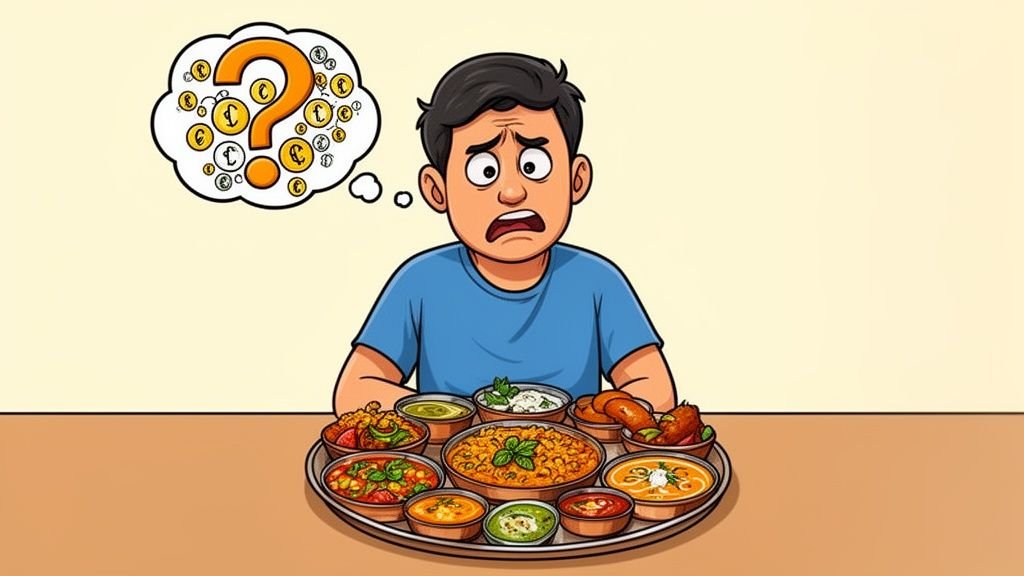
That reaction makes sense. Indian food is not one thing. A restaurant main can range from about 300 calories for tandoori chicken to about 870 calories for chicken korma, and even starters swing sharply, from 320 calories for a meat samosa to 20 calories for tomato sambal or cucumber raita according to this calorie chart for Indian food items. If two dishes on the same menu can land that far apart, guessing by appearance alone is a weak strategy.
Why Indian meals are harder to log than generic app entries
The challenge is not only restaurant richness. It is also the way Indian diets are structured. Indian dietary patterns often provide a lower share of calories from fruits, vegetables, and proteins than international recommendations, while whole grains, starchy vegetables, and dairy foods often exceed recommended proportions. Processed foods can make up nearly 30% of daily calories for urban households, which is one reason accurate, specialized tracking matters if you want your numbers to reflect how you eat, as noted in this dietary analysis of Indian households.
That means a standard calorie app built around toast, salad, and grilled chicken often misses the mark. It may not reflect grain-heavy plates, mixed dishes, or regional preparation styles.
The reward is not perfection
Many believe the goal is exactness. It is not. The reward is consistency with enough accuracy to make better decisions.
When you stop treating Indian food as impossible to track, you notice patterns quickly:
- Rich gravies hide more calories than they look like they should
- Dry grilled items are often easier to estimate
- Small sides can be almost irrelevant or surprisingly dense
- Your family’s version of a dish matters more than the generic app entry
The skill is not “know every calorie.” The skill is “know how to break a plate down fast and accurately.”
That shift removes a lot of food anxiety. You can still enjoy biryani, dal, korma, sabzi, or a weekend meal out. You just stop logging them blindly.
Deconstructing Home-Cooked Meals for Accurate Calories
You finish cooking a pot of dal, serve everyone, then try to log your meal from memory. That is where home tracking usually starts to drift. A little extra oil in the tadka, a second ladle of rice, and a vague idea of serving size can turn a decent estimate into a bad one.
Home cooking still gives you the best chance of getting calories right, because you control the ingredients, the fat used, and the final portions. For Indian food, that control matters more than any generic app entry.
The basic method that works
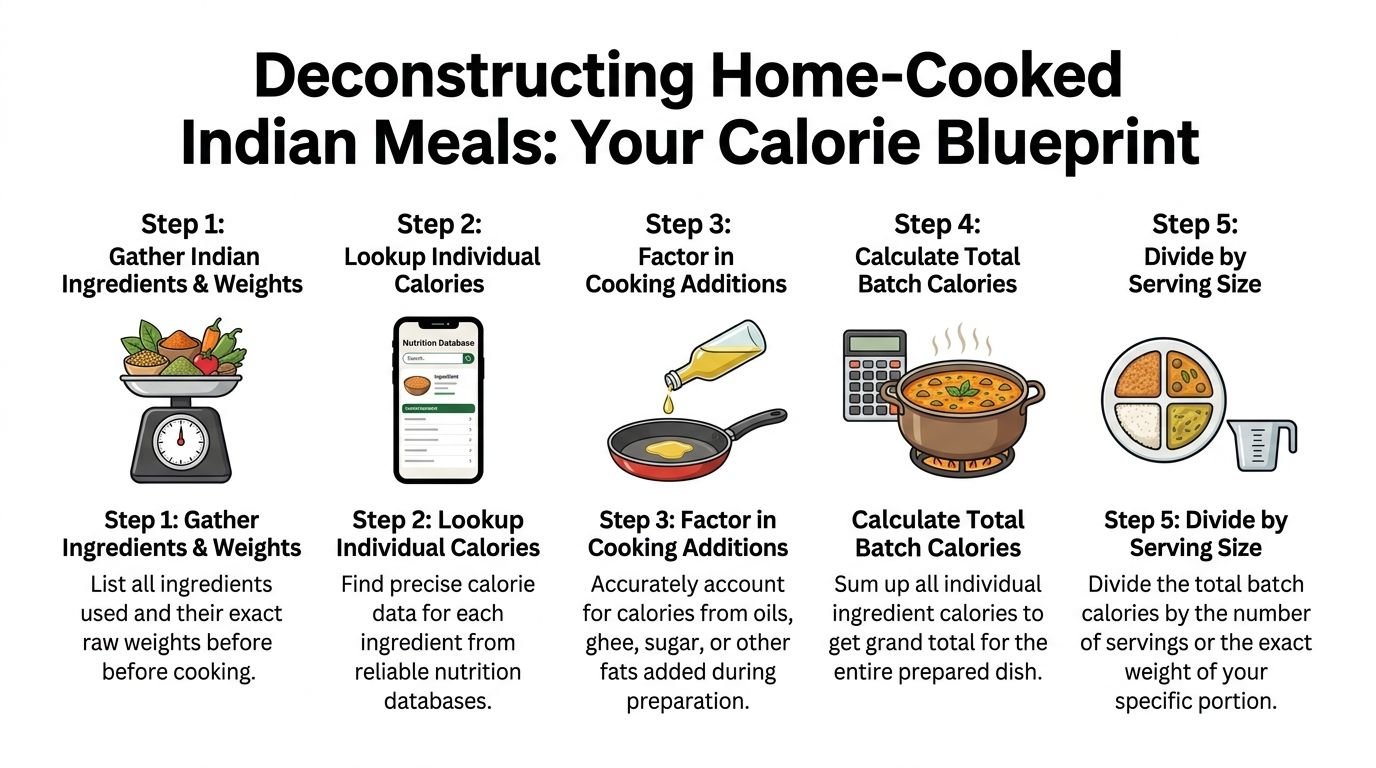
The reliable method at home is straightforward. Weigh ingredients before cooking, log each one, total the full recipe, then divide the finished dish by the number of servings you obtain. It takes a few extra minutes, but those minutes buy accuracy where it counts most.
The ingredients that change the total fastest are usually the ones people eyeball. Oil, ghee, butter, cream, coconut milk, cashew paste, peanuts, and paneer can shift a dish far more than the tomatoes, onions, or spinach around them. In practice, fats are the first place I ask clients to tighten up, because that is where undercounting happens every week.
Use this workflow:
Write down every ingredient
Include the obvious items and the easy-to-forget ones. Oil for sautéing, ghee for finishing, curd in the marinade, sugar in chai, peanuts in poha, coconut in chutney.Weigh ingredients in their raw form
Raw weights are easier to track consistently than cooked weights, especially for rice, dal, meat, and vegetables that lose or absorb water.Pull calorie values from a reliable database
Stay consistent with one source when possible. That keeps your saved recipes cleaner.Calculate the total for the whole batch
One kadhai of sabzi or one pressure cooker of rajma is a batch. Log the full pot first.Portion the cooked dish deliberately
Divide by the number of servings you will eat from that batch, or weigh the final cooked dish and log your own portion by grams.
Where Indian home meals get underestimated
A homemade meal can look light and still be calorie-dense. The gap usually comes from cooking medium and portion logic, not from the main vegetable or dal.
Pay close attention to these:
Oil and ghee
They disappear into the dish, so they are easy to forget and hard to estimate later.Tadka
A final tempering still counts, even if it feels small.Calorie-dense add-ons
Cream, butter, coconut, cashew paste, paneer, peanuts, sev, and cheese can move a meal from moderate to heavy very quickly.Staples
Rice, roti dough, poha, suji, and potatoes often contribute more than people expect.Serving size drift
A family “one bowl” is not a measurement. It is a habit.
A concrete batch calculation
Take a simple aloo gobi made at home. If the batch uses 200g potatoes, 150g cauliflower, 100g tomatoes, 1 onion, 15g ginger-garlic, and 2 tablespoons of oil, you would log each ingredient, add the batch total, and then divide by the number of servings.
That approach matters more than the exact dish. Once you know how to total one sabzi, you can repeat the same method for rajma, chana masala, chicken curry, paneer bhurji, upma, or khichdi.
I usually tell clients to do the full math for their regular recipes once, save those recipes, and stop starting from zero every time. A good companion guide for that process is this article on how to calculate calories in homemade food.
The trade-off that pays off
Yes, weighing ingredients feels slow in the beginning.
But it gets easier fast, and the payoff is real. After one or two weeks, you build your own reference library based on your family’s cooking style, your pan size, your oil habits, and your actual portions. That is far more useful than guessing from five different app entries for “dal curry.”
The key habit for accuracy at home is to measure ingredients before you cook.
That manual system gives you a dependable baseline. Then the hybrid approach becomes powerful. You can use your saved recipe numbers for repeated home meals, and use AI tools like PlateBird to speed up logging when the dish is mixed, the portion is messy, or you want a faster check without redoing all the math by hand.
A home tracking checklist
Use this every time you cook:
Log fats first
If oil or ghee does not get logged at the start, it often gets missed.Measure the main calorie carriers
Rice, atta, lentils, potatoes, paneer, coconut, nuts, and meat deserve the most attention.Keep spices in perspective
Typical spice amounts usually add little. Focus your effort where the calories are.Decide servings before you eat
If the pot makes four servings, record four. Do not guess at the table.Save repeat recipes
Once your dal, sabzi, or curry is built properly once, reuse it. That is how tracking becomes consistent instead of exhausting.
Smart Estimation Hacks for Dining Out
Restaurant food is where precision drops and judgment matters more. You cannot weigh the biryani. You cannot ask how much ghee went into the dal and expect a useful answer. You need a field method.

The best approach is to break the plate into components, then apply a caution factor to rich dishes.
Build the plate from parts
A practical restaurant method is to split the meal into staples, curry, and sides. A technical example puts 2 rice servings at 400 to 450 kcal, curry at 160 to 270 kcal per cup, and sides at 200 kcal. The same guide notes that a key pitfall is fat underestimation, and that tadka can double a dal from 200 to 400 kcal. It also notes that visual methods are only about 65% accurate for professionals, which is why good heuristics matter, according to this restaurant-focused calorie estimation guide.
That gives us a useful restaurant workflow:
| Plate part | What to identify | What to watch |
|---|---|---|
| Staple | Rice, naan, roti, dosa, biryani base | Portion creep |
| Main | Dal, paneer, chicken curry, fish curry | Oil, cream, butter |
| Side | Raita, papad, pickle, chutney | Small items still count |
| Extras | Dessert, starter, refill | Easy to forget |
What works better than guessing the whole dish
When individuals log “one Indian meal,” the estimate is usually poor. When they log “rice + dal + paneer + raita,” accuracy improves because each component is easier to recognize.
Use visual anchors:
- A cup-shaped portion of dal or curry is a better estimate than “one bowl”
- A fist-sized rice serving gives you a rough standard when the plate is piled high
- A palm-sized piece of grilled protein is easier to judge than a saucy mixed serving
If you need extra help with visual judgment, this guide on serving sizes for weight loss helps translate portions into something you can use in real life.
Read the menu like a coach
The menu gives clues before the plate arrives.
Choose words carefully:
- Tandoori usually signals a lighter path than creamy gravy dishes
- Korma often deserves a higher estimate because of its rich base
- Malai, makhani, butter, creamy, fried should immediately push your estimate upward
- Dry, roasted, grilled, steamed tend to be easier to manage
This does not mean “never order rich food.” It means log rich food like rich food.
Restaurant calorie counting is less about exact math and more about refusing to underestimate fat.
A short visual breakdown can help if you want to sharpen that instinct before your next meal out.
The restaurant buffer
What does not work is pretending restaurant curry equals your home version. Even when the dish name matches, the kitchen goal is different. Restaurants cook for flavor, texture, and repeat business, not for your calorie target.
So the smart trade-off is this:
- Estimate the obvious components
- Assume hidden fat is higher than you want it to be
- Choose consistency over false precision
If the dish is shiny, creamy, or leaves oil on the plate, increase caution. If it is grilled and dry, your estimate can stay tighter.
That is how you stay honest without turning dinner out into a stressful audit.
Putting It All Together With Worked Examples
You cook dal makhani at home on Sunday, then order chicken curry out on Friday, and both end up in the same food log. That is where many people lose consistency. The method has to flex with the meal.
At home, accuracy comes from ingredients. At restaurants, accuracy comes from identifying the dish correctly, estimating visible portions, and adding a sensible buffer for hidden fat. When you combine those two skills, Indian food becomes much easier to track week after week.
Example one with dal makhani at home
Dal makhani teaches an important lesson fast. The lentils and beans give the dish its structure, but the calories often rise from what gets added at the end. A modest amount of butter and cream keeps it manageable. A generous finish can change the log a lot.
For a home version, build the recipe from the pot upward. Weigh the raw dal and rajma. Add onion, tomato, oil, butter or ghee, and cream. Then divide the full recipe by the number of servings obtained, not the number you hoped to get.
Sample Calorie Breakdown: Home-Cooked Dal Makhani (1 Serving)
| Ingredient | Weight (grams) | Calories |
|---|---|---|
| Whole lentils | measured raw | log from your database |
| Kidney beans | measured raw | log from your database |
| Onion | measured raw | log from your database |
| Tomato | measured raw | log from your database |
| Butter or ghee | measured | log from your database |
| Cream | measured | log from your database |
I do not want you copying a generic dal makhani number from a database and assuming it fits your kitchen. Your recipe matters more than the label. Once you build it once, save it, and future entries become quick.
That is the hybrid approach in practice. Manual counting gives you a reliable baseline for your own cooking. Later, tools like macro tracking apps for mixed meals and fast logging can help you enter that meal without repeating the math every time.
Example two with a restaurant chicken order
Now use a different standard. A restaurant chicken dish can swing hard depending on preparation, even when the menu makes both options sound equally reasonable.
As mentioned earlier, a serving of tandoori chicken might be approximately 300 calories, while chicken korma can be up to 870 calories. The tracking lesson is not memorizing those exact numbers. The lesson is recognizing that grilled, dry chicken is usually easier to log than a rich, sauce-heavy curry.
A practical estimate looks like this:
Tandoori chicken
Log the chicken portion with a tighter estimate. There is less sauce, less visible fat, and fewer unknowns.Chicken korma
Log the chicken, then account for the creamy base with a wider buffer. This is the better choice only if you are willing to estimate generously.
That trade-off matters. Precision is easier with simpler dishes. Rich restaurant gravies require honesty more than mathematical neatness.
A practical plate comparison
Small additions change totals fast. A samosa and a bowl of raita do not belong in the same calorie category, even if both feel like side items.
As noted earlier, a meat samosa contains 320 calories, while a raita can be 20 calories. That is why “just a little extra” needs a quick check before it disappears from the log.
Use four questions with any mixed Indian meal:
What are the clear components on the plate?
Rice, bread, chicken, paneer, dal, chutney, dessert.Which part is calorie-dense by cooking method?
Fried pastry, creamy gravy, visible oil, buttered bread.What can you estimate tightly, and what needs a buffer?
Grilled protein is tighter. Restaurant sauce needs more caution.Can this become a repeat entry next time?
If yes, save it and stop solving the same problem from scratch.
That is how the full system comes together. You use manual breakdowns where they give you better accuracy, especially for home food. You use pattern recognition and smart buffers where exact ingredient data is not realistic, especially when eating out. That mix is what keeps tracking accurate enough to work, and simple enough to keep doing.
From Tedious Math to Instant Logging with PlateBird
Manual tracking teaches awareness. It also has friction. That is the trade-off.
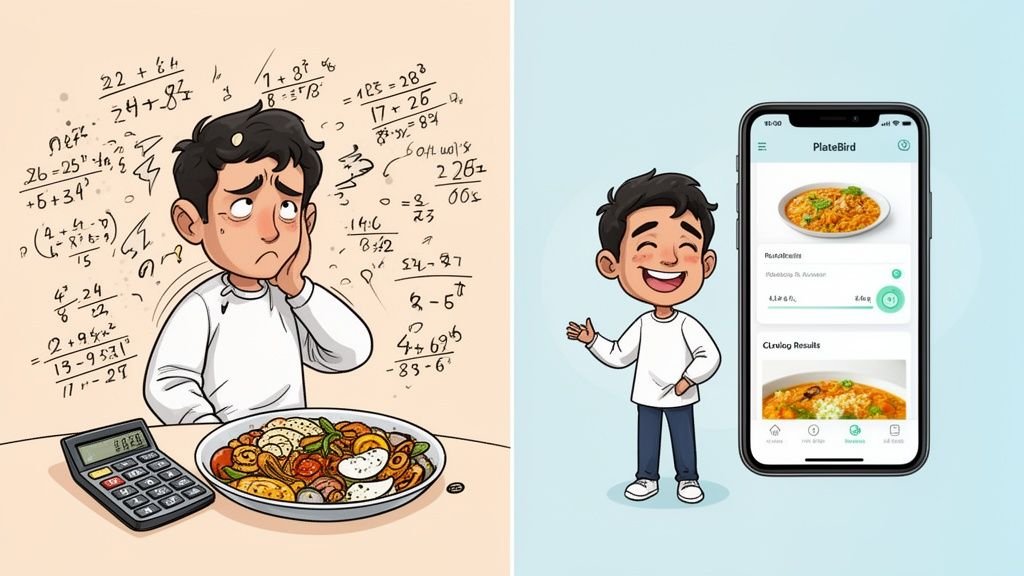
You should absolutely learn the kitchen-scale method for your regular recipes and the deconstruction method for restaurant meals. But if every log feels like homework, many stop. That is why the practical endgame is not “do more math.” It is “use the math to train your eye, then make logging fast.”
Where manual tracking still wins
Manual entry is strongest in two situations:
Home recipes you repeat often
Once you build a recipe properly, your future logs become simple.Meals with hidden ingredients you know better than an app does
Your own paneer curry, your mother’s rajma, your meal-prep khichdi.
Here, your personal database becomes valuable. You do the careful work once. Then you reuse it.
Where AI tools help most
The weak point of manual tracking is speed, especially when the plate is mixed or the meal is social. Indian food often arrives as combinations. Rice, curry, sabzi, dal, raita, papad, chutney, maybe dessert. That is where AI-assisted logging becomes useful.
A tool like PlateBird fits that gap well because it supports both fast text logging and photo logging. If you type a meal in plain language, it cuts down the hunting and scrolling that slows individuals down. If you snap a photo of a mixed plate, the app helps identify what is on it before you start eating.
That matters because the hardest part of tracking Indian food is often not commitment. It is interruption. Logging breaks your flow, so you postpone it, then forget details.
The hybrid system I recommend
The method I recommend to clients is simple and sustainable:
- Measure and build your staple home recipes
- Use estimation rules when eating out
- Log recurring meals in the fastest way possible
- Use photos when the plate is too mixed to type cleanly
- Review patterns, not just isolated meals
That forms the bridge between old-school calorie counting and modern tools. You are not replacing knowledge with automation. You are using knowledge to make automation more accurate.
A generic tracker often struggles with Indian meals because the dish names are broad and the preparations vary. A tool designed to remove friction is more useful, especially when it lets you log repeated meals quickly. If you want to compare that style of app, this overview of the best macro tracking app is a practical starting point.
The best tracking tool is the one you will still be using after the motivation spike is gone.
That is why speed matters. Not because accuracy is unimportant, but because a slightly imperfect log done consistently beats perfect intentions that never get recorded.
Your Path to Consistent and Stress-Free Tracking
By the time individuals get calorie tracking to work with Indian food, they stop asking, “What is the exact number?” and start asking, “What is the most honest method for this meal?”
That is the right question.
At home, the answer is simple. Weigh ingredients, count the fats, save the recipe, reuse it. When you cook this way for your usual meals, you remove most of the uncertainty.
Outside the home, the job changes. Identify the dish correctly, split the meal into parts, and respect hidden fats. That is enough to make strong decisions without carrying a food scale to dinner.
What to remember every time you eat
Deconstruct the meal
Indian food becomes easier to log when you stop treating the plate as one mystery item.Take fats seriously
Oils, ghee, butter, cream, and tadka change totals faster than many realize.Use precision where it is available
Home-cooked meals deserve real measurement.Use estimation where it is necessary
Restaurant logging is a judgment skill, not a lab test.
The mindset that keeps this sustainable
Do not wait until you can do it perfectly. Start with one meal you eat often. Build from there.
Maybe it is your breakfast poha. Maybe it is dal and rice at lunch. Maybe it is your usual Friday takeout. Once you track one recurring meal properly, the process gets less intimidating.
Food should not feel like a test you are failing. You can enjoy Indian food and still track it well. You just need methods that match the food on your plate.
If you want calorie tracking to feel quick instead of draining, PlateBird is worth trying. You can type what you ate in plain English or snap a photo of your meal, which is especially useful for mixed Indian plates and repeat meals you do not want to calculate from scratch every time.