If you want to calculate macros for weight loss that actually works, you have to do two things right: eat in a calorie deficit and get the right balance of protein, fat, and carbs. It all starts with figuring out your daily calorie budget. From there, you'll set a solid protein goal, and then the rest of your calories get split between fats and carbs in a way that works for you.
Your Personal Blueprint for Weight Loss Starts Here
Let's be real for a second. Most generic diet plans are doomed from the start because they miss the most important variable: you. This isn't just about counting calories; it’s about understanding why tracking your macros—the specific ratio of protein, fats, and carbs—is a complete game-changer for changing your body.
This is about strategy, not starvation. When you tailor your macros to your body and lifestyle, you’re not just losing weight. You're losing fat while holding onto precious muscle, keeping your energy levels stable, and kicking hunger to the curb.
And let's face it, having a smart plan has never been more important. The World Health Organization reported that in 2022, a staggering 2.5 billion adults were overweight. Projections even show that by 2030, a high BMI could affect nearly half of all adults globally. This is exactly why a deliberate, personalized approach like calculating your macros is so effective—it puts you back in control.
For a quick overview of how we're going to tackle this, I’ve put together a simple cheat sheet. This table breaks down the entire macro-calculation process into a few key phases.
Quick Start Macro Calculation Cheat Sheet
| Phase | What You Will Do | Key Takeaway |
|---|---|---|
| 1. Set Calories | Estimate your Total Daily Energy Expenditure (TDEE) and create a sustainable calorie deficit. | The foundation for all weight loss is consuming fewer calories than you burn. |
| 2. Prioritize Protein | Calculate a protein target based on your body weight to support muscle retention and satiety. | Protein is your most important macro for ensuring you lose fat, not muscle. |
| 3. Balance Fats & Carbs | Allocate your remaining calories to fats and carbohydrates based on your personal preference. | Flexibility here allows you to create a diet you can actually stick with long-term. |
This roadmap gives you a bird's-eye view, but now it's time to dive into the details. Let's get started.
A Clear Roadmap to Success
Getting your numbers right doesn't require a nutrition degree. The whole process is simpler than you think and breaks down into a few straightforward steps.
- First, we’ll nail down your calories. This means figuring out your body's daily energy needs so we can create a calorie deficit that’s effective but won't leave you feeling drained.
- Next up is your protein goal. This is non-negotiable. It's the key to making sure the weight you lose is fat, not muscle.
- Finally, we'll split the rest. The remaining calories will be divided between fats and carbs to fuel your workouts, support your hormones, and, most importantly, fit your life.
This quick visual breaks down exactly how these three pieces fit together.
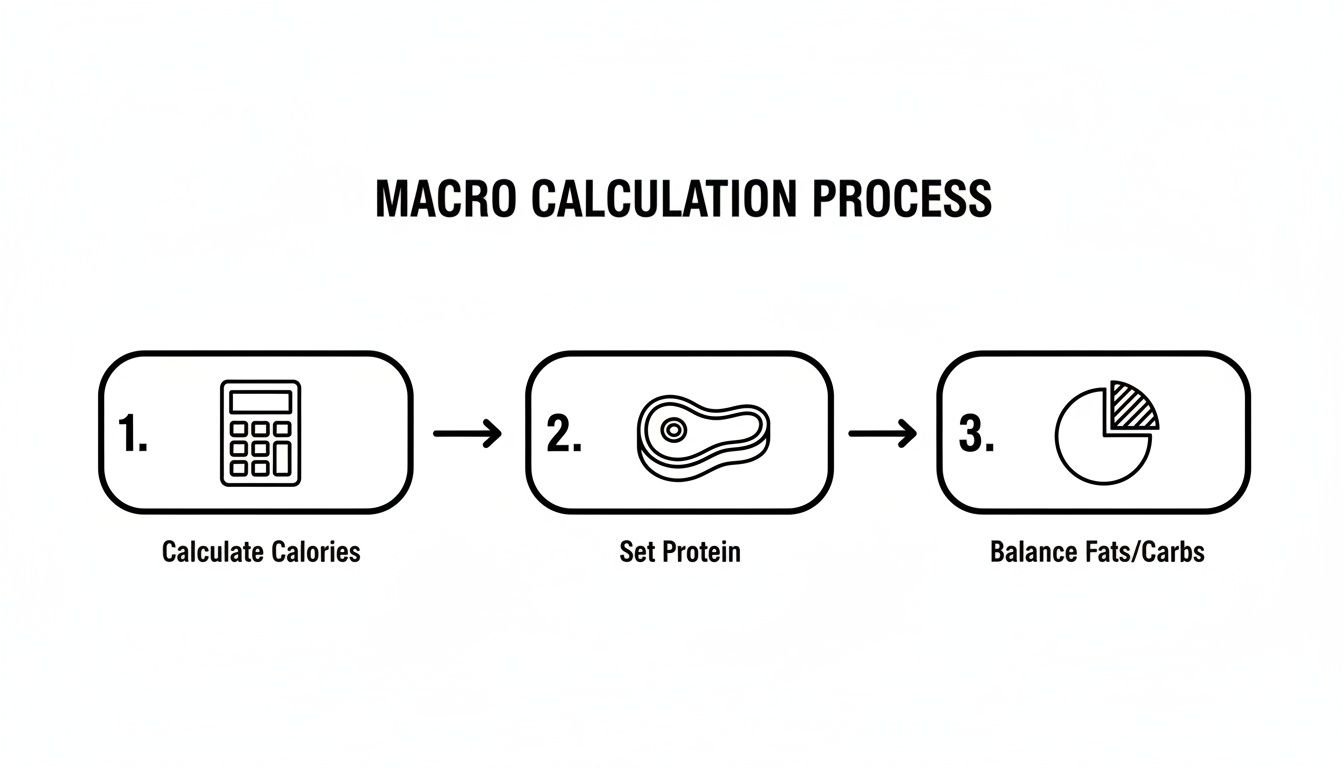
As you can see, mastering your macros is a logical flow, not some unsolvable puzzle. Everything starts with that first step: finding your personal calorie target.
Setting Your Calorie Starting Line for Fat Loss
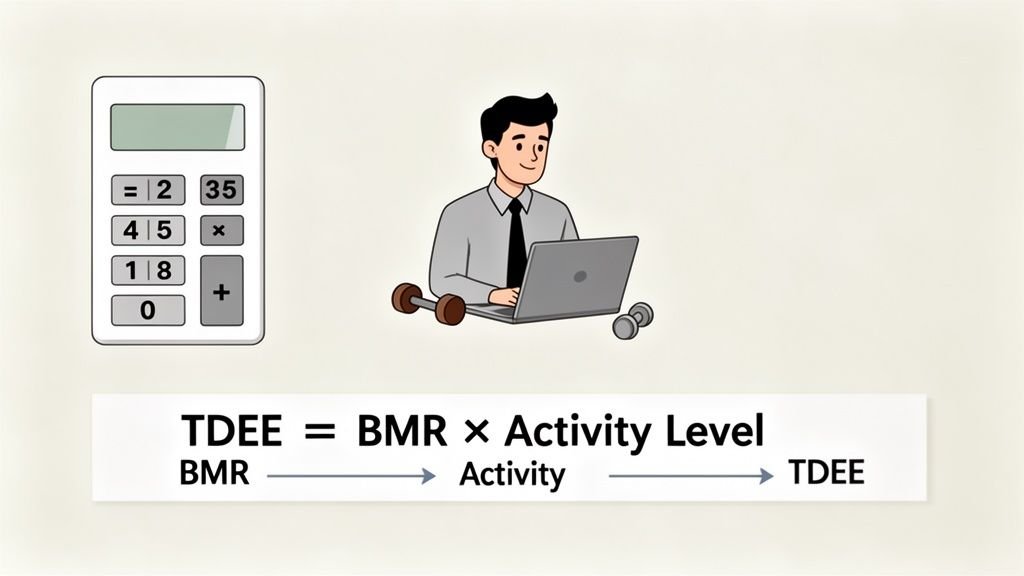
Before we can even begin to talk about macros, we have to figure out your calorie budget. It all starts with a concept called your Total Daily Energy Expenditure, or TDEE.
Think of it as your body's "maintenance mode." It’s a solid estimate of the total calories you burn in a day—from sleeping and breathing to walking the dog and crushing a workout. If you eat this many calories, your weight should, in theory, stay the same. To lose fat, we need to eat just a little bit less.
The most common and trusted way to get this number is by using the Mifflin-St Jeor equation to find your Basal Metabolic Rate (BMR), which is the energy you burn just by being alive. Then, we simply multiply that by a factor that reflects your daily activity.
Finding Your Maintenance Calories
Your BMR is a personal number, calculated using your sex, age, height, and weight. Once we have that, we just need an honest assessment of your activity level to find your TDEE.
Let's walk through this with a real-world example. We'll use "Sarah," who's a 35-year-old woman, stands at 5'7" (170 cm), and weighs 150 lbs (68 kg). She has a desk job but stays active by getting to the gym 3-5 times a week.
Here’s how her numbers break down:
- Her BMR Calculation: (10 x 68 kg) + (6.25 x 170 cm) – (5 x 35 years) – 161 = 1,407 calories
- Her Activity Multiplier: Since she's moderately active, we'll use a multiplier of 1.55.
- Her Estimated TDEE: 1,407 (BMR) x 1.55 (Activity) = 2,181 calories per day.
So, Sarah's body uses about 2,181 calories a day just to maintain her current weight. This is the crucial baseline we've been looking for.
A Word of Caution: Your TDEE is an educated guess, not gospel. It's a starting point. You'll need to watch your progress over a few weeks and adjust this number based on real-world results.
Creating a Deficit That Actually Works
Now that we have Sarah's maintenance number (2,181), it's time to set a deficit for fat loss. This is a critical step where a lot of people stumble. They get excited and slash their calories too aggressively, which is a recipe for burnout, muscle loss, and wild cravings.
The smarter play is a moderate, sustainable deficit. Subtracting 300-500 calories from your TDEE is the sweet spot. It’s enough to trigger steady fat loss—usually around 0.5 to 1 pound per week—without making you feel miserable.
Let’s apply this to Sarah:
- Starting TDEE: 2,181 calories
- A Smart Deficit: 2,181 – 400 = 1,781 calories
We can round this to a nice, even number. Her new daily target for weight loss is 1,800 calories. This deficit is small enough that it won't tank her energy or kill her gym performance.
If you're curious to learn more about the science behind this, we break it all down in our guide to creating an effective calorie deficit.
This 1,800-calorie target is the final piece of the puzzle. Now we have a budget, and we can finally start deciding how to spend it on protein, carbs, and fats.
Protein: Your Muscle-Sparing Secret Weapon
Alright, you’ve got your calorie goal. Now for the most important piece of the fat-loss puzzle: protein. Think of your calories as the speed limit for your weight loss journey. Protein is what ensures you don’t throw your hard-earned muscle out the window along the way.
Here’s the thing about being in a calorie deficit: your body is looking for energy, and it isn't particularly sentimental. It will happily break down muscle tissue for fuel right alongside body fat.
That's where a high-protein diet comes in. It acts as a big, flashing sign for your body that says, "Hands off the muscle!" This "muscle-sparing" effect is crucial because we want to lose fat, not just weight.
Why You Should Double Down on Protein
Focusing on protein does more than just protect muscle. For one, the more muscle you hold onto, the higher your metabolism stays, meaning you're burning more calories around the clock—even while resting.
Protein also has the highest Thermic Effect of Food (TEF). In simple terms, your body uses more energy to digest protein than it does for fats or carbs. It's a small but meaningful metabolic advantage you get with every high-protein meal.
This isn't just a hunch; it's a well-documented strategy when you calculate macros for weight loss. In fact, studies show that people who pair a high protein intake with consistent macro tracking lose 20-30% more weight over six months than those who just count calories. The data on this is incredibly compelling, as highlighted in resources like the World Obesity Atlas.
Nailing Down Your Daily Protein Number
So, how much do you actually need? A solid, evidence-backed rule of thumb for fat loss is 1.6 to 2.2 grams of protein per kilogram of body weight (that’s about 0.7 to 1.0 grams per pound).
Let's bring back our example, Sarah, who weighs 68 kg (150 lbs). We can find her ideal range pretty easily:
- Low End: 68 kg x 1.6 g/kg = 109 grams of protein
- High End: 68 kg x 2.2 g/kg = 150 grams of protein
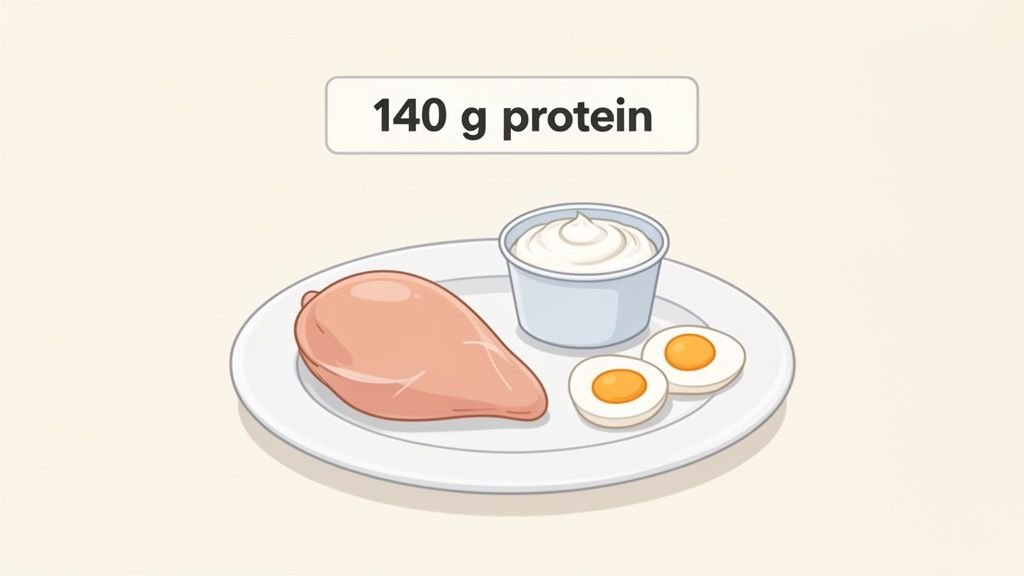
For Sarah, a fantastic target is right in the middle: around 140 grams of protein per day. This amount is the sweet spot—it delivers all the muscle-saving, appetite-crushing benefits without feeling impossible to hit.
My Pro Tip: Don't get hung up on hitting your protein goal to the exact gram. Think of it as a target range. If your goal is 140g, anything between 130g and 150g is a solid win. It's the consistency over days and weeks that truly drives results.
What Does 140 Grams of Protein Actually Look Like?
Numbers on a screen are one thing, but food on a plate is another. To make this real, here’s a totally achievable way Sarah could hit her 140-gram protein target:
- Breakfast: A cup of Greek yogurt with a scoop of protein powder swirled in (~45g protein)
- Lunch: A big, satisfying salad topped with 6 oz of grilled chicken breast (~50g protein)
- Snack: A couple of hard-boiled eggs and a small handful of almonds (~18g protein)
- Dinner: A 5 oz filet of salmon served with a side of roasted asparagus (~30g protein)
See? When you build each meal around a solid protein source, that 140-gram goal doesn't seem nearly as daunting. If you need more ideas, we've put together a ton of easy ways to increase your protein intake.
With our calorie and protein numbers locked in, we're ready to figure out the rest of our macro plan.
Tuning Your Energy: Setting Your Fat and Carb Intake
Alright, you’ve got your protein goal locked in. Now for the fun part—divvying up the rest of your calories between fats and carbohydrates. This is where the cookie-cutter advice ends and true personalization begins.
Forget the endless “good vs. bad” food debate. Both fats and carbs are your primary energy sources, and the way you balance them can make or break how you feel day-to-day. Getting this right is key to supporting hormone health, fueling great workouts, and making this whole process feel less like a diet and more like a high-performance plan.
Don't Fear the Fat
For years, we were all told that fat was the enemy. Thankfully, we've moved past the low-fat craze. Dietary fat is absolutely essential for your body to function correctly. It’s not just a backup fuel source; it's the raw material your body uses to produce critical hormones like testosterone and estrogen.
Slash your fat intake too low, and you're asking for trouble—it can tank your mood, libido, and overall sense of well-being. Fats also help you absorb certain vitamins (A, D, E, and K) and keep inflammation in check. So, no, we're not cutting them out.
As a solid starting point, aim to get 20-30% of your total daily calories from dietary fat. This is the sweet spot for most people, providing enough to keep your hormones happy without eating up too much of your calorie budget.
Let's go back to our friend Sarah and her 1,800-calorie goal. If she aims for a moderate 25% from fat, the math is straightforward:
- 1,800 calories x 0.25 = 450 calories from fat
- Since fat has 9 calories per gram: 450 / 9 = 50 grams of fat per day.
That gives her a clear target of 50g of fat, which she can get from sources like avocados, nuts, seeds, and olive oil.
Carbs: Your Performance Fuel
Now for the final piece of the puzzle. Whatever calories are left after you've accounted for protein and fat? Those are for carbohydrates. Think of carbs as your body's high-octane fuel—the go-to energy source for powering through a tough workout or just staying sharp at work.
It’s tempting to slash carbs to almost nothing when you’re trying to lose weight. While a lower-carb approach can certainly work for some, completely ditching them often leaves people feeling exhausted, foggy-headed, and weak in the gym. That's a recipe for quitting.
For Sarah, we just need to fill in the blank:
- Total Calories: 1,800
- Calories from Protein: 140g x 4 cal/g = 560
- Calories from Fat: 50g x 9 cal/g = 450
- Remaining Calories for Carbs: 1,800 – 560 – 450 = 790 calories
- Grams of Carbs: 790 calories / 4 cal/g = 197.5 grams (we can round that to a clean 200g)
And there it is. Sarah’s starting macro plan is 140g Protein / 50g Fat / 200g Carbs.
Finding the Macro Split That Works for You
The breakdown we just created for Sarah is a fantastic, balanced starting point. It’s pretty close to a 40/30/30 split (carbs/protein/fat), which works well for a lot of people. But here's the most important secret: the best macro split is the one you actually enjoy and can stick with consistently.
Some people feel incredible and crush their workouts with more carbs. Others find that a higher fat intake keeps them feeling full and satisfied for longer. I've coached fitness enthusiasts who saw amazing progress on a plan with around 2g of protein per kg of bodyweight plus plenty of carbs to fuel performance. As some meta-analyses show, this kind of dedicated approach can lead to significant fat loss over time. You can dig into some of that research on macro splits and their effectiveness on PubMed.
Don't be afraid to treat your starting numbers as a baseline. Live with them for a couple of weeks, see how you feel, and then tweak them to better suit your body and your life.
Bringing Your Numbers to Life with Smart Tracking
So, you’ve done the math. You have your calorie target, your protein goal is set, and you know how your fats and carbs should balance out. You have a solid plan on paper. But here’s the thing I’ve seen time and again: a plan is only as good as your ability to stick with it. This is where the real work—and the real results—begin.
Let’s get one thing straight. Consistency will always, always beat perfection. You don’t need to nail your numbers to the gram every single day. What you do need is a tracking process that’s so simple it becomes second nature. If it’s not easy, you won’t do it for long.
Forget the old-school way of logging food. No more spending your lunch break scrolling through endless food databases, manually adding every last ingredient, or scanning a mountain of barcodes. That friction is exactly why most people give up. It’s time to track smarter, not harder.
Make Daily Tracking Feel Effortless
This is where modern tools have been a complete game-changer. An app like PlateBird, for example, was built specifically to remove all that annoying friction that makes tracking feel like a chore. Logging a meal shouldn't be a five-minute ordeal; it can be as quick as sending a text.
You can just type what you ate—say, ‘chicken rice broccoli’—and let the app's AI do the heavy lifting. It instantly breaks down the meal into calories and macros for you. This simple, natural language input can turn a tedious task into a ten-second habit.
Here’s a look at how seamless that can be.
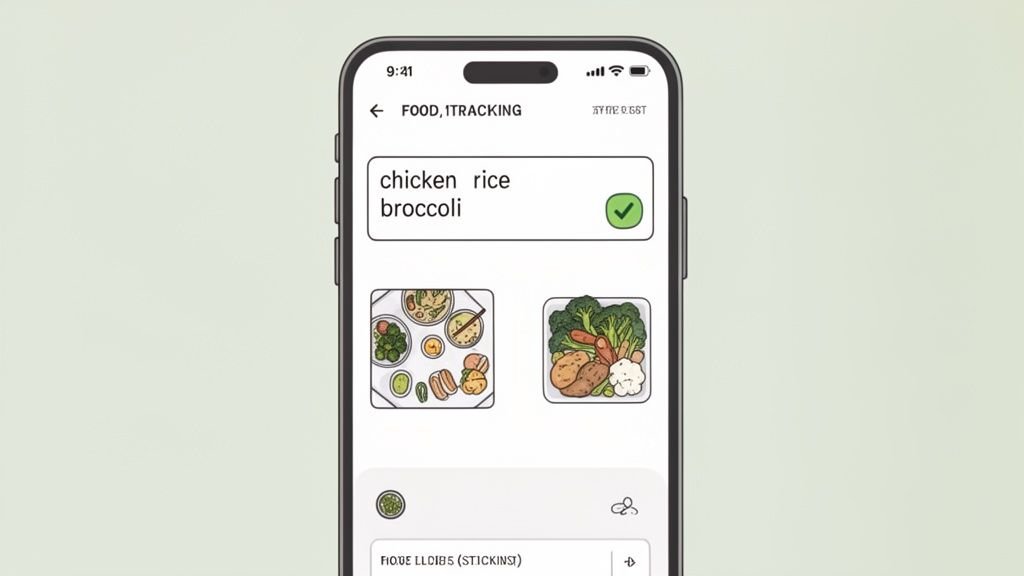
If you’re more of a visual person, you can just snap a picture of your plate. The tech in PlateBird can identify what’s on it and give you a solid nutritional estimate before you even pick up your fork.
This is the key difference. When you move from clunky, manual searching to quick, intuitive logging, you free up your mental energy to focus on your food choices, not on mind-numbing data entry.
Making Smart Adjustments When Progress Stalls
No matter how perfectly you calculate macros for weight loss from the get-go, your body is a master of adaptation. The numbers that delivered great results for the first four weeks might not do the trick in the next four. When you inevitably hit a weight loss plateau—meaning the scale hasn't moved for two weeks or more—don't panic. It's not a sign you've failed; it's just a signal that it's time to make a small, strategic adjustment.
There’s absolutely no need for drastic cuts. The simplest and most effective first move is to slightly reduce your daily calories by about 100-150. You can easily do this by trimming a bit from your daily carbs or fats while keeping that all-important protein goal locked in.
Here’s the process I recommend to my clients:
- Be Consistent First: Keep tracking your weight, measurements, and progress photos weekly. Data is your best friend.
- Wait for a Real Plateau: Don't react to normal day-to-day weight swings. Only consider a change after 2-3 weeks of zero progress.
- Make One Small Tweak: Try reducing your daily carbs by 15-20g or your fats by 5-7g. Pick one, not both.
- Re-Evaluate: Give the new numbers a few weeks to work their magic before you even think about making another change.
This methodical approach keeps you moving forward without the frustration of feeling stuck. To stay on top of your plan and progress, using a reliable macro calculator for weight loss can give you the precision you need. And if you’re looking to go even deeper on this, don't miss our complete guide on https://platebird.com/how-to-count-macros/.
Common Questions About Macro Tracking Answered
Once you have your starting numbers, the real learning begins. It’s one thing to have a plan on paper, but it's another thing entirely to apply it to the beautiful mess of real life. Let's walk through some of the most common hurdles I see people face when they first start to calculate macros for weight loss.
Do I Need to Hit My Macros Perfectly Every Day?
Let me be perfectly clear: absolutely not. Chasing perfection is the fastest way to burn out.
Think of your macro targets as a destination in your GPS. The goal is to get close, not to land on the exact square inch of pavement. I always tell my clients to aim for a range—getting within 5-10 grams of your protein and fat goals is a huge win.
Carbohydrates are your most flexible lever. They’re there to fill in the rest of your calories for the day. If you go a little over on carbs but nail your protein and stay within your calorie goal, you’re doing great. What truly matters is your weekly average. One "off" day doesn't sink the ship.
Perfection is the enemy of progress. A "good enough" day that's tracked is far more valuable than a "perfect" day that never happens. It's about building a sustainable habit, not achieving a flawless log.
How Do I Track Macros When Eating Out?
Ah, the classic dilemma. The good news is that a social life and your fitness goals can absolutely coexist. Eating out doesn't have to be a black hole for your tracking.
Your food tracking app is your best friend here. Most apps, including PlateBird, have massive databases of restaurant meals. Can't find your exact seared salmon with quinoa? Just find a similar entry from another restaurant and use that as your estimate. It’s far better than logging nothing at all.
Here’s a pro tip: do a little recon. Look up the menu online before you go. This lets you make a calm, informed choice instead of a rushed, hungry one. Spot a meal built around lean protein and veggies, make your best guess when you log it, and then put your phone away and enjoy the company.
How Often Should I Adjust My Numbers?
This is where patience becomes a superpower. You have to give your body time to respond to the new plan. Stick with your starting macros for at least 2-4 weeks before even thinking about making a change.
Your body weight will fluctuate daily for a million reasons—water, salt, stress. That's normal. A true plateau is when your average weight hasn't budged for two or more weeks.
If you hit that point, it’s time for a small, strategic adjustment. The simplest first move? Drop your daily calories by 100-200, which you'll typically do by trimming a bit from your carbs or fats. Always keep that protein target high to protect muscle mass.
Ready to stop guessing and start tracking with effortless precision? PlateBird turns logging into a simple, two-second task. Just type what you ate or snap a picture, and let our AI do the rest. Download PlateBird for free on iOS and start hitting your goals faster. Get started with PlateBird today.