If you’re anything like me, you’ve probably been down the rabbit hole of calorie counting. You know the drill: weighing every almond, logging every bite, and feeling like your entire day revolves around a food-tracking app. It’s exhausting.
I spent years trapped in that cycle. I tried everything—low-carb, low-fat, you name it—and nothing ever felt sustainable. It was all a stressful math problem I could never quite solve. Then, I found a much simpler, more intuitive way to think about food, and it completely changed the game for me.
The Secret to Weight Loss Is Already on Your Plate
The answer wasn’t in an app or a complicated diet plan. It was right there on my dinner plate.
I’m talking about the plate method. It’s a straightforward visual strategy that’s less about obsessive tracking and more about building a balanced meal. You simply divide your plate into three sections, no measuring cups required.
Here’s the breakdown:
- Fill half your plate with non-starchy vegetables.
- Dedicate one quarter to a source of lean protein.
- Use the final quarter for complex carbohydrates.
This isn’t just a neat trick; it’s a strategy backed by solid science. Loading up on high-volume, low-calorie vegetables is the key. A 2022 review in the journal Nutrients found that using portion-control plates led to significant weight loss, with one study showing participants kept the weight off for three months. Why? Because filling half your plate with veggies adds fiber and bulk, which helps you feel full on far fewer calories.
Before we dive into building your own, let’s look at a simple blueprint. This table breaks down exactly what should go on your plate and why each component is so important for hitting your goals.
The Ideal Weight Loss Plate Blueprint
A quick visual guide to the recommended plate proportions for effective weight management, highlighting the role of each food group.
| Plate Section | Proportion | Food Group Examples | Primary Role |
|---|---|---|---|
| Vegetables | 50% (Half) | Broccoli, spinach, bell peppers, zucchini, leafy greens | Fills you up with fiber and nutrients for very few calories, creating volume and satiety. |
| Protein | 25% (Quarter) | Chicken breast, fish, tofu, beans, Greek yogurt | Builds and repairs muscle, boosts metabolism, and keeps you feeling full longer, reducing cravings. |
| Carbs | 25% (Quarter) | Quinoa, sweet potatoes, brown rice, whole-wheat pasta | Provides sustained energy for your workouts and daily activities, preventing crashes and fatigue. |
| Fats | (Added on top) | Avocado, olive oil, nuts, seeds | Supports hormone function and vitamin absorption. Use sparingly (e.g., a thumb-sized portion or a drizzle). |
This framework isn't about perfection; it's a flexible guide that works for real life. It helps you build satisfying meals that naturally support your weight loss journey without the mental gymnastics of constant counting.
The real beauty of this method is it naturally creates a calorie deficit without you having to count a single calorie. This simple shift in focus—from what you can't eat to how much good stuff you can pile on your plate—makes all the difference.
This visual approach freed me from the anxiety of tracking every morsel. It made healthy eating feel effortless and sustainable, whether I was cooking at home or eating out. It’s not a diet; it’s a blueprint for a healthier relationship with food.
Building Your Perfect Plate for Any Meal
Let's get practical. Moving from the idea of a balanced plate to actually eating one doesn't have to be complicated. The goal is to make this feel second nature, not like you're solving a math problem at every meal. It's about building a visual template in your head that you can use anywhere, anytime.
The first move, and honestly the most important one, is to mentally draw a line down the middle of your plate. Fill one entire side—that's half of your plate—with non-starchy vegetables. This is your foundation. We're talking about high-volume, low-calorie powerhouses that fill you up with fiber and nutrients. Go wild with spinach, load up on broccoli, throw in some colorful bell peppers, or build a massive salad. This single habit is the secret sauce to making plate proportions work for weight loss.
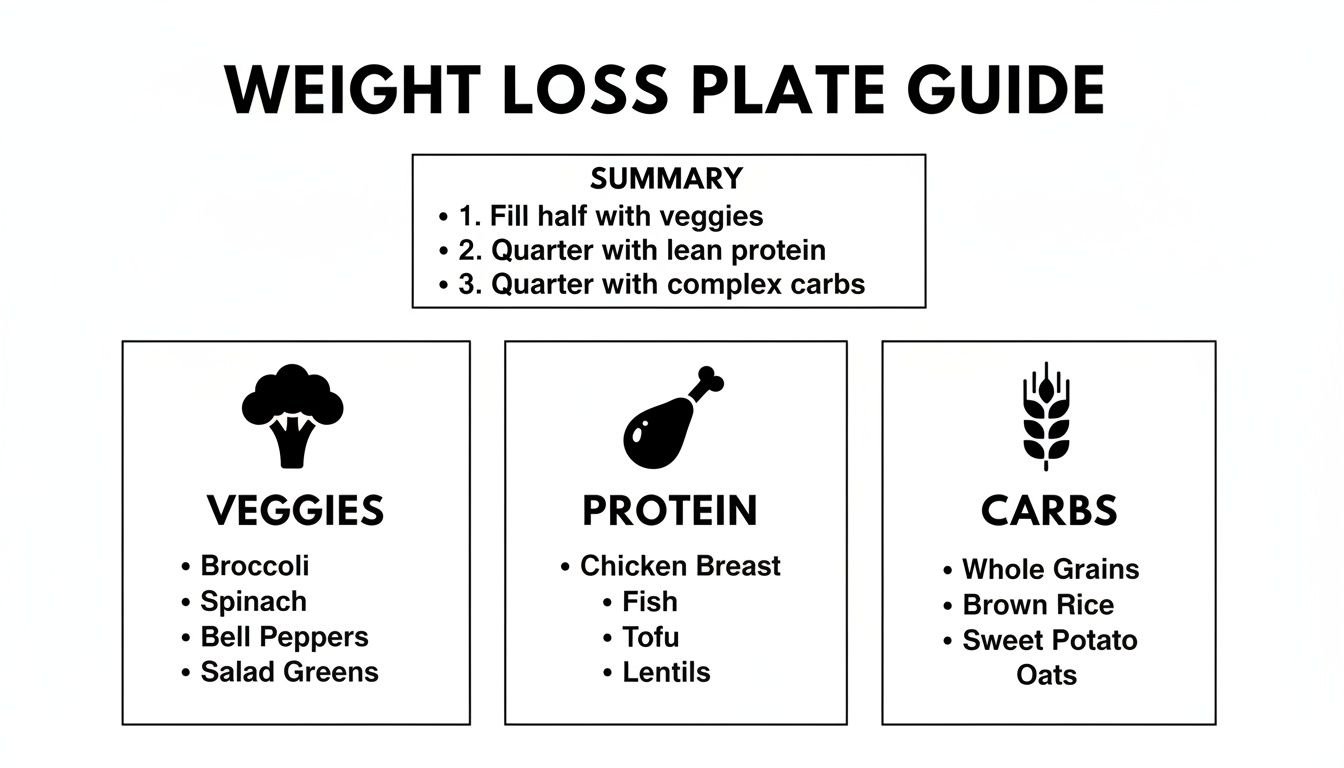
As you can see, loading up on veggies is what makes this whole approach so effective. It creates a satisfying, filling meal without packing in excess calories.
Assembling Your Protein and Carbs
With half your plate looking green and gorgeous, you’ve got two empty quarters left to fill.
One of those quarters is reserved for lean protein. This is what's going to keep you feeling full and satisfied for hours, which is a game-changer for avoiding afternoon snack attacks. Protein is also essential for holding onto muscle while you lose fat. Think grilled chicken, baked salmon, tofu, or a solid scoop of lentils. Having pre-cooked protein on hand makes this a no-brainer; we've got some great high-protein meal prep ideas if you need inspiration.
That leaves the final quarter of your plate for complex carbohydrates. These are your body's preferred fuel source. You want to choose carbs that are packed with fiber and release energy slowly, like quinoa, sweet potatoes, brown rice, or whole-wheat pasta. This gives you steady energy instead of the quick spike and crash you get from more processed carbs.
Remember: Don't forget healthy fats! They aren't a main section of the plate but are added as a "garnish." This could be a drizzle of olive oil on your veggies, a few slices of avocado, or a sprinkle of nuts or seeds. A portion is typically about the size of your thumb.
Practical Tips for Real Life
This all sounds great in your own kitchen, but what about when you're out in the wild? At a restaurant, a friend's house, or a work lunch? The key is learning to eyeball your portions without a scale or measuring cup in sight.
Luckily, you have a perfect portioning tool attached to your arm. Your hand is a surprisingly accurate and discreet guide.
- Protein: A portion about the size of your palm is a good target for lean protein (around 3-4 ounces).
- Carbs: Use a cupped hand to estimate your serving of complex carbs.
- Fats: Your thumb (from the tip to the knuckle) is a great way to measure a serving of dense fats like nut butter or oils.
Using your hand as a guide takes the stress out of eating out. When your plate arrives, you can do a quick mental check. If that side of fries is taking up half the plate, don't be afraid to ask for a side salad or steamed veggies instead. It's not about being restrictive; it's about making smart, simple swaps that keep you on track.
How Your Plate Size Secretly Impacts Your Success
We spend so much time obsessing over what goes on our plates, but we often miss a crucial part of the puzzle: the plate itself. This isn't just about food; it's about the subtle psychology of how we see our meals.
Your brain can play some funny tricks on you, especially when it comes to food. Have you heard of the Delboeuf illusion? It’s a fascinating visual trick where the exact same amount of food looks tiny on a large plate but feels generous and plentiful on a smaller one. Understanding the impact of large plates is a complete game-changer.
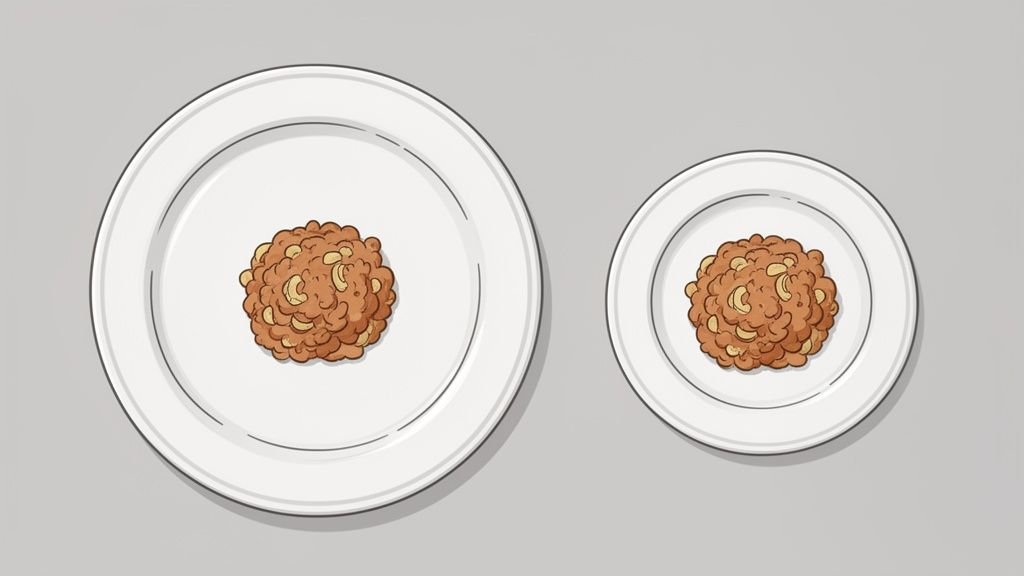
I had a personal lightbulb moment with this a few years ago. I was serving dinner and noticed my standard 12-inch dinner plates were basically serving platters. I was unconsciously piling on more food just to make the plate look full.
The 9-Inch Plate Revelation
That very week, I went out and bought a set of 9-inch plates—what you might call a salad or luncheon plate. The difference was staggering. Suddenly, a perfectly portioned meal looked huge. That quarter-plate of chicken and quarter-plate of quinoa no longer looked lonely; they looked just right.
The most surprising part was the mental shift. I didn't feel like I was dieting or restricting myself at all. My brain registered a "full plate," so I felt satisfied and wasn't tempted to go back for seconds or start grazing an hour later.
And this isn't just my experience. The science is solid. A 2017 study in Obesity Science & Practice found that using smaller plates seriously boosted feelings of fullness. In fact, researchers in the UK calculated that adults could slash their daily intake by up to 279 calories just by making this one simple swap.
By simply changing your dishware, you trick your brain into feeling satisfied with less food. This one change can effortlessly remove hundreds of calories from your day, accelerating your progress on plate proportions for weight loss without feeling like you're sacrificing a thing.
Think about what that really means. Dropping nearly 280 calories a day can lead to almost a pound of weight loss every two weeks—with zero other changes to your diet.
- 12-inch plates are notorious for causing "portion distortion," making normal servings look skimpy.
- 9-inch plates reframe your perception, turning healthy portions into a satisfying, substantial meal.
This is the hidden magic of managing your environment instead of relying on pure willpower. You’re making the right choice the easy choice. It's a simple, passive strategy that works for you meal after meal.
Tracking Your Plate Proportions the Modern Way
Building your plate with the right proportions is an amazing skill. But let's be real—some days you look down at your meal and think, "Is that really a quarter of my plate?" or "Did I eyeball that chicken portion right?" This is where a little bit of tech can make all the difference, turning your good intentions into solid, repeatable results.
While the visual plate method is fantastic for building intuition, using a food tracking app is like having a coach in your corner. It’s the tool that confirms your estimates are on point and gives you the hard data you need to fine-tune your approach. It bridges the gap between guessing and knowing.
Making Tracking Feel Effortless
Forget the tedious old days of scrolling through endless databases for "chicken breast, boneless, skinless, grilled." Modern apps have completely changed the game. Imagine you’ve just made a beautiful plate of salmon, roasted asparagus, and quinoa. Instead of a ten-minute data entry chore, you just reach for your phone.
The goal is to make logging less of a hassle and more of a quick, insightful check-in. In fact, some of the best macro tracking apps now use photo recognition. You just snap a picture of your plate, and the app does the heavy lifting.
Take a look at how PlateBird's photo logging analyzes a meal in seconds.
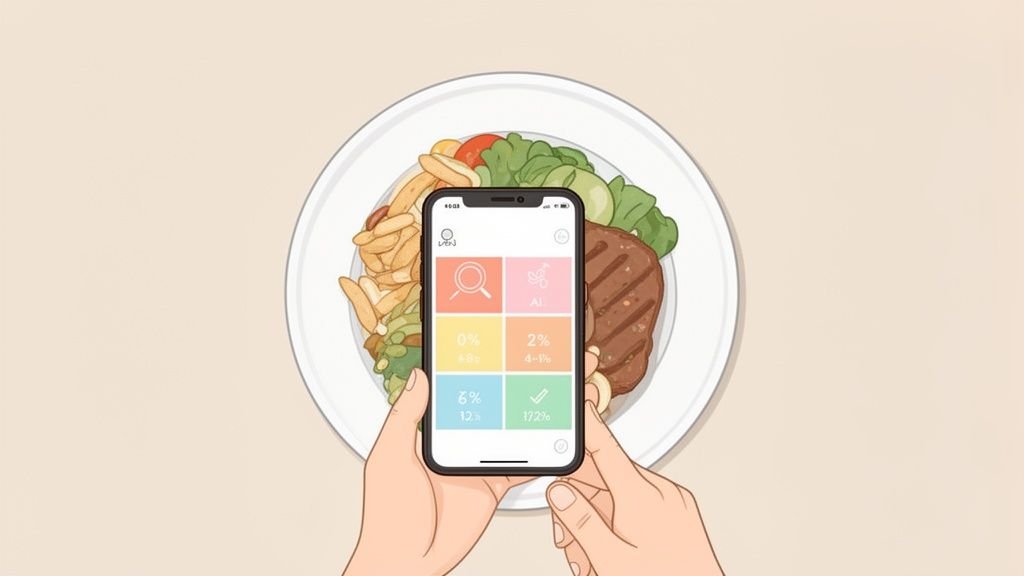
Here, the app’s AI instantly identifies the steak, the fries, and the side salad, giving you a full nutritional breakdown. It’s the perfect reality check to see if your visual estimate of plate proportions for weight loss actually lines up with your calorie and macro targets for the day.
From Photo to Insight in Seconds
This gives you immediate, actionable feedback. Looking at the example above, you’d instantly see the protein from the steak, the carbs from the fries, and the nutrients from the salad. It empowers you to make smarter adjustments on the fly. Maybe you notice the fries account for more calories than you expected—so next time, you might swap half of them for extra greens.
This isn’t about being perfect. It’s about building awareness. Using an app to double-check your meals, even just a few times a week, will dramatically sharpen your portion-estimating skills for good.
I tell my clients to think of it as a spot-check. Use the visual plate method as your daily guide, and an app like PlateBird as your trusted advisor to confirm you're on track, especially when you hit a frustrating plateau.
More Than Just Photos
Beyond slick photo recognition, sometimes the fastest way to log is to just type. With smart apps, you don't even have to be formal. Typing something as simple as "salmon asparagus quinoa" is all it takes for the AI to understand your meal and calculate everything for you.
This modern approach really helps lock in your new habits.
- It's Fast: You can log an entire day's worth of food in under a minute with quick text or a photo.
- It's Accurate: You get precise data that either confirms your visual portions are working or shows you where to adjust.
- It Builds Habits: The app learns your favorite meals over time, creating one-tap shortcuts for your go-to breakfast or that salad you always make for lunch.
When you combine the freedom of the visual plate method with these quick tech check-ins, you create a powerful system that’s actually sustainable. It’s the best of both worlds—the simplicity of eating by eye, with the data-backed confidence of having a personal nutritionist right in your pocket.
Making Your Plate Work for You: Fitness, Plateaus, and Real Life
Your body is anything but static, so why should your plate be? I've seen it countless times: someone starts crushing their workouts, feels amazing, but then hits a wall of fatigue. They're still eating the same "diet" plate, not realizing their body is screaming for more fuel.
This is also how the dreaded weight loss plateau happens. The scale just stops moving. It’s frustrating, but it’s not a sign of failure. It's simply your body's way of telling you it's time to make a strategic change. This is a totally normal part of the journey, and a simple adjustment is often all you need to get things moving again.
Fueling for Fitness, Not Just Fat Loss
When you ramp up your activity—whether you're training for a 5K or just adding an extra gym day—your energy needs shift. Your standard weight loss plate might not cut it anymore. We need to think more like an athlete, even if we don't feel like one yet.
This is where you can start adjusting your plate based on your day's demands:
- Easy or Rest Days: Stick with the classic formula: 50% vegetables, 25% lean protein, and 25% quality carbs. This is your foundation for light activity and recovery.
- Moderate Training Days: After a solid hour-long workout, you need to refuel. Shift your plate to roughly one-third protein, one-third carbs, and one-third vegetables. This gives you a bigger dose of energy for muscle repair and performance.
- Hard Training Days or Long Runs: On days with two-a-day workouts or a really long run, carbs become your best friend. Your plate should look closer to 50% carbs, 25% protein, and 25% vegetables to fully replenish your energy stores.
This isn't about throwing your diet out the window; it's about intelligently giving your body exactly what it needs to perform and recover.
How to Break Through a Weight Loss Plateau
Hitting a plateau is your body's clever way of saying it has adapted to your current routine. It’s become more efficient. Now, you need to gently shake things up.
My first piece of advice is always this: don't immediately slash your calories. Before you do anything drastic, take an honest look at your portions. Has that "quarter plate" of rice slowly crept into a third of the plate? Use a tool like PlateBird to do a quick visual check-in. You might be surprised by a little "portion creep."
If your portions are genuinely on point, try a subtle shift. Slightly shrink your carbohydrate section and fill that new space with more non-starchy vegetables. This simple swap reduces your overall calories and boosts your fiber and nutrient intake, all without making you feel deprived.
Of course, the real test comes when you're not in your own kitchen. At a restaurant, a party, or a potluck, just take a second to mentally deconstruct the meal. Find the protein, spot the carbs, and load up on the veggies first. Knowing how to eat healthy while traveling or navigating social events is what turns this method from a short-term diet into a skill you can use for life.
Navigating the Plate Method: Your Questions Answered
Even the best-laid plans can hit a few snags in the real world. When you’re shaking up years of eating habits, it’s completely normal to have questions. Let's walk through some of the most common hurdles people run into when they first start building their plates for weight loss.
One of the biggest concerns I hear is, "What if I'm still hungry after I finish my plate?" This is a classic, especially in those first couple of weeks as your body and hunger cues recalibrate.
My go-to solution is simple: double down on your non-starchy vegetables. They’re packed with fiber and water, which literally fills up your stomach and sends those all-important "I'm full" signals to your brain. If you've cleaned your plate and still feel that gnawing hunger, go for another helping of roasted broccoli or a big handful of salad—not more chicken or potatoes.
What About Casseroles and Mixed Meals?
It’s one thing to portion out a chicken breast, some quinoa, and a pile of greens. But what happens when it’s all mixed together in a stew, a pasta bake, or a casserole? You just have to learn to see the components.
When you're cooking a mixed dish, think about the ingredients going in. A great chili, for example, would break down like this:
- Protein: Lean ground turkey or a mix of beans (making up about a quarter of the bulk)
- Vegetables: Heaps of onions, bell peppers, and tomatoes (aiming for half the pot)
- Carbohydrates: A small amount of beans, or serving it over a scoop of quinoa (the final quarter)
When you go to serve yourself, eyeball the scoop to get that same balance. Here's my favorite trick: serve the casserole or stew over a fresh bed of spinach or with a massive side salad. That way, you’re always guaranteeing you hit that crucial 50% veggie mark.
Can This Really Work Without Counting Calories?
Yes, absolutely! In fact, that’s the whole point. The plate method is a visual, intuitive way to manage your intake without getting bogged down in numbers. By loading up on low-calorie, high-volume veggies and being mindful of your portions for denser foods, you create a calorie deficit almost by accident.
For so many people, this is the key to finally ditching diet obsession and rebuilding a healthier relationship with food.
The plate method’s real power is its simplicity. It teaches you to build a satisfying meal that aligns with your weight loss goals, no math required. It shifts the focus from restriction to abundance.
That said, if you feel like you've hit a plateau, using an app to check in once in a while can be a great way to fine-tune your portion-estimating skills. It keeps you honest.
Is the Plate Method Good for Vegans or Vegetarians?
It’s a fantastic fit for plant-based eating. The core principle doesn’t change at all: half your plate is still non-starchy vegetables, and a quarter is still your complex carbs.
The only switch is your protein source. For that quarter of your plate, you’ll lean on plant-based powerhouses:
- Tofu and tempeh
- Lentils and chickpeas
- Edamame and black beans
Just be sure to mix up your protein sources to get the full spectrum of amino acids. A classic meal of rice and beans, served with a big side of fajita-style peppers and onions, fits this framework perfectly.
Ready to stop guessing and start seeing real results? You can take all the guesswork out of your plate proportions with PlateBird. Just snap a photo of your meal, and our AI gives you an instant breakdown of your calories and macros, making sure your visual estimates are spot-on. Download it for free and start tracking smarter today.