- A Quick Reference Guide to Protein Quality
- Understanding PDCAAS and DIAAS Scores
- Your Go-To Guide for Animal-Based Protein Quality
- The Complete Plant-Based Protein Quality Chart
- Applying the Protein Quality Chart to Your Goals
- Exploring Protein Market and Quality Trends
- Frequently Asked Questions About Protein Quality
Ever wonder why 25 grams of protein from a chicken breast seems to do more for you than 25 grams from beans? It's not just in your head. The real story isn't just about the total grams on a nutrition label; it's about protein quality—how efficiently your body can actually absorb and use what you eat.
Figuring this out is the key to truly dialing in your nutrition, whether you're trying to build muscle, manage your weight, or just eat a more balanced diet.
A Quick Reference Guide to Protein Quality
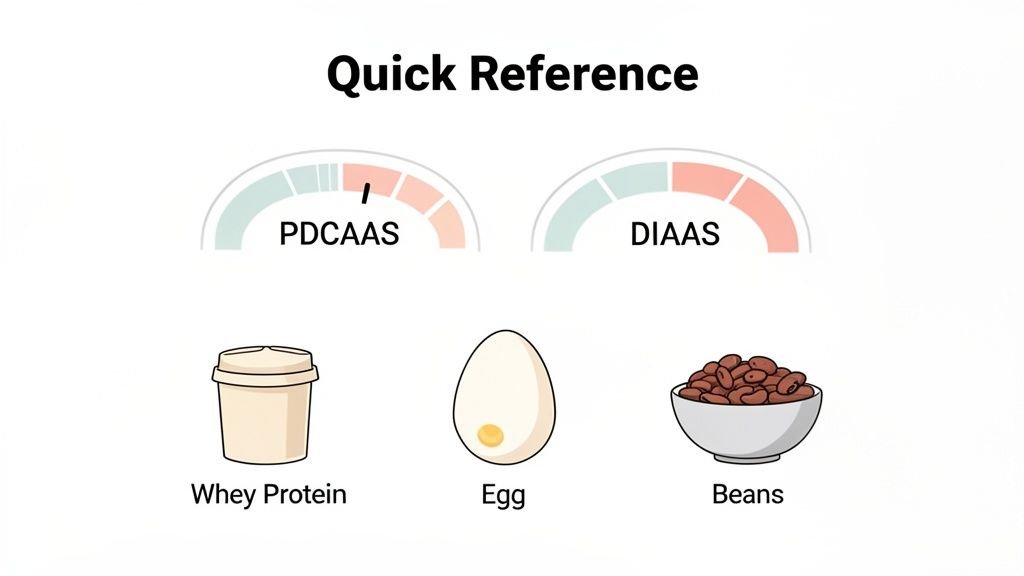
Think of a protein quality chart as your personal decoder ring for nutrition labels. It cuts through the noise and gives you a simple score that tells you what you're really getting. Before we dive into the full chart, let's quickly break down what actually makes a protein source "high-quality."
The Two Pillars of Protein Quality
When scientists rank proteins, they're really looking at two critical factors: the amino acid lineup and how well we can digest it.
Amino Acid Profile: Proteins are built from 20 different amino acids. Our bodies can make most of them, but there are nine essential amino acids we absolutely must get from our food. A "complete" protein is one that delivers all nine of these in the right amounts.
Digestibility: This is simply a measure of how much of a protein your body can break down and absorb. If your body can't access it, it can't use it.
This is why sources like whey, casein, and eggs are often called the gold standard—they tick both boxes with flying colors, offering a complete amino acid profile and excellent digestibility. In the sections to come, we’ll get into the specific scoring systems (PDCAAS and DIAAS) that measure all this.
To help you get started, here’s a quick-reference table that shows the approximate PDCAAS scores for some of the most common protein sources you’ll encounter.
Protein Quality at a Glance
| Protein Source | Category | PDCAAS Score (Approx.) | Good For |
|---|---|---|---|
| Whey Protein Isolate | Animal/Dairy | 1.0 | Post-workout recovery, muscle building |
| Casein | Animal/Dairy | 1.0 | Sustained protein release (e.g., before bed) |
| Egg (Whole) | Animal | 1.0 | Everyday meals, balanced nutrition |
| Soy Protein Isolate | Plant-Based | 1.0 | Vegans, muscle building, general health |
| Chicken Breast | Animal | 0.98 | Lean protein for meals, weight management |
| Beef | Animal | 0.92 | Muscle mass, iron source |
| Lentils | Plant-Based | 0.78 | Vegans, fiber, combining with other proteins |
| Kidney Beans | Plant-Based | 0.68 | Plant-based meals, fiber, pairing with grains |
This table gives you a snapshot, but understanding how to combine these foods is where the magic happens. For example, pairing beans with rice creates a complete protein, overcoming the lower score of beans alone.
Knowing these scores helps you get more from every gram of protein you consume. Applying this knowledge is crucial for effective meal planning, a topic we cover in detail in our guide to high protein meal prep. This is vital information for everyone, from an athlete looking to maximize performance to a vegan who needs to be strategic about their food choices.
Understanding PDCAAS and DIAAS Scores
You’ve probably heard that not all protein is created equal, but how do we actually measure that difference? For years, the global standard for grading protein quality was the Protein Digestibility Corrected Amino Acid Score (PDCAAS), a method the World Health Organization adopted back in 1993.
PDCAAS essentially looks at two things: a protein's amino acid profile and how much of it your body can digest. The final score, presented on a scale from 0 to a perfect 1.0, gave us a reliable way to rank different protein sources for a long time.
But here's the catch with PDCAAS: it has a ceiling. The score is capped at 1.0, meaning even exceptionally high-quality proteins can't score any higher. As a result, fantastic sources like whey, casein, and egg protein all get stuck with the same perfect score, making it impossible to see if one is actually superior to another.
The Evolution to DIAAS
To get a clearer picture, scientists developed a more precise method: the Digestible Indispensable Amino Acid Score (DIAAS). This is where things get really interesting. While PDCAAS measures digestibility across the entire digestive system, DIAAS zooms in on the small intestine—the exact place where amino acids are absorbed into your bloodstream.
This distinction is crucial because it gives us a much truer measure of a protein's bioavailability, or how much of it your body can genuinely put to work.
The biggest upgrade with DIAAS is that the scores are not capped. A protein can score above 1.0, which shows it delivers more than 100% of the essential amino acids your body needs per gram.
Take whey protein, for example. It gets a 1.0 on the PDCAAS scale, but its DIAAS score is 1.09. That single number tells you it isn't just "perfect"—it's exceptional.
What the Scores Mean for You
Knowing the difference between these two scoring systems helps you make much smarter decisions when looking at a protein quality chart.
PDCAAS: Think of this as a great starting point. Anything with a score near 1.0 is an excellent, complete protein source. It’s a reliable, if not perfectly nuanced, metric.
DIAAS: This is the high-definition version. It's especially valuable for athletes or anyone with high protein demands who needs to optimize every gram for muscle repair and growth.
For instance, chickpeas have a very respectable DIAAS of 0.83. This tells us they are a good plant-based protein, but they don't quite provide all the essential amino acids in the ideal ratios. On the other hand, milk protein boasts a DIAAS of 1.18, highlighting its superior quality. This kind of detail is what empowers you to build a better diet, whether you're meticulously planning your meals or just logging a quick snack in PlateBird.
Your Go-To Guide for Animal-Based Protein Quality
If you've spent any time focusing on fitness, you know that animal-based proteins are the heavy hitters. It's not just gym lore; the science is clear. These proteins deliver the complete package of essential amino acids our bodies need, and they're incredibly easy for us to digest and put to work.
That efficiency is why animal proteins are at the top of the food chain, so to speak. They command the largest slice of a global protein market valued at a staggering USD 52.26 billion in 2024. Their high scores on quality metrics like PDCAAS and DIAAS are the reason. With whey protein hitting a DIAAS of 1.09 and lean beef at 0.92, they consistently deliver more usable protein than most plant-based alternatives. For a deeper dive into the numbers behind the industry, this protein market analysis from SkyQuest is a fascinating read.
The chart below gives you a quick visual on how these scoring systems can tell different stories about the same food.
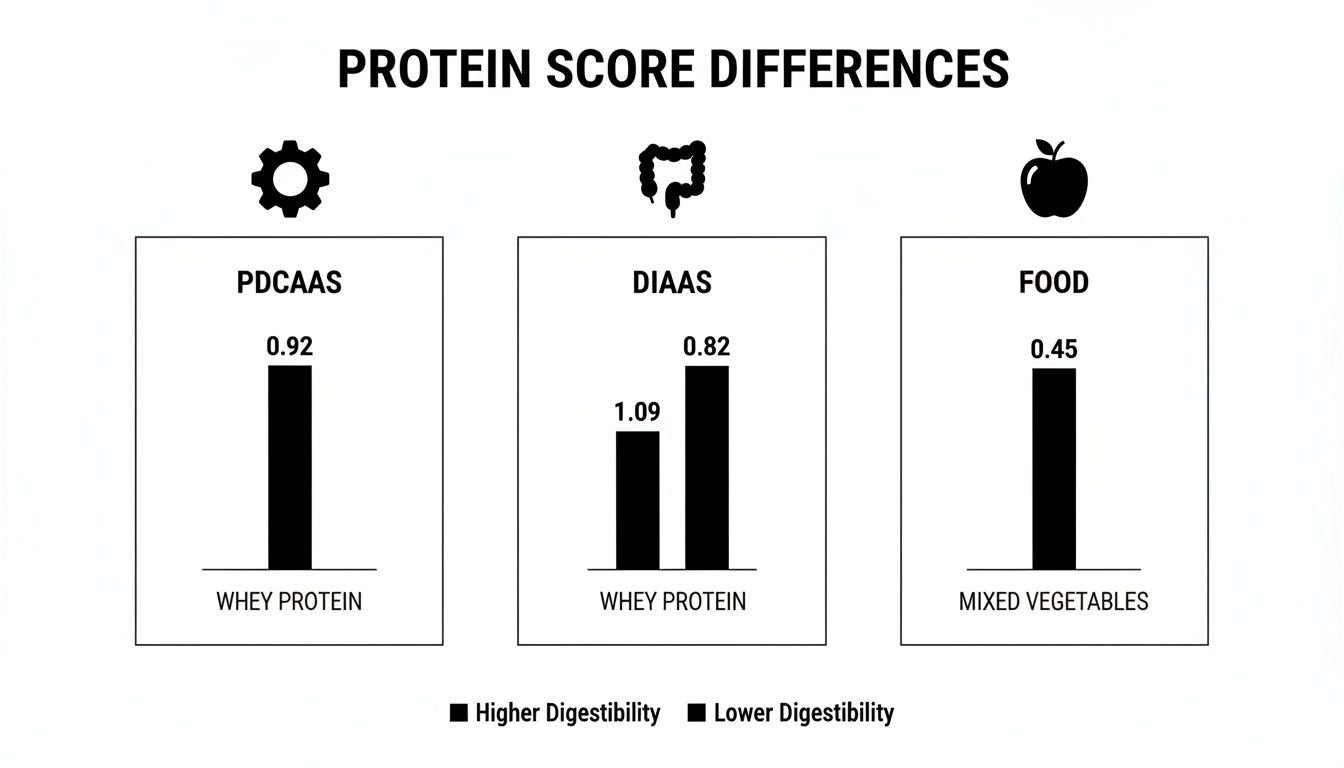
You can see how the newer DIAAS method often gives animal proteins like whey an even higher score, reflecting how much of that protein you're actually absorbing.
Reference Chart of Animal Protein Quality Scores
To cut through the noise, I've put together a straightforward reference chart. Whether you're trying to hit your macros, dialing in your meal plan, or just logging your food in PlateBird, this is the data you need to make smart choices.
| Protein Source | PDCAAS | DIAAS (where available) | Protein per 100g | Key Takeaway |
|---|---|---|---|---|
| Whey Protein Isolate | 1.00 | 1.09 | ~90g | The gold standard for fast absorption. Perfect for your post-workout shake. |
| Casein | 1.00 | 1.18 | ~80g | A slow-release protein. Take it before bed to feed your muscles all night. |
| Whole Egg | 1.00 | 1.13 | ~13g | Nature's multivitamin. A super bioavailable and versatile protein source. |
| Beef (Lean) | 0.92 | 0.92 | ~26g | A powerhouse for building mass. It's also packed with iron and vitamin B12. |
| Chicken Breast | 0.98 | 1.08 | ~31g | The lean, clean protein champ. A go-to for weight management and meal prep. |
| Fish (Tuna) | 0.99 | 0.93 | ~29g | A fantastic source of protein that also delivers anti-inflammatory omega-3s. |
| Greek Yogurt (Plain) | 1.00 | 1.14 | ~10g | Gives you high-quality protein plus a dose of gut-friendly probiotics. |
This table makes one thing obvious: animal-based proteins consistently score at the top, ensuring you get the most bang for your buck with every gram you eat.
How to Use the Animal Protein Chart
So, what does all this data really tell us? For one, it confirms that dairy proteins like whey and casein are absolute champions when it comes to bioavailability, boasting some of the highest DIAAS scores around. If you tolerate dairy, adding Greek yogurt or a glass of quality milk is a simple and effective way to bump up your protein intake. If you're wondering which milk is right for you, we break it down in our guide to the best milk for weight loss.
Here’s a perfect example of why the details matter: On the older PDCAAS scale, both whey and whole eggs get a perfect score of 1.00. But the more accurate DIAAS method shows a difference, with whey at 1.09 and eggs at 1.13. This tells us that your body can actually use the protein from eggs a bit more efficiently.
This is the kind of insight that separates casual eating from strategic nutrition. When you understand these numbers, you stop just counting grams and start choosing protein that works harder for your body. It's about making every meal a deliberate step toward your goal.
The Complete Plant-Based Protein Quality Chart
Let's talk about plant protein. If you've ever felt a little lost trying to figure out which sources are "best," you're not alone. Unlike most animal proteins, which come with all the essential amino acids our bodies need, plant-based proteins often require a bit more strategy. But it’s a strategy that is surprisingly simple once you get the hang of it.
It’s no surprise that understanding this is more important than ever. The plant-based protein market is exploding—it’s the fastest-growing part of a global industry projected to jump from USD 88.55 billion in 2025 to USD 120.16 billion by 2035. For a deeper look at these numbers, the protein ingredient analysis from Future Market Insights is a great resource.
While many individual plant sources don't quite stack up to whey or casein on their own, their real power is unlocked when you combine them.
How to Build a Complete Plant-Based Protein
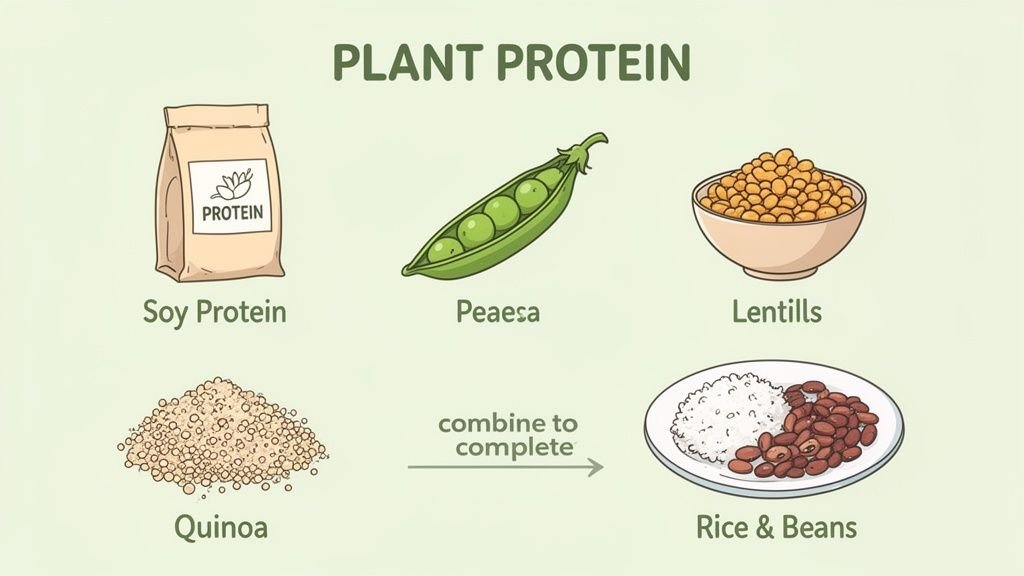
The key concept here is protein combining. Think of it this way: most plants are "incomplete" proteins, meaning they're running low on at least one of the nine essential amino acids. But the brilliant part is that their weaknesses are usually complementary.
- Legumes (like beans and lentils): Tend to be low in the amino acid methionine.
- Grains (like rice and wheat): Are often low in the amino acid lysine.
When you eat them together in the same meal—like a classic bowl of rice and beans or some hummus with pita bread—you’re creating a complete amino acid profile. Your body gets everything it needs, just as if it came from a single "complete" source.
Your Reference Chart for Plant-Based Protein Quality
I've put together this plant-based protein quality chart to give you the PDCAAS and DIAAS scores at a glance. You can use it to spot the heavy hitters and figure out smart pairings for your meals, whether you're planning your week or logging your food in an app like PlateBird.
| Protein Source | PDCAAS | DIAAS (where available) | Protein per 100g (cooked) | Key Takeaway |
|---|---|---|---|---|
| Soy Protein Isolate | 1.00 | 0.90 | ~90g | A plant-based powerhouse. It's a complete protein all on its own. |
| Pea Protein Isolate | 0.89 | 0.82 | ~80g | Very high in lysine. It's a perfect match for rice or oat proteins. |
| Quinoa | 0.85 | — | ~4.4g | One of the few whole foods that naturally contains all nine essential amino acids. |
| Lentils | 0.78 | — | ~9g | An amazing source of fiber and protein. Pair with grains like rice or bread. |
| Chickpeas | 0.76 | 0.83 | ~8.9g | The star of hummus. Combine with tahini and pita for a complete protein meal. |
| Rice Protein | 0.50 | — | ~8g | Low in lysine but rich in methionine, making it the ideal partner for pea protein. |
| Hemp Protein | 0.46 | — | ~50g | A solid source of healthy fats, but it definitely needs a partner for a complete profile. |
Looking at the chart, it's easy to see why certain plant proteins have become so popular. Soy protein isolate, with its perfect PDCAAS of 1.00, really does hold its own against many top-tier animal proteins.
Never underestimate the power of simply combining foods. A bowl of chili made with kidney beans (PDCAAS 0.68) served over a bed of brown rice creates a meal with a complete amino acid profile, effectively boosting its overall quality score.
This is what makes a plant-focused diet so powerful and sustainable for anyone, from athletes building muscle to someone just trying to stay healthy. It isn't about finding one perfect source—it's about creating synergy right on your plate.
Applying the Protein Quality Chart to Your Goals
Alright, so you’ve got this chart full of numbers. What now? This isn't just data for scientists—it's a practical roadmap you can use every single day to fine-tune your nutrition and hit your goals faster.
How you use these scores really depends on what you're trying to accomplish. Let's dig into how different people can make this chart work for them, whether you're looking to lose weight, build muscle, or nail down a plant-based diet.
For Weight Loss and Management
When you're trying to shed a few pounds, hunger is often the biggest hurdle. High-quality protein is your secret weapon. It helps you feel fuller for longer and protects your hard-earned muscle while you're eating in a calorie deficit.
Think about it: choosing foods with high PDCAAS and DIAAS scores means you're getting more bang for your buck, calorically speaking. That's why a serving of Greek yogurt (DIAAS 1.14) or a lean chicken breast (DIAAS 1.08) can keep you satisfied for hours, while other foods might leave you raiding the pantry an hour later.
- Feel Fuller, Longer: Prioritize foods like eggs, lean meats, fish, and dairy. Their complete amino acid profiles are incredibly effective at signaling to your brain that you're full.
- Protect Your Muscle: When you cut calories, your body can start breaking down muscle for energy. High-quality protein gives your body the building blocks it needs to spare that muscle, so you're losing fat instead.
- Practical Example: Swap that morning bagel for two scrambled eggs. You'll likely consume fewer calories but gain a complete, bioavailable protein source that keeps hunger pangs at bay until lunchtime.
For Athletes and Fitness Enthusiasts
If you’re regularly hitting the gym, your protein strategy is all about two things: repair and growth. After a workout, your muscles are like sponges, ready to soak up amino acids to start rebuilding. This is where protein quality—and the speed of digestion—becomes critical.
Use the protein quality chart to pinpoint your best options for recovery. You're looking for proteins packed with essential amino acids, especially leucine, which is the key that turns on muscle protein synthesis.
With its lightning-fast absorption and a sky-high DIAAS score of 1.09, whey protein isolate is pretty much the gold standard for post-workout recovery. It floods your muscles with leucine and other essential amino acids almost immediately, kickstarting the repair process when it matters most.
But don't just focus on your post-workout shake. Slower-digesting proteins like casein (DIAAS 1.18) or whole-food sources like lean beef (DIAAS 0.92) are fantastic for providing a steady stream of amino acids over several hours. These are perfect for meals later in the day or right before bed to fuel recovery overnight.
For Vegans and Vegetarians
For anyone on a plant-based diet, this chart is an indispensable resource. It’s true that most individual plant proteins don't contain all nine essential amino acids in optimal amounts, but the fix is surprisingly simple: protein combining. You can find more info on this by reading our guide on how to determine your ideal macro ratios.
By pairing different plant foods, you can easily create a meal that delivers a complete amino acid profile.
- Grains + Legumes: The classic rice and beans combo isn't just a staple for its flavor; it's a perfect protein pairing. Rice is low in the amino acid lysine, which beans have in abundance. Together, they create a complete protein.
- Seeds + Legumes: Think hummus (chickpeas) with whole-wheat pita bread or a sprinkle of sesame seeds on a lentil salad. It's a delicious and effective strategy.
- Practical Example: A hearty lentil soup (high in lysine) served with a slice of whole-grain toast (supplying methionine) makes for a synergistic meal that ticks all the essential amino acid boxes.
When you start applying these strategies, the protein quality chart stops being a list of numbers and becomes your personal guide to eating smarter and crushing your goals.
Exploring Protein Market and Quality Trends
It might seem like a simple choice—whey protein after a workout or pea protein in your chili. But every time you make that decision, you’re casting a vote in a massive global movement, and the food industry is listening very, very carefully. The growing demand for higher-quality nutrition is completely reshaping what we see on grocery store shelves.
This isn’t some fringe trend. It’s a huge market. The global protein ingredients market hit an incredible USD 38.5 billion in 2024 and is projected to climb to USD 41.2 billion by 2026. That kind of money shows just how seriously people are taking protein quality, especially those of us using tools like PlateBird to dial in our nutrition. For a deeper dive into the numbers, the protein ingredients report from Intel Market Research has the full breakdown.
The Consumer Drive for Better Protein
So, what does this market explosion really mean for you? It means companies are pouring money into R&D to create products that actually deliver on the promise of a protein quality chart. We're past the point of just wanting a high protein number on the label; we want sources that our bodies can truly use.
This push from consumers is driving real innovation, particularly in a few key areas:
- Smarter Plant Proteins: Scientists are getting much better at processing plant sources to boost their digestibility and round out their amino acid profiles. This is why you’re now finding pea protein isolates that can go toe-to-toe with dairy.
- Specialized Animal Proteins: For athletes, the whey and casein isolate market keeps getting more sophisticated. We now have options engineered for specific timing, whether it’s rapid absorption for post-workout recovery or a slow-release casein for overnight muscle repair.
- Hybrid Formulations: You’ll also notice more brands blending different protein sources, like pea and rice. This isn't just a gimmick; it’s a direct application of protein combining, creating a complete amino acid profile from multiple plant sources.
When you see a new micro-filtered whey isolate or a next-gen plant blend, you can be sure it’s not just marketing fluff. It’s a direct response from the industry to educated consumers who are demanding better quality.
Ultimately, this all comes back to empowering you. The more you understand the data in a protein quality chart, the better you'll be at spotting the products that are genuinely aligned with nutritional science. Your personal dietary choices are doing more than just helping you meet your goals—they're part of a worldwide shift toward smarter, more effective nutrition.
Frequently Asked Questions About Protein Quality
Even with a detailed protein quality chart in front of you, turning those numbers into smart, real-world meal decisions can feel a bit abstract. It’s one thing to know the scores, but it’s another to understand how they affect your actual diet.
Let's clear up a few of the most common questions we hear, so you can put this knowledge to work with confidence.
Does Protein Quality Matter if I Hit My Daily Protein Target?
I get this one a lot, and the answer is a firm yes, quality still matters—a lot. Hitting a daily goal, like 120 grams of protein, is a huge win. But where that protein comes from has a massive impact on what your body actually absorbs and uses.
Think of it this way. If you get those 120 grams from sources like chicken, eggs, and Greek yogurt (all with stellar DIAAS scores over 1.0), you're giving your body a full toolkit of highly usable amino acids. But if those grams come mostly from lower-quality sources like bread and rice, you're getting a much less effective toolkit, even if the total gram count is the same.
The person eating higher-quality protein will see better results in muscle repair, feel fuller for longer, and support more efficient body functions. Quantity gets you in the game, but quality is how you win it.
How Do I Combine Plant Proteins to Make a Complete Protein?
Making a "complete" protein from plants isn't nearly as complicated as it sounds. You don’t need a degree in biochemistry, just a simple strategy called protein combining. It’s all about pairing foods that fill in each other’s amino acid gaps.
Most plant foods are low in one or more of the nine essential amino acids, which is why they’re often called "incomplete." The trick is to eat two or more that complement each other.
- Grains + Legumes: This is the classic pairing for a reason. Think rice and beans, lentil soup with a side of naan, or even a simple peanut butter sandwich on whole-wheat bread.
- Legumes + Nuts/Seeds: Hummus is a perfect real-world example. It’s made from chickpeas (a legume) and tahini, which is a paste made from sesame seeds.
And here's the best part: you don't even have to eat them in the same meal. As long as you're eating a good variety of plant proteins throughout the day, your body is smart enough to pool the amino acids and build what it needs.
Are Expensive Protein Powders Better Than Whole Foods?
Protein powders are incredibly convenient, but are they truly better than whole foods? Not really. It’s more of a trade-off between convenience and total nutrition.
A top-tier whey isolate, for instance, boasts an impressive DIAAS score of 1.09 and gets to your muscles fast, which is perfect for that post-workout window. But a filet of salmon (DIAAS 0.93) or a humble whole egg (DIAAS 1.13) delivers more than just protein. They also provide a whole symphony of other nutrients—omega-3s, vitamins, and minerals—that you just won’t find in a scoop of powder.
The bottom line is that both have a role to play. Powders are a fantastic supplement for reaching your goals, especially around your workouts. But for your overall health, nothing beats a diet built on a foundation of whole-food protein sources. Your protein quality chart is the perfect tool for deciding which source fits the moment best.
Ready to stop guessing and start tracking your nutrition with precision? PlateBird makes it effortless. Just type what you ate—like "chicken and rice"—or snap a picture of your meal, and our AI does the rest. Ditch the tedious food logging and hit your goals faster. Download PlateBird on the App Store and start logging your meals in seconds.