You’ve probably heard of the 1200-calorie diet. It's one of the most common and widely discussed approaches for weight loss, and for good reason. It promises a clear, straightforward number to hit every day. But before you jump in, it’s worth asking the most important question: is this the right path for you?
Think of a 1200-calorie diet less like a restrictive sentence and more like a tight nutritional budget. With this budget, your job is to become a savvy shopper, "spending" your calories on foods that give you the biggest bang for your buck—plenty of protein, vitamins, and minerals.
When done right, it can be a safe starting point for certain people, particularly smaller, more sedentary women. The key is making sure every meal is packed with nutrients. Without that careful planning, you can easily end up feeling tired, hungry, and run the risk of nutrient deficiencies.
Is a 1200 Calorie Diet a Good Fit for You?
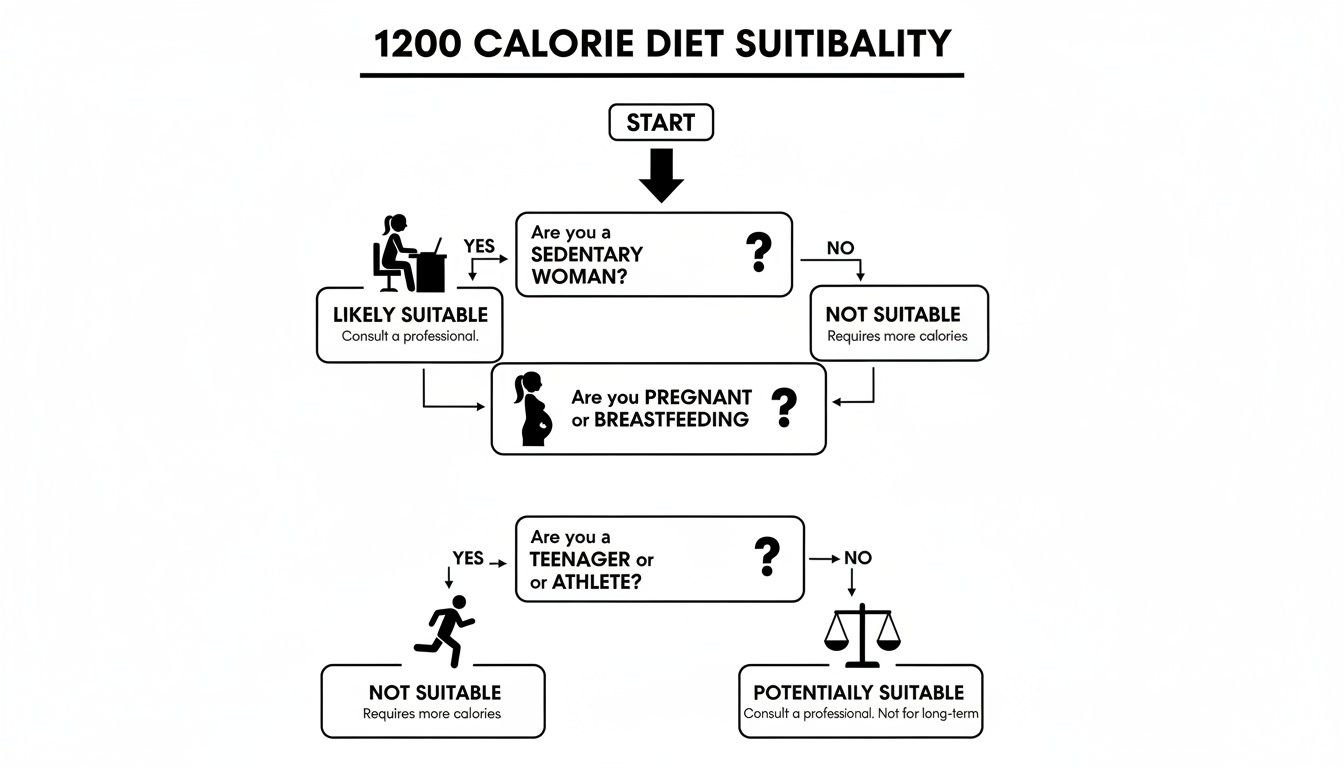
A 1200-calorie intake is definitely not a one-size-fits-all magic number. For some people, it creates an effective and safe calorie deficit, which is the fundamental driver of weight loss. But for many others, it’s simply not enough fuel to get through the day, let alone thrive.
Whether it's a good fit really comes down to your personal stats—things like your height, weight, sex, and how active you are. As registered dietitian Julia Zumpano from Cleveland Clinic often points out, a plan that works wonders for one person could be downright insufficient for another.
For context, the National Library of Medicine notes that the average intake for weight loss is usually closer to 1,500 calories for women and 2,000 for men. That makes 1200 calories a pretty significant drop for most people.
This decision tree can help you visualize whether it might be a good fit for your situation.
Ultimately, your goal should always be sustainable health, not just chasing a number on the scale. Part of that is understanding how diet and exercise work together. If you're curious, you can explore the interesting debate around Food Vs Fitness: Which Is More Crucial For Effective Weight Loss.
Making an Informed Decision
To help you figure out where you stand, here’s a quick-reference guide.
Who Should Consider a 1200 Calorie Diet
| Good Candidate For 1200 Calories | Should Consult a Doctor First |
|---|---|
| Sedentary women with a smaller frame. | Men, who typically have higher calorie needs. |
| Individuals seeking a short-term, structured plan to kickstart weight loss. | Athletes or anyone with a very active lifestyle. |
| People who have previously lost weight safely on a similar intake. | Anyone pregnant, breastfeeding, or a growing teenager. |
| Those under the guidance of a doctor or registered dietitian. | Individuals with a history of eating disorders. |
| Those with medical conditions like diabetes or thyroid issues. |
This isn't about giving you a rigid set of rules, but about helping you feel informed enough to make a safe, realistic choice for your unique body and lifestyle.
Where Did the 1200 Calorie Myth Even Come From?
That number—1200 calories. It seems to be everywhere in the diet world, doesn't it? For decades, it’s been treated as the magic bullet for weight loss. But where did this number actually come from? The answer isn't from a modern clinical trial, but from a book written over a century ago.
Believe it or not, the 1200-calorie benchmark dates all the way back to 1918. A physician named Dr. Lulu Hunt Peters published a wildly popular book, Diet and Health: With Key to the Calories, which introduced the entire concept of calorie counting to the American public. This was a revolutionary idea at a time when World War I food rationing and a cultural shift towards thinner bodies created the perfect storm. Her advice landed on fertile ground. You can find a great deep dive into this trend on StayFitMom.com, but the takeaway is simple: this idea is old.
From Wartime Idea to Modern Dogma
Dr. Peters' message was straightforward and hit at just the right time. With patriotism tied to conserving food, counting calories felt like a disciplined, responsible thing to do. Her simple formula caught on like wildfire and, without much revision, became a fixture in dieting advice for generations.
The problem is, our understanding of the human body has changed profoundly since 1918. What was once a simple guideline has become a risky rule for many, and following this century-old advice without context can backfire spectacularly.
The Hidden Dangers of Going Too Low
When you drop your calories to a number as low as 1200 without a doctor's guidance, your body doesn't just happily start burning fat. It panics. It thinks there’s a famine, and it kicks into survival mode.
Your body’s primary goal is to keep you alive, not to help you fit into a smaller pair of jeans. When it senses a drastic energy deficit, it fights back with protective measures that can make lasting weight loss feel impossible.
This biological self-preservation can show up in a few nasty ways:
- Hormonal Havoc: Drastic calorie cuts can throw your hunger, mood, and metabolism-regulating hormones completely out of whack. This is what's behind that classic "hanger" and the intense, uncontrollable cravings that can sabotage your progress.
- A Sluggish Metabolism: Your body is smart. If it thinks fuel is scarce, it will slow down your metabolic rate to conserve every last calorie. This not only stalls weight loss but makes it much easier to regain weight later on.
- The Rebound Effect: Because this level of restriction is so hard to maintain, most people eventually stop. When they do, their newly sluggish metabolism can cause them to gain back all the weight they lost, and sometimes even more.
Understanding this history isn't just for fun—it's critical. It helps explain why this number is so pervasive, but also why a one-size-fits-all approach is a recipe for frustration. A sample 1200 calorie diet might be a starting point for some, but knowing its origins and limitations is the first step toward using it safely and effectively.
How to Build a Nutrient-Dense 1200 Calorie Plate
When you're working with just 1200 calories, every bite counts. Seriously. But instead of seeing it as a restriction, I want you to reframe it. Think of it as a fun, strategic challenge: how can I pack the most nutritional punch into every calorie? This is the whole idea behind nutrient density.
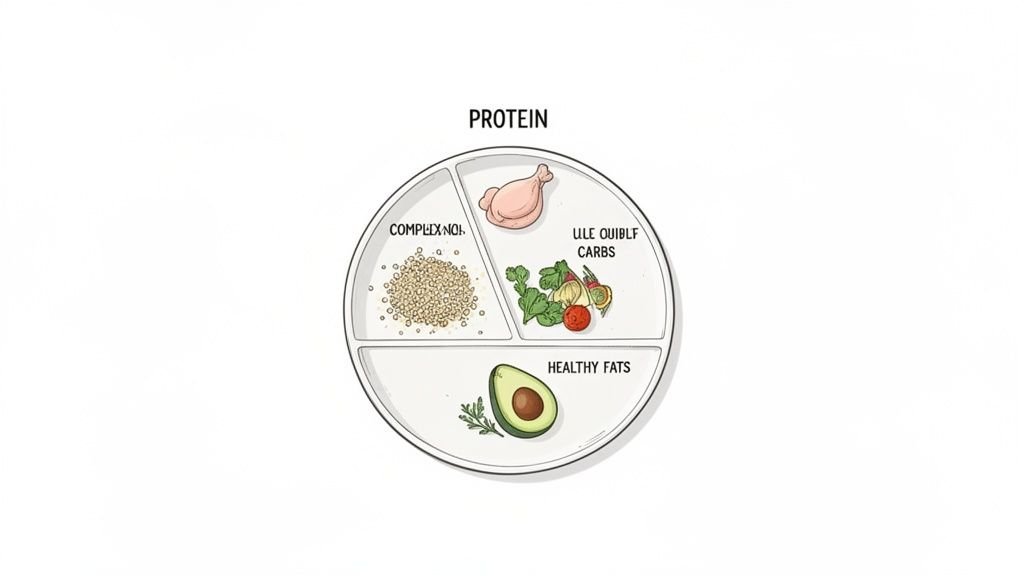
Forget focusing on what you have to cut out. Let’s talk about what we’re going to build. Your plate is the blueprint, and our main materials are the macronutrients—protein, carbs, and fats. Each one has a job to do, and getting the balance right is what makes a meal satisfying and keeps you from feeling hungry and deprived.
The Power of Protein
Protein is your absolute cornerstone. On a sample 1200 calorie diet, it's the one thing you can't afford to skimp on. Why? It's the king of satiety. That's the feeling of being full and satisfied that stops you from wandering into the kitchen an hour after you've eaten.
It also does the crucial work of protecting your hard-earned muscle. When you're losing weight, your body can pull energy from both fat stores and muscle tissue. Eating enough protein sends a strong signal to your body: "Hey, use the fat for fuel, and leave the muscle alone!"
Smart Protein Choices:
- Lean Meats: Chicken breast, turkey, and extra-lean beef.
- Fish and Seafood: Salmon, tuna, cod, and shrimp.
- Plant-Based Power: Lentils, beans, tofu, and tempeh.
- Dairy and Eggs: Greek yogurt, cottage cheese, and whole eggs.
Choosing Your Carbs Wisely
Carbs are what your body loves to use for quick energy, but all carbs are not created equal. On a lower-calorie plan, you have to be a bit of a connoisseur.
Here’s a simple way to think about it: refined carbs like white bread and sugar are like throwing kindling on a fire. You get a big, fast flame that burns out quickly, leaving you cold and needing more fuel. On the other hand, complex carbs from things like oats, quinoa, sweet potatoes, and fibrous veggies are like slow-burning logs. They provide a steady, reliable source of energy that keeps you going for hours.
By prioritizing fiber-rich, complex carbohydrates, you get long-lasting energy and essential nutrients without the blood sugar spike and subsequent crash that often leads to cravings.
It's not just about weight loss, either. The kind of calories you eat can have a huge impact on your health. An interesting 1997 study looked at women on a 1200-calorie plan and found that while both high-carb and low-carb groups lost about the same amount of weight, their metabolic health markers were quite different. It’s a great reminder that the quality of your calories matters just as much as the quantity.
Don't Fear the Fat
For years, fat was made out to be the villain, but we know better now. Healthy fat is essential for everything from hormone production to brain function. The trick is simply choosing the right kinds and keeping an eye on your portions, as fats are naturally higher in calories.
Good-for-you fats—the kind you find in avocados, nuts, seeds, and olive oil—do more than just taste good. They help your body absorb important vitamins (like A, D, E, and K) and add a richness to meals that makes them far more satisfying. Even a small amount can make a world of difference in how full and content you feel.
Building your plate with these three components doesn't just help you stay within your calorie goal; it ensures you're truly nourishing your body. Once you get the hang of it, you’ll find that tracking your meals becomes second nature. But if you're ever stuck on a homemade recipe, you can discover how to calculate calories in homemade food with a few easy tips.
Your Sample 7-Day 1200 Calorie Meal Plan
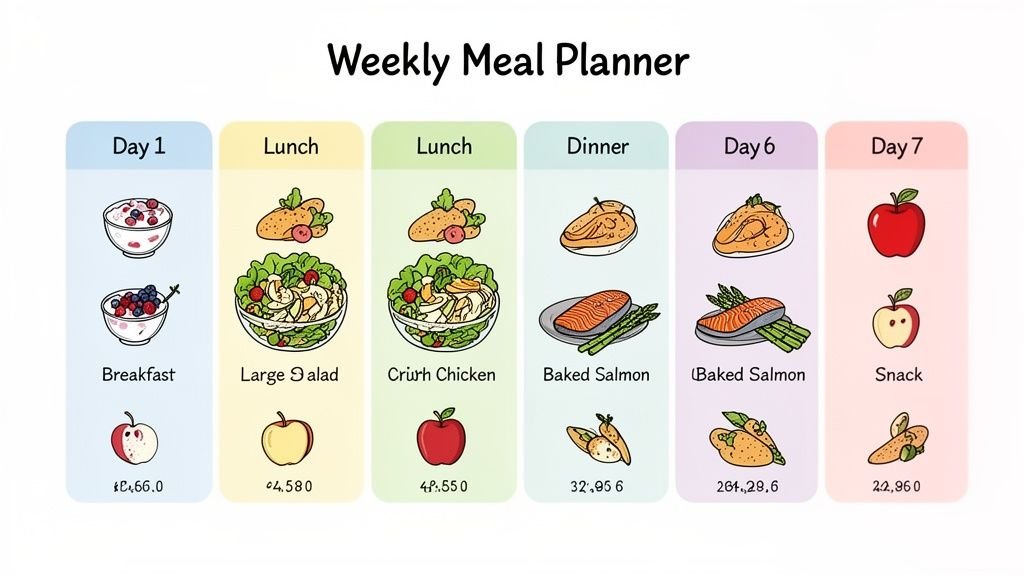
Alright, let's get down to it. Theory is one thing, but seeing a real plan laid out day by day is what makes it feel possible. This sample 1200 calorie diet is all about showing you how delicious and satisfying this can be.
We've designed this plan using simple, whole foods you can find at any grocery store—no weird ingredients or complicated cooking required. The goal here is to prove that eating at a lower calorie target doesn't mean a week of bland food. It can be vibrant and full of flavor. Each day includes three meals and a snack, landing right around 1,200 calories.
Think of this as a blueprint, not a strict set of rules. If you don't like salmon, swap it! Just keep your calorie and macro goals in mind as you make changes.
Day 1 Kickstart
Let’s ease into the week. These first meals are simple, packed with protein, and designed to keep you feeling full and energized right from the start.
- Breakfast (≈280 calories): A high-protein Greek Yogurt Bowl is a perfect way to begin. Just mix 1 cup of plain, non-fat Greek yogurt with 1/2 cup of mixed berries and a tablespoon of chopped almonds.
- Lunch (≈350 calories): You can't go wrong with a classic Chicken Salad. Combine 4 oz of grilled chicken breast with 2 cups of mixed greens, cherry tomatoes, and cucumber. Drizzle with 2 tablespoons of a light vinaigrette.
- Dinner (≈420 calories): For dinner, try a fantastic Sheet Pan Lemon Herb Salmon. Bake a 4 oz salmon fillet with 1 cup of asparagus and cherry tomatoes. All it needs is a squeeze of lemon juice, a sprinkle of dill, and a teaspoon of olive oil.
- Snack (≈150 calories): A medium apple paired with one low-fat string cheese stick is the ideal combo of fiber and protein to tide you over.
Day 2 Veggie-Powered
Today is all about loading up on vegetables. They add tons of volume and nutrients to your meals, helping you feel full without adding a lot of calories.
- Breakfast (≈290 calories): Whip up a quick Veggie Scramble using two large eggs, a big handful of spinach, and some chopped bell peppers. Have it with a single slice of whole-wheat toast.
- Lunch (≈330 calories): A hearty Lentil Soup is incredibly warming and filling. A generous 1.5-cup serving gives you excellent fiber and plant-based protein.
- Dinner (≈400 calories): How about a Turkey Burger served in a crisp lettuce wrap? A 4 oz lean ground turkey patty with a side of steamed green beans makes for a satisfying, low-carb dinner.
- Snack (≈160 calories): Enjoy 1/2 cup of cottage cheese with some sweet, sliced peaches.
This weekly structure is your roadmap. Having a plan eliminates decision fatigue—that "what should I eat?" moment that so often leads to grabbing something less-than-ideal on impulse.
Day 3 Mid-Week Momentum
By day three, you're likely finding your rhythm. These meals are designed to be especially quick to prepare, helping you power through the middle of the week.
- Breakfast (≈275 calories): Oatmeal is a fantastic source of slow-releasing energy. Cook 1/2 cup of rolled oats with water or unsweetened almond milk, then top it with a sprinkle of cinnamon and a few walnuts.
- Lunch (≈360 calories): Put together a simple Tuna Salad Wrap. Use 3 oz of canned tuna (packed in water), a tablespoon of Greek yogurt instead of mayo, some chopped celery, and a whole-wheat tortilla.
- Dinner (≈410 calories): A quick Shrimp Stir-fry is perfect for a busy night. Sauté 4 oz of shrimp with 2 cups of mixed stir-fry veggies (like broccoli, snap peas, and carrots) in a light soy-ginger sauce.
- Snack (≈140 calories): A small handful of almonds (~20) is an easy and satisfying snack loaded with healthy fats.
Day 4 Through Day 7 Your Full Week at a Glance
To help you visualize the rest of the week, here’s everything in one place. You'll start to see the pattern: lean protein in every meal, lots of colorful vegetables, and smart, simple snacks.
| Day | Breakfast (Calories) | Lunch (Calories) | Dinner (Calories) | Snack (Calories) |
|---|---|---|---|---|
| Day 4 | Protein Smoothie with 1 scoop protein powder, spinach, and 1/2 banana (≈300) | Leftover Shrimp Stir-fry (≈410) | Chicken and Veggie Skewers with 4 oz chicken (≈350) | Rice cakes with peanut butter (≈150) |
| Day 5 | Two hard-boiled eggs and an orange (≈230) | Large Quinoa Salad with chickpeas and veggies (≈400) | Baked Cod with roasted broccoli (≈380) | A pear (≈100) |
| Day 6 | Greek Yogurt Bowl (repeat from Day 1) (≈280) | Leftover Quinoa Salad (≈400) | Lean Beef and Bell Pepper Stir-fry (4 oz beef) (≈390) | Baby carrots with hummus (≈120) |
| Day 7 | Veggie Omelet with cheese (≈310) | Canned Salmon on whole-wheat crackers (≈350) | Grilled Chicken Breast with a large side salad (≈360) | Mixed berries (≈80) |
Your Weekly Grocery List
We want to make starting as simple as possible. Here’s a shopping list built from the sample 1200 calorie diet plan above to get you ready for the week.
- Proteins:
- Chicken Breast (approx. 20 oz)
- Salmon Fillets (approx. 8 oz)
- Lean Ground Turkey (4 oz)
- Shrimp (4 oz)
- Cod Fillet (4 oz)
- Extra-Lean Beef (4 oz)
- Canned Tuna and Salmon
- Eggs (one dozen)
- Lentils (canned or dry)
- Chickpeas (canned)
- Whey or Plant-Based Protein Powder
- Dairy & Dairy Alternatives:
- Plain, Non-fat Greek Yogurt
- Low-fat Cottage Cheese
- Low-fat String Cheese
- Unsweetened Almond Milk
- Vegetables:
- Mixed Greens/Spinach
- Asparagus, Broccoli, Bell Peppers
- Cherry Tomatoes, Cucumber
- Carrots, Celery, Snap Peas
- Onion, Garlic
- Fruits:
- Mixed Berries (fresh or frozen)
- Apples, Oranges, Bananas, Pears
- Lemons
- Grains & Legumes:
- Rolled Oats
- Quinoa
- Whole-wheat Bread and Tortillas
- Whole-wheat Crackers/Rice cakes
- Pantry Staples & Healthy Fats:
- Almonds, Walnuts
- Olive Oil
- Low-sodium Soy Sauce
- Light Vinaigrette Dressing
- Hummus
- Herbs and Spices (dill, cinnamon, ginger)
Simple and Delicious 1200 Calorie Recipes
Let’s be honest: a meal plan is only worth the paper it’s printed on if the food is actually something you want to eat. This is where we get to prove that "low calorie" and "delicious" aren't mutually exclusive. The recipes below take the simple ingredient lists from our sample 1200 calorie diet and turn them into meals you'll genuinely look forward to.
These aren't complicated, chef-level dishes. They're designed for real, busy lives—quick to assemble, perfect for prepping ahead, and incredibly satisfying. Let's get cooking.
Sheet Pan Lemon Herb Salmon and Veggies
I think of this as the ultimate weeknight-winner. It’s a complete, balanced meal on a single pan, which means cleanup is a breeze. You get a fantastic source of lean protein and healthy omega-3s without spending your whole evening in the kitchen.
Ingredients (1 serving):
- 1 (4 oz) salmon fillet
- 1 cup asparagus, trimmed
- 1/2 cup cherry tomatoes
- 1 tsp olive oil
- 1 tbsp fresh dill, chopped
- 1 lemon, half juiced and half sliced
- Salt and pepper to taste
Instructions:
- First things first, preheat your oven to 400°F (200°C).
- On a baking sheet, toss the asparagus and cherry tomatoes with olive oil, salt, and pepper.
- Nestle the salmon fillet among the veggies. Drizzle it with lemon juice, sprinkle over the fresh dill, and lay the lemon slices on top.
- Bake for 12-15 minutes. You'll know it's done when the salmon is opaque and flakes easily with a fork.
Nutrition Info (Approximate):
- Calories: 380
- Protein: 25g
- Fat: 26g
- Carbs: 12g
Quick Black Bean and Corn Salsa Salad
Need a vibrant, filling lunch that’s ready in less than ten minutes? This is it. This salad is my go-to when I'm short on time but don't want to skimp on flavor or end up hungry an hour later. It's loaded with plant-based protein and fiber that really sticks with you.
Ingredients (1 serving):
- 1/2 cup canned black beans, rinsed well
- 1/2 cup frozen or canned corn, thawed
- 1/4 cup red onion, finely diced
- 1/4 cup bell pepper, diced
- 2 tbsp cilantro, chopped
- Juice of 1 lime
- Optional: 1/4 avocado, diced
Instructions:
- In a medium bowl, just combine the black beans, corn, red onion, and bell pepper.
- Toss in the cilantro and squeeze the lime juice all over.
- Give it a good stir. If you're adding avocado, fold it in gently at the end.
- You can eat it right away on its own, pile it onto some leafy greens, or pair it with a few whole-grain crackers.
Nutrition Info (Approximate, without avocado):
- Calories: 210
- Protein: 9g
- Fat: 1g
- Carbs: 45g
High-Protein Greek Yogurt Bowl
Breakfast really does set the tone for the day. This simple bowl is a protein powerhouse that takes just a minute to assemble, but its effects last for hours. It provides a sweet, satisfying start that helps you sidestep that dreaded mid-morning energy crash.
If I could give only one piece of advice for managing hunger, it would be this: start your day with protein. It keeps your blood sugar stable and helps you feel full and in control, making it so much easier to stick to your goals.
Ingredients (1 serving):
- 1 cup plain, non-fat Greek yogurt
- 1/2 cup mixed berries (fresh or frozen)
- 1 tbsp chopped almonds or walnuts
- Optional: 1 tsp chia seeds for extra fiber and healthy fats
Instructions:
- Spoon the Greek yogurt into a bowl.
- Top it with your berries and chopped nuts.
- If you're using them, sprinkle the chia seeds over everything. That's it!
Nutrition Info (Approximate, with almonds):
- Calories: 280
- Protein: 25g
- Fat: 7g
- Carbs: 30g
Effortless Meal Tracking with Platebird
You’ve put in the work. You’ve planned your meals, gone grocery shopping, and prepped everything for your sample 1200 calorie diet. But now comes the part most of us dread: actually logging every single ingredient. This is often where a good plan hits a wall. Let's be honest, manual tracking is a grind, and it can quickly suck the joy right out of eating.
What if tracking could be as simple as sending a quick text? That’s the whole idea behind PlateBird. We built it to get rid of that friction, making it feel less like a chore and more like a tiny bit of magic in your pocket.
Tracking Without the Tedium
Forget about wrestling with barcode scanners or scrolling through endless lists of generic foods. PlateBird is all about speed and simplicity. You just tell the app what you ate, plain and simple.
You can type 'eggs toast coffee' or 'chicken rice and broccoli,' and our AI does the heavy lifting, instantly calculating the calories and macronutrients for you. It’s a totally different way of thinking about tracking—one that actually respects your time.
Here's an example of how you can log an entire meal just by snapping a photo.
As you can see, the app uses computer vision to identify everything on the plate, from the salmon right down to the asparagus. It gives you a complete nutritional breakdown before you even pick up your fork.
A Smarter App That Learns Your Habits
PlateBird isn't just a simple calculator; it’s a smart companion that actually learns your eating patterns over time. It notices the meals you log most often and turns them into convenient one-tap shortcuts. That high-protein breakfast you love? After a few days, logging it is as easy as a single tap.
This is a complete game-changer if you meal prep. Once you log a meal from your sample 1200 calorie diet, PlateBird remembers it. The next day, there's no need to re-enter all the ingredients. Just tap once, and you're done.
Our goal was to build a tool that makes consistency feel effortless. When tracking is this easy, you're far more likely to stick with it long enough to see the real, lasting results you’re working so hard for.
This is about more than just another app. We wanted to give you a tool that genuinely removes the single biggest headache in managing your nutrition. When you can log your entire day in under 60 seconds, you can put your energy where it belongs: enjoying your food and feeling good about your progress.
Ready to see how simple it can be? You can explore how PlateBird works and feel the difference firsthand. It's free to download, and you can start tracking right away—no account needed.
Got Questions About the 1200 Calorie Diet? Let's Talk.
It's totally normal to have a few questions swirling around your head before starting something like a 1200-calorie plan. In fact, it’s a great sign—it means you’re thinking critically about your health. Let's walk through some of the most common concerns I hear so you can move forward with confidence.
Can I Still Work Out on This Diet?
Absolutely, but you'll want to be smart about it. Gentle movement is your best friend here. Think brisk walks, yoga, or some light resistance training. These activities are fantastic for supporting your goals without demanding a ton of fuel.
Where you need to be careful is with high-intensity exercise. Think of your body like a car—you can't expect to win a race on a quarter tank of gas. Intense workouts burn a massive amount of energy, and 1,200 calories likely won't be enough to cover that and your body's basic needs. If you’re an athlete or love grueling gym sessions, this calorie level is almost certainly too low. Always listen to your body; if you feel faint or weak, that’s a clear signal to refuel.
What if I'm Still Hungry All the Time?
Feeling hungry, especially when you're just starting, is a real challenge. The trick isn't to just ignore it, but to outsmart it.
- Are you hungry or just thirsty? Our brains sometimes mix these signals up. Before you grab a snack, try drinking a big glass of water and giving it 15 minutes. You might be surprised.
- Fill your plate, not your calorie budget. This is where non-starchy vegetables are your secret weapon. Piling on spinach, broccoli, bell peppers, and zucchini adds a ton of satisfying volume and fiber for very few calories.
- Lean into protein. We’ve talked about this before, but it’s worth repeating. Protein is the key to feeling full and satisfied. Make sure every single meal and snack has a solid source of it.
How Long Can I Safely Stick to This Plan?
This is a crucial question. A 1200-calorie diet should be seen as a short-term tool, not a forever plan. For most people, it's something you’d use for a few weeks to kickstart a weight loss journey, ideally with a nod from your doctor.
Sticking with it for too long can backfire, leading to nutrient gaps and a sluggish metabolism.
Think of a very-low-calorie diet as a launchpad, not the destination. Its job is to create a controlled deficit for a short period. The real goal is to eventually move to a sustainable, long-term eating plan you can thrive on.
Will I Lose Muscle?
That’s a valid worry on any diet that creates a calorie deficit. When your body needs energy, it can pull from both fat stores and muscle tissue. So, how do you tell it to leave your hard-earned muscle alone?
You fight back with a two-part strategy: make protein a priority at every meal, and get some resistance training in. This powerful combination sends a strong signal to your body: "Hey, we need this muscle! Burn that fat for fuel instead."
Ready to make hitting those protein goals and tracking your meals feel effortless? With PlateBird, you can log your food just by typing what you ate or snapping a photo. Stop the tedious manual entry and see how simple tracking can be. Download for free and start tracking in seconds.