When you hear “1,500-calorie diet,” what comes to mind? For a lot of people, it’s visions of tiny portions, sad-looking salads, and a whole lot of hunger. But I’m here to tell you that’s not the reality at all.
You can absolutely eat delicious, satisfying food and still hit that number. It’s all about being strategic.
Your Quick Guide to a 1500 Calorie Day
The number 1,500 gets thrown around a lot in the weight loss world, and for good reason. For many of us, it hits a sweet spot—creating a calorie deficit that encourages weight loss without making you feel like you’re starving.
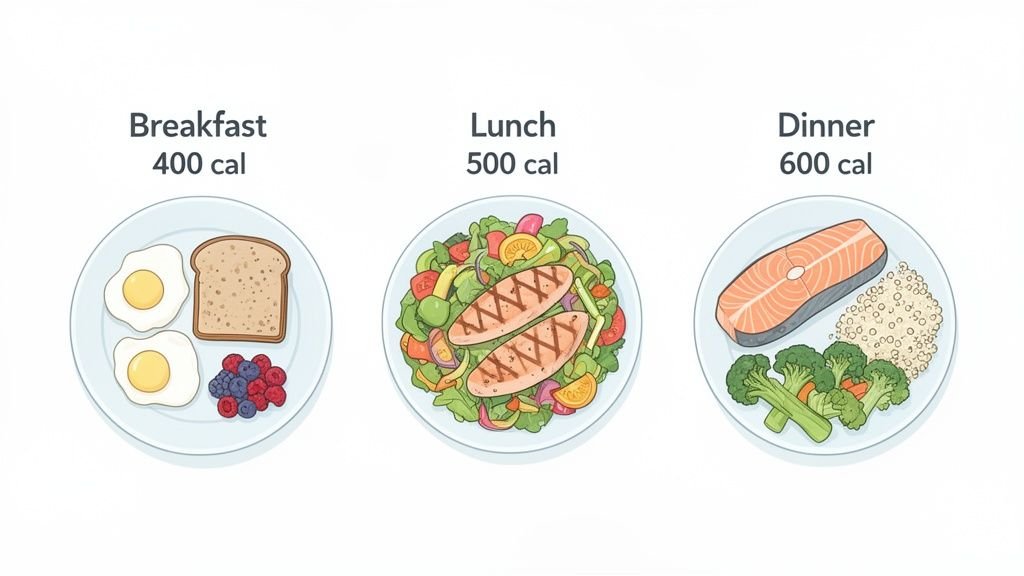
This isn’t about deprivation. It's about being smart with your choices. We’re talking a day that could start with fluffy, protein-rich eggs, move on to a huge, colorful salad for lunch, and wrap up with a perfectly cooked piece of salmon and a side of roasted veggies. See? Your plate can be full and still fit within the plan.
To give you a clearer picture, here’s a quick breakdown of how those calories might be distributed throughout a typical day.
Sample 1500-Calorie Day at a Glance
| Meal | Example Foods | Approximate Calories |
|---|---|---|
| Breakfast | 2-egg omelet with spinach and 1 slice of whole-wheat toast | 350 calories |
| Lunch | Large salad with grilled chicken, mixed greens, veggies, and a light vinaigrette | 450 calories |
| Dinner | 4-oz baked salmon, 1 cup roasted broccoli, and 1/2 cup quinoa | 500 calories |
| Snacks | A medium apple with 1 tbsp peanut butter and a small Greek yogurt | 200 calories |
This table is just one example, but it shows how you can fuel yourself consistently from morning to night, keeping hunger at bay.
Why It Works for Weight Management
So, how does this actually lead to weight loss? It all comes down to simple math.
Let’s take a sedentary woman between 31 and 50. She might need around 1,800 calories just to maintain her current weight. By dropping down to 1,500 calories, she creates a daily deficit of 300 calories. Since it takes a deficit of about 3,500 calories to lose one pound of fat, this steady approach can result in a sustainable loss of about 0.5–1 pound per week. If you want to dive deeper into how this works with protein and fiber, Medical News Today has a great article on it.
This re-frames the whole idea of a "diet." It’s no longer a short-term punishment but a long-term, sustainable plan for fueling your body right.
The secret here isn't just counting calories; it’s about focusing on nutrient density. This means choosing foods that give you the most bang for your buck—lots of vitamins, minerals, protein, and fiber—for the fewest calories. That's the key to feeling full and energized.
What to Expect in This Guide
In the rest of this guide, I'm going to walk you through exactly what a 1,500-calorie day can look like, no matter your food preferences. We’ll get into the nitty-gritty.
- Real meal examples: I’ll show you what a satisfying breakfast, lunch, and dinner actually look like on a plate.
- Simple portion guides: You'll learn some easy visual tricks to eyeball portions so you don't have to live with a food scale.
- Tips for staying full: We'll cover simple strategies to make your meals work harder for you, keeping hunger away.
And to make things even easier, I'll show you how a tool like PlateBird can help you log all of this without the usual headache, so you can stay focused on your goals.
Why Is 1,500 Calories Such a Common Goal for Weight Loss?
That 1,500-calorie number seems to pop up everywhere in the world of weight loss, doesn't it? It’s not just a number pulled out of a hat. For many people, it's a powerful starting point—a well-researched target that makes the whole process feel much more manageable.
To get why it works, think of your body's energy needs like a daily budget. This budget is your basal metabolic rate (the calories you burn just by being alive) plus all the energy you use moving around, from walking to the car to hitting the gym. For a lot of folks, that daily total is comfortably above 1,500 calories.
Creating a Small, Steady Shortfall
When you aim for around 1,500 calories, you’re creating a small, consistent gap between the energy you’re consuming and the energy your body is burning. This is what’s known as a calorie deficit. It’s like spending just a little bit less than you earn each day—over time, that small difference really starts to add up.
To make up for that energy gap, your body has to dip into its savings account: your stored body fat. It starts converting that fat into fuel, which is exactly how fat loss happens. A 1,500-calorie plan is designed to kickstart this process gently, without shocking your system.
This is a world away from those extreme crash diets that slash your calories down to nothing. Those can backfire by slowing your metabolism and even causing you to lose muscle, making it harder to keep the weight off. A moderate deficit, on the other hand, helps you shed fat while keeping your metabolism humming along.
The Simple Math of a Milestone
For the average woman, eating 1,500 calories a day often creates a deficit of about 500 calories. Here’s where the magic happens: one pound of body fat holds roughly 3,500 calories of stored energy.
By creating a 500-calorie deficit each day, you set yourself on a path to lose about one pound per week (500 calories x 7 days = 3,500 calories).
This steady pace is the secret sauce. It’s what helps you build real, lasting habits without the frustration and burnout that come with trying to do too much, too fast. Think of 1,500 calories not just as a number, but as a framework for reaching your goals safely. To really dig into the science, check out our full guide on what a calorie deficit is and how it powers weight loss.
At the end of the day, aiming for 1,500 calories is a proven strategy, not a fad. It’s built on the simple, powerful principle of energy balance. Once you understand why it works, you can start your journey with the confidence that you’re working with your body, not against it.
When you hear the number 1,500 calories, what comes to mind? For a lot of people, it sounds restrictive, maybe even a little daunting. But what does that number actually look like on a plate throughout the day? The reality is often surprisingly generous and far from boring.
It’s all about making smart, filling choices that you genuinely enjoy. To show you just how flexible and satisfying it can be, I've put together three full-day menus. Each one clocks in at around 1,500 calories, but they're designed for completely different lifestyles: a classic balanced approach, a vibrant plant-based day, and a high-protein plan for those who are more active.
But first, why does this number even work for weight loss? It all comes down to a simple concept.
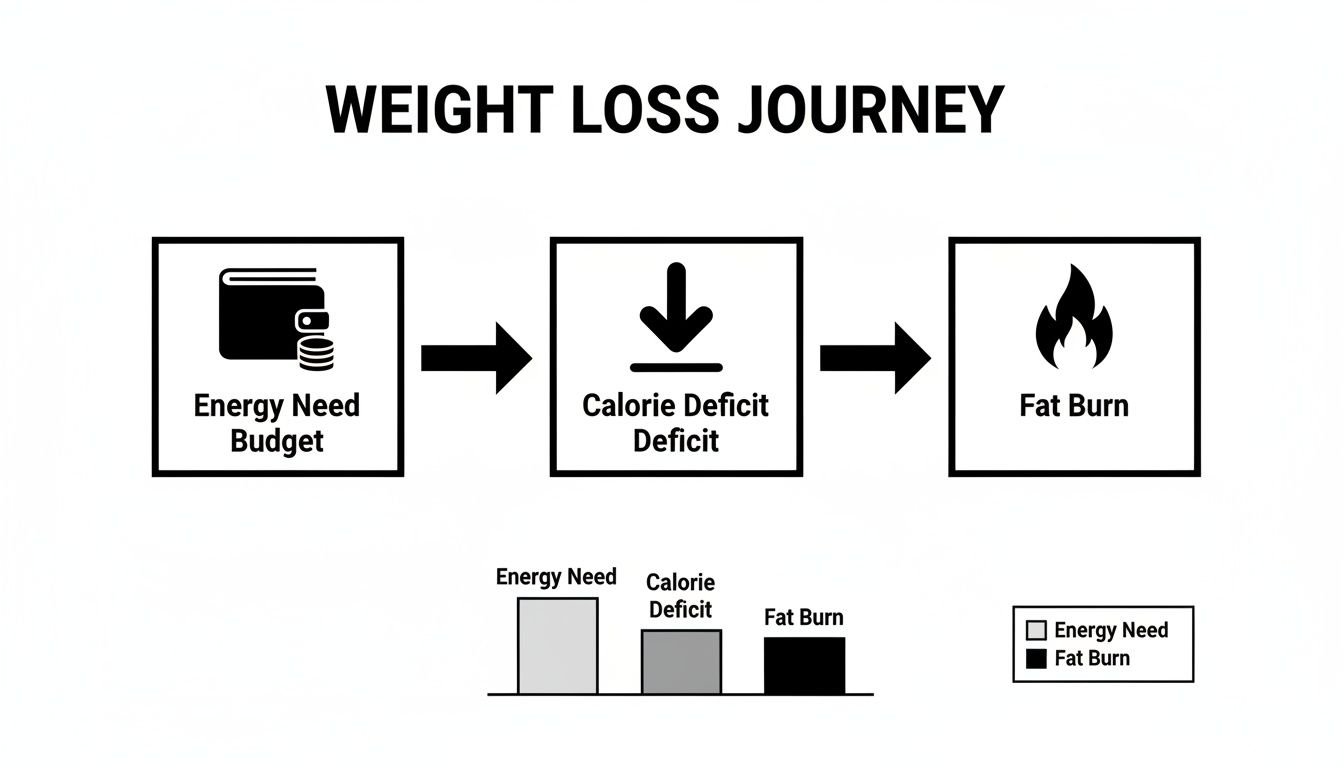
It's a simple formula: when you eat fewer calories than your body uses, it has to find that energy somewhere else. That "somewhere else" is your body's stored fat, which it starts to burn for fuel. That's the core of how a calorie deficit leads to weight loss.
Menu 1: The Classic Balanced Day
This approach is my go-to for people who love wholesome, familiar foods. It's the perfect picture of balance, where protein, healthy fats, and good carbs all have a place at the table, working together to keep you feeling full and energized.
- Breakfast (≈400 calories): Two scrambled eggs with a handful of spinach and ¼ cup of feta cheese. On the side, one slice of whole-wheat toast topped with half a small avocado. You get a fantastic mix of protein and healthy fats to kick off your morning right.
- Lunch (≈450 calories): A big, satisfying salad with mixed greens, 1 cup of chopped veggies (like bell peppers and cucumber), and a 4-ounce grilled chicken breast—about the size of a deck of cards. Drizzle with two tablespoons of a light vinaigrette.
- Dinner (≈500 calories): A 4-ounce serving of baked salmon, about 10 spears of roasted asparagus, and a scoop of quinoa roughly the size of a tennis ball.
- Snack (≈150 calories): One medium apple, sliced, with a tablespoon of almond butter. It's the perfect combo of fiber and fat to crush afternoon cravings.
Pro-Tip for Fast Logging: If you're using a food tracker like PlateBird, logging this day is a breeze. For breakfast, you could literally just type “2 eggs with spinach feta toast and avocado” and the AI sorts it out. It turns what used to be a chore into a task that takes seconds.
Menu 2: The Vibrant Plant-Based Day
Think eating plant-based means you'll be hungry? Think again. This menu is bursting with fiber and plant-powered protein, showing just how colorful and abundant a vegan 1,500-calorie day can be.
- Breakfast (≈350 calories): A warm bowl of oatmeal. Make it with ½ cup of dry rolled oats, one cup of almond milk, and top it with a handful of mixed berries and a tablespoon of chia seeds for extra fiber and staying power.
- Lunch (≈500 calories): A seriously hearty chickpea salad wrap. Mash 1 cup of chickpeas with two tablespoons of vegan mayo, some diced celery, and onion. Pile it into a large whole-wheat tortilla with a big handful of fresh spinach.
- Dinner (≈500 calories): A delicious lentil and vegetable stir-fry. Sauté 1 cup of cooked lentils with 2 cups of your favorite mixed veggies (broccoli, carrots, and snap peas work great) in a light soy-ginger sauce. Serve it all over ½ cup of brown rice.
- Snack (≈150 calories): A small handful of almonds (about 20) and a clementine. Simple, effective, and delicious.
This menu really proves how incredibly filling fiber-rich foods are. You'll be surprised how satisfied you feel.
Menu 3: The High-Protein Power Day
If you have a more active lifestyle or you're focused on building or maintaining muscle, bumping up your protein is a great strategy. This menu puts protein front and center at every meal to boost satiety and support your fitness goals.
- Breakfast (≈400 calories): A protein-packed smoothie to get you going. Just blend one scoop of vanilla protein powder, one cup of unsweetened almond milk, half a banana, and a tablespoon of peanut butter. It’s fast, filling, and tastes like a treat.
- Lunch (≈450 calories): A deconstructed burrito bowl. Start with a bed of shredded lettuce and top it with 4 ounces of cooked lean ground turkey, ½ cup of black beans, ½ cup of corn salsa, and a big dollop of plain Greek yogurt.
- Dinner (≈550 calories): Time to refuel. A 5-ounce sirloin steak (roughly the size of your palm), a large baked sweet potato, and a generous side of steamed green beans. This is a powerhouse meal with plenty of protein and complex carbs.
- Snack (≈100 calories): A single-serving container of plain Greek yogurt. It’s simple, effective, and packs a protein punch for very few calories.
So, as you can see, what 1,500 calories looks like isn't some rigid, one-size-fits-all prescription. It’s a flexible framework you can adapt to any diet or preference—from classic to plant-based to high-protein—all while enjoying food that looks great and leaves you feeling completely satisfied.
Mastering Portions Without Needing a Scale
Okay, so we’ve seen what a 1,500-calorie day can look like on a plate. But let's be honest—the idea of weighing every last gram of chicken or rice can feel like a full-time job. It’s one thing in your own kitchen, but it’s a whole different story when you’re out with friends or grabbing a quick lunch.
I get it. Constantly relying on a food scale can strip the joy out of eating. The great news is that you can ditch the scale and still get incredible results. The secret is learning to eyeball your portions, and the only tool you need is the one you carry with you everywhere: your hand.
Trading a scale for your hand isn't about being less accurate; it's about being more practical. It turns a plate of food from a math problem into an intuitive, manageable meal.
Your Built-In Measurement Tool
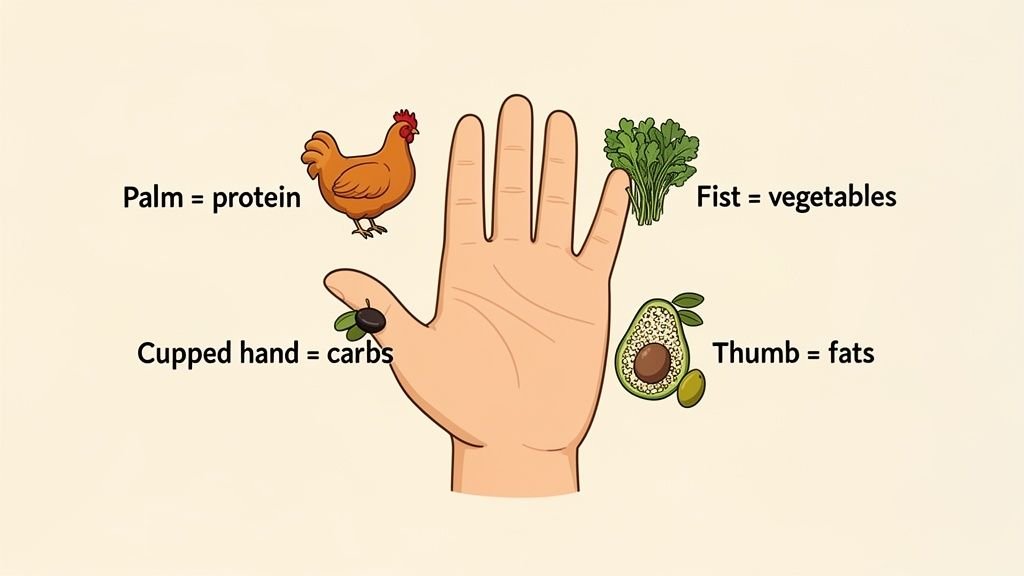
This is often called the "hand-trick," and it’s one of the most powerful skills you can learn for sustainable fat loss. It’s not about perfection. It’s about being consistently close enough to keep making progress, whether you’re at home or at a restaurant.
Here’s how it works in the real world:
- Protein (Chicken, Fish, Steak): A serving should be about the size and thickness of your open palm. This typically gets you in the ballpark of 3-4 ounces.
- Vegetables (Broccoli, Salad Greens): Picture your closed fist. That’s roughly the amount of non-starchy veggies you should aim for.
- Carbohydrates (Rice, Pasta, Quinoa): Make a cupped hand. A serving of cooked carbs should fit right in there, which is about ½ cup.
- Fats (Oils, Butter, Nut Butters): Look at your thumb. From the tip to the first knuckle, that's your guide for a serving of dense fats like olive oil or peanut butter.
Think about it: a meal suddenly becomes a palm of salmon, a fist of asparagus, a cupped handful of quinoa, and a thumb of olive oil. You can build that plate anywhere, anytime, without a single measurement. It’s a game-changer.
Fine-Tuning Your Estimation Skills
Becoming a natural estimator takes a little practice, but you can get good at it surprisingly quickly. The trick is to create a simple feedback loop for yourself: first, you guess, then you check.
When you’re at home, try plating your meal using just your hand as a guide. Before you dig in, snap a quick photo.
This is where an app like PlateBird becomes your coach. Upload the picture, and its AI will analyze the food, estimate the portions, and give you the calorie breakdown. You get instant feedback on how well you estimated. Was your "cupped hand" of rice actually closer to a full cup? Was that "thumb" of peanut butter a little too generous?
This isn’t about being right or wrong; it’s about calibrating your eyes. Each time you do it, your brain gets a little smarter. For a deeper look at different tracking methods, you can check out our complete guide on how to count calories accurately.
Before you know it, you’ll be able to walk into any situation—a holiday dinner, a business lunch, a backyard barbecue—and build a balanced plate without a second thought. That’s real food freedom.
How to Make 1500 Calories Feel Like More Food
Let's be honest, one of the biggest hurdles to starting a 1,500-calorie plan is the mental game. You start picturing tiny portions and dread the thought of spending your days feeling famished. But what if you could make your meals feel bigger and more satisfying without bumping up the calories one bit?
It's not about willpower or magic; it's about working with your body's natural hunger cues. The real secret to staying full is focusing on the "power trio" of nutrients that promote satiety: protein, fiber, and healthy fats. These three are your best friends because they slow down digestion and send strong signals to your brain that you're satisfied.
The 400-Calorie Showdown
To see how this plays out in the real world, just picture two different 400-calorie meals. In one corner, we have a sugary pastry and a coffee. In the other, a big plate filled with a grilled chicken breast, a hefty pile of steamed broccoli, and a scoop of quinoa. Both meals have the exact same calorie count, but they couldn't be more different in how they'll make you feel.
That pastry gives you a quick, fleeting rush of energy from all the refined carbs and sugar. It gets digested in a flash, and you'll likely feel that familiar energy crash and be starving again within an hour. The chicken, broccoli, and quinoa, on the other hand, are loaded with protein and fiber. This meal takes your body much longer to break down, which means you'll feel full, steady, and energized for hours.
This is the core principle of making 1,500 calories feel abundant. By choosing foods that are high in satiety, you’re not just eating fewer calories; you’re staying fuller for longer, which is the key to sustainable weight management.
Embrace Volume and Hydration
Another trick I've learned is to embrace volume eating. This simply means filling your plate with foods that are physically large but very low in calories. Think leafy greens, crunchy cucumbers, zucchini, and berries. A massive salad with two whole cups of spinach adds up to only about 15 calories, letting you physically fill your plate—and your stomach—without blowing your budget.
And don't underestimate the power of hydration. So often, our brains get their signals crossed and mistake thirst for hunger. Sipping water throughout the day can stop those false hunger alarms before they start and gives your metabolism a nice little boost.
Finally, making protein a priority is absolutely non-negotiable. CDC data shows the average person gets about 15% of their calories from protein, but for feeling full and protecting muscle, more is often better. In fact, one global PNAS study found that even a small increase in protein was tied to better health across all age groups. If you're looking for ways to get more of it into your diet, our guide on high-protein meal prep is packed with ideas.
Your 1500-Calorie Questions, Answered
Whenever people start a new eating plan, especially one focused on a specific calorie target like 1,500, the same questions tend to pop up. It's completely normal! Let's walk through some of the big ones so you can feel confident about what you’re doing.
Is a 1,500-Calorie Diet Safe for Everyone?
That's a great first question, and the honest answer is no. Think of 1,500 calories as a common benchmark for weight loss, but it's definitely not a one-size-fits-all number.
For many men, very active women, or taller folks, this could be too restrictive. Your body's real energy needs are unique. That's why it's always smart to have a quick chat with your doctor or a registered dietitian before diving in, just to make sure it’s the right approach for you.
Will I Feel Hungry All the Time?
Not at all! In fact, if you feel constantly ravenous, something's off. The real game-changer isn't how much you eat, but what you eat.
A plate loaded with lean protein, fiber-rich veggies, and satisfying whole grains will keep you feeling full for hours. Compare that to the same number of calories from processed snacks, and the difference is night and day.
It all comes down to choosing foods that work for you, not against you. Focus on protein and fiber, drink plenty of water, and you'll feel energized and satisfied, not deprived.
Can I Still Build Muscle on This Plan?
This is a tricky one. Building a significant amount of new muscle is tough when you're in a calorie deficit because your body needs extra energy to create new tissue.
However, you can absolutely hold onto the muscle you have, and if you're new to working out, you might even build some. Your best bet is to pair your 1,500-calorie plan with consistent strength training and make sure you’re hitting your protein goals. This tells your body to burn fat for fuel while protecting your hard-earned muscle.
Ready to stop guessing and start seeing real results? See for yourself how PlateBird makes logging meals as simple as sending a text. Download PlateBird on the App Store and start your journey today.