
You're probably here because your effort and your results don't seem to match.
You're making better food choices. You're trying to exercise more. Maybe you've cut back on snacks, started lifting, or promised yourself this time you'll stay consistent. But the scale barely moves, or it moves in the wrong direction, and you end up asking the most frustrating nutrition question there is.
How much should I be eating?
That's where TDEE comes in. If you've been searching “what is TDEE,” the simple answer is this: it's your body's daily calorie budget. It's the number that helps you decide whether you should eat less, eat more, or stay right where you are.
The Missing Number in Your Fitness Plan
A lot of people start with good intentions and bad math.
They clean up breakfast, add a few workouts, and assume progress should follow automatically. Then life gets busy, hunger kicks up, weekends get messy, and nothing feels clear anymore. They're not failing because they're lazy. They're missing a number that gives the whole plan context.
That number is Total Daily Energy Expenditure, or TDEE.
Think about someone who says, “I'm eating healthy, but I'm not losing weight.” That can mean a dozen different things. Healthy foods can still add up to more energy than the body uses. On the other side, someone trying to build muscle might eat too little without realizing it, then wonder why training feels flat.
TDEE is the practical answer to a simple question: what does your body likely need each day to maintain your current weight?
Once you know that number, your next step gets much easier. If you want to lose weight, you usually eat below it. If you want to maintain, you aim around it. If you want to gain, you eat above it.
This is also why random diet rules often fall apart. “No carbs after dinner” doesn't tell you whether your intake fits your body. “Eat clean” doesn't tell you whether you're under, over, or right at maintenance. TDEE does.
If you're restarting a routine this year, it helps to pair nutrition clarity with a training plan that doesn't beat up your body. These tips for injury-free New Year fitness resolutions are a smart reminder that consistency works best when both food and training are realistic.
Your TDEE The Four Parts of Your Energy Budget
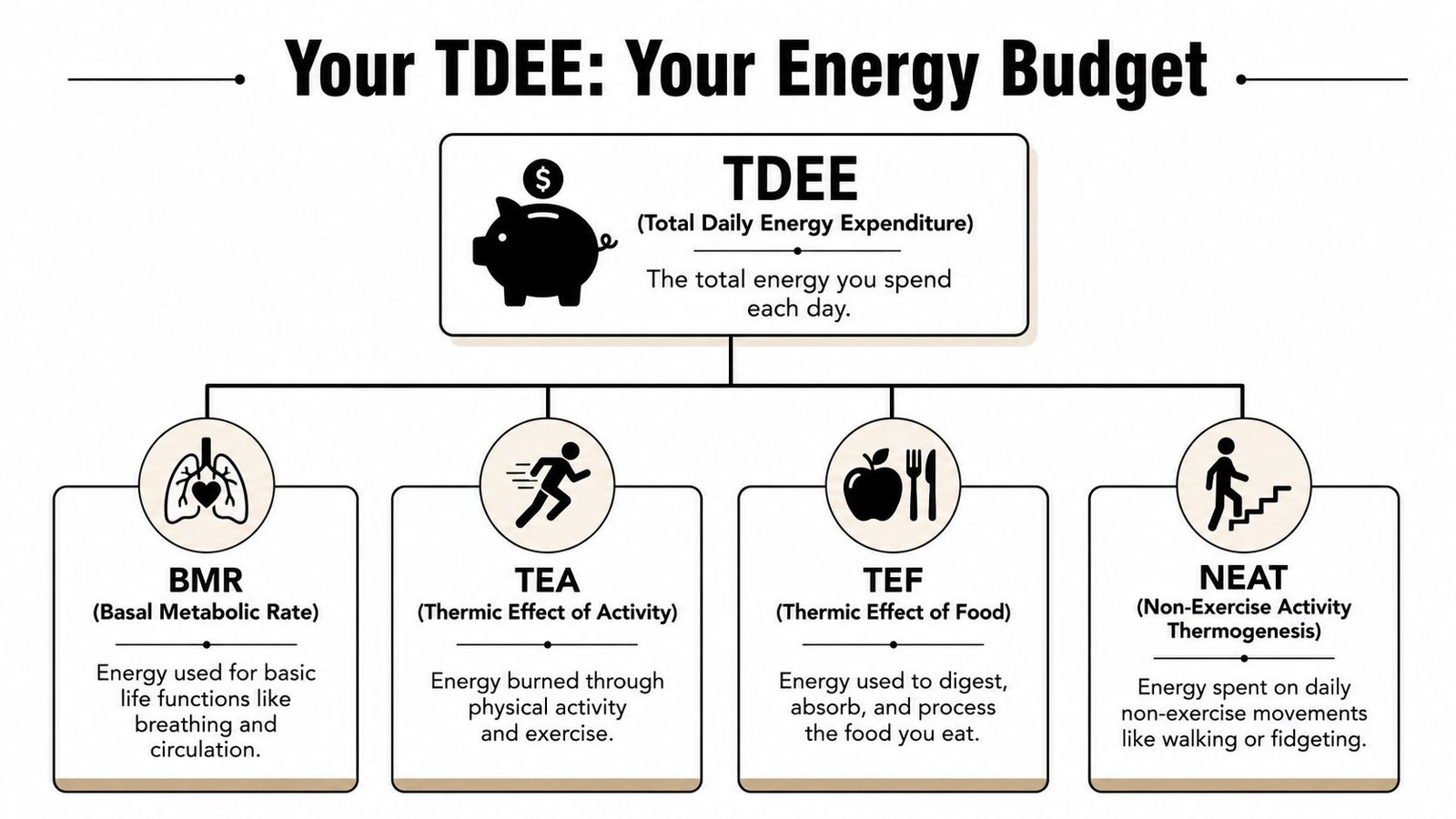
TDEE sounds technical, but the idea is straightforward. TDEE = BMR + TEF + NEAT + TEA, and because it includes all daily energy use, it's the best single estimate for the calories needed to maintain current body weight, as explained in this overview of how to calculate TDEE.
BMR is your fixed cost
Your BMR, or basal metabolic rate, is the energy your body uses just to stay alive. Breathing, circulation, body temperature, organ function. Even if you stayed in bed all day, your body would still burn calories doing those basic jobs.
I like to call this your rent. You don't choose it day to day. It's the cost of keeping the lights on.
TEF is the cost of processing food
Your TEF, or thermic effect of food, is the energy your body uses to digest, absorb, and process what you eat.
This confuses people because they assume all calories eaten are immediately available. They're not. Your body spends some energy handling the meal itself.
NEAT is your sneaky daily burn
Your NEAT, or non-exercise activity thermogenesis, covers all the movement that isn't formal exercise. Walking to the car. Pacing during a phone call. Standing while cooking. Carrying groceries. Cleaning the kitchen.
For many people, this is the most overlooked part of TDEE.
Practical rule: Don't judge your daily calorie needs by gym time alone. A short workout and an otherwise inactive day can burn less energy than a day with lots of walking, standing, errands, and chores.
TEA is your planned exercise
Your TEA, or thermic effect of activity, is the energy you burn during intentional exercise. Lifting, running, cycling, classes, sports. This is often the first activity considered.
It matters, but it's only one slice of the full picture.
Here's a simple way to remember the four parts:
| Part | Plain-English meaning | Budget analogy |
|---|---|---|
| BMR | Energy for basic survival | Rent |
| TEF | Energy to digest food | Processing fee |
| NEAT | Everyday movement | Miscellaneous spending |
| TEA | Planned workouts | Intentional spending |
If calorie tracking terms feel abstract, it also helps to understand the basics of energy itself, like how many calories are in a gram of protein, carbs, and fat. That makes TDEE easier to use in real meals instead of just seeing it as a calculator number.
How to Calculate Your Estimated TDEE
Typically, a lab test isn't required to get started. What's needed is a reasonable estimate that can be used today, then adjusted based on real-life results.
A common way to estimate TDEE is to first estimate BMR using a predictive equation, then multiply it by your activity level. Historical TDEE guidance often references formulas like Harris-Benedict, while more recent clinical guidance commonly favors Mifflin-St Jeor for healthy adults, as discussed in this review of TDEE history and estimation methods.
Step one, estimate your BMR
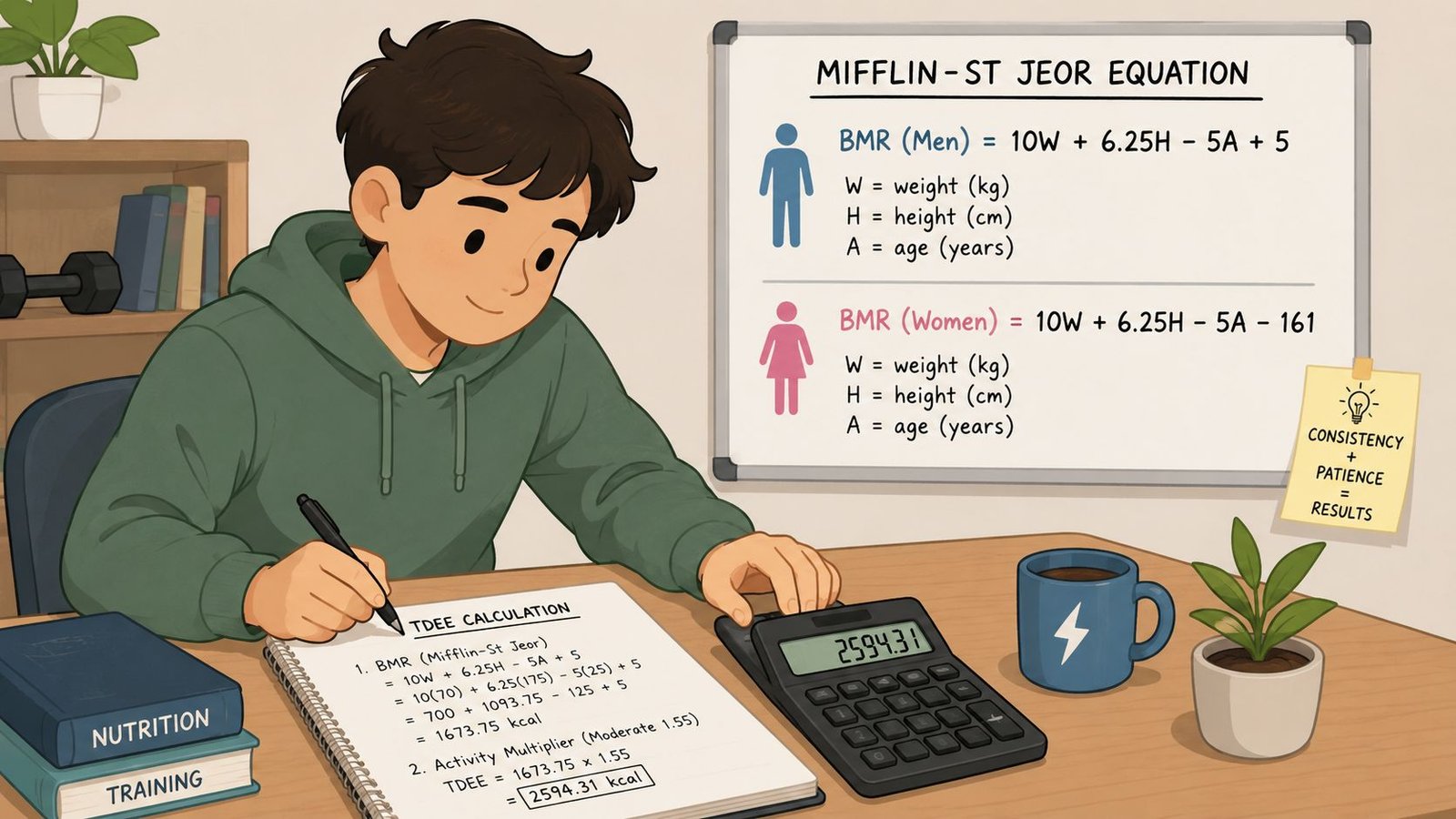
Use the Mifflin-St Jeor equation.
For men:
BMR = 10 × weight in kg + 6.25 × height in cm – 5 × age in years + 5
For women:
BMR = 10 × weight in kg + 6.25 × height in cm – 5 × age in years – 161
This gives you an estimate of what your body burns at rest.
Step two, choose your activity multiplier
TDEE is commonly built from BMR or REE plus activity multipliers such as 1.2 for sedentary adults, 1.375 for lightly active people, 1.55 for moderately active adults, 1.725 for very active adults, and 1.9 for extremely active adults, according to this overview of what TDEE is and how multipliers work.
A useful way to think about those categories:
- Sedentary means mostly sitting, little intentional activity
- Lightly active usually means some movement or a few easy workouts
- Moderately active often fits people with regular training and decent daily movement
- Very active usually means hard training, physical work, or both
- Extremely active is reserved for unusually high workloads
Individuals tend to do better when they choose conservatively. Desk job plus a few gym sessions often isn't as active as it sounds.
Step three, multiply BMR by activity
Let's use a simple example with the verified reference point.
If someone's BMR is 1,500 kcal/day, their estimated TDEE would be:
- About 1,800 kcal/day if sedentary
- About 2,325 kcal/day if moderately active
- About 2,850 kcal/day if very active
That range shows why two people with the same body size can need very different calorie intakes.
This walkthrough can help if you want to see the math explained visually:
Step four, treat the result as a starting point
Your estimated TDEE is not a verdict. It's a starting target.
Use it for a couple of weeks, pay attention to your body weight trend, training performance, hunger, and consistency, then adjust if needed. The best TDEE estimate is the one that matches what your body does in real life, not just what a calculator spits out.
Using Your TDEE to Reach Your Goals
Once you have an estimated TDEE, you can finally use calories with purpose instead of guessing.
If you want to maintain
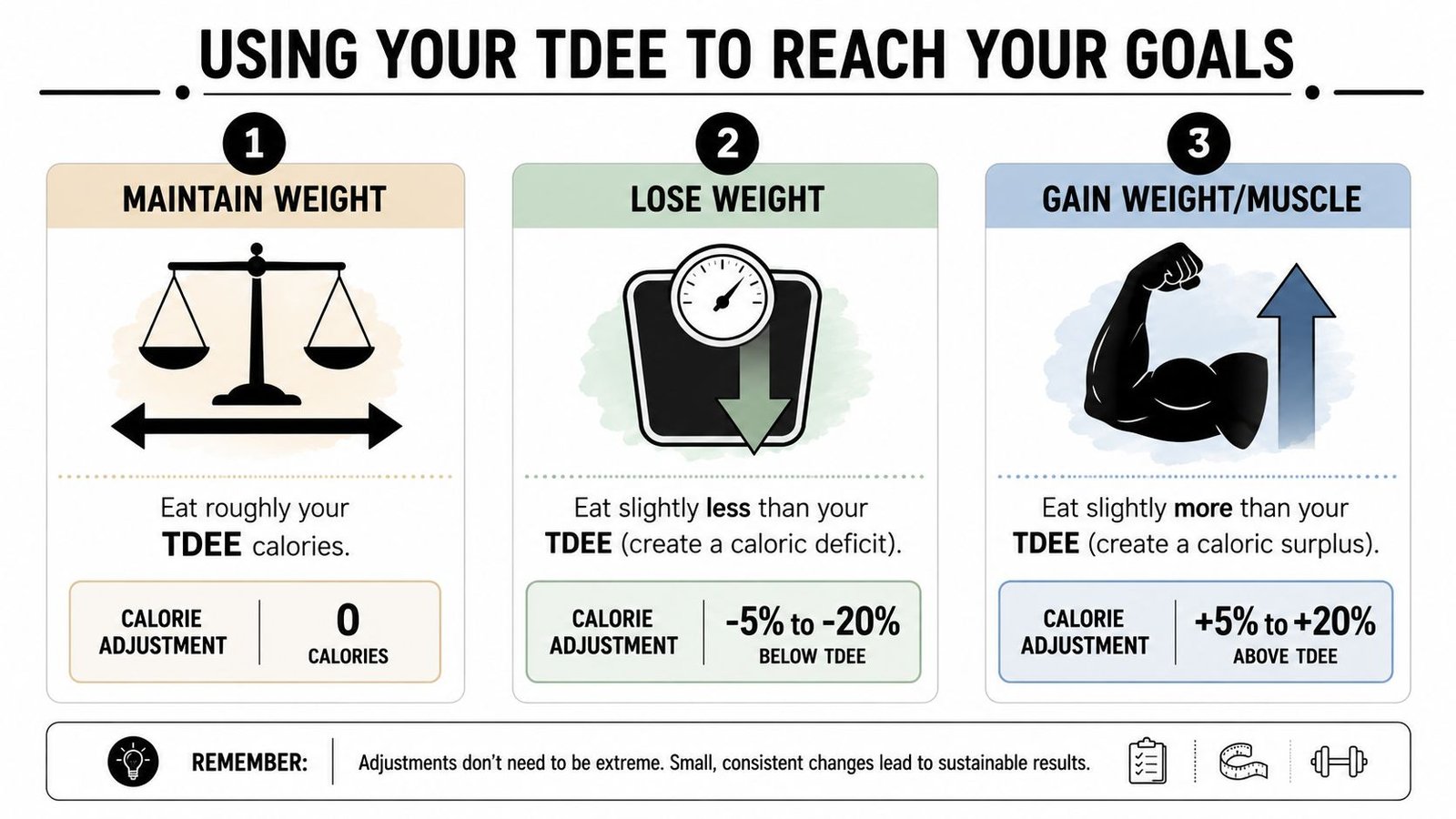
Eat roughly around your TDEE.
This is a good phase if you're happy with your current body weight, want to focus on performance, or need a break from dieting. Maintenance is also useful after a dieting phase because it gives you a stable reference point.
If you want to lose weight
You'll need a calorie deficit, which means eating below your TDEE. If you're new to the idea, this guide on what a calorie deficit is gives a clean explanation of how that works in practice.
The key is sustainability. If your plan leaves you constantly hungry, tired, and frustrated, you probably won't stick with it.
If you want to gain weight or muscle
You'll need a calorie surplus, which means eating above your TDEE.
Many active people get stuck. They train hard, think they're eating a lot, but still hover around maintenance. A small, consistent surplus is usually easier to manage than trying to force huge meals.
A useful calorie target is one you can follow on ordinary weekdays, not just on your most disciplined day.
Recalculate when your body changes
This part matters more than is often realized. TDEE is not static. It changes with body weight and activity, and research notes that TDEE declines with weight loss because both resting energy expenditure and physical activity energy expenditure tend to decrease, which is why calorie targets often need recalibration during a cut or after a big change in body mass or training, according to this research review on energy expenditure and weight loss.
That means your original target can stop working because your body is no longer the same as when you started.
If meal planning is the part that makes this feel messy, some people find it easier to organize repeat meals and shopping ideas with tools like Mealdill, especially when they're trying to stay consistent with a deficit, surplus, or maintenance intake.
Common TDEE Traps and How to Avoid Them
You plug your stats into a calculator, get a number, follow it for two weeks, and then start wondering why your progress does not match the prediction. That moment trips up a lot of beginners.
TDEE works best as a starting estimate, not a promise. Usually, the issue isn't TDEE itself. It's the way people use the number day to day.
Trap one, overrating your activity level
A few hard workouts per week can make someone feel highly active. But TDEE is based on your whole day, not the 45 minutes you spent training.
If your job is desk-based, your evenings are mostly sedentary, and your step count is low, “moderately active” may overshoot your real calorie needs. A better approach is to choose the activity level that matches your average week, then adjust after you watch your weight trend for a couple of weeks.
Honesty beats optimism here.
Trap two, assuming workouts drive most of your calorie burn
Your daily energy budget works like a household budget. Exercise is one category, but it is not the only one, and for many people it is not the biggest one either. Resting metabolism, digestion, and all the small movements that happen outside the gym also shape your total burn. The Cleveland Clinic's overview of TDEE and the role of nonexercise activity thermogenesis is a useful reminder that daily movement outside planned workouts matters more than many people expect.
It means the full day matters.
- Walk more on purpose. Regular steps, short walks, and movement breaks are often easier to repeat than adding more hard training.
- Protect your baseline activity. Chores, errands, standing, and pacing during calls all count.
- Be careful with “eating back” workouts. Watch estimates from wearables and cardio machines closely, since they can run high.
A visible gym session gets all the credit. Quiet movement across the day often has more influence on your real-world calorie needs.
Trap three, quitting because calculators disagree
Different calculators use different formulas. So different answers are normal.
Do not keep searching until you find the number you like best. Pick one reasonable estimate, use it consistently, and compare it against what your body does over time. If you need help tightening up the food side of the process, this guide on how to count calories accurately without making it miserable can make the testing phase much easier.
Trap four, changing everything at once
This is one of the fastest ways to get confused and frustrated. If you cut calories hard, add extra cardio, start a lifting program, and try to hit perfect macros in the same week, you create too many moving parts to learn from.
Keep it boring for a bit.
- Set one calorie target based on your TDEE estimate.
- Track consistently long enough to spot a pattern.
- Change one variable at a time if progress is too slow or too fast.
That steady approach fits real life better than a perfectionist reset. The same idea shows up in implementing hybrid fitness solutions. Simple systems tend to survive busy schedules better than rigid plans.
Make TDEE Work for You with Smart Tracking
Knowing what TDEE is gives you direction. Tracking is what turns that direction into action.
Quitting isn't because calorie awareness is useless. They quit because logging food feels annoying. Searching giant databases, scanning labels, rebuilding the same breakfast over and over, and guessing restaurant meals can make the process feel heavier than it needs to be.
Reduce friction or you won't stay consistent
The best nutrition plan is often the one that asks the least from you during a busy Tuesday.
That's why simple systems matter. Repeating a few go-to meals, pre-logging food, and keeping your meal structure boring in the best way can make TDEE much easier to use. If your week includes at-home meals, takeout, and gym days that don't happen on a perfect schedule, it helps to think in flexible routines instead of strict meal plans. This article on implementing hybrid fitness solutions makes a useful point about blending structure with real life, and the same mindset works for nutrition.
Track patterns, not perfection
If you miss one meal log, don't turn that into a lost day. Log the next meal.
If your estimate was off, adjust it. If weekends look different from weekdays, account for that instead of pretending they don't. The people who get the most out of TDEE usually aren't the most obsessive. They're the most consistent.
A practical place to start is learning how to count calories without overcomplicating every bite. Once you understand the basics, TDEE stops being just a concept and becomes a number you can use.
Keep the process light enough that you'll still do it when work is hectic, the kids need dinner, or your schedule gets messy.
That's the part many articles skip. TDEE only helps if you can apply it on real days, not imaginary perfect ones. Keep your estimate simple, track accurately, review your trend, and make small changes when needed. That's how the number becomes useful.
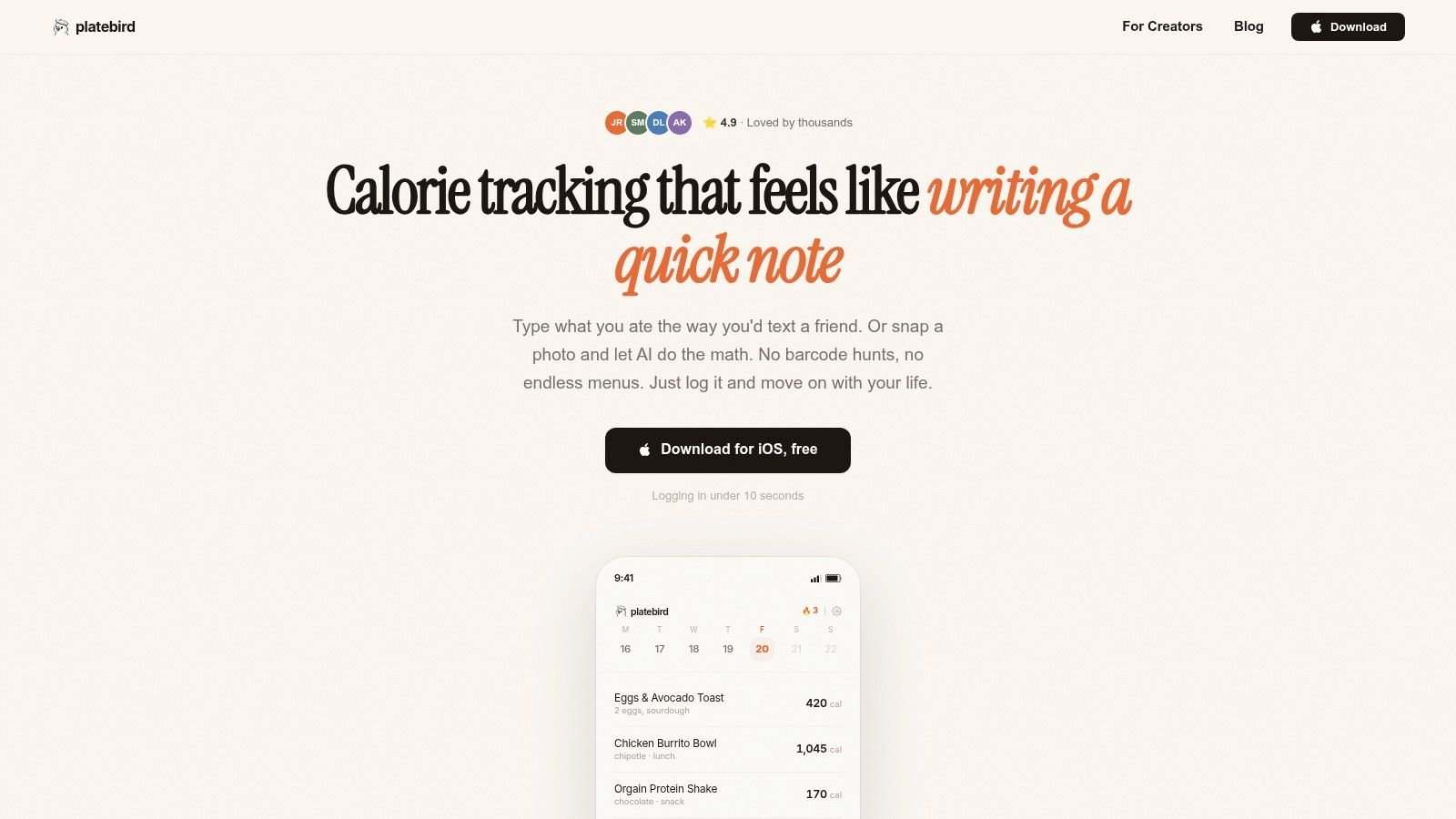
If you want an easier way to apply your TDEE without turning food logging into a chore, try PlateBird. You can type meals like “eggs toast coffee” or snap a photo of your plate, and it quickly turns your intake into calories and macros so you can stay consistent with less effort.