
The most popular advice about fruit sugar is also the least helpful. One side says fruit is always healthy, so don't worry about it. The other says sugar is sugar, so fruit is basically dessert with vitamins. Neither view gives you much to work with in real life.
If you're trying to lose weight, steady your energy, manage blood sugar, or calm a sensitive gut, the useful question isn't “Is fruit good or bad?” It's what kind of fruit, in what form, and in what amount for your body. That's a very different conversation.
As a nutrition educator, I usually tell clients that fruit doesn't need to be feared, but it also doesn't need to be treated like a free food in every situation. The middle ground is often the most beneficial approach. You can enjoy fruit, get the benefits, and still make smart choices based on your goals.
Is the Sugar in Fruit Actually Bad for You
Your confusion makes sense. You've probably heard “avoid sugar” and “eat more fruit” in the same week.
Both messages are missing context. Fruit contains fructose, a naturally occurring sugar, but that doesn't automatically make a bowl of berries metabolically equal to a soda or a pastry. The body responds not only to the sugar itself, but also to the form it comes in.
Source matters more than the label
A whole fruit comes with water, fiber, and plant structure. That package changes how quickly the sugar is delivered and how filling the food feels. Added sugars in sweet drinks or processed foods don't arrive in the same package.
That's why “fruit sugar” isn't a useful category by itself. A person eating an orange, a person drinking apple juice, and a person having a sweetened beverage are all consuming sugars from very different sources.
A better rule: Stop asking whether fruit has sugar. Ask how that sugar is being delivered.
For many people, this shift removes a lot of unnecessary food anxiety. It also makes tracking easier. Instead of trying to ban fruit, you start noticing patterns. Which fruits keep you full? Which ones seem easier on your digestion? Which forms, like juice or dried fruit, are easy to overdo?
Fruit can fit into a weight loss plan
If you're working on body composition or appetite control, fruit often fits well when it replaces more processed sweets and snacks. Practical habit-based approaches, like these Blue Haven RX weight loss strategies, can help you think in terms of routines and food quality instead of all-or-nothing restriction.
The key is staying out of the two extremes. Fruit isn't the villain. But if you're someone who logs food, manages IBS symptoms, or watches total carbs, it also makes sense to be aware that some fruits deliver a much heavier fructose load than others.
Understanding Fructose Source and Why It Matters
Fructose is often called “fruit sugar,” but that nickname causes trouble. It makes people assume all fructose behaves the same way no matter where it comes from.
It doesn't.
The package changes the effect
Think of fructose like water. Water sipped slowly from a bottle feels very different from water dumped all at once. The substance is the same, but the delivery changes the experience.
Food works similarly. In whole fruit, fructose arrives inside a food matrix that includes fiber, water, intact plant cells, and other nutrients. In added sugars, especially sweetened beverages, that structure is mostly absent. The sugar is easier to consume quickly and in larger amounts.
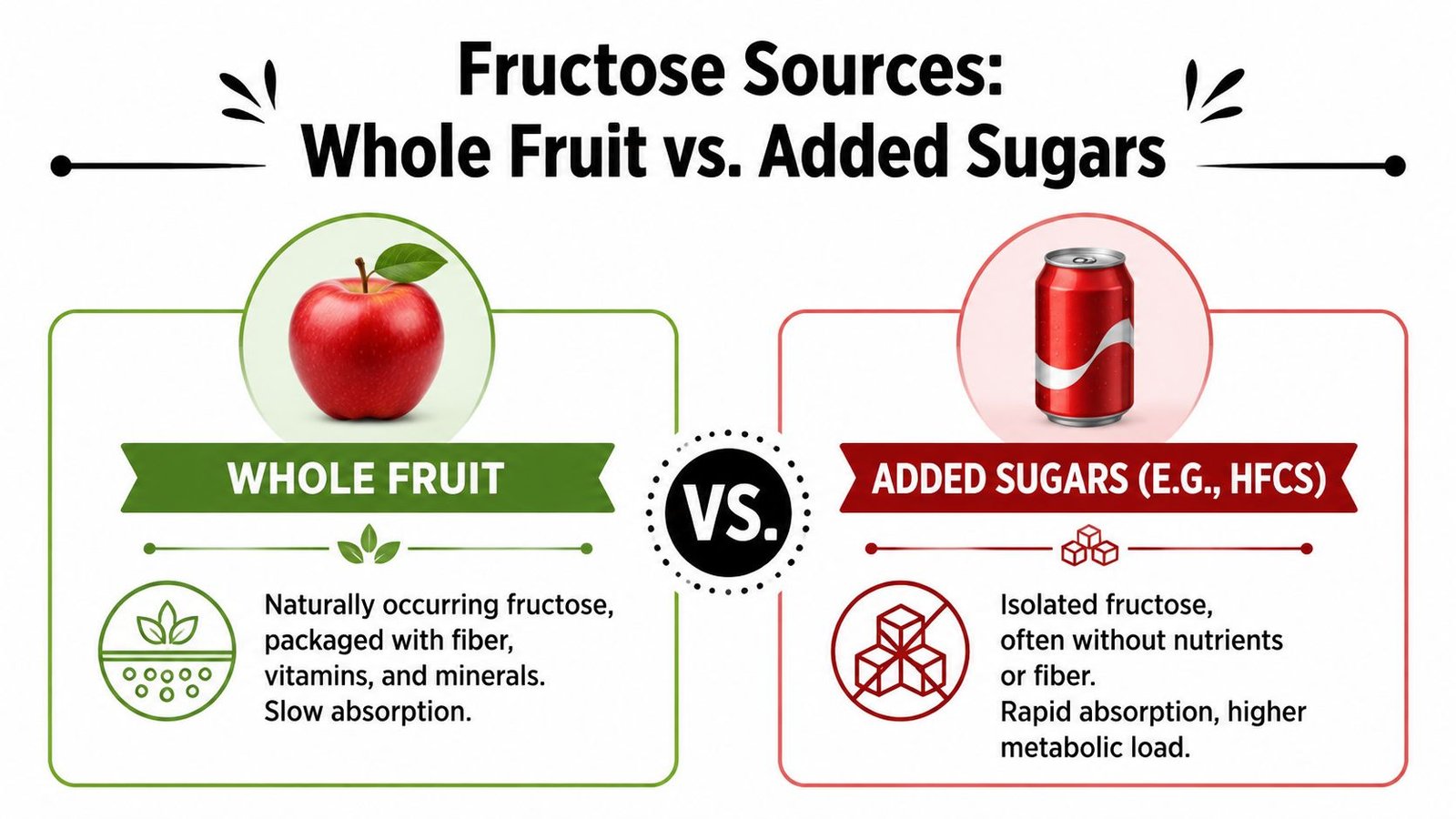
That difference matters enough that extension guidance from the University of Florida notes that many discussions wrongly blur fructose in whole fruit with fructose from sugar-sweetened beverages, while scientific literature increasingly separates these sources. The same guidance also notes that moderate whole fruit intake is often associated with lower type 2 diabetes risk, unlike added sugars in these broader diet patterns, as explained in the University of Florida fructose guidance.
Why this gets misinterpreted
People hear “fructose can be a problem” and then start looking suspiciously at apples and blueberries. But the main concern in everyday nutrition comes from added-fructose sources or concentrated forms, not from eating normal portions of whole fruit.
Here's the practical distinction:
- Whole fruit tends to be slower to eat, more filling, and harder to consume in excess quickly.
- Juices and sweet drinks can deliver sugar fast, with little of the structure that slows intake.
- Processed foods with added sugars often combine sweetness with low satiety, which makes portion creep common.
Whole fruit and added sugar may share a sugar molecule, but they don't arrive in the body in the same context.
That's the frame I want clients to use when they think about fructose in fruits. Don't reduce fruit to a sugar number alone. Look at the source, the form, and how that food behaves in your routine.
How Your Body Processes Fructose From Whole Fruits
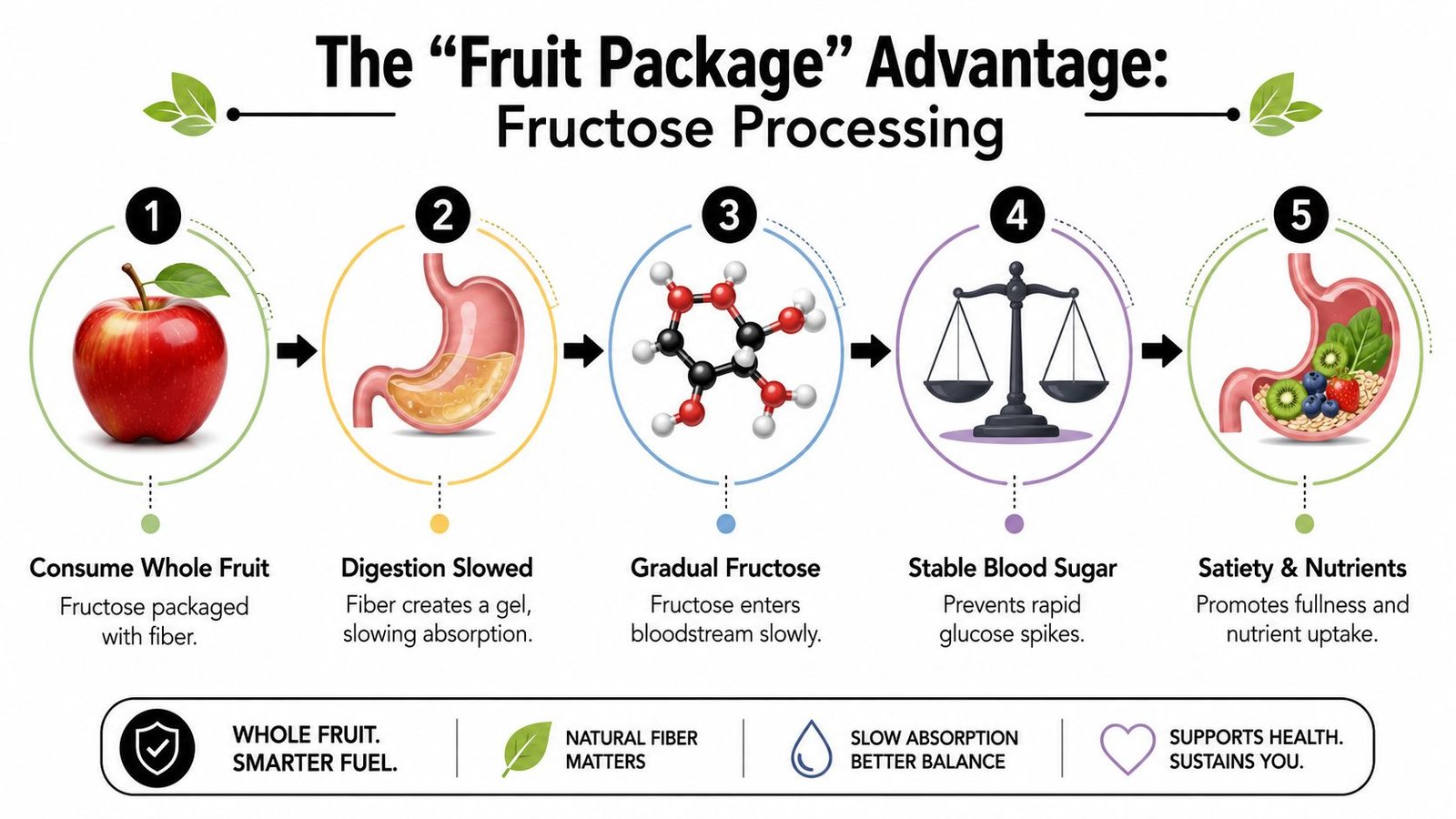
A simple way to understand whole fruit is to think of it as a time-release capsule. The fructose is there, but it's not hitting your system in the same way as a drink or a concentrated sweetener.
The fruit matrix slows the process
Whole fruits deliver fructose within a fibrous structure. Fiber and intact cell walls slow gastric emptying and reduce the rate of sugar delivery to the small intestine. Clinical guidance from the University of Virginia specifically points out that concentrated fruit sources like juice and dried fruit are often less tolerated, while fresh or frozen fruit is often better tolerated in modest portions such as 1/2 cup of cut fruit or one medium fruit per serving, according to the University of Virginia low-fructose handout.
This is the “how” behind the advice.
Why juice and dried fruit feel different
Juice removes much of the fruit's natural structure. Dried fruit concentrates what's left into a smaller volume. So even when the starting ingredient is fruit, the eating experience changes.
You can drink juice quickly. You can eat a lot of dried fruit before your body registers fullness. Whole fruit usually asks you to chew, slow down, and stop sooner.
That's why some people say they “do fine with fruit” but feel bloated or snacky with juice or dried fruit. They're not imagining it. The format changes tolerance and portion ease.
Practical ways to use this
If you want to keep fruit in your diet while staying more metabolically steady, these habits usually help:
- Choose intact fruit first when possible. An orange, apple, kiwi, or berries usually create a very different eating experience than juice.
- Treat dried fruit as concentrated rather than casual. It can fit, but it's easy to underestimate.
- Pair fruit with a meal or snack if you notice better appetite control that way.
If you're interested in the broader blood sugar side of meal structure, these Dr. Matt's blood sugar insights offer a helpful plain-language overview. And because fiber is one of the big reasons whole fruit behaves differently, this explainer on whether fiber has calories adds useful context on why fiber-rich foods often feel more satisfying than their sugar content alone would suggest.
Clinical shortcut: If a fruit has been liquefied or concentrated, treat it differently from the whole version.
A Practical Guide to Fructose in Common Fruits
This point often brings the topic into focus for many. Fructose in fruits isn't uniform. “Fruit” is too broad to be useful if you're tracking symptoms, carbs, or appetite.
The spread can be dramatic. According to the Fruit Juice Science Centre, examples include 0 g in limes, 0.6 g in a lemon, 3.0 g in 1 cup of raspberries, 7.1 g in a banana, 9.5 g in an apple, 11.8 g in a pear, 12 g in 1 cup of grapes, and 32.4 g in 1 mango, as shown in the Fruit Juice Science Centre fructose reference.
Fructose content in common fruits per serving
| Fruit | Serving Size | Approx. Fructose (grams) | Category |
|---|---|---|---|
| Lime | 1 fruit | 0 g | Lower fructose |
| Lemon | 1 fruit | 0.6 g | Lower fructose |
| Raspberries | 1 cup | 3.0 g | Lower fructose |
| Banana | 1 fruit | 7.1 g | Moderate fructose |
| Apple | 1 fruit | 9.5 g | Higher fructose |
| Pear | 1 fruit | 11.8 g | Higher fructose |
| Grapes | 1 cup | 12 g | Higher fructose |
| Mango | 1 fruit | 32.4 g | Very high fructose |
What the table actually means
The goal here isn't to ban mangoes or apples. It's to understand that one fruit choice can create a very different fructose load than another.
A cup of raspberries and one mango don't belong in the same mental bucket if you're trying to reduce fructose at a meal. If you're just eating for general health and feel good with a variety of fruit, this difference may not matter much. But if you're logging food carefully or troubleshooting bloating, it matters a lot.
That's also why generic food trackers can be misleading. “Fruit” as a single entry is too vague. Even “mixed fruit” can hide a very different balance depending on whether the bowl contains berries and citrus or apples and grapes.
A simple decision rule
Use fruit in one of three ways depending on your goal:
- For general healthy eating, rotate different fruits and don't obsess over small differences.
- For appetite and blood sugar awareness, choose more often from fruits that feel filling and less easy to overconsume.
- For digestion tracking, be more precise about the exact fruit and portion.
If you want one easy example, swapping a higher-fructose fruit for berries can change the fructose load of a meal without removing fruit altogether. This is also one reason berries are so popular in tracking plans. If you're curious about one of the most common options, this guide on whether blueberries have fiber pairs well with the table above.
Health Effects and Individual Gut Tolerance
Generally, whole fruit is not the metabolic problem the internet makes it out to be. In a balanced eating pattern, whole fruit usually brings benefits that go beyond its sugar content.
Where people get tripped up is assuming that everyone tolerates fruit the same way. They don't.

For most people, fruit is a positive food
If you're eating whole fruit in reasonable portions, it can support fullness, nutrient intake, and a more satisfying diet overall. That's very different from grazing on sweetened snacks or drinking calories.
The fear starts when people hear that fructose can trigger symptoms in some settings and assume that means fruit itself should be minimized across the board. That's usually not necessary.
For IBS and FODMAP issues, specificity matters
If you have IBS, frequent bloating, or suspected fructose malabsorption, then fruit type becomes much more important. A fruit-fructose reference commonly used in practical guidance shows higher fructose examples such as apple at about 9.5 g, pear at about 11.8 g, and mango at about 32.4 g, while berries and citrus are often used as lower-load substitutes, as summarized in this guide to fructose content in fruit.
That doesn't mean those higher-fructose fruits are “bad.” It means they may be less comfortable for some guts.
If fruit gives you symptoms, don't start by removing all fruit. Start by changing the type, the portion, or the form.
A food-and-symptom log is often more revealing than a list of “good” and “bad” foods. Some people tolerate small servings well but react to larger ones. Others do fine with berries yet notice trouble with apples, pears, juice, or dried fruit.
If you're trying to connect everyday eating patterns with longer-term blood sugar markers, it can also help to understand fructosamine levels, which gives a different lens than a single finger-stick reading. That kind of context can be useful when fruit anxiety is really standing in for a broader concern about sugar regulation.
How to Track Fruit Intake the Smart Way
If fruit is healthy for you but the dose and type still matter, tracking should reflect that reality. The problem is that many food logs make fruit harder to track accurately than it should be.
“Fruit salad,” “banana,” or “apple slices” can all be entered loosely. But fructose in fruits varies enough that vague logging isn't very helpful when you're watching carbs, comparing meals, or trying to spot symptom patterns.
What smart tracking should actually do
A modern tracker should make it easy to log the exact fruit, the approximate portion, and the rest of the meal without making you scroll through endless generic entries. That's especially helpful when your real-life meals aren't perfect serving sizes.
If you're comparing tools, a guide to the best macro tracking app can help you think about what matters most. Speed, food recognition, and ease of repeated logging usually matter more than endless manual database searching.
The best fruit tracking approach is simple:
- Log the specific fruit instead of “fruit.”
- Estimate the portion reasonably rather than trying to be perfect.
- Notice patterns over time. One apple won't tell you much. Repeated responses will.
That's how tracking becomes useful. Not as a punishment system, but as a way to turn confusion into useful feedback.
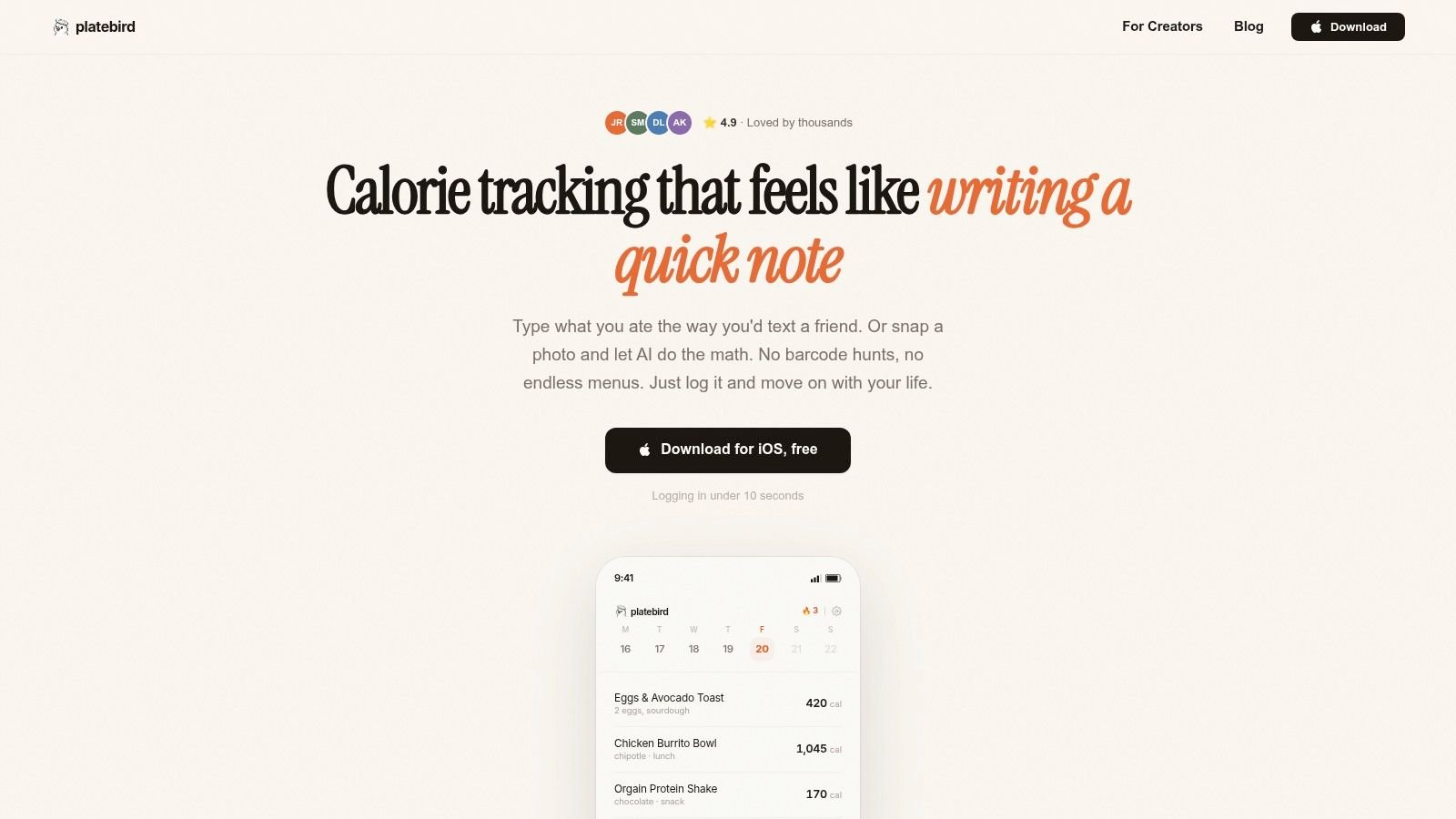
If you want a faster way to log meals without getting buried in food database searches, PlateBird makes tracking feel much lighter. You can type what you ate or snap a photo, then use the log to spot the exact fruit choices and meal patterns that work best for your goals.