
You're probably here because you tried to “be good” with food, moved a little more, and expected your body to cooperate.
Instead, you got the most annoying result possible. Not a total disaster. Just enough confusion to make you wonder whether calorie math is broken. Maybe you started eating what a calculator told you was right, but your weight stayed the same. Maybe you cut back and ended up hungry, distracted, and tired by midafternoon. Maybe you work at a desk all day, train hard a few evenings a week, and have no idea whether you count as sedentary or active.
That frustration makes sense. Most advice gives you one calorie number and treats it like a fact carved in stone. Real life doesn't work that way. Your body has a baseline energy cost, your routine changes how much you burn, and modern lifestyles often sit awkwardly between the old categories on calorie calculators.
Think of your body like a budget. Calories are your daily spending money. Some of that budget goes to fixed bills, some goes to movement, and some goes to the basic cost of processing food. If you don't know your real budget, it's easy to overspend without realizing it, or cut too hard and feel awful.
Why Eat Less Move More Is Incomplete Advice
A new client will often tell me the same story in slightly different words: “I'm eating less and exercising more, so why isn't this working?”
Usually, they aren't failing. They're guessing.
“Eat less, move more” is a simple description of energy balance. It isn't a complete plan. It doesn't tell you how much less to eat, how much more to move, or how to adjust when your life doesn't fit neatly into a generic calculator box.
Why the advice feels true but still falls short
If your body is a budget, then “eat less, move more” is like hearing “spend less than you earn.” That advice is correct. It just doesn't help much if you don't know your income, your fixed bills, or where your money is leaking.
Calories work the same way. You need a starting number that matches your body and your routine. Without that, people tend to bounce between extremes:
- They under-eat on weekdays and feel virtuous, then end up raiding the pantry at night because hunger finally catches up.
- They overestimate exercise calories and unknowingly erase the progress they thought they made at the gym.
- They copy someone else's target from social media, even though that number was built for a different body, schedule, and goal.
That's why a clear explanation of how a calorie deficit works helps so many beginners. It turns vague diet language into a practical rule you can use.
The real problem is mismatch
A lot of people aren't struggling because they lack discipline. They're struggling because the number they're following doesn't match the life they're living.
Take two people who both say, “I'm moderately active.” One walks a lot for work and is on their feet most of the day. The other sits for most of the day but does a hard evening workout. Those are not the same energy patterns, even if both people feel “active.”
Practical rule: If your calorie target makes you feel confused, constantly hungry, or stuck for weeks, don't assume your body is broken. Assume your estimate needs work.
Daily calorie needs are a tool, not a punishment
Daily calorie needs find their utility. Not as a diet rule. Not as a moral score. Just as information.
Once you know roughly how much energy your body uses in a normal day, food choices get less emotional. You can decide whether you want to maintain, lose, or gain. You can adjust with intention instead of reacting to every random weigh-in.
That shift matters. Guessing creates stress. A workable estimate creates options.
Your Body's Baseline The BMR Explained
Start with the part of calorie burn you do not have to earn.
Your body uses energy all day, even when you are fully at rest. That baseline is BMR, or Basal Metabolic Rate. It covers the behind-the-scenes work that keeps you alive, whether you are answering emails, sleeping, or taking a rest day.
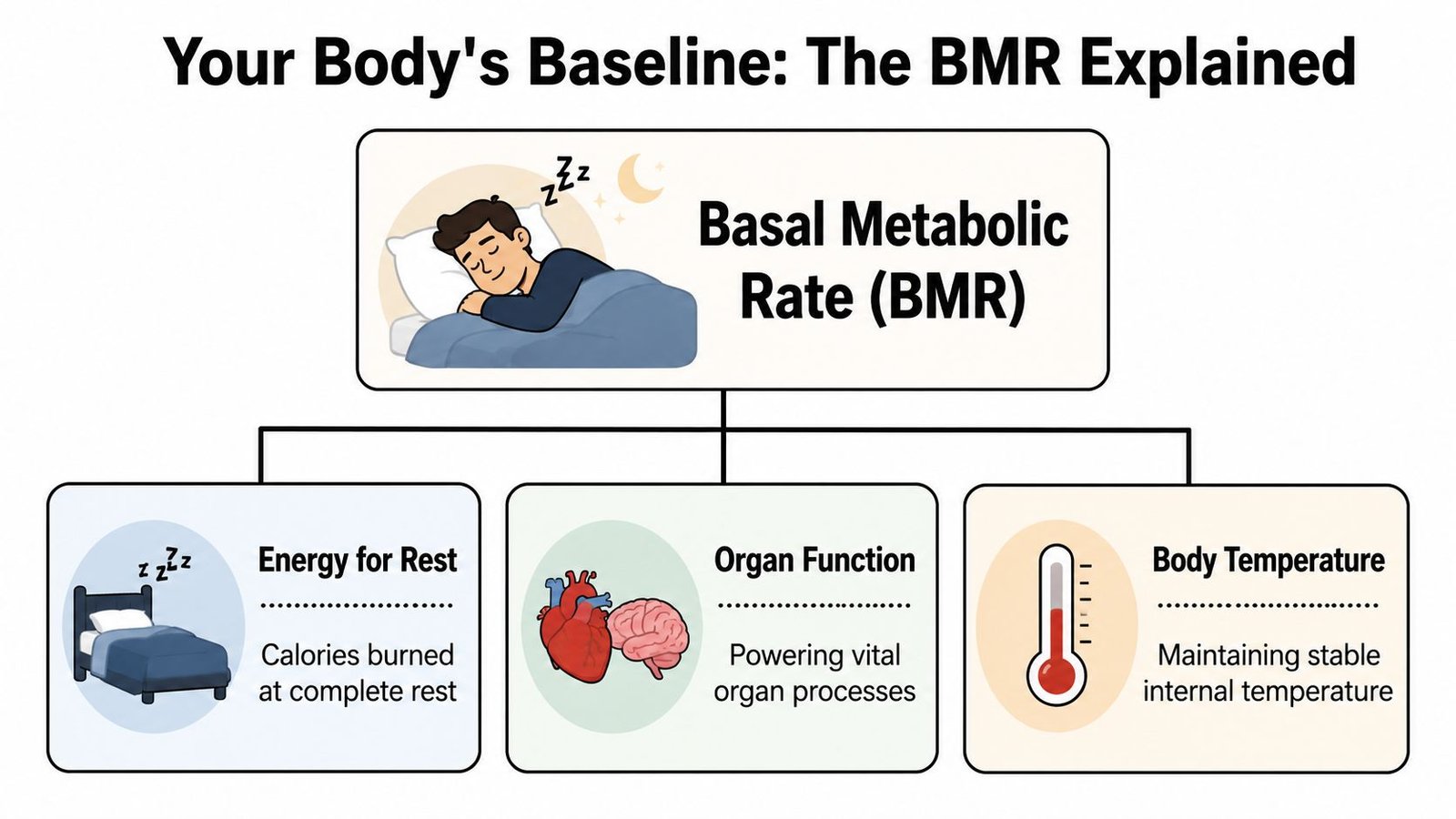
What BMR pays for
Even if you stayed in bed all day, your body would still need fuel. Your heart pumps. Your lungs bring in oxygen. Your brain sends signals. Your body keeps your temperature in a safe range.
This is often overlooked because exercise is more visible. You can feel a workout. You cannot feel your liver, kidneys, or nervous system using energy every minute. Yet those systems make up a large share of your daily calorie use. The Cleveland Clinic explanation of BMR describes it as the calories your body needs to perform basic life-sustaining functions at rest.
A helpful way to picture it is a body budget. BMR is your fixed monthly bill. It gets paid before your steps, workouts, or weekend plans enter the picture.
Why this matters for beginners
Many new calorie trackers make one of two errors.
They cut calories too hard because they assume food only "counts" if they exercised that day. Or they give exercise too much credit and eat back every calorie their watch reports.
Both mistakes come from the same misunderstanding. Exercise adds to your total burn, but it does not replace your baseline. Your body was already spending energy before the workout started.
That point matters even more in modern life. A person with a desk job and hard evening training sessions may look "active" on paper, but their day still includes many hours of low movement. If they use a generic calorie target without understanding BMR first, their estimate can swing too high or too low.
Your baseline is the starting number, not a bonus number.
A simple mental model
Use three buckets:
- BMR is your fixed cost
- Movement is your variable cost
- Digestion is a smaller extra cost
This is why two people can eat the same lunch and need different calorie totals by the end of the day. One may have a higher fixed cost before activity is even counted.
General calorie charts can still be useful for context. The Dietary Guidelines for Americans, 2020-2025 provide broad estimated calorie ranges by age, sex, and activity level. Those ranges are starting points, not personal prescriptions. If you want a practical companion after you learn your baseline, your guide to TDEE and weight management shows how baseline needs connect to real-world calorie targets.
That is why a single calorie number is often wrong. Your true daily need starts with BMR, then gets shaped by how your life is built.
Adding Life to the Equation Calculating Your TDEE
You sit for eight hours, crush a hard workout after work, and then open a calorie calculator. One dropdown asks you to choose a lifestyle: sedentary, lightly active, moderately active, or active. If your day is half office chair and half intense training, that single label can miss how you live.
That is where TDEE, or Total Daily Energy Expenditure, becomes more useful than a generic calorie chart. If BMR is your body's base bill, TDEE is the full daily budget after work, walking, chores, workouts, and digestion are added in. It is the closer estimate of what your body spends over a real day, not just at rest.

Why generic activity labels can mislead you
Many calculators sort daily life into broad buckets. That makes the math easy, but real schedules are often mixed.
A person may spend most of the day at a desk and still train hard for 45 minutes at night. Someone else may never do a formal workout but walk, lift, carry, and stand for hours at work. Both people burn energy differently, yet a basic calculator may push them into the same category or the wrong one.
Atlantic Health notes this problem clearly in its discussion of calorie estimates and activity levels. A 2023 study cited there found that many people with desk jobs who also exercise regularly rate themselves as more active than they are across the whole day, which can push calorie targets too high and slow fat loss progress, as described by Atlantic Health.
The desk job athlete problem
This is one of the biggest reasons calorie math feels confusing.
An intense workout absolutely counts. But one hard session does not erase ten hours of low movement. If you choose “active” because your workouts are challenging, the calculator may assign you the calorie needs of someone who trains and also moves a lot between workouts.
That difference adds up fast.
A better approach is to treat calculator categories as rough starting estimates rather than fixed identities. Your true calorie need depends on the shape of your whole day.
A better way to judge your true activity level
Ask practical questions instead of picking the label that sounds closest:
- How many hours of my day are spent sitting?
- Outside workouts, do I walk much or stay mostly still?
- Are my workouts short and intense, or am I active for long stretches?
- Do my weekdays and weekends look completely different?
These questions help you build a more honest estimate. They also make it easier to adjust later if your first number misses the mark.
If food logging feels confusing while you do this, learning the basics of how calories in a gram of protein, carbs, and fat add up can make the numbers easier to follow.
If your routine is mixed, your first calorie target should be treated like a draft.
For a deeper breakdown of how activity factors shape your estimate, your guide to TDEE and weight management is a useful companion read.
TDEE is a living number
Your TDEE changes when your routine changes. Training blocks, step counts, sleep, stress, travel, and even the season can shift how much energy you use.
That is why a single calorie number is often wrong for modern life. The better method is simple. Start with an estimate, watch your weight and hunger for a couple of weeks, and adjust from there. That process gives you a number based on your real life, not just a dropdown menu.
The Two Key Formulas for Finding Your Numbers
When people hear “calculate your calories,” they often picture complicated math. It's more manageable than it sounds.
For BMR, two names come up again and again: Mifflin-St Jeor and Harris-Benedict. Both aim to estimate your baseline calorie needs from your body size, age, and sex. The main difference is that one is generally treated as the more current tool.
Mifflin-St Jeor and Harris-Benedict side by side
| Formula | Comparison |
|---|---|
| Mifflin-St Jeor | Considered a better predictor of BMR, especially for the general population. |
| Harris-Benedict | An older formula, which may overestimate BMR by about 5%. |
If you're just trying to get a practical starting point, Mifflin-St Jeor is usually the more sensible choice. Harris-Benedict still appears in older calculators, so it's worth recognizing the name, but many people do better starting with the newer estimate.
The formulas in plain English
Here's the Mifflin-St Jeor equation:
- For women: BMR = (10 × weight in kg) + (6.25 × height in cm) − (5 × age in years) − 161
- For men: BMR = (10 × weight in kg) + (6.25 × height in cm) − (5 × age in years) + 5
The numbers may look clinical, but they're just a way of translating your body stats into an estimated baseline.
If unit conversions confuse you, it helps to understand how calories relate to grams and food math before you start plugging numbers into any app or calculator.
A worked example
Let's use a hypothetical example from the research background because it makes the process less abstract.
A woman is 35 years old, 162.6 cm tall, and weighs 75 kg.
Using Mifflin-St Jeor:
- 10 × 75 = 750
- 6.25 × 162.6 = 1,016.25
- 5 × 35 = 175
Now put it together:
- 750 + 1,016.25 − 175 − 161
- Estimated BMR = about 1,430 calories/day
That number is her baseline. Not her fat-loss target. Not her “allowed” food for the day. Just the rough cost of keeping the engine running.
Turning BMR into a practical daily target
To estimate TDEE, you then apply an activity factor. The earlier caution is relevant when selecting this factor. Choose your category conservatively if your lifestyle is mixed.
A simple process looks like this:
- Calculate BMR using a formula.
- Choose an activity level based on your full day, not just your workout.
- Estimate TDEE by adjusting BMR upward for activity.
- Test it in real life for a couple of weeks instead of assuming the first number is perfect.
That last step is where confidence grows. The formula gives you a starting line. Your actual routine tells you whether the estimate needs tweaking.
Adjusting Calories for Your Specific Goal
Once you have a rough maintenance range, the next question is simple: what are you trying to do with it?
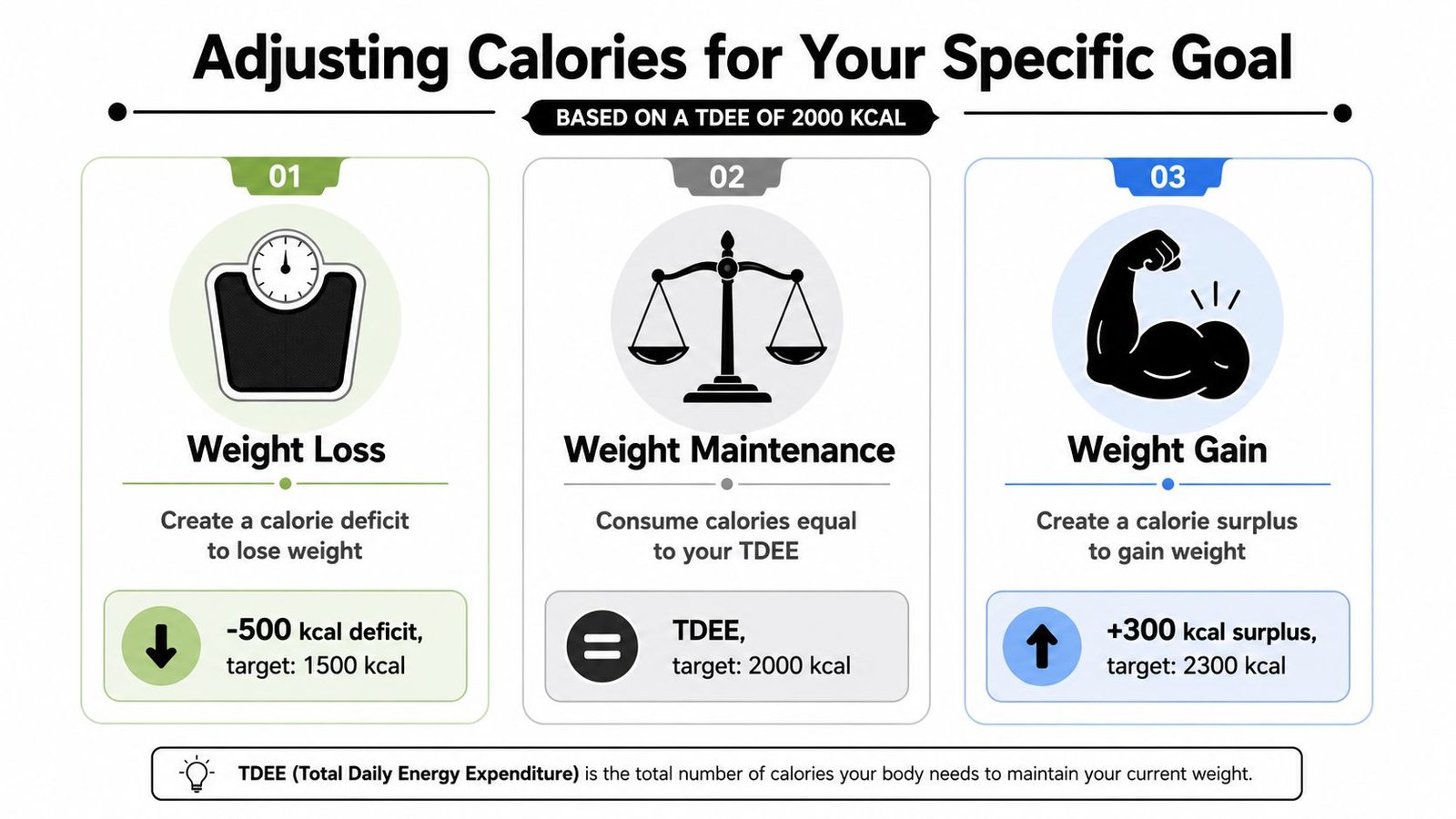
There are only three broad directions. Eat around maintenance to stay the same. Eat below it to lose. Eat above it to gain. The hard part isn't understanding the idea. It's making the adjustment without getting too aggressive.
A simple visual helps:
For weight loss
The safest starting place is usually a moderate calorie deficit, not a crash diet.
For sustainable weight loss of 1 to 2 lbs per week, a calorie deficit of 500–600 kcal/day is clinically recommended. It's also important not to drop below 1,200 kcal/day for women or 1,500 kcal/day for men without medical guidance, according to the British Heart Foundation.
That gives you a practical framework:
- If your maintenance intake is around 2,000 kcal/day, a weight-loss target might be 1,400 to 1,500 kcal/day.
- If your maintenance intake is around 2,500 kcal/day, a weight-loss target might be 1,900 to 2,000 kcal/day.
The point isn't to hit a perfect number every single day. The point is to create a repeatable gap between what your body uses and what you eat.
For maintenance and muscle gain
Maintenance is exactly what it sounds like. You eat roughly in line with what your body uses. This is useful if you're happy with your weight, trying to stabilize after dieting, or learning to track before changing anything.
Weight gain usually means eating above maintenance. In practice, that works best when the surplus is intentional and your training supports the goal. Otherwise, “bulking” can turn into random overeating very quickly.
The useful mindset is this: your goal decides the direction, but your estimated maintenance is still the anchor.
Here's a short explainer if you want a second voice on the topic:
Don't ignore food quality inside the calorie target
Two people can eat the same calories and feel very different.
One person builds meals around protein, fiber-rich foods, and satisfying portions. The other uses the same calorie budget on foods that disappear fast and leave them hungry. On paper, the calories match. In real life, one plan is much easier to stick with.
That's why calorie goals work best when they're paired with meals you can repeat without white-knuckling it. If you want a structured option designed for an older adult audience, this overview of achieve results with weight loss programs may help you compare what guided support can look like.
A good calorie target doesn't just change your weight. It still lets you function like a normal person.
From Numbers to Action With Practical Calorie Tracking
Knowing your target is useful. Following it consistently presents a common challenge.
Not because they're lazy. Because traditional tracking is annoying.
You forget ingredients. You estimate portions badly. You log breakfast and lunch, then give up at dinner because the meal is complicated. After a few days, the plan falls apart, not because daily calorie needs are unclear, but because the tracking method asks too much from a busy life.
Where tracking usually goes off course
The biggest problems are rarely dramatic. They're small leaks.
- Portions drift: A bowl of cereal, spoonful of peanut butter, or splash of oil can be much larger than you think. If you've ever needed help with serving conversions, guides on converting cereal cups to grams show why eyeballing can mislead you.
- Meals get skipped in the log: Snacks, drinks, bites while cooking, and restaurant extras often disappear from memory.
- People quit when logging feels slow: If every meal requires a search marathon, consistency won't last.
Make tracking boring and repeatable
The best calorie tracking system is the one you'll still use when work is busy, your kid needs something, or you're eating leftovers from a container.
That usually means keeping the process simple:
- Log close to the time you eat. Memory gets fuzzy fast.
- Repeat meals on purpose. Familiar breakfasts and lunches reduce decision fatigue.
- Use packaging, labels, or weighed portions when possible. Accuracy improves when you stop guessing.
- Review patterns, not single days. One high day doesn't define anything.
For a practical refresher on the basics, this guide on how to count calories is a helpful place to tighten up your method.
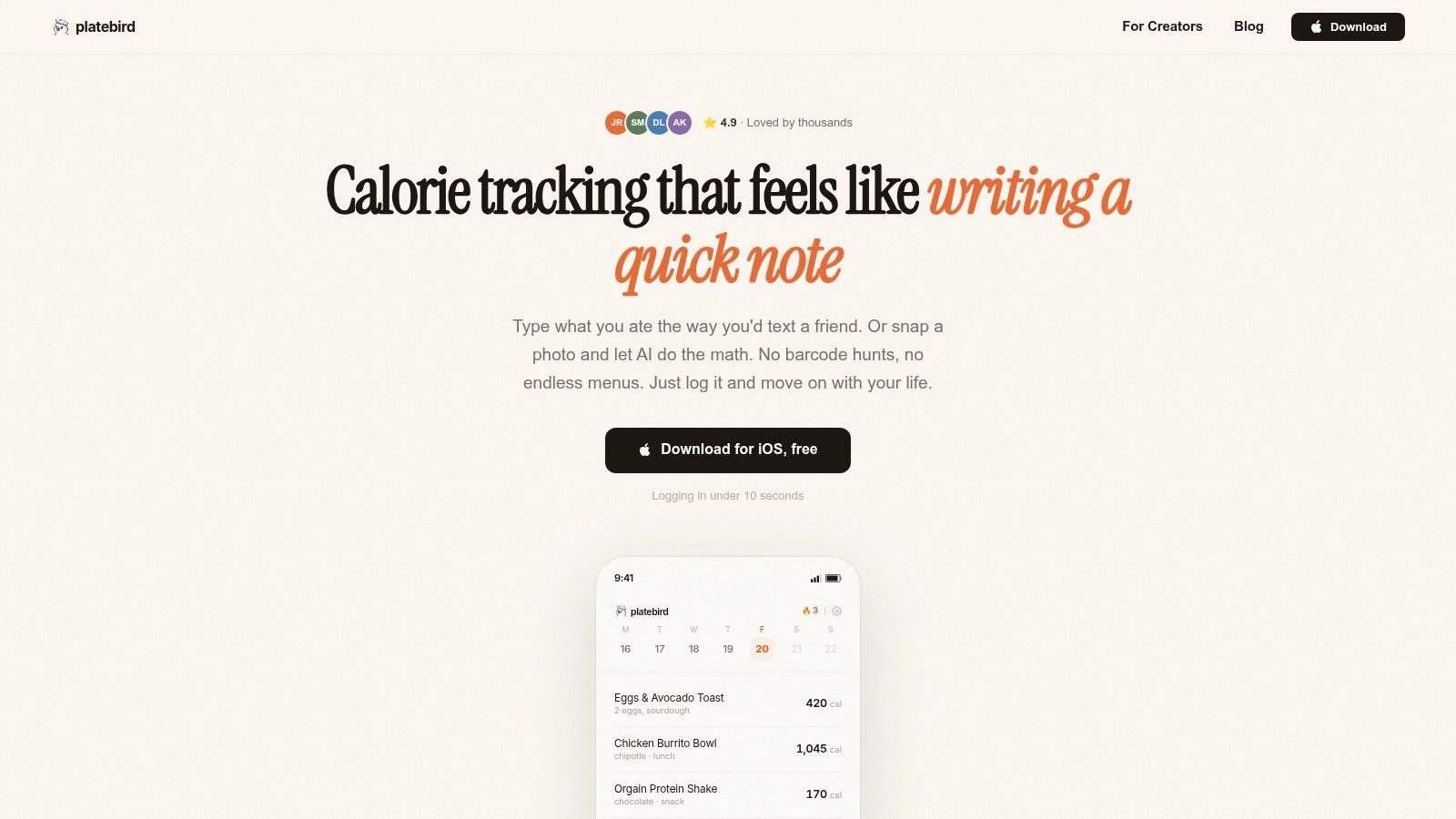
Here's what modern logging tools aim to solve:
The mindset that makes this sustainable
Treat tracking like collecting data, not passing judgment on yourself.
If your weight isn't moving the way you expected, that doesn't mean you blew it. It usually means one of two things happened. Your intake estimate is off, or your maintenance estimate is off. Both are fixable.
That's the enabling part. Once you understand daily calorie needs as a body budget, you stop negotiating with random diet rules and start making informed adjustments.
If you want calorie tracking to feel quick enough to do every day, PlateBird makes logging simple. You can type a meal like “eggs toast coffee,” snap a photo, and get calories and macros without digging through endless menus. It's built for busy people who want to stay consistent without turning food tracking into a second job.