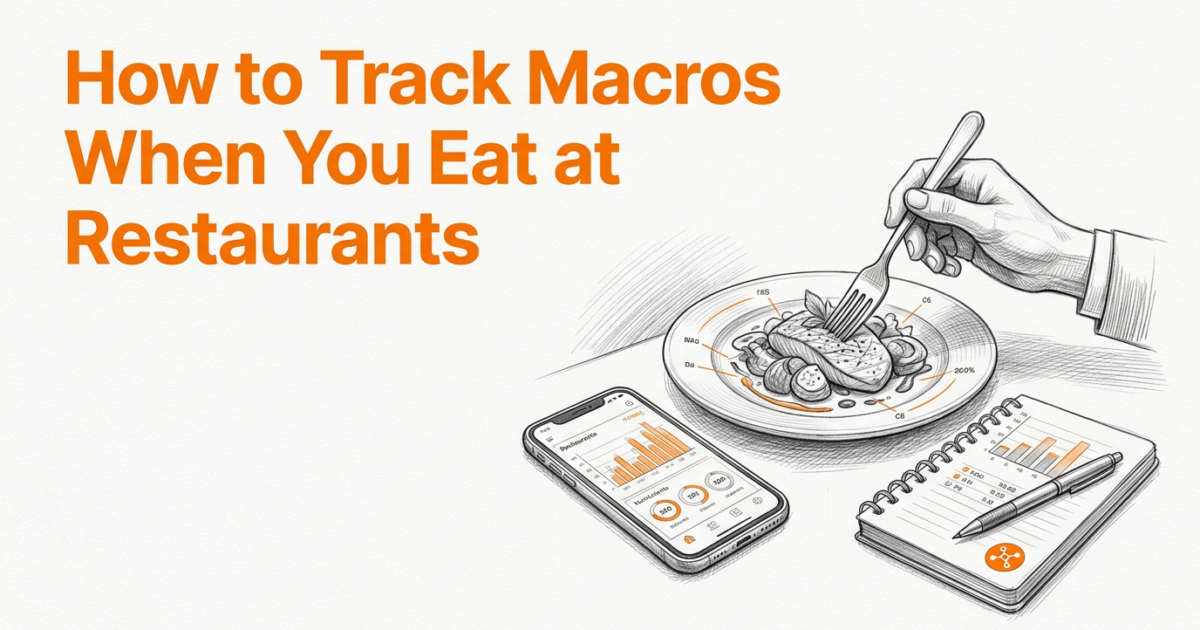
How to Track Macros When You Eat at Restaurants
You order a grilled salmon bowl at your favorite spot, feel good about the choice, and log it as best you can. Three weeks in, the scale hasn’t moved. You’re eating out four nights a week and the numbers you’re entering feel like educated guesses at best.
The problem isn’t discipline. It’s that restaurant plates don’t come with labels. Portion sizes swing wildly from one cook to the next, sauces get ladled on without measurement, and even chain restaurants with posted nutrition info can be off by 20 to 30% depending on who made your plate that night.
Knowing how to track macros when you eat at restaurants comes down to a few honest techniques, a realistic sense of where errors creep in, and a smarter approach to estimation. This guide covers all three.
Why restaurant tracking feels like guesswork
You’re not imagining it. Restaurant meals are genuinely harder to track than home-cooked food. A chicken breast at home weighs what your scale says it weighs. At a restaurant, it could be 4 oz or 8 oz depending on the kitchen, the cut, and whether the cook had a generous hand.
Manual estimation tends to run low. Research published in the Journal of the Academy of Nutrition and Dietetics found that people underreport calories by around 25% on average when logging manually. At a restaurant, that gap widens because there are more variables: cooking oil you can’t see, sauces you didn’t ask for, portion sizes that don’t match what the menu lists.
Oils are a quiet culprit. A stir-fry that looks light might have 2 to 3 tablespoons of oil cooked in, adding 240 to 360 calories you’d never guess from looking at the plate. Grilled meats often get a butter finish. Salads arrive with dressing already tossed, not served on the side.
Then there’s the database problem. Generic searches like “grilled chicken sandwich” in a food app can return entries ranging from 350 to 700 calories. You pick one and hope. That kind of variation is why generic lookups often fail for anyone trying to stay within 100 calories of their actual intake.
The meal isn’t the problem. The gap between what you ate and what you logged is the problem.
The component breakdown method
The single most reliable manual technique is to stop logging the dish as a whole and start logging it as parts. A burrito bowl is not a unit. It’s rice, beans, grilled chicken, cheese, sour cream, salsa, and guacamole. Each component has a reasonable estimate. The whole dish doesn’t.
Start with the protein
Protein is the anchor. A restaurant chicken breast is usually 5 to 8 oz cooked. That’s roughly 35 to 55 g of protein and 175 to 275 calories before any sauce or oil. Salmon fillets at most restaurants run 5 to 6 oz, landing around 250 to 300 calories and 30 to 35 g of protein.
If you’re hitting 150 g of protein daily, getting the protein estimate right matters more than nailing the carbs. A 20 g underestimate on protein is a real miss. Experienced trackers often recommend treating protein as the non-negotiable number and allowing more flexibility on fat and carbs.
Estimate the base
Rice, pasta, potatoes, and bread are the carbohydrate floor of most restaurant meals. A restaurant serving of white rice is typically 1 to 1.5 cups cooked, which puts you at 200 to 300 calories and 44 to 66 g of carbs. A side of roasted potatoes might be 150 to 200 calories. Pasta portions at restaurants are notoriously large, often 2 to 3 cups cooked, which can reach 400 to 600 calories before sauce.
Think of the base as the floor plan. Get that number roughly right and the rest of the tracking builds on a solid foundation.
Account for the extras
Sauces, dressings, cheese, and garnishes are where estimates fall apart. A 2-tablespoon pour of Caesar dressing is about 160 calories and 17 g of fat. Sour cream adds roughly 60 calories per 2 tablespoons. A standard portion of guacamole at a fast-casual restaurant is about 230 calories on its own.
A useful approach from registered dietitians is to add a 10 to 15% buffer on your total estimate to account for cooking oils and hidden fats you can’t see. If your component breakdown lands at 700 calories, log 770 to 805. It’s not perfect, but it’s more honest than a clean number.
Logging a round, clean number for a restaurant meal usually means you’re underestimating. Add a buffer before you close the entry.
Photo tracking vs manual logging
Typing “Thai green curry” into a food database and picking the closest match is a different exercise from showing the actual plate to an AI that can see the portion size, identify the components, and break it down visually. The gap in accuracy is real.
Visual breakdown of meals into components pushes accuracy to around 90% versus 65% for a similar-item lookup. That difference matters over a week of eating out 3 to 5 times. At 25% underreporting per meal, a professional eating out four nights a week could be logging 1,400 to 2,000 calories less than they actually ate by Friday.
PlateBird automatically calculates your calories, protein, carbs, and fat from text or photos. Just type what you ate or snap a picture. No manual logging, no barcode scanning. For a restaurant meal with five components, that’s the difference between a 30-second log and a 5-minute one.
The practical value shows up on busy nights. You’re at a work dinner, the food arrives, you have 90 seconds before the conversation resumes. A photo log fits that window. A manual component breakdown does not.
Accuracy comparison by method
It’s worth being honest about what each method gets right and where each one fails. Neither is perfect. The question is which errors you can live with.
|
Method |
Typical accuracy |
Time per meal |
Works without labels |
Handles mixed dishes |
|---|---|---|---|---|
|
Generic database search |
65-75% |
3-8 minutes |
Partially |
Poorly |
|
Manual component breakdown |
75-85% |
5-10 minutes |
Yes |
Better, but slow |
|
Chain restaurant nutrition page |
70-80% |
2-5 minutes |
Only for chains |
No |
|
AI photo recognition |
85-95% |
Under 1 minute |
Yes |
Yes |
Barcode scanning fails for around 60% of restaurant meals because there’s nothing to scan. Chain restaurant pages cover roughly 80% of menu items, but the posted numbers assume standard portions, which don’t always match what lands on your table. Manual component breakdown is the most reliable no-tech method, but it takes 5 to 10 minutes and requires you to know your portion estimates well.
Nutritionists who work with clients on restaurant eating often recommend the component method as a starting point, then calibrating over time as you get better at eyeballing portions. That’s sound advice. The trade-off is that it takes weeks to build that calibration, and the early estimates are the least accurate ones.
Tips for specific situations
Weight loss beginners
If you’re new to tracking, don’t try to nail every macro on a restaurant night. Focus on protein and total calories first. Getting within 150 calories of your actual intake is a realistic goal for the first few weeks. Precision comes with practice.
Pre-logging the night before helps. If you know you’re going to a specific restaurant, look up the menu, pick your meal in advance, and log a reasonable estimate before you go. This reduces decision fatigue and makes the log feel less like a penalty after the fact.
Plant-based eaters
Mixed plant-based dishes are among the hardest to estimate manually. A tofu scramble, a grain bowl with tahini, or a lentil curry each have multiple protein and fat sources that interact in ways a generic search won’t capture. Plant-based eaters face around 15% higher estimation errors for mixed dishes compared to simpler protein-and-vegetable plates.
The component method works here, but you need to know your plant proteins. Firm tofu runs about 10 g of protein per 100 g. Cooked lentils are around 9 g per 100 g. Edamame delivers 11 g per 100 g. If you’re hitting a grain bowl with multiple plant proteins, add each one separately rather than searching the dish as a whole.
Busy professionals eating out frequently
If you’re eating out 3 to 5 times a week, consistency matters more than perfection on any single meal. A useful heuristic is to get within 10% of your daily calorie target across the week, rather than trying to hit it exactly every day. One dinner that’s 200 calories over doesn’t derail a week of solid tracking.
The time cost is real. Manual logging for a restaurant meal can take 5 to 15 minutes if you’re being thorough. Over five restaurant meals a week, that’s 25 to 75 minutes of logging time. That’s where photo-based logging earns its place in a practical routine.
Consistency over five restaurant meals matters more than perfection on one. A good-enough log you actually complete beats a precise one you skip.
Ordering smarter to make tracking easier
You don’t have to sacrifice the meal to make it trackable. A few ordering habits make the numbers easier to work with without turning dinner into a negotiation.
-
Ask for sauces and dressings on the side. You control the pour, and a tablespoon of dressing is 80 calories instead of an unknown quantity tossed through the salad.
-
Choose grilled over fried when you care about fat accuracy. Fried coatings add 100 to 200 calories that are genuinely hard to estimate.
-
Order simple plates when you need a clean log. A grilled protein with a vegetable and a starch is three components. A casserole or a stew is fifteen.
-
Skip the bread basket if you’re not logging it. It’s not about restriction; it’s about not adding an unknown 150 to 300 calories that you’ll forget to enter.
-
Split a side dish instead of ordering your own. Half a portion of fries is easier to estimate and log than a full one with an ambiguous serving size.
Simplifying the plate is one of the most consistent recommendations from dietitians who work with people tracking macros at restaurants. The simpler the dish, the fewer variables, and the closer your estimate will land.
Pre-scan the menu
If you know where you’re going, spend two minutes with the menu before you leave. Identify two or three options that fit your macro targets for the day. You’re not locked in, but having a plan means you’re not making a tracking decision under time pressure at the table.
For chain restaurants, the nutrition page is worth checking. The numbers aren’t always accurate to what arrives on your plate, but they give you a useful starting range. A Chipotle chicken burrito bowl with rice, black beans, chicken, cheese, and salsa runs around 700 to 750 calories and 45 to 50 g of protein by their posted numbers, which is a reasonable anchor even if your actual bowl is slightly different.
Common mistakes that throw off your numbers
A few errors come up repeatedly for anyone tracking restaurant meals for the first time.
-
Logging the dish name instead of the components. “Pad Thai” in a food database might be 400 calories or 900 calories depending on the source. Break it into noodles, protein, egg, and peanuts instead.
-
Forgetting the cooking fat. A restaurant wok uses 2 to 4 tablespoons of oil per dish. That’s 240 to 480 calories that don’t appear on the plate visually.
-
Using home portion sizes for restaurant portions. A restaurant pasta portion is typically 2 to 3x a standard home serving. Log accordingly.
-
Skipping the log entirely when it feels too complicated. A rough estimate logged is more useful than a perfect estimate skipped. Log something.
-
Trusting the calorie count on a chain’s app without adjusting for portion variation. Use it as a floor, not a ceiling.
Experienced macro trackers note that the biggest accuracy gains come not from finding a better database but from getting better at estimating portion sizes. A palm-sized portion of protein is roughly 3 to 4 oz cooked. A cupped hand of rice is about half a cup. A thumb of fat is roughly a tablespoon. Those reference points travel with you everywhere.
The people who get better at restaurant tracking fastest are the ones who stop looking for the perfect database entry and start getting comfortable with a calibrated estimate.
Research on self-reported dietary intake consistently shows that visual portion estimation improves with practice. The first month of restaurant tracking is the least accurate. It gets better.
Frequently asked questions
How accurate is manual macro tracking at restaurants?
Manual tracking at restaurants typically lands between 65% and 85% accurate depending on the dish complexity and how well you know portion sizes. Simple plates with clear components are easier to estimate. Mixed dishes, stews, and anything with a sauce are harder. Adding a 10 to 15% buffer to your estimate helps account for cooking oils and unmeasured additions.
Does PlateBird work for takeout containers?
Yes. You can photograph a takeout container directly and the AI will identify the components and estimate the macros. The accuracy is higher when the food is spread out and visible rather than buried under a lid, so taking the photo after you’ve opened the container and plated it gives better results.
What should I do when I can’t find a restaurant dish in any database?
Break it into components and log each one separately. Identify the protein, the starch or base, the vegetables, and any sauces or fats. Estimate the portion of each using hand-size references: palm for protein, cupped hand for grains, thumb for fats. Add a 10% buffer to the total. It won’t be exact, but it will be closer than a generic dish search.
Is it worth tracking macros at restaurants if the numbers are never exact?
Yes. Imperfect data is still useful data. A consistent log with some estimation error gives you a real picture of your eating patterns over time. The goal is directional accuracy, not lab precision. Knowing you’re reliably eating 500 calories more than you thought on restaurant nights is actionable information, even if the exact number varies.
How do I handle restaurants that don’t post nutrition information?
Use the component method and treat the meal as a sum of its parts rather than a single entry. For ethnic cuisines or independent restaurants, look up the base ingredients rather than the dish name. A bowl of pho breaks down into broth, rice noodles, beef slices, and garnishes. Each has a reasonable estimate. The dish as a whole does not.
Restaurant tracking gets easier the more you do it. The first few attempts feel slow and imprecise. By week four, the component breakdown becomes automatic, your portion estimates get tighter, and the whole process takes two minutes instead of ten.
If you want restaurant tracking to feel manageable instead of like a guessing game, try PlateBird free. You can snap a photo of your plate before the first bite or type a quick description like “grilled salmon bowl with rice and vegetables,” and the AI breaks down the calories, protein, carbs, and fat automatically. For nights when you’re eating out four times a week and don’t have time to build a manual component log, that speed makes tracking macros when you eat at restaurants realistic rather than overwhelming. You might also find our guide on Best AI Nutrition Tracking Apps: Photo-Log Macr… helpful.