A cup of split pea soup often lands around 25 to 40 grams of carbs, with many common versions sitting in the mid-20s to 30 grams per cup. That sounds simple until you realize your actual bowl could be much lower or much higher depending on the recipe, portion size, fiber, and add-ins.
You might be standing at the stove with a ladle in your hand, or staring at a diner menu, wondering whether this warm, familiar soup fits your plan today. Split pea soup has a healthy reputation for good reason. It's hearty, rich in fiber, and satisfying. But if you're tracking carbs, trying to manage blood sugar, or just aiming for a more consistent intake, “healthy” doesn't answer the specific question.
The confusing part is that split pea soup isn't one fixed food. A thin cafeteria version, a canned soup, and a thick homemade pot with ham all behave differently. Even when the name on the label is the same, the carb count can shift a lot.
That's why a single number can mislead you. What matters more is learning how to judge your specific bowl. Once you know which ingredients drive the count up or down, split pea soup stops feeling like a guessing game.
The Comforting Bowl and the Lingering Question
A lot of people run into the same moment with split pea soup. Lunch looks sensible. Dinner feels cozy. Then the thought creeps in: “Is this low-carb, or am I underestimating it?”
That uncertainty makes sense. Split peas are legumes, so they bring both starch and fiber to the table. The soup often feels lighter than pasta or bread, yet it can still carry a meaningful carb load. If you've ever logged “split pea soup” into an app and wondered whether the result matches what's in your bowl, you're not being picky. You're noticing a real nutrition problem.
Why this soup confuses people
Split pea soup has two identities at once. It's a classic comfort food, but it's also a bean-based dish with a substantial carbohydrate contribution. That combination trips people up.
Here's where readers usually get tangled:
- It's made from peas, so it seems like it should be low-carb. Peas are vegetables, but split peas are also dried legumes, which changes the carb picture.
- It's thick and filling, so people assume it must be heavy in calories only. In reality, the carbs matter too.
- It has a lot of fiber, which makes the total number look scarier than the digestible portion may be.
- Recipes vary wildly. One bowl may be mostly peas and broth. Another may include potatoes, carrots, or bread on the side.
Practical rule: If you're asking about carbs in split pea soup, the right answer usually starts with “which recipe?”
A bowl can fit your plan
You don't have to ban split pea soup just because the numbers aren't tiny. For many people, it works well as a filling meal because it's not just carbs. It also tends to bring fiber and protein, which can make it more satisfying than a carb source that digests quickly.
That's the key shift. Instead of looking for one magic number, look for a way to estimate the bowl in front of you with more confidence. Once you can do that, you can decide whether to enjoy a full bowl, a smaller serving, or a version you tweak at home.
The Official Carb Count for Split Pea Soup
You probably want a clean answer here, like one label-friendly number you can plug into your food log. Split pea soup rarely cooperates.
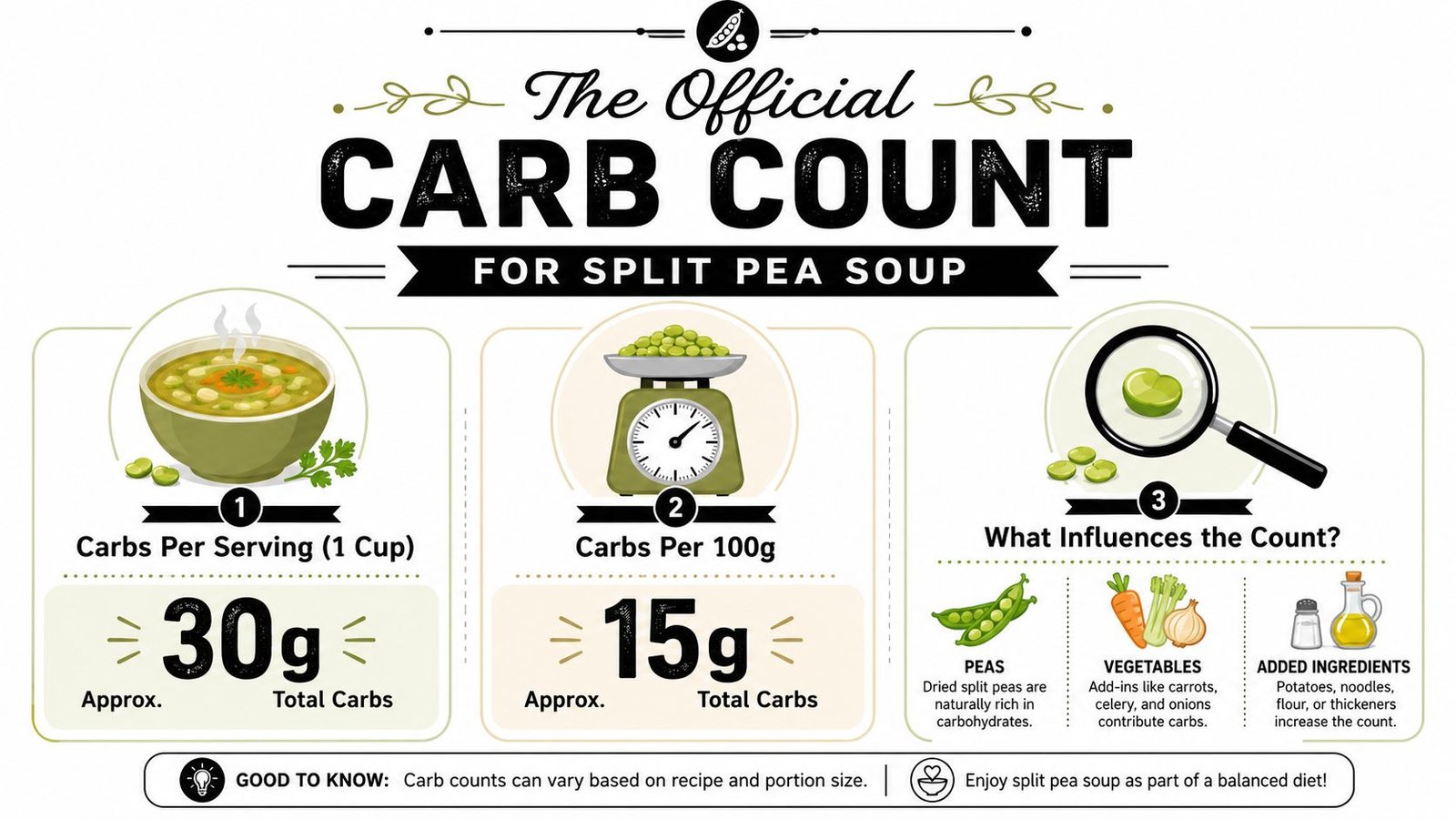
A practical starting point is this. A commonly cited 1-cup serving of canned, reduced-sodium split pea soup contains 30 g of total carbs, 5 g of fiber, and 180 calories (canned split pea soup listing). That gives you a useful default for a standard grocery-store version.
The baseline numbers most people need
If you need a quick rule of thumb, about 30 grams of total carbs per cup is a reasonable place to begin for canned split pea soup.
That said, homemade and food-service versions can land lower or higher. A Princeton dining nutrition label lists 14.2 g of total carbohydrate in a 6-ounce serving with 4.9 g fiber (Princeton dining split pea soup nutrition label). A smaller serving with more broth will naturally look different from a thick, pea-heavy cup at home.
So the useful takeaway is not one official number carved in stone. It is a starting range, plus a way to judge where your bowl falls inside it. If you need help with the fiber side of the equation, this quick guide to total carbs and net carbs makes the math easier.
Why a generic entry only helps so much
Split pea soup works a bit like oatmeal. Two bowls can both be called the same food, while one is thin and spoonable and the other is dense enough to stand up on the spoon. The carb count shifts for the same reason. More peas packed into each serving means more carbs in that serving.
Portion size muddies the picture too. A cafeteria cup, a restaurant crock, and a home ladle are not interchangeable. Even before you get to recipe differences, the serving vessel changes the count.
The “official” carb count for split pea soup is best used as a baseline. Your actual bowl depends on how concentrated it is and how much you poured.
A simple way to estimate your own bowl
Use this quick framework before you log it:
| Serving style | Likely carb picture | What it usually means |
|---|---|---|
| Thin soup with lots of broth | Lower per serving | Fewer peas in each spoonful |
| Standard canned soup | Around 30 g per cup | A reasonable default estimate |
| Thick homemade soup | Higher per bowl | More split peas packed into the serving |
If you are staring at a bowl and trying to make a smart guess, start with the canned 1-cup entry, then adjust based on thickness and portion size. That approach is far more accurate than treating every split pea soup recipe as if it were identical.
Understanding Net Carbs vs Total Carbs in Your Soup
A bowl of split pea soup can look carb-heavy at first glance, then feel more confusing once you notice how much fiber it contains. That is why total carbs and net carbs can point you to two different conclusions about the very same soup.
The simple math
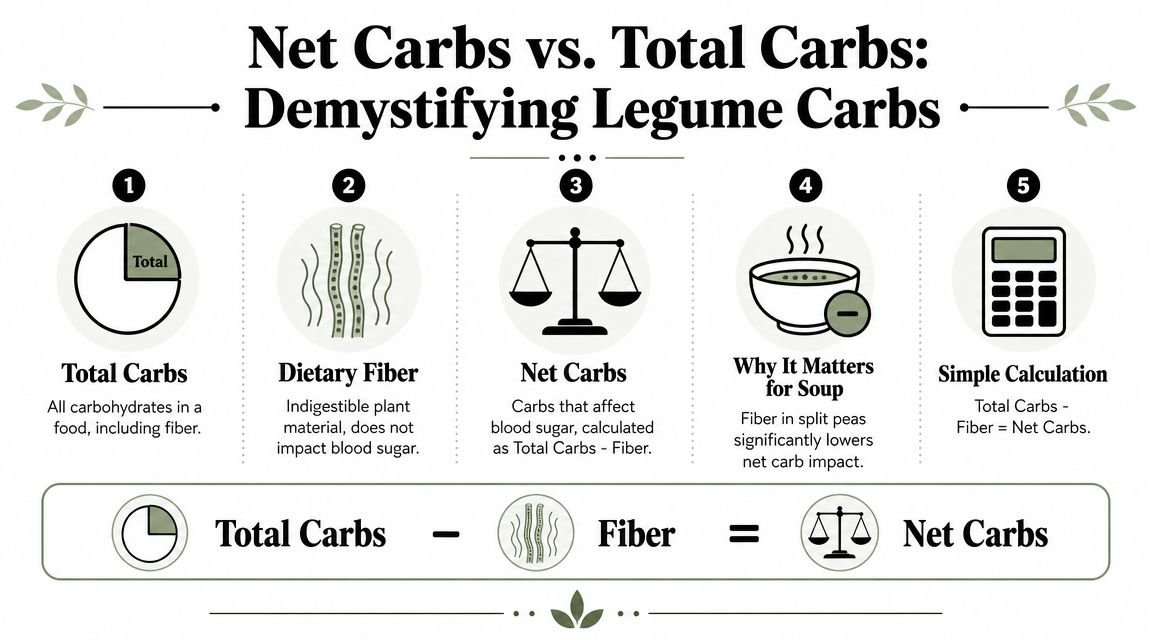
Total carbs means all the carbohydrate in the serving.
Fiber is included in that total.
Net carbs are commonly calculated as:
Total carbs – fiber = net carbs
For split pea soup, that distinction matters because peas bring both starch and a meaningful amount of fiber. So the total-carb number can look high, while the net-carb number lands lower than you might expect from a comfort food this thick and hearty.
A good way to picture it is to treat total carbs as the full ingredient list, while net carbs focus on the portion your body is more likely to handle as digestible carbohydrate.
Why fiber changes the conversation
Fiber slows the story down.
If two foods both have a similar total-carb number, but one brings much more fiber, they may not affect your meal plan in the same way. Split pea soup often falls into that second category. It is still a carb-containing food, but it is not built like a refined soup thickened mostly with flour or served with little fiber.
That matters if you are trying to make a practical decision at the table. A bowl of split pea soup may fit more comfortably into some eating plans than the label first suggests, especially if you track net carbs. If you want a plain-English refresher, this guide explaining total carbs vs net carbs lays out the basics clearly.
When total carbs matter more than net carbs
Different tracking styles use these numbers differently.
- If you count total carbs, use the full carbohydrate number for the serving.
- If you count net carbs, subtract the fiber from the total.
- If you are watching blood sugar closely, use both numbers, then pay attention to portion size and what else is in the bowl.
That last point trips people up. A high-fiber soup can still add up fast if the bowl is large, very thick, or loaded with split peas. Fiber gives useful context. It does not erase the carbs.
So for your own bowl, use both numbers like two measuring tools in the same kitchen. Total carbs tell you the full amount. Net carbs help you estimate the digestible share more realistically.
Why Your Soup's Carb Count Varies So Much
Most confusion stems from split pea soup sounding like one dish, but nutritionally behaving like a family of dishes.
Published recipes show a large spread. Some land at about 38 g total carbs per 1-cup serving with 15 g fiber, some reach 50 g total carbohydrates per 1¾-cup serving with 17 g fiber, and one database entry reports 41.4 g total carbs. That range reflects changes in pea concentration, vegetables, broth amount, and texture, which is why using a generic entry can create a 20 g+ error per serving in carb tracking (Greater Chicago Food Depository split pea soup recipe).
The biggest drivers of carb changes
A few recipe features make the biggest difference.
- Pea concentration: More split peas in less liquid means a denser, higher-carb bowl.
- Serving size: A mug, cup, and oversized soup bowl aren't the same thing.
- Added vegetables: Some vegetables keep the soup lighter. Others push carbs up more.
- Thickeners and extras: Potatoes, flour, and bread toppings can change the math fast.
- Puréed texture: A very thick, smooth soup often signals more solids packed into each serving.
Homemade versus canned versus cafeteria
Homemade soup gives you the most control. Canned soup gives you a label, which is helpful, but not every brand follows the same formula. Cafeteria or dining-hall soup can be surprisingly modest or more concentrated than you expect depending on the recipe.
If you want to understand the effect of fiber in these changes, this article on whether fiber has calories adds useful context.
Carb content of split pea soup variations
| Soup Type | Approx. Total Carbs | Approx. Fiber | Approx. Net Carbs | Key Notes |
|---|---|---|---|---|
| Canned, reduced-sodium, 1 cup | 30 g | 5 g | 25 g | Reliable packaged baseline from a common listing |
| Homemade with ham, 1 cup | 25.4 g | 12.1 g | 13 g | High fiber changes the net-carb picture |
| WVU institutional recipe, 1 cup | 18 g | Not listed | Not listed | Lighter standardized recipe |
| Princeton dining serving, 6 oz | 14.2 g | 4.9 g | 9.3 g | Smaller portion size matters |
| Higher-carb published recipe, 1 cup | 38 g | 15 g | 23 g | Denser pea-heavy version |
| Larger published serving, 1¾ cup | 50 g | 17 g | 33 g | Bigger bowl, bigger impact |
How to estimate your own bowl
If you're looking at a bowl and trying to make a smart estimate, ask yourself:
- How thick is it? Thick usually means more peas per spoonful.
- What's in it besides peas? Ham doesn't drive carbs up much by itself, but potatoes and bread do.
- How big is the serving? A restaurant “cup” can be modest. A home bowl can be much larger.
- Was it made to be rustic or silky? A heavily puréed soup often packs more solids into each serving.
A good estimate isn't about perfection. It's about noticing the ingredients that move the number.
How to Make Delicious Low-Carb Split Pea Soup
If you cook at home, you have more control than you might think. Split pea soup recipes can range from about 30 g of carbs in a homemade vegetarian version to over 41 g in other formulations, showing how strongly the ingredient list shapes the final bowl (homemade split pea soup nutrition discussion).

Lower the carb count without losing the soul of the soup
The easiest mistake is trying to turn split pea soup into something it isn't. You don't need to strip it down until it tastes flat. It works better to make targeted changes.
- Use fewer starchy add-ins. If your family recipe includes potatoes, reducing or skipping them can help.
- Lean on aroma vegetables. Onion, celery, garlic, and herbs build flavor without making the soup feel heavy.
- Choose texture strategically. A little cauliflower or celery root can add body if you want creaminess without relying on more starchy ingredients.
- Watch the side items. Bread, crackers, and croutons can add more carbs than expected.
Think in layers, not restrictions
Flavor matters. People often add starch because they're trying to make the soup feel heartier, but savory depth can come from other places too.
Try building the pot with:
- Smoky elements like ham or a smoked seasoning profile
- Herbs such as thyme or bay
- A long simmer so the peas break down naturally
- A final texture adjustment with broth instead of extra starch
A lower-carb split pea soup still needs to taste generous, not austere.
A cooking demo can also help if you want ideas for texture and timing:
The most practical kitchen mindset
Don't ask, “How do I make split pea soup low-carb?” Ask, “What in my version is pushing the carbs up?”
That question usually leads to better choices. Sometimes the answer is the peas themselves, and that's fine. Sometimes it's the potatoes, the oversized serving, or the thick hunk of bread on the side. When you spot the actual source, you can change the recipe without losing the comfort that made you want the soup in the first place.
Logging Your Soup Accurately with PlateBird
You ladle out a bowl of split pea soup, open your food log, and hit the usual problem. None of the database entries look quite right. One version seems too thin, another includes potatoes, and a third assumes a much smaller serving than the bowl in front of you.
That mismatch matters because split pea soup is not one fixed food. Your bowl reflects your peas, your add-ins, and your portion size. A generic entry can get you in the ballpark, but recipe-based logging gets you closer to the carbs you ate.
Why recipe-based tracking works better
Soup works a bit like a blended budget. The total carb count starts with the full pot, then each ingredient pushes that number up or keeps it steadier. Split peas do most of the carb heavy lifting, while onions, carrots, potatoes, ham, broth, and any side of bread can change the final count in smaller or larger ways.
That is why many home cooks prefer tools that help them calculate calories in homemade food instead of picking the closest-sounding match from a long list. Logging from the recipe, or from a photo and description of the finished bowl, usually reflects reality better.
For people who like comparing recipe tools, resources that help you track recipe calories can also be useful when you are building or adjusting a soup from scratch.
A better way to log this meal
A few habits make split pea soup much easier to log with confidence:
- Log the whole pot when you cook it. This gives you a better baseline for meal prep and leftovers.
- Measure the serving you eat. One cup, one large bowl, and one restaurant crock can be very different.
- Note the carb drivers. Potatoes, extra carrots, a thicker pea ratio, or bread on the side can change the entry more than seasonings or broth.
- Save repeat versions. If you make the same recipe often, future entries become much faster and more consistent.
Consistency beats guesswork.
If you know your soup is heavier on peas and lighter on starchy add-ins, your log should reflect that. If your version includes potatoes or comes with a thick slice of bread, count those too. The goal is not lab-level precision. The goal is a record that matches your real habits closely enough to help you make useful decisions over time.
If you want food logging to feel less like homework, PlateBird makes it simple. You can type a meal like “bowl of homemade split pea soup with ham” or snap a photo, and the app estimates calories and macros in seconds so you can stay consistent without digging through endless database entries.