- The Enduring Myth of Midnight Carbs
- What Actually Happens When You Eat Carbs at Night
- Debunking the Nighttime Fat Gain Fear
- The Quality of Your Bedtime Carb Changes Everything
- Your Practical Guide to Timing and Portions
- Smart Bedtime Snacks for Your Specific Goal
- Find Your Sweet Spot by Tracking Results
The most repeated rule in nutrition is often the least helpful one. “Never eat carbs before bed” sounds clean and disciplined, but real bodies don't work by slogan.
If you've ever stood in your kitchen at night, hungry, tired, and mildly annoyed by all the conflicting advice online, you're not the problem. The advice is. For one person, a small evening carb snack may help them unwind and fall asleep more easily. For another, the wrong carb too close to bedtime may leave them restless, overheated, or wide awake.
That's why the better question isn't whether carbs before bed are good or bad. It's good for what.
Are you trying to lose fat without feeling deprived? Build muscle and recover from training? Sleep more soundly? Those are different goals, and they don't always point to the same nighttime eating strategy. Once you stop treating bedtime carbs as a moral issue and start treating them as a tool, the whole topic gets simpler.
The Enduring Myth of Midnight Carbs
The myth survives because it feels intuitive. You eat carbs at night, you go to sleep, you're less active, so those carbs must “turn into fat.” That story is tidy. It's also far too simple.
Your body doesn't switch into a special fat-storing mode because the clock says 9:30 p.m. It's still handling food the same basic way it always does. It digests, absorbs, stores, and uses energy according to what you've eaten across the day, how active you've been, how much you need, and what's going on hormonally.
Why the rule feels convincing
A lot of people notice that nighttime eating can get messy. The snack isn't usually a bowl of oats and yogurt. It's often cookies, cereal straight from the box, chips, or takeout after a long day of under-eating and decision fatigue. Then bedtime feels worse, hunger cues get confusing, and the carb itself gets blamed for the whole situation.
That's where the myth gets power. It takes a real pattern and assigns the wrong cause.
Practical rule: Don't confuse “carbs before bed” with “mindless overeating at night.” Those aren't the same behavior.
There's another reason people stay confused. Sleep advice and fat-loss advice often get mashed together. One person is asking, “Will this help me sleep?” Another is asking, “Will this slow fat loss?” Another wants better recovery after lifting. They all get the same blunt answer, even though they're asking different questions.
A more useful way to think about it
Instead of using a hard ban, use three filters:
- Your goal: Better sleep, better recovery, easier fat loss, or less late-night hunger.
- Your carb choice: Whole-food, fiber-rich carbs tend to behave very differently from refined sweets.
- Your timing: A meal early in the evening isn't the same as a large snack right before you lie down.
That shift matters. It takes you out of guilt and puts you back into observation. If you eat carbs before bed and sleep well, wake up steady, and stay on track with your intake, that's useful information. If you wake up bloated, restless, or hungrier the next morning, that's useful too.
The body isn't asking you to follow dogma. It's asking you to notice patterns.
What Actually Happens When You Eat Carbs at Night
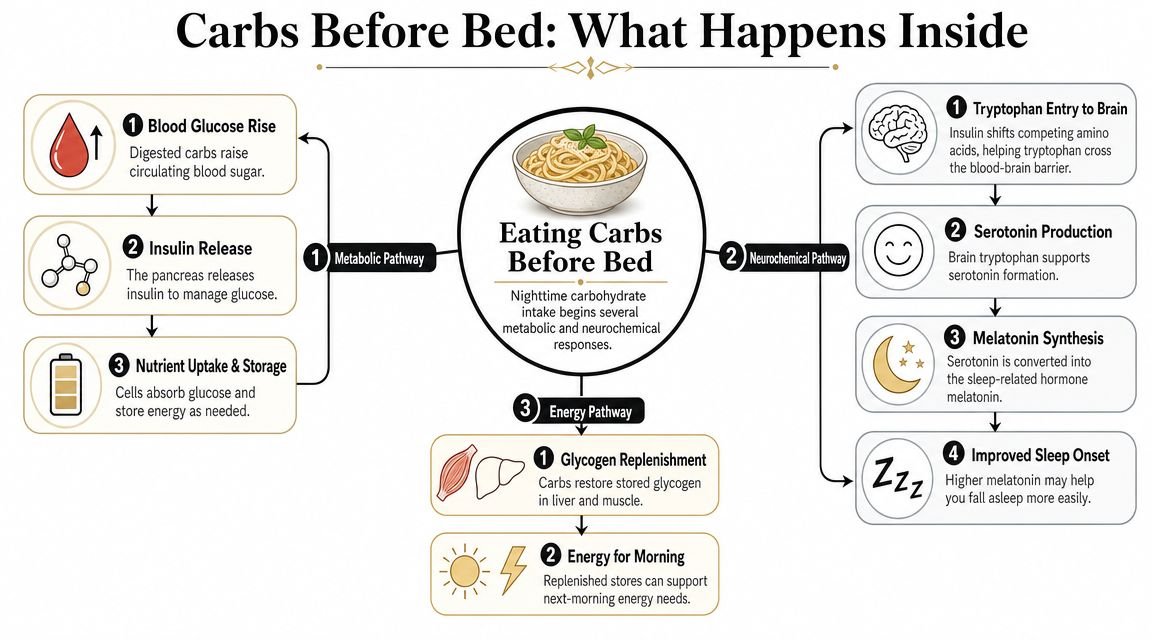
Carbs aren't just “energy.” They also affect the chemical environment that helps your brain transition toward sleep. A simple way to picture it is this: carbs can act like a key that helps open the doorway to sleep-related brain chemistry.
The short version inside your body
When you eat carbohydrates, your blood glucose rises and your body releases insulin. The term “insulin” often evokes immediate negative thoughts, but insulin is doing one of its normal jobs here. It helps move nutrients where they need to go.
That shift also changes competition among amino acids in the bloodstream. As a result, tryptophan has an easier path into the brain. Once there, it contributes to the production of serotonin, which then contributes to melatonin, the hormone closely involved in your sleep cycle.
This doesn't mean every carb snack is a sleep hack. It means the pathway is biologically plausible and part of why some people feel calmer or sleepier after the right evening meal.
Sleep is more than falling asleep fast
Sleep quality has layers. Falling asleep quickly is one part. Staying asleep and moving through healthy sleep stages is another.
A 2022 review on carbohydrate intake and sleep in PMC reported that lower carbohydrate intake was associated with more slow-wave sleep and less REM sleep, and it also noted that high-glycemic meals eaten about 4 hours before sleep can support an easier transition into sleep, while meals within 3 hours of bedtime can increase awakenings.
That's the nuance people usually miss. Carbs may help one part of sleep while making another part less ideal if the dose, timing, or type is off.
Some people benefit from a gentle nudge into sleep. Others do better protecting deep, restorative sleep by keeping nighttime eating lighter.
Carbs can also help refill the tank
There's a second nighttime effect that has nothing to do with drowsiness. Carbs help replenish glycogen, which is stored carbohydrate in the muscles and liver. If you trained hard that day, especially with lifting, intervals, or a long endurance session, some evening carbs may support recovery and help you wake up with better energy.
That doesn't mean you need a huge pasta dinner at midnight. It means a sensible amount of carbohydrate in the evening can fit a recovery-focused plan.
A useful way to think about nighttime carbs is this:
- Brain effect: They may help some people settle into sleep.
- Sleep-stage effect: They can influence sleep architecture, which is why timing matters.
- Recovery effect: They can top up fuel stores after training.
All three can be true at once. The trick is choosing the version that matches what you want most right now.
Debunking the Nighttime Fat Gain Fear
The fear sounds like this: “If I eat carbs before bed, my body won't use them, so it will store them as fat.”
That idea gives meal timing far too much power.
Fat gain doesn't come from eating one carb-containing snack at a certain hour. It comes from consistently taking in more energy than your body uses over time. Your body is always storing and using energy across the day and night. It isn't waiting for darkness to turn rice, oats, or fruit into body fat on contact.
The clock isn't the main driver
If two people eat the same total amount of food, the person who includes some carbs at night doesn't automatically gain fat because of timing alone. What matters more is whether that bedtime eating helps or hurts their overall intake.
For some people, a planned evening snack prevents the “I already messed up, so I'll keep eating” spiral. That can make fat loss easier. For other people, nighttime eating opens the door to mindless grazing. That can make fat loss harder. The issue there isn't the existence of carbs. It's the eating pattern.
Where people get tripped up
Nighttime hunger often has a backstory. Common ones include:
- Undereating earlier: You stayed “good” all day, then got intensely hungry at night.
- Skipping protein: Meals were light on staying power, so cravings hit later.
- Using rules that backfire: The ban on evening carbs made them feel even more compelling.
- Eating while half-distracted: TV, scrolling, and stress make it harder to notice fullness.
None of that means carbs before bed are fattening in themselves. It means nighttime eating can expose weak spots in your routine.
If a small, planned bedtime snack helps you stay consistent with your calories and sleep better, it may support fat loss better than white-knuckling hunger.
A calmer standard to use
Ask better questions than “Are carbs after 7 p.m. bad?”
Try these instead:
- Did this fit my overall intake for the day?
- Did it leave me satisfied, not stuffed?
- Did I sleep well afterward?
- Did it reduce the urge to keep snacking?
That's a much more grounded way to judge whether carbs before bed are helping or hurting. Stricter nighttime rules are often not necessary; instead, what's needed is a more honest look at one's whole pattern.
The Quality of Your Bedtime Carb Changes Everything
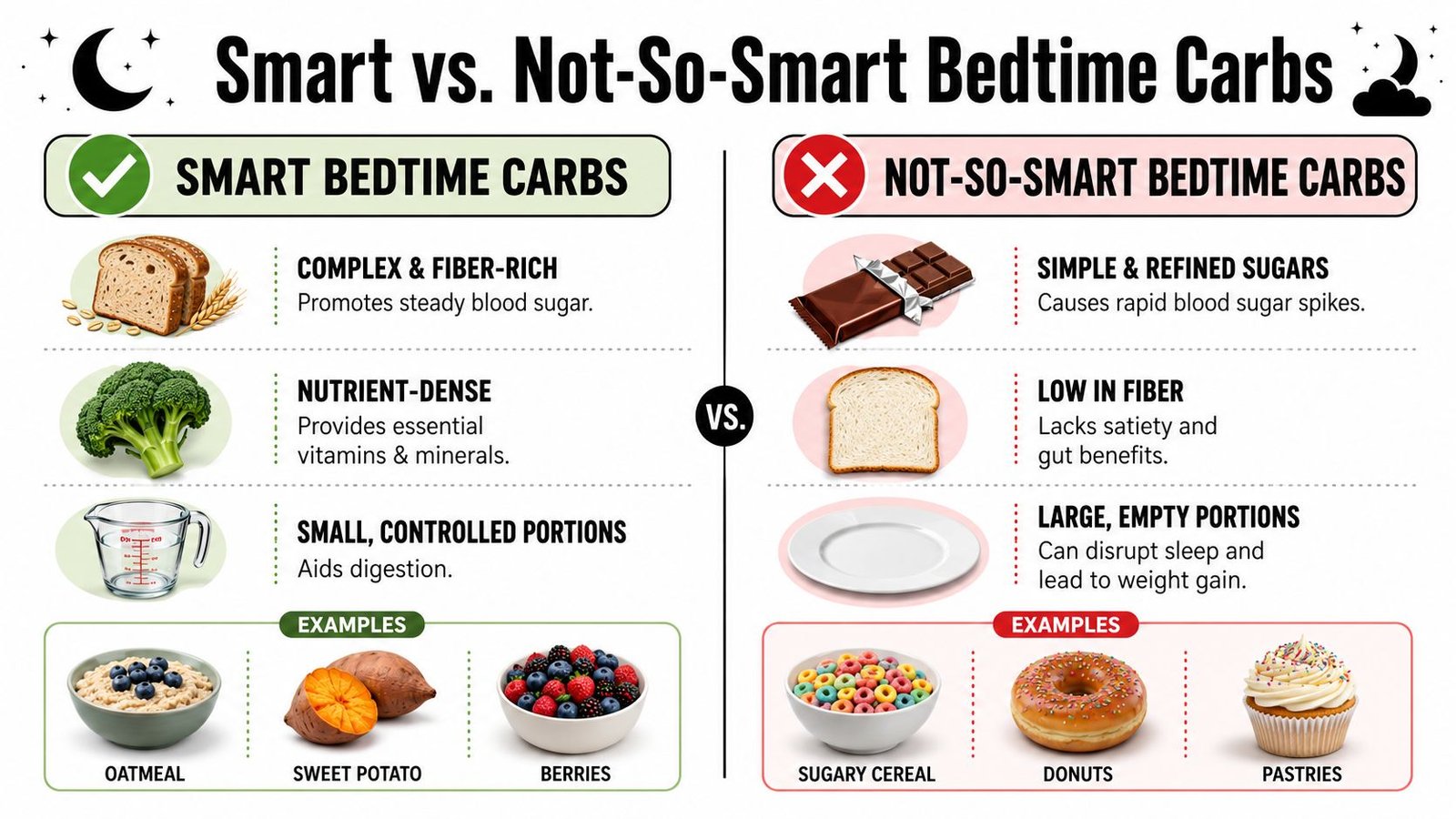
If bedtime carbs affect you differently from your friend, one big reason is carb quality. A bowl of oats with berries and a sleeve of cookies are both “carbs,” but they don't ask your body to do the same job overnight.
Smart bedtime carbs versus disruptive ones
Think of high-quality carbs as a slow-burning log on a fire. Think of refined sugary carbs as paper tossed into the flames. One tends to burn more steadily. The other flares fast and fades fast.
A 2024 Frontiers in Nutrition study on carbohydrate quality and sleep patterns found that people with higher intake of high-quality carbohydrates had a 29% lower odds of poor sleep patterns, while higher intake of low-quality carbohydrates was linked to a 39% higher odds of poor sleep patterns.
That's the most important pivot in this whole conversation. The type of carb matters at least as much as the timing.
What usually counts as a better bedtime choice
If you want carbs before bed to work with you instead of against you, lean toward foods that digest more steadily and bring fiber or nutrients along with them. If you need ideas, this list of complex carbohydrate foods gives you solid starting points.
Good bedtime options often include:
- Oatmeal: Soft, easy to eat, and easy to pair with protein.
- Fruit: Kiwi, berries, banana, or apple can work well depending on portion and tolerance.
- Sweet potato: A simple whole-food option if dinner runs later.
- Whole grain toast or crackers: Useful in a small portion with a protein source.
- Yogurt plus fruit: A practical combo when you want both carbs and protein.
A quick visual comparison helps.
| Carb type | Common examples | Typical nighttime effect |
|---|---|---|
| Higher-quality carbs | Oats, fruit, beans, sweet potato, whole grains | Often steadier digestion and fewer “I want more” loops |
| Lower-quality carbs | Candy, pastries, sugary cereal, white bread desserts | More likely to feel easy to overeat and less satisfying |
The point isn't perfection. A refined food once in a while isn't a crisis. But if you regularly feel wired, snacky, or unsatisfied after nighttime carbs, quality is one of the first things to check.
Here's a useful visual guide for bedtime choices:
Quality also changes appetite
Refined carbs tend to be easy to eat quickly and in large amounts. That matters at night, when willpower is lower and portions can drift. Higher-quality carbs usually create more friction in a good way. They take longer to eat, they often pair better with protein, and they're more satisfying.
That's why the better bedtime question isn't just, “Should I eat carbs?”
It's, “What kind of carb will leave me feeling stable, sleepy, and done eating?”
Your Practical Guide to Timing and Portions
Timing changes the experience of carbs before bed more than is commonly understood. The same food can feel soothing at one hour and disruptive at another.
A PMC review on pre-sleep meal timing and sleep onset noted that a high-glycemic carbohydrate meal consumed about 4 hours before bedtime has been associated with shorter sleep onset latency, while a high-carbohydrate meal within 3 hours of sleep can lead to more nocturnal awakenings.
A simple timing framework
You don't need a stopwatch. You need a workable window.
- Earlier evening often works best: If dinner lands a few hours before bed, carbs may help you wind down without sitting heavily in your stomach.
- Closer to bed means smaller is smarter: If you're eating later, keep the portion modest and easy to digest.
- Large meals are the risky move: Big portions right before lying down are more likely to feel uncomfortable and disturb sleep.
That makes bedtime carbs less of a yes-or-no issue and more of a volume-and-distance issue.
One useful rule: The closer your snack is to bedtime, the simpler and smaller it should be.
How much should you eat
There isn't one perfect number for everyone. Your body size, training load, appetite, and earlier meals all change the answer. But in practice, a small to moderate portion is generally more beneficial than turning a bedtime snack into a second dinner.
Use hand-based estimates if you don't want to measure:
- A cupped hand of carbs: Think a small bowl of oats, a piece of fruit with yogurt, or a slice or two of toast.
- Add protein if possible: It tends to improve fullness and makes the snack feel more balanced.
- Stop at “comfortably satisfied”: Bedtime is not the ideal time to test your maximum appetite.
If you want your overall intake to line up with your training or body-composition goal, a macros guide for setting your intake can help you decide whether that evening snack fits your day.
Signs your timing is off
Watch for a few patterns:
- You fall asleep fine but wake up in the middle of the night.
- You go to bed feeling overly full.
- You feel hot, restless, or thirsty after eating.
- The snack triggers more snacking instead of ending hunger.
If those show up, don't assume carbs are the enemy. Adjust the timing, portion, or food choice first. Small tweaks usually teach you more than extreme rules.
Smart Bedtime Snacks for Your Specific Goal
The best bedtime snack for a lifter isn't always the best one for someone in a fat-loss phase. That's where blanket advice falls apart.
A Sleep Doctor overview on whether you should eat carbs before bed notes that the benefits are conditional and goal-dependent. In some studies, higher carbohydrate intake has been linked to faster sleep onset. In others, lower carbohydrate intake has been associated with more restorative slow-wave sleep. The “best” option depends on what you're trying to get from it.
If your goal is better sleep
For sleep, think calm, light, and steady. You want something that takes the edge off hunger without making digestion the main event of the night.
A few sensible examples:
- Greek yogurt with berries
- Oatmeal made small, with milk or yogurt stirred in
- Whole grain toast with cottage cheese and a little fruit
These work because they combine a moderate amount of carbohydrate with protein, which can help you feel settled rather than snacky.
If your goal is muscle gain or recovery
When you train hard, bedtime carbs can be part of recovery, especially if your earlier meals were rushed or your workout finished late. Here, the carb isn't just about sleep. It's also about refilling what training used.
Good fits might include oatmeal with protein powder, rice with a lean protein as part of dinner, or yogurt with granola and fruit if you need something quick.
If your goal is fat loss
Fat loss usually works best when the bedtime snack is planned instead of impulsive. The goal is to remove late-night chaos, not create another chance to overshoot your intake.
Good options tend to be simple and repetitive:
- Apple with Greek yogurt
- Small bowl of oats with cinnamon
- Berries with cottage cheese
- One slice of toast with peanut butter and a protein side
Here's a quick-reference table.
| Primary Goal | Snack Example | Why It Works |
|---|---|---|
| Better sleep | Greek yogurt with berries | Light, easy to digest, and includes both carbs and protein |
| Muscle gain | Oatmeal with protein powder | Supports recovery and feels more substantial after training |
| Fat loss | Apple with Greek yogurt | Helps control hunger with a modest, structured snack |
| General evening hunger | Whole grain toast with cottage cheese | Simple, balanced, and less likely to turn into grazing |
The pattern matters more than the exact food. A quality carb plus protein is usually the safest place to start. It's satisfying, easier to portion, and less likely to kick off the “what else can I eat?” loop.
Find Your Sweet Spot by Tracking Results
The most useful answer to the carbs before bed question usually comes from your own data, not someone else's rule.
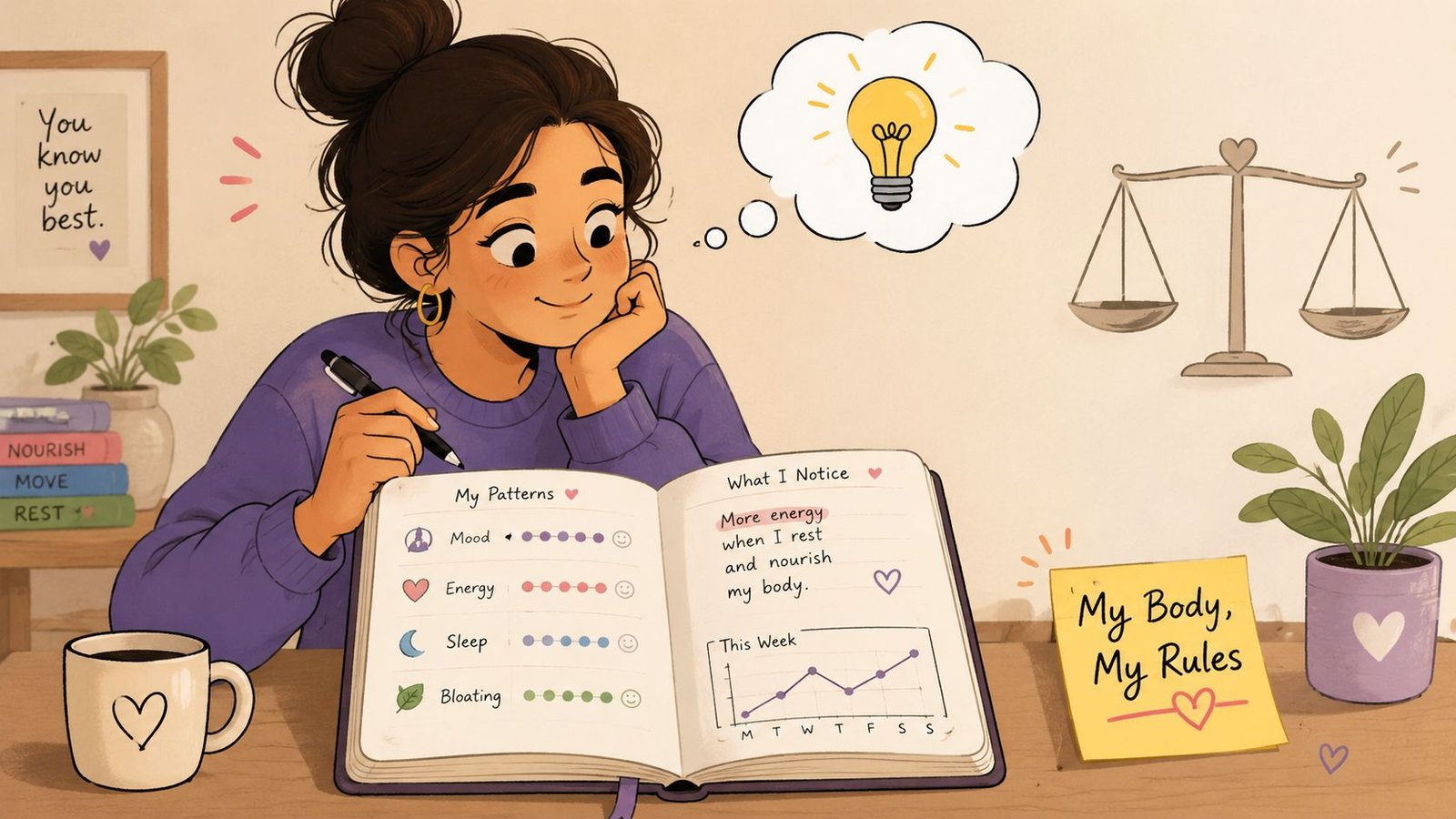
Try one bedtime approach for several nights in a row. Keep the food, portion, and timing reasonably consistent. Then pay attention to what happens next. Not just whether you fell asleep, but whether you stayed asleep, how your stomach felt, how hungry you were the next morning, and how your training felt later in the day.
What to track
You don't need a complicated spreadsheet. A few observations are enough:
- Sleep quality: Did you fall asleep easily and stay asleep?
- Morning energy: Did you wake up steady or groggy?
- Hunger patterns: Did the snack calm appetite or trigger more cravings?
- Workout quality: If you train, did recovery and performance feel better?
Your best bedtime carb strategy is the one that matches your goal and produces a pattern you can repeat without stress.
If you want a simple way to keep an eye on carb intake overall, a free carb counter tool can help you notice whether your evening choices are fitting the rest of your day.
A lot of nutrition confusion disappears when you stop asking, “What's the perfect rule?” and start asking, “What happens when I do this consistently?” That's how you find the version of carbs before bed that fits your body, your schedule, and your priorities.
If you want to test carbs before bed without turning food logging into homework, PlateBird makes it easy. You can type a meal like “Greek yogurt with berries” or snap a photo, and it quickly estimates calories and macros so you can compare your bedtime snack with your sleep, hunger, and training results over time.