
People love to call Medjool dates “nature's candy” and leave it at that. That advice sounds simple, but it's not very helpful if you track your calories, carbs, and fiber.
If you use a food logging app, a Medjool date isn't just a vague healthy snack. It's a specific entry that can either fit your day beautifully or eat up a surprising chunk of your calorie and carb budget. What's often presented online can be simpler, but Medjool dates are sweet, energy-dense fruit with some useful nutrients. They are not junk food, and they are not a free food either.
That middle ground is where individuals get confused. They see “fruit” and assume low calorie. Or they see “sugar” and assume bad. Neither view tells you what to do when you're deciding whether to log one date, two dates, or skip them and choose something else.
Are Medjool Dates Nature's Candy or a Superfood
The most popular advice gets this wrong by forcing Medjool dates into an all-or-nothing label. They're not a harmless candy replacement you can eat mindlessly. They're also not a magical superfood that overrides basic calorie math.
They're best understood as a compact source of carbohydrate energy. That makes them useful in some situations and less useful in others. If you're heading into a workout, a date can be practical. If you're sitting at your desk and already close to your calorie target, grabbing several because they're “natural” can backfire fast.
A lot of clients make the same mistake with “healthy” foods. They focus on the ingredient story instead of the nutrition entry. The same thing happens with greens powders, adaptogens, and trendy add-ins. If you're curious about another example of a food getting a health halo, this rundown of moringa powder benefits is useful because it shows how nutrition conversations often blur the line between genuinely helpful and overhyped.
What the label should really be
If I were helping someone log dates accurately, I'd describe them this way:
- Whole-food sweetener that comes with fiber and minerals
- High-carb snack that works best when portioned
- Fast convenience fuel for active people
- Easy-to-overeat food if you treat it like berries or melon
That last point matters. Medjool dates feel small in your hand, but they're not nutritionally small.
Practical rule: Don't log a Medjool date under “fruit” in your mind. Log it under “dense carb source.”
That mindset changes your decisions. You stop asking, “Are dates healthy?” and start asking, “Do these fit my goal right now?”
For people thinking about energy support specifically, foods for energy is a better lens than “good” versus “bad.” Dates can absolutely belong in that conversation. They just need context.
The Complete Medjool Dates Nutrition Profile
Regarding Medjool dates nutrition, people typically seek one clean answer. The problem is that dates are often eaten one at a time, while nutrition data is often shown per serving. For tracking, both views matter.
A standard 2-date serving (48 g) provides 133 calories, 36 g carbohydrate, 32 g sugar, 3.2 g fiber, 0.8 g protein, and 0 g fat, plus 7% DV potassium, 19% DV copper, 7% DV vitamin B6, and 6% DV magnesium according to Healthline's Medjool dates nutrition breakdown.
Medjool Date Nutrition Facts
| Nutrient | Amount per 1 Date (~24g) | Amount per 100g |
|---|---|---|
| Calories | 66.5 | qualitatively higher because dates are energy-dense |
| Carbohydrates | 18 g | qualitatively high |
| Sugars | 16 g | qualitatively high |
| Fiber | 1.6 g | qualitatively meaningful |
| Protein | 0.4 g | qualitatively low |
| Fat | 0 g | qualitatively negligible |
That single-date view is the one most trackers need. If you eat one pitted Medjool date, you're logging 66.5 calories, 18 g carbs, 16 g sugars, and 1.6 g fiber. If you eat two while making dinner and two more after dinner, that's not “just a few dates.” That's a real nutrition event.
What those numbers mean in plain English
The calories come mostly from carbohydrate. Protein is minimal. Fat is absent. So if your day already runs high in carbs and low in protein, dates don't correct that imbalance. They add more carbs.
That doesn't make them a poor food. It just tells you their job. Dates are there for energy, sweetness, and some fiber and minerals, not for satiety through protein.
Here's where tracking apps can trip people up. Some databases list dates by piece, some by serving, some by weight, and some by “pitted” versus “un-pitted.” If your entry says “1 Medjool date,” check whether that matches the larger, soft dates you ate. Logging by grams is often cleaner, especially if you use dates in recipes.
If fiber confuses you in your app totals, this guide on whether fiber has calories helps explain why foods can be carb-heavy but still behave a bit differently than pure sugar.
A smarter way to read the entry
Instead of staring at the sugar line only, read a date entry in this order:
- Calories first. It's easy to underestimate them.
- Total carbs next. That's what affects your carb budget most.
- Fiber after that. Useful, but not enough to make dates “low-carb.”
- Protein last. You'll usually need another food if you want a balanced snack.
That sequence keeps Medjool dates nutrition practical instead of theoretical.
Understanding the Sugar and Glycemic Impact
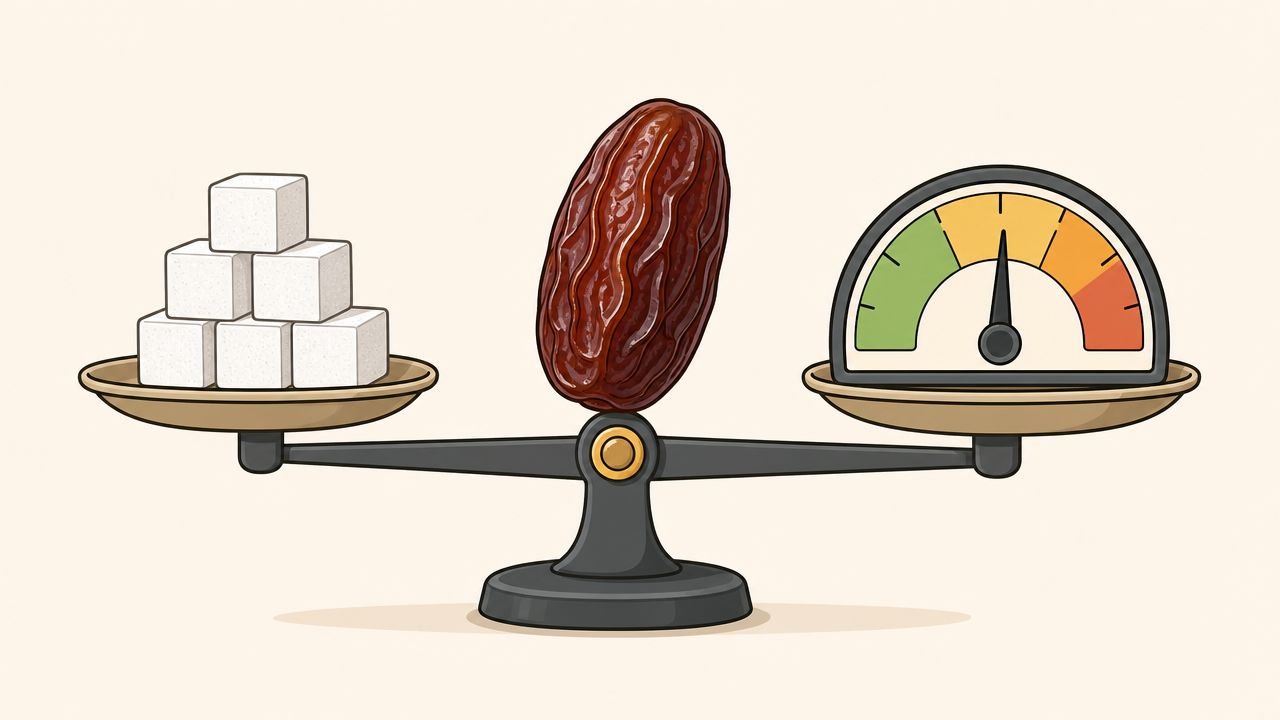
Sugar is a common reason for hesitation around dates, and that hesitation makes sense. Medjool dates taste intensely sweet because they are, in fact, sugar-rich fruit.
In a peer-reviewed study of Mexican-grown Medjool dates, the pulp averaged 75.32% total sugars on a dry-weight basis, including 37.21% glucose, 33.17% fructose, and 5.06% sucrose, with an energy value of 330.83 kcal per 100 g dry weight in the PMC-published analysis of Medjool date composition.
Why the sugar story is easy to misread
People often hear two messages at once. First, “dates are high in sugar.” Second, “dates are better than candy.” They assume one of those must be false. Both can be true.
Candy is mostly refined sugar without the fiber and food structure of whole fruit. A Medjool date is still sugar-rich, but the sugar is packaged inside the fruit matrix with some fiber. That doesn't make it low sugar. It means your body isn't dealing with it in exactly the same way as a spoonful of table sugar.
A simple analogy helps. Think of sugar delivery like traffic flow. Candy is an open highway. A whole date is still a fast route, but there are a few speed controls. It's not slow like beans or lentils. It's also not the same as drinking sugar dissolved in a soda.
What to do if you track carbs closely
If you count total carbs, Medjool dates belong in the same mental category as other dense carb foods, not watery fruit. If you track net carbs, it helps to understand how apps handle fiber deductions. This explainer on what net carbs are is useful if that part of your log feels inconsistent.
For people managing blood sugar or trying to choose lower-impact snacks, broad snack planning matters more than obsessing over one food in isolation. A practical resource is Rip Van's diabetic snack guide, especially if you're comparing dates with snacks that include more protein or fat.
One date can fit. A handful without logging usually doesn't.
The tracking takeaway
When clients say, “But it's natural sugar,” I usually answer, “Natural sugar still counts.”
That's not meant to scare you away from dates. It's meant to keep your logging honest. If your afternoon snack includes dates, count them fully. If your smoothie includes dates, count them fully. If your energy bites are sweetened with dates instead of syrup, count them fully.
Whole-food sugar is still sugar. The difference is that whole foods can bring more to the table than sweetness alone.
Health Benefits Beyond Quick Energy
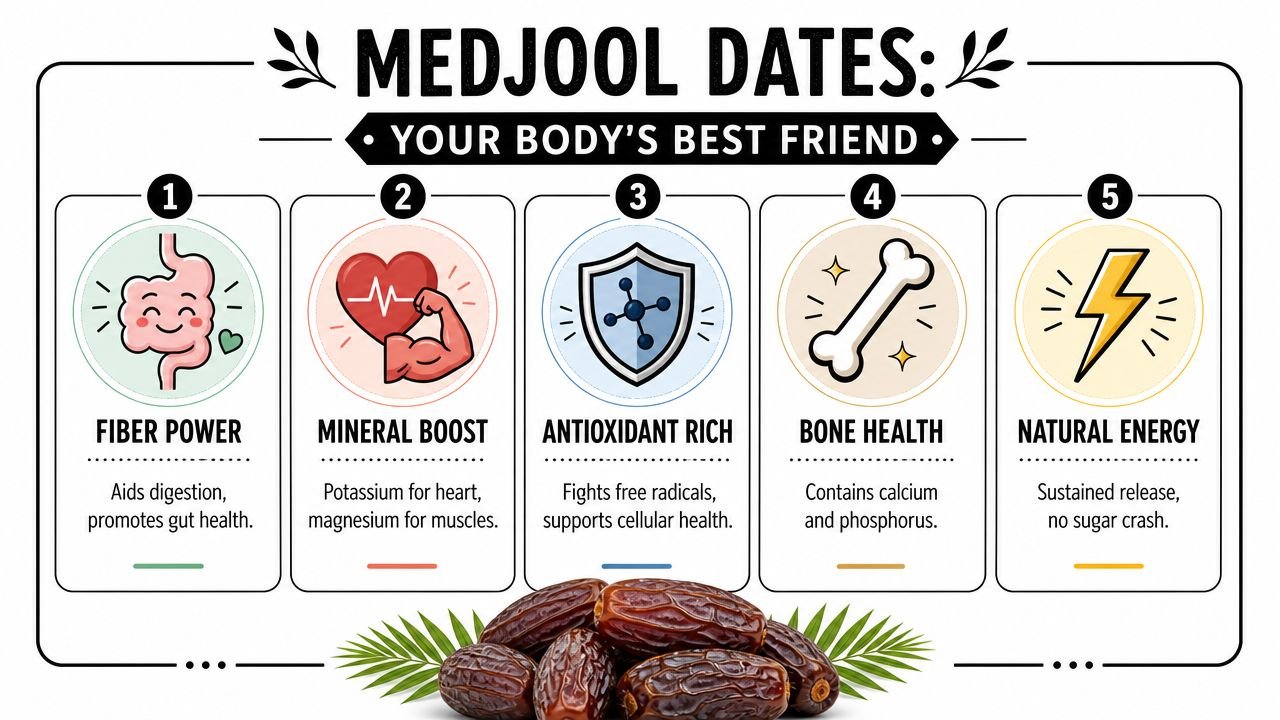
If you only look at the carb line, you miss why many people enjoy dates and feel good including them in a balanced diet. Medjool dates offer more than fast fuel, even if fast fuel is their main role.
The most useful benefits are practical ones. They can help with fiber intake, they contribute potassium, copper, magnesium, and vitamin B6, and they can make sweet foods feel more satisfying than highly processed snacks. That matters because a food doesn't have to be low calorie to be worth eating.
What trackers often overlook
A tracking app gives you numbers. It doesn't always give you context.
If you see a date logged as mostly carbs, you might assume it has little nutritional value. That's too simplistic. The same serving data cited earlier shows dates supply measurable amounts of potassium, copper, magnesium, and vitamin B6. Those aren't flashy nutrients in most app dashboards, but they still matter for day-to-day health.
Three benefits stand out:
- Fiber support. Dates aren't a fiber superstar compared with legumes or high-fiber cereals, but they do contribute. That can help with regularity and make a sweet snack more filling than pure sugar.
- Mineral intake. Potassium and magnesium matter for people who train, sweat, or need better overall diet quality.
- Food satisfaction. A sticky, rich, sweet date can sometimes satisfy a dessert urge with a smaller portion than pastries or candy would.
Digestion and the bigger picture
People chasing better digestion often jump straight to supplements. Food patterns usually matter more. If constipation or irregularity is part of the issue, a broader look at hydration, total fiber, and routine is useful. This guide on how to restore regular bowel movements is a good complement because dates alone won't fix digestion if the rest of the diet is low in fiber and fluids.
A food can be high in sugar and still offer benefits. The question is whether those benefits match your needs and your portion.
Why this matters for real life
Dates can make healthy eating feel less restrictive. That's not a small thing. A lot of sustainable nutrition comes from finding foods that are enjoyable enough to repeat and structured enough to fit your targets.
If one or two dates help you avoid a nightly spiral into sweets, that may be more valuable than the raw macro line suggests. If dates trigger overeating for you, the benefit disappears. Your response matters as much as the label.
Medjools for Weight Loss and Fitness Goals
Medjool dates can be either helpful or sneaky. The same food that works beautifully before training can work badly as an untracked “healthy nibble” during a fat-loss phase.
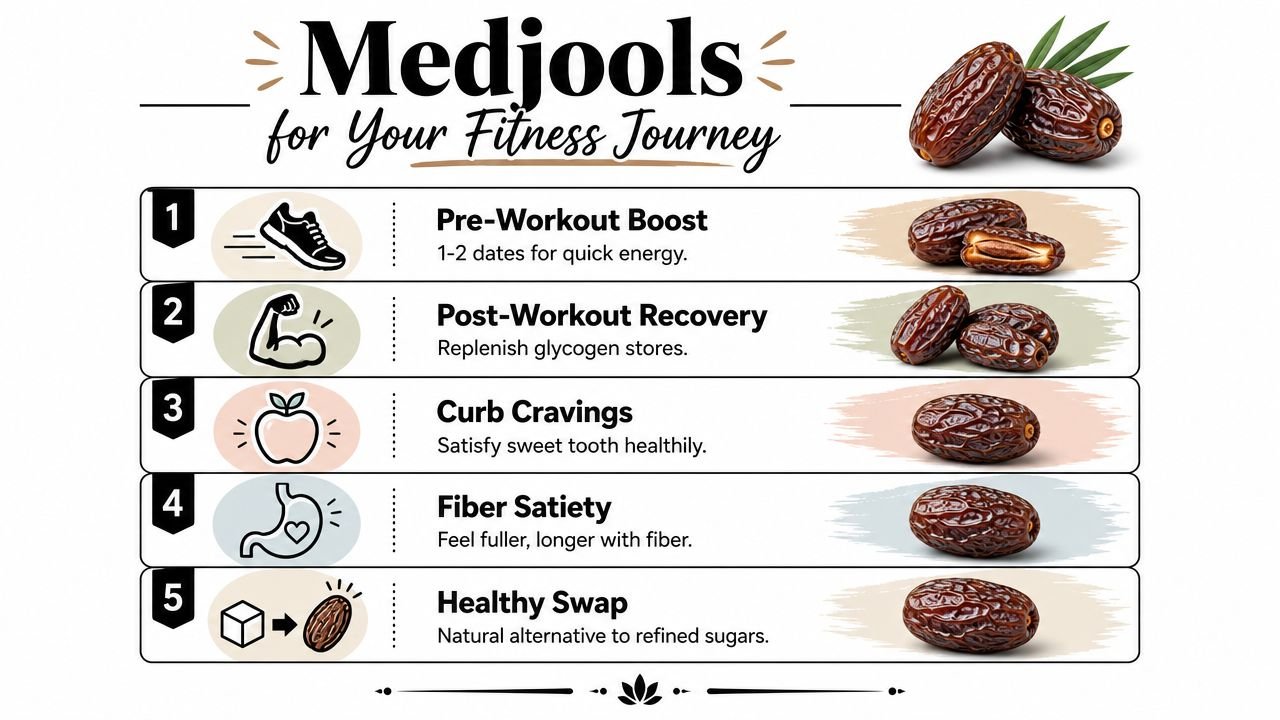
USDA-aligned nutrition data show about 66.5 kcal, 18 g carbohydrate, 16 g sugars, and 1.6 g fiber per pitted date, or 133 kcal, 36 g carbs, 32 g sugar, and 3.2 g fiber for two dates. That profile makes them useful as a compact pre-workout or endurance fuel when portion-controlled, according to Medical News Today's Medjool dates overview.
For fat loss
For weight loss, dates work best when you stop treating them like a vague healthy snack and start treating them like a planned carb source.
One date may fit nicely into a calorie deficit. Several dates eaten casually while cooking, packing lunches, or cleaning the kitchen can push you out of that deficit without much fullness. That's the trap.
A useful pattern for fat loss looks like this:
- Use one date intentionally when you want something sweet after a meal.
- Pair it with protein or fat if you need more staying power, such as yogurt, nuts, or nut butter.
- Avoid eating from the container because sticky, soft foods are easy to keep grabbing.
Logging tip: If the date is large, soft, or especially heavy, log by gram weight instead of by piece.
That last point matters more than people think. “One date” sounds precise, but Medjool dates vary in size. If you're using a food scale anyway, grams remove the guesswork.
For training
Dates shine most for people who exercise. They're easy to digest, portable, and sweet enough to be eaten even when a full meal isn't wanted.
They work well in a few situations:
Before a workout
If you train soon and need quick carbs, a date can be a convenient option.During long activity
Some endurance athletes like foods that are compact and easy to carry. Dates fit that role well if your stomach tolerates them.After training
Dates can help replenish carbs, but they're better paired with a protein-rich food if recovery is the goal.
Here's the video if you want a visual look at how people use them in practice:
A simple decision filter
Ask these three questions before you eat them:
| Question | If yes | If no |
|---|---|---|
| Do I need quick energy soon? | Dates may be useful | Choose a more balanced snack |
| Do I have room in my carb budget? | Log and enjoy | Reduce portion or swap |
| Am I eating them on purpose? | Easier to control | Easy to overeat |
That's the weight-loss and fitness answer. Medjool dates are neither diet food nor diet sabotage. They're a tool. Use them for the job they're good at.
Smart Ways to Enjoy and Log Medjool Dates
The easiest way to make dates work in real life is to stop eating them alone by default. Alone, they're mostly a quick-carb bite. Paired well, they become a more balanced snack or a smarter dessert.
Real-world examples that log well
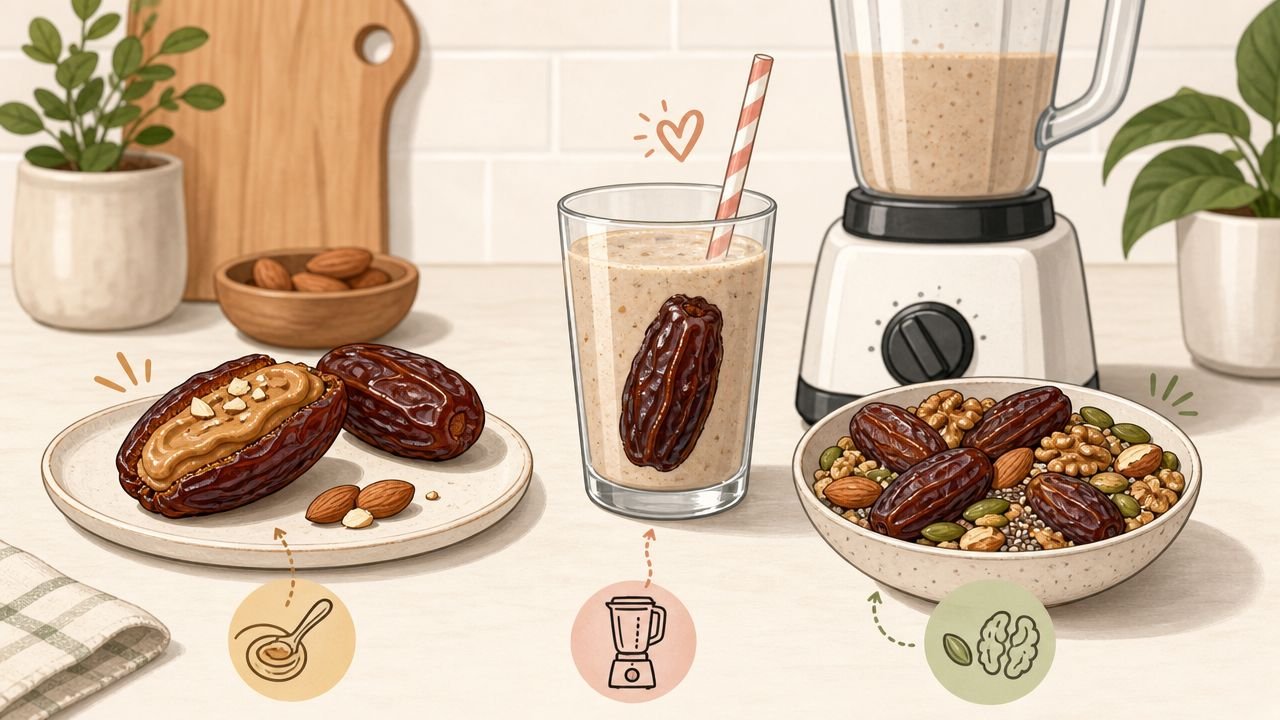
A client of mine used to eat three dates straight from the pantry every afternoon and wonder why her hunger came roaring back. We changed nothing dramatic. She started having one date stuffed with nut butter alongside Greek yogurt. Same sweet flavor, better balance, easier to log, and less “accidental snacking.”
Another common use is in smoothies. Dates can replace part of the sweetness from juice or flavored yogurt, but they still need to be counted. If you blend two dates into a smoothie with milk, banana, oats, and protein powder, you haven't made a low-calorie drink. You've made a substantial meal. That's fine if you log it that way.
Good combinations include:
- Stuffed dates with nuts or nut butter when you want dessert that feels richer than the portion size suggests
- Chopped dates in yogurt for sweetness plus protein
- Sliced into oatmeal when you need a sweeter breakfast without adding table sugar
- Blended into sauces or energy bites if you're replacing refined sweeteners with whole fruit
How to log them without fooling yourself
Tracking errors happen most with mixed foods.
If you eat dates whole, logging is simple. If you use them in recipes, count the full number or weight of dates added to the batch, then divide by servings. Don't log “homemade energy balls” as a guess if you can help it. Build the recipe once and reuse it.
A few practical rules help:
- Log before eating when dates are part of a snack plate or dessert board
- Weigh recipe ingredients when dates are blended, chopped, or pasted into a mixture
- Watch combo foods because nut butter, chocolate, coconut, and oats can turn a healthy snack into a very dense one
Dates are easiest to manage when you treat them like an ingredient with a purpose, not background sweetness that doesn't count.
Swaps that make sense
Dates can be a smart swap for refined sweeteners in some meals because they add sweetness plus a bit of fiber and micronutrients. But that doesn't mean they're “free.” The better question is whether the swap improves satisfaction and diet quality enough to be worth the calories.
For many people, it does. Especially if the choice is one satisfying stuffed date instead of a less satisfying processed sweet that leads to more grazing later.
If you want food tracking to feel this practical every day, PlateBird makes it easy to log meals, snacks, and portion changes without turning nutrition into homework. You can quickly record foods like Medjool dates, mixed snacks, or homemade recipes so your calorie and macro budget stays clear while you work toward weight loss, performance, or better eating habits.