You order the burrito bowl because it feels like the responsible choice. No tortilla. Plenty of vegetables. Beans for fiber. Chicken for protein. It looks fresh, balanced, and way more “on track” than a burger and fries.
Then the doubt kicks in halfway through lunch. Was the rice scoop bigger than usual? Did the guac turn this into a much heavier meal than you intended? If you’re trying to lose weight, hit macros, or want to understand what you’re eating, burrito bowl calories can get confusing fast.
That confusion is normal. A burrito bowl isn’t one food. It’s a stack of separate decisions, and each scoop changes the final total. The good news is that once you understand how those layers work, you can build a bowl that fits your goals without turning lunch into math homework.
The Healthy Lunch That Might Not Be
You’re standing in line at a fast-casual spot, mentally checking the “good choice” box. Bowl instead of burrito. Chicken instead of something fried. Salsa instead of a creamy dressing. It feels clean.
Then the employee adds rice, beans, chicken, corn, cheese, sour cream, and guacamole. Nothing looks outrageous on its own. But together, the bowl becomes the nutrition version of a packed suitcase. Every extra item seems small until you try to lift the whole thing.
Why people misread burrito bowl calories
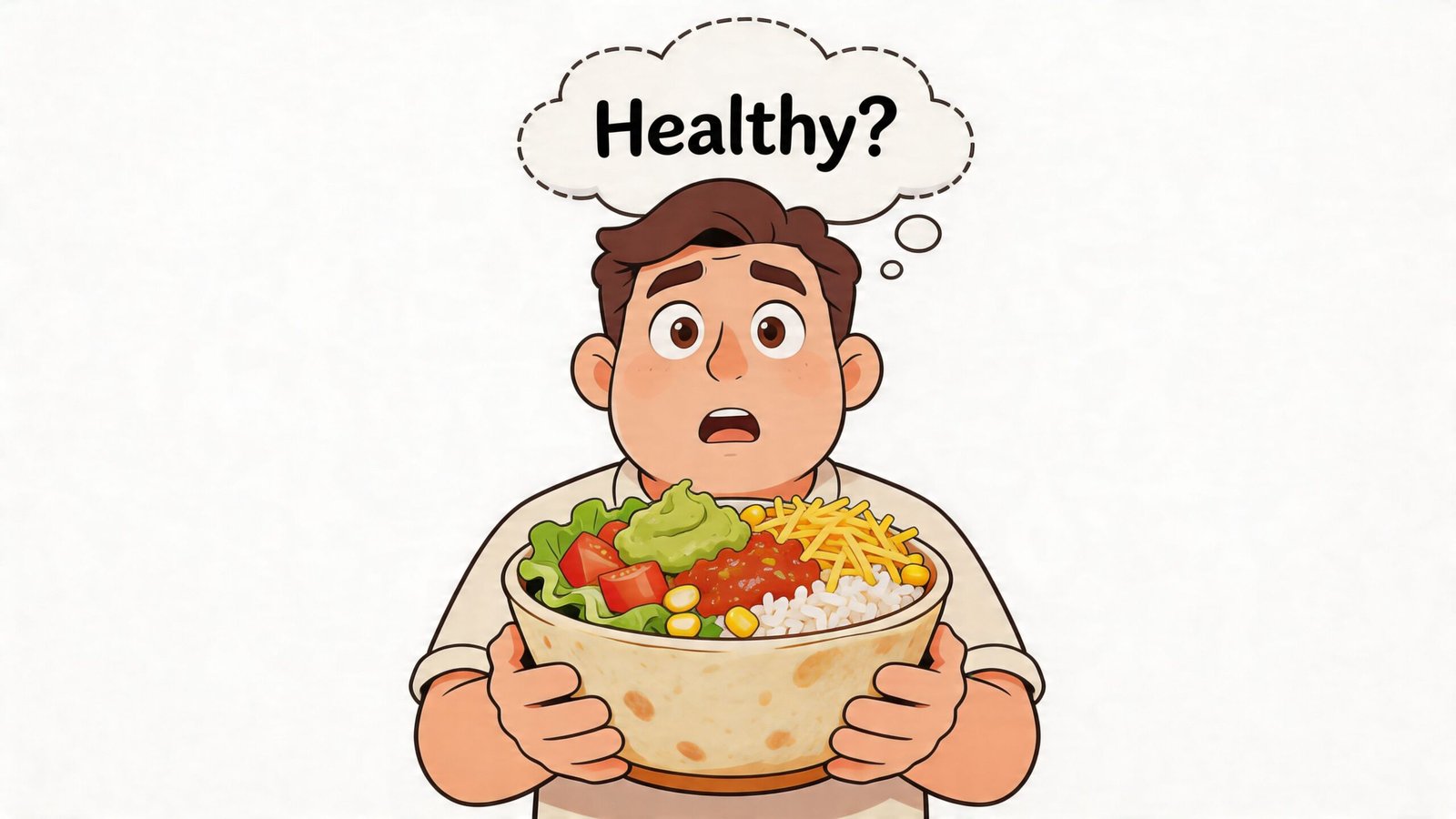
Many smart, health-conscious eaters get tripped up. A bowl made from recognizable ingredients can still carry a lot more energy than it appears to. Research on burrito calorie estimation found that bowls people perceived on the low end at 410 kcal averaged 647 kcal, a 58% gap, according to this PMC study on calorie estimation in burritos.
That finding matters because it shows the problem isn’t laziness. It’s visual estimation. Humans are not great at eyeballing mixed meals, especially when ingredients overlap and disappear into each other.
Practical rule: If a meal has multiple scooped ingredients, don’t trust your eyes to total it up accurately.
Fresh ingredients can still stack up fast
A chicken burrito bowl can absolutely be a solid choice. One standard chicken burrito bowl listed by Fitia weighs 595 grams and contains 663 calories, with rice, beans, corn, avocado, vegetables, and grilled chicken strips in the mix, as shown in this Fitia chicken burrito bowl nutrition entry.
That’s not automatically “too much.” For some people, it fits perfectly. For others, it uses a big chunk of the day’s calorie budget at lunch. The issue isn’t that burrito bowls are bad. It’s that they’re easy to underestimate, and underestimating them can subtly hinder progress.
If your healthy lunch hasn’t been producing the results you expected, this may be the missing piece. The bowl wasn’t the problem. The guesswork was.
Deconstructing Your Bowl Calorie by Calorie
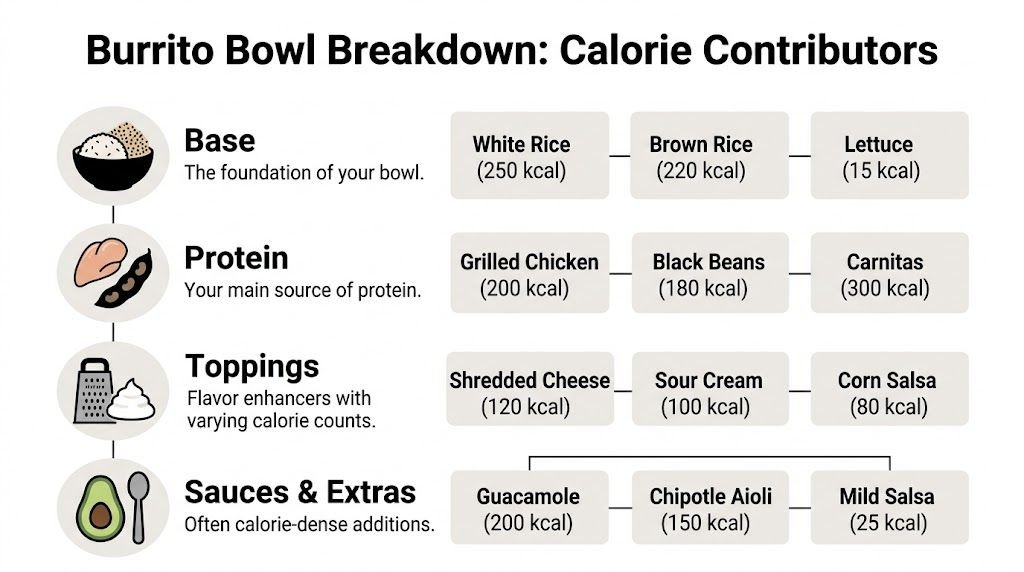
A burrito bowl makes more sense when you stop viewing it as one menu item and start seeing it like a building. Every bowl has a foundation, a main structure, supporting layers, finishing touches, and a few ingredients that can accelerate calories quickly.
That mental model helps because you’re no longer asking, “Is this bowl healthy?” You’re asking, “Which layer is doing the heavy lifting here?”
The foundation
The base decides how dense the bowl feels before toppings even enter the picture. Rice creates a hearty bowl. Lettuce keeps it lighter and bulkier.
Think of the base as the floor plan. A roomy floor plan can hold more furniture, and a rice-heavy bowl invites the rest of the meal to grow with it.
The structure
Protein is the anchor. It affects calories, fullness, and how satisfying the meal feels two hours later.
Chipotle’s official calculator shows the following protein options per serving: chicken 180 calories, steak 150 calories, barbacoa 170 calories, and carnitas 210 calories, according to the Chipotle burrito bowl nutrition calculator. This is one of the clearest examples of why burrito bowl calories vary so much. Two bowls can look nearly identical and still land differently just because of the protein choice.
The supporting layers
Beans, fajita vegetables, and salsas often make a bowl feel nutritious and complete. They also create a common tracking trap. Because they seem “healthy,” people tend to count them loosely or forget them entirely.
Here’s a simple way to think about these layers:
- Beans add staying power. They contribute substance and make the bowl more filling.
- Vegetables add volume. They help the bowl look generous without pushing calories up as aggressively.
- Salsas add flavor contrast. They can make a lighter bowl feel far less boring.
If you cook at home, learning how to calculate calories in homemade food makes this layer much easier to understand, because you can see how each spoonful changes the total.
The calorie accelerants
Some ingredients act like “small parts, big impact” additions. Cheese, sour cream, queso, and guacamole don’t usually dominate the bowl visually, but they can shift the total quickly.
A useful coaching lens is this: some ingredients are load-bearing, and some are luxury finishes. Protein, beans, and vegetables usually help the meal do a job. Creamy toppings often improve taste, but they also raise the calorie cost of each bite.
The easiest bowls to underestimate are the ones with several modest-looking extras.
A better way to judge a bowl
Instead of memorizing every ingredient number, scan your bowl in layers:
- What’s the base? Rice-heavy or veggie-heavy?
- What’s the protein? Leaner or richer?
- What adds volume? Beans, lettuce, fajita vegetables, salsa?
- What accelerates calories? Cheese, sour cream, queso, guac?
That’s the difference between random tracking and informed tracking. You don’t need perfect recall. You need a system.
The Calorie Difference Between Chipotle and Your Kitchen
Restaurant bowls and homemade bowls may share the same name, but they don’t behave the same way nutritionally. The biggest difference is control.
At a restaurant, you get someone else’s scoop. In your kitchen, you get your scoop. That sounds minor until you realize burrito bowl calories are heavily shaped by portions that are hard to judge once everything lands in one container.
What happens at a fast-casual chain
Chipotle is a useful example because the menu is highly customizable. Their nutrition calculator shows that protein alone can shift the bowl meaningfully, with steak at 150 calories and carnitas at 210 calories per serving. Once rice, beans, and toppings are added, a standard bowl can land anywhere from 800 to over 1200 calories, based on the official Chipotle nutrition calculator.
That range explains why “I had a burrito bowl” tells you almost nothing by itself.
A lighter order and a loaded order can sit in the same bowl, come from the same restaurant, and still produce very different results.
What changes when you build it at home
At home, you can decide whether the rice is a true serving or a generous heap. You can choose whether guacamole is a small accent or a full topping. You can also build the bowl around what matters most to you, whether that’s protein, fullness, or a lower overall calorie total.
Homemade bowls also teach you something restaurants can’t. You begin to notice which ingredients make the meal satisfying. Many people discover they don’t miss extra cheese if the salsa is bright and the protein is well seasoned.
Restaurant food hides portion size in plain sight. Home cooking makes portion size visible.
Burrito bowl ingredient calorie comparison
| Ingredient | Standard Choice (Calories) | Lower-Calorie Swap (Calories) | Notes |
|---|---|---|---|
| Protein | Carnitas (210) | Steak (150) | Protein choice alone can change the bowl meaningfully. |
| Protein | Chicken (180) | Steak (150) | A smaller shift, but still worth noticing. |
| Base | Rice-based bowl | Lettuce-based bowl | Use a lighter base when you want more room for beans or toppings. |
| Toppings | Guacamole-heavy bowl | Salsa and fajita veggie focused bowl | Flavor can stay high even when calorie-dense extras are reduced. |
| Build style | Restaurant scoop | Home-portioned bowl | The main advantage at home is portion clarity. |
If you want to get better at spotting these tradeoffs on packaged foods and meal components, it helps to know how to read nutrition labels.
A practical takeaway
Restaurant bowls are convenient, flavorful, and often built from quality ingredients. The challenge isn’t the restaurant itself. The challenge is that the final bowl reflects both your choices and the hand that served them.
Your kitchen gives you a tighter feedback loop. If your goal is fat loss or more precise macro tracking, that extra control matters.
Smart Swaps to Build a Low-Calorie Burrito Bowl
Lowering burrito bowl calories doesn’t mean ordering the sad version of lunch. The best swaps keep the bowl satisfying while trimming the ingredients that add a lot without helping much with fullness.
That’s why I prefer the phrase smart upgrades. A good swap should still leave you excited to eat the meal.
Start with the protein
If you only change one thing, change the protein. In Chipotle burrito bowls, protein choice creates a 43% calorie variance, from 150 to 210 calories per serving. Carnitas is the highest at 210 kcal, while chicken is 180 kcal, according to this Chipotle burrito bowl protein breakdown.
The reason is fat content. Richer meats bring more energy density. That doesn’t make them off-limits. It just means you should choose them on purpose.
A simple coaching rule:
- Choose chicken when calories are tighter
- Choose carnitas when flavor is the priority and the rest of the bowl stays lighter
- Use steak as a middle-ground option
Build volume before you add extras
It's common to want a bowl that looks full. That’s reasonable. A skimpy bowl rarely feels satisfying.
The trick is to create fullness with ingredients that stretch the bowl physically before you pile on calorie-dense finishes.
Some of the best upgrades are straightforward:
- Base swap. Use less rice or a lettuce-heavy base if you want more room for beans and toppings.
- Volume boost. Add fajita vegetables and salsa to make the bowl feel abundant.
- Creamy control. Choose one rich topping instead of stacking several.
A bowl that feels generous is easier to stick with than a bowl that only looks disciplined.
Pick your indulgence instead of layering them all
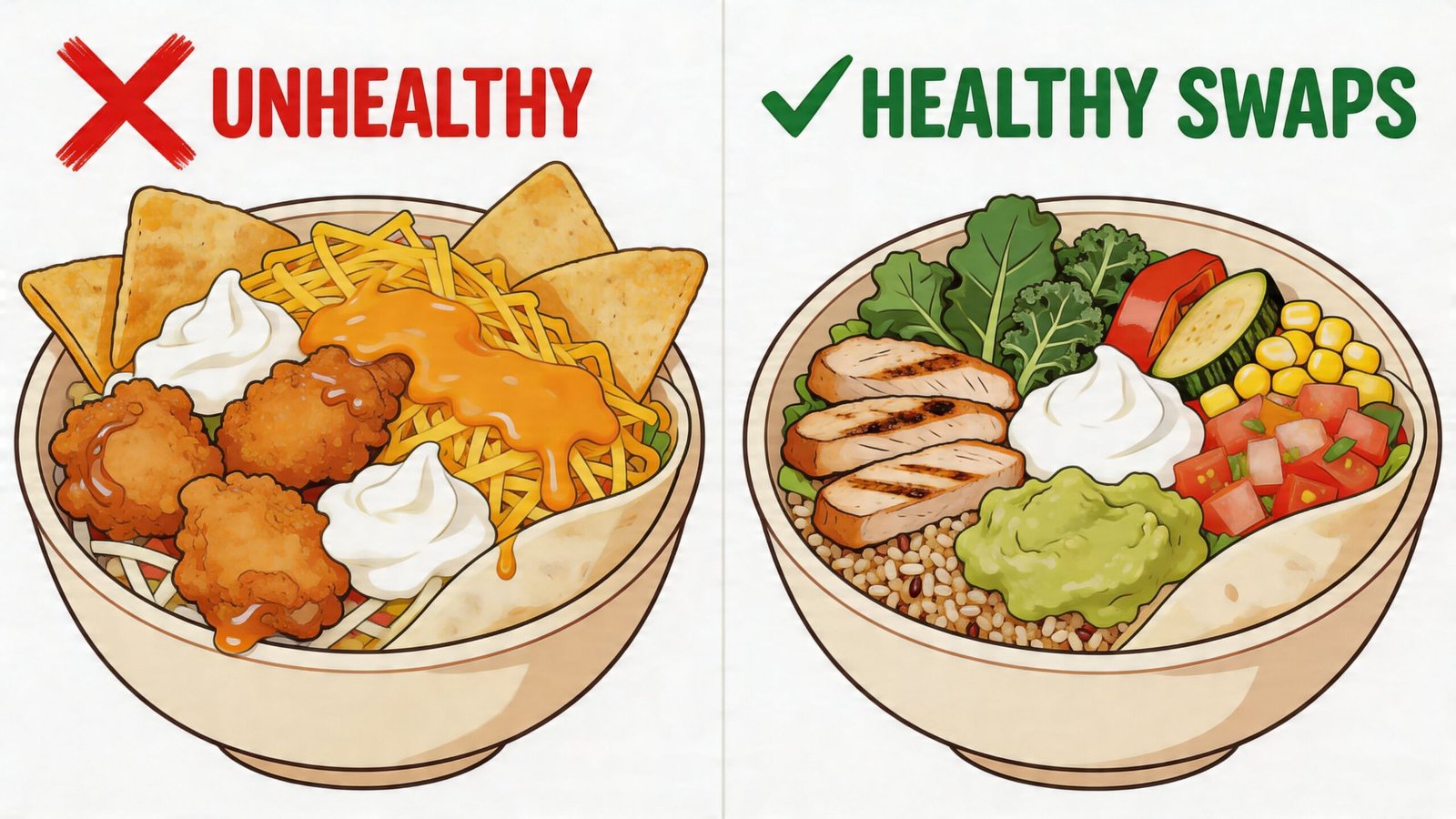
Many bowls veer off track with certain additions. Cheese seems small. Sour cream seems small. Guacamole seems small. Together, they can turn a moderate lunch into a much heavier one.
A better approach is to pick the one extra you care about most. If guacamole makes the meal feel complete, keep it and skip another creamy topping. If cheese is essential, build the rest of the bowl around that choice.
This kind of tradeoff thinking works because it protects satisfaction. You’re not removing pleasure. You’re deciding where pleasure matters most.
Here’s a useful visual guide before your next order:
Smart upgrades that still taste like a real meal
Try this decision framework when ordering:
- Anchor the bowl with leaner protein
- Use vegetables and salsa for bulk and flavor
- Keep beans if they help fullness
- Choose one richer topping intentionally
- Stop adding once the bowl already sounds complete
That last point matters. A satisfying bowl usually becomes satisfying before the final two extras get added.
The Modern Way to Track Burrito Bowl Calories
Manual logging sounds simple until you’re staring at a customized bowl and trying to decide which database entry is “close enough.” Is it a chicken bowl? A chicken and rice bowl? A restaurant burrito bowl? A homemade burrito bowl with guac? The labels rarely match the meal in front of you.
That’s why burrito bowl calories are such a common sticking point for new trackers and busy people alike. Generic entries flatten a highly customized meal into a rough guess.
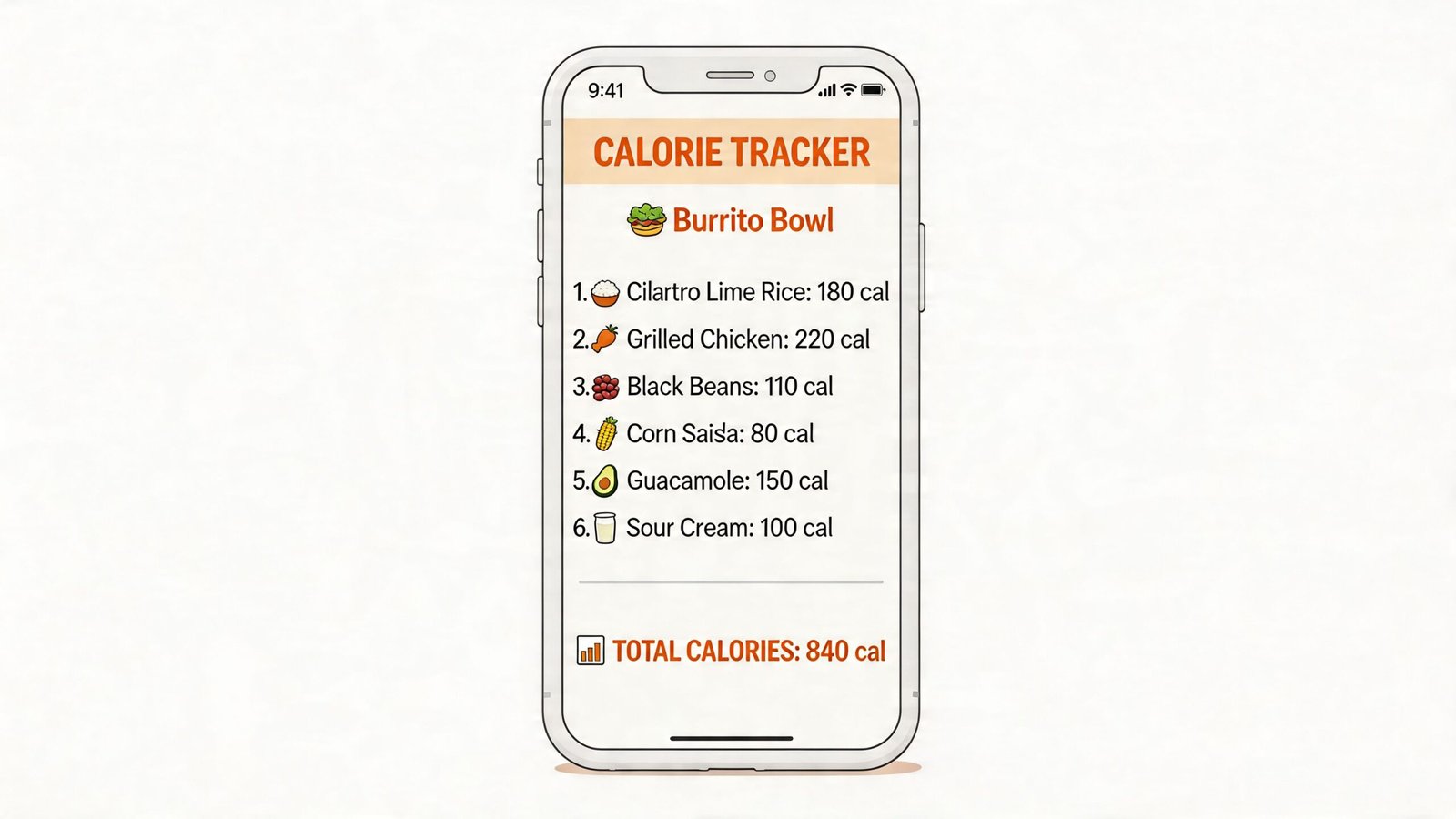
Why manual logging breaks down
Existing content on burrito bowl calories often misses the main problem: portion variability and logging errors. Users regularly ask how to log custom bowls, and that’s exactly where manual tracking apps struggle, as noted in this discussion of generic burrito bowl logging challenges.
The friction usually shows up in a few places:
- Too many similar database entries. You pick the closest option, not the most accurate one.
- Mixed ingredients. Once salsa, rice, beans, and toppings overlap, eyeballing portions gets messy.
- Repeat meals with slight changes. One day has extra guac, the next doesn’t. Logging starts to feel annoying.
What a better tracking workflow looks like
A better system matches how people eat. Nobody wants to reconstruct every scoop from memory after lunch.
That’s why modern tracking tools have shifted toward faster input methods, especially for meals that don’t come with a barcode. Text-based logging lets someone enter a meal in plain language. Photo logging helps when the bowl is already assembled and you need help identifying ingredients and estimating portions.
If you’re still learning the basics, it helps to start with a simple primer on how to count calories, then layer in tools that reduce the guesswork.
The best tracking method is the one you’ll keep using on busy days, not just on your most motivated days.
Accuracy matters, but consistency matters too
Many people think tracking fails because they lack discipline. More often, it fails because the process is too tedious. Burrito bowls expose that weakness immediately because they’re customizable by design.
A practical tracking habit looks like this:
- Log soon after ordering or eating
- Record notable extras like guacamole, cheese, or sour cream
- Use repeatable descriptions for meals you order often
- Review patterns over time instead of obsessing over one bowl
That approach turns calorie tracking into feedback, not punishment. You stop chasing perfection and start building awareness.
Taking Control of Your Burrito Bowl
A burrito bowl isn’t automatically a diet food, and it isn’t automatically a problem either. It’s a format. What matters is how the layers stack.
Once you understand that a bowl has a base, a protein, supporting ingredients, and a few calorie accelerants, the meal stops feeling mysterious. You can look at it and understand why it lands where it does. That’s a big shift from “I hope this fits” to “I know how to shape this.”
What mastery actually looks like
You don’t need to fear rice. You don’t need to swear off guacamole forever. You don’t need to turn lunch into a joyless exercise in restriction.
You do need a repeatable decision process:
- Notice the base
- Choose protein intentionally
- Use vegetables and salsa for volume
- Add rich toppings on purpose, not by habit
- Track the bowl in a way that matches real life
That’s how burrito bowl calories become manageable. Not through food guilt, but through better visibility.
Use the bowl as a tool, not a test
For meal preppers, gym-goers, parents, and busy professionals, the burrito bowl can be one of the most flexible meals around. It can be hearty, protein-focused, vegetable-heavy, or comfort-driven depending on the day.
Even the container can influence how you think about portions and meal structure. If you’re curious about different serving and packaging formats, this guide to types of bowls gives helpful context for how bowls are used across meal styles.
The bigger lesson is simple. A burrito bowl is a canvas. You’re not at the mercy of it. You’re the one building it.
If you want calorie tracking to feel fast instead of frustrating, try PlateBird. You can type what you ate in plain language or snap a photo of your meal, and the app breaks down calories and macros without the usual database scavenger hunt. For customized meals like burrito bowls, that kind of low-friction logging makes it much easier to stay consistent.