- The Nutritional Showdown A Head-to-Head Comparison
- Health Benefits for Your Specific Wellness Goals
- How to Prepare and Use Flax and Chia Seeds
- Accurate Macro Logging for Flax and Chia
- Which Seed Is Right for You A Goal-Based Guide
- Proper Storage to Preserve Nutritional Power
- Frequently Asked Questions About Flax and Chia
You're probably deciding between two tiny add-ons that look interchangeable in a jar but behave very differently in a real diet.
One goes into oatmeal and turns creamy. The other gets sprinkled on yogurt and, if it isn't prepared right, may pass through you with a lot of its value still trapped inside. That's why most flax vs chia comparisons miss the part that matters most in practice: not just what's on the label, but what your body can access and what your food log is capturing.
As a coach, I don't treat these seeds as nutritional twins. I treat them as two different tools. Chia is often the easier plug-and-play choice. Flax can be excellent too, but only if you use the right form. If you skip that detail, your meal prep and your tracking can drift away from reality fast.
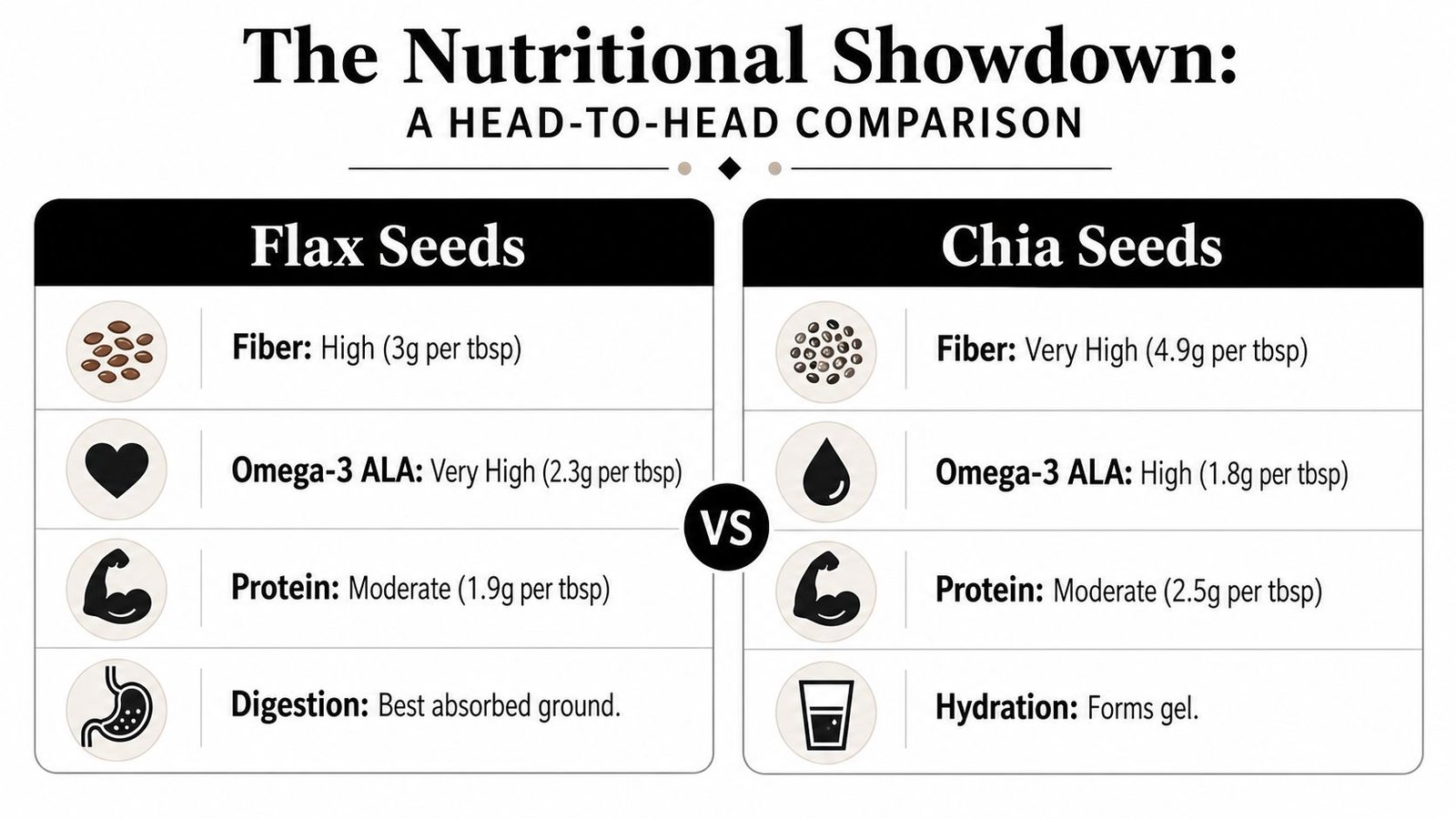
The Nutritional Showdown A Head-to-Head Comparison
You log a tablespoon of seeds in your breakfast bowl and expect the entry to reflect what you consumed. With flax and chia, that assumption gets shaky fast, because the label numbers are only part of the story. The seed's form changes how much your body can access, and it can also change how accurately you log the meal in PlateBird or any other tracker.
Here's the fast view, using one source for consistency: Healthline's nutrition breakdown of chia and flax.
| Nutrient or trait | Flax seeds | Chia seeds |
|---|---|---|
| Calories per ounce | 534 kcal | 486 kcal |
| ALA omega-3 per ounce | 6,000 mg | 4,900 mg |
| Calcium per ounce | 60 mg | 179 mg |
| Total fiber per ounce | 8 to 8.5 g | 9.8 to 10 g |
| Protein density | 18.3 g per ounce | 16.5 g per ounce |
Where flax wins
Flax has the stronger ALA omega-3 profile per ounce. It also edges higher on protein density. For clients trying to get more nutritional value into a smaller serving, that matters.
The practical catch is form. Whole flax often passes through with much of the seed intact, so the food log may look better than the nutrition outcome. Ground flax is the version that makes the numbers more meaningful in real life.
Where chia wins
Chia comes in lower in calories per ounce and higher in both fiber and calcium. If the goal is fullness, more bulk in a meal, or a simple way to raise intake of non-dairy calcium, chia usually does that job with less prep.
It also tends to create fewer logging mistakes. Whole chia is still usable because it absorbs liquid and softens, while whole flax is the version that causes the most disconnect between what gets logged and what gets absorbed.
What these numbers mean in actual meals
On paper, the gap looks straightforward. In practice, preparation decides whether the advantage shows up on your plate.
A tablespoon of whole flax sprinkled over yogurt can look identical in your app to a tablespoon of ground flax stirred into oats, but those are not nutritionally equivalent in a useful sense. One is much easier for your body to access. Chia has its own version of this issue. Dry chia and soaked chia can log similarly, yet soaked chia usually changes meal volume, texture, and fullness enough to affect how satisfied you feel afterward.
That matters if you are working toward a fiber target and trying to line up your intake with your log. If you need a benchmark for that daily target, this guide on how much fiber you should have each day helps put the seed numbers into context.
For digestion, the better seed is often the one you prepare in a way your body handles well and your tracking app can represent accurately. Rawbiotics insights on gut health make the same practical point from a digestive angle. Texture, hydration, and tolerance all shape the outcome.
So the headline is simple. Flax has the stronger omega-3 edge, but ground flax is the form that earns its place. Chia is usually easier to use, easier to absorb in a practical sense, and easier to log without kidding yourself about what ended up in the meal.
Health Benefits for Your Specific Wellness Goals
Breakfast is a good place to make this decision. If someone adds chia to oats and lets it sit, the bowl gets thicker, heavier, and usually more filling. If that same person adds flax for omega-3s but uses it in a form their body does not access well, the food log can look better than the meal performs.
That is why the best seed depends on the goal, the form, and how accurately you can track it.
Chia usually fits better when the priority is appetite control, steadier energy, and meals that keep you full for longer. Flax stands out when you want more ALA and the plant compounds called lignans.

For appetite control and blood sugar steadiness
Chia has a practical edge here because it changes the texture and volume of a meal. In a breakfast you can see and feel, soaked chia takes up space, slows the eating pace, and often improves fullness after the meal. That matters for clients who log breakfast carefully but still end up snacking an hour later.
In a controlled glucose challenge trial, Salba-chia reduced blood glucose area under the curve by 82.5±19.7 mmol/l over 120 minutes, compared with 60.0±19.7 mmol/l for flax. The same trial found a 35% lower blood sugar level at the 30-minute absorptive phase for chia versus flax, and satiety ratings from chia were twice as high as those from flax relative to a glucose control, according to the PubMed study summary.
For real meals, this usually shows up as better staying power from chia pudding, overnight oats, or yogurt with soaked chia than from a light sprinkle of seeds on top.
For digestion and meal comfort
Both seeds can help with regularity, but they feel different in the gut and they fit meals differently. Chia absorbs water and creates a gel, which some people find gentler and more satisfying. Ground flax mixes in more unobtrusively, which can be easier for clients who do not like the texture of soaked chia.
Form matters here too. Dry chia added without enough fluid can be uncomfortable for some people. Whole flax may get logged as fiber, but if much of it passes through intact, your app entry can overstate what you really got from the serving.
If constipation or slow digestion is a concern, hydration matters as much as fiber. For a broader read on food-first bowel support, Rawbiotics insights on gut health are a useful companion resource.
If you are trying to hit a daily target instead of guessing, this guide on how much fiber you should have a day helps put seed servings into context.
For hormonal health and anti-inflammatory support
Flax has the stronger case when the goal is higher ALA intake and more lignans. That gives it a different use in a nutrition plan. I usually steer clients toward flax when they want a small daily add-in that does more than raise fiber.
The catch is practical. Flax only earns that spot if you use ground flax and use it consistently. Chia is often easier to stick with because it works in more forms and is simpler to log with less guesswork about what your body accessed.
My practical summary is simple:
- Choose chia when you want a breakfast or snack that feels bigger, slows digestion, and keeps you full longer.
- Choose flax when your priority is ALA and lignans, and you are willing to use it in ground form.
- Choose the one you will prepare the right way because whole versus ground, and dry versus soaked, can change both the nutrition you absorb and the accuracy of your food log.
How to Prepare and Use Flax and Chia Seeds
This is the part that changes everything.
In a flax vs chia comparison, the seed form matters more than commonly perceived. Chia works whole. Flax does not work the same way. If you treat them as interchangeable in the kitchen, you can end up eating one and absorbing the other.
Why whole flax is a problem
Unlike chia, which is bioavailable whole, flax's nutritional value depends on processing. If someone logs “1 tbsp flax” without specifying that it's ground, they may underestimate calories and fiber intake by up to 30 to 40% because the body can't break down the hard flax shell to access the nutrients inside. Logging whole flax as if it behaves like ground flax creates a false macro entry, according to Dummies' explanation of flax versus chia use.
Practical rule: If flax isn't ground, don't assume you're getting the full nutritional value listed in your app or on the package.
That's why I tell clients to buy ground flaxseed or grind whole flax just before using it. For smoothies, a strong blender can help. For oatmeal, yogurt bowls, or baking, pre-ground flax is usually the easiest move.
Why chia is simpler
Chia is more forgiving. You can use it whole in yogurt, oats, puddings, or drinks and still count on bioavailability. Soaked chia and dry chia change texture, but not in the same make-or-break way as flax.
Soaking does matter for experience. Dry chia sprinkled onto a meal stays more noticeable. Soaked chia becomes gel-like and tends to create more volume. That can make a breakfast feel more substantial, which is often helpful for people trying to avoid random snacking later.

Best uses by format
Here's the kitchen version of the decision:
- Ground flax in smoothies: Easy way to hide texture and improve actual absorption.
- Ground flax in oatmeal or baking: Works well when you want a mild, nutty flavor.
- Whole chia in overnight oats: Great when you want a thicker, more filling breakfast.
- Soaked chia in pudding: Best for people who like a spoonable texture and want a fiber-forward option.
- Either seed in yogurt: Chia adds texture. Ground flax disappears more easily.
For breakfast ideas that make chia easy to use in real life, start your day with Nutrition Geeks if you want a simple porridge format rather than a plain pudding.
What doesn't work well? Buying whole flax, sprinkling it over food, and assuming the label equals what your body absorbed. That's the most common mistake I see.
Accurate Macro Logging for Flax and Chia
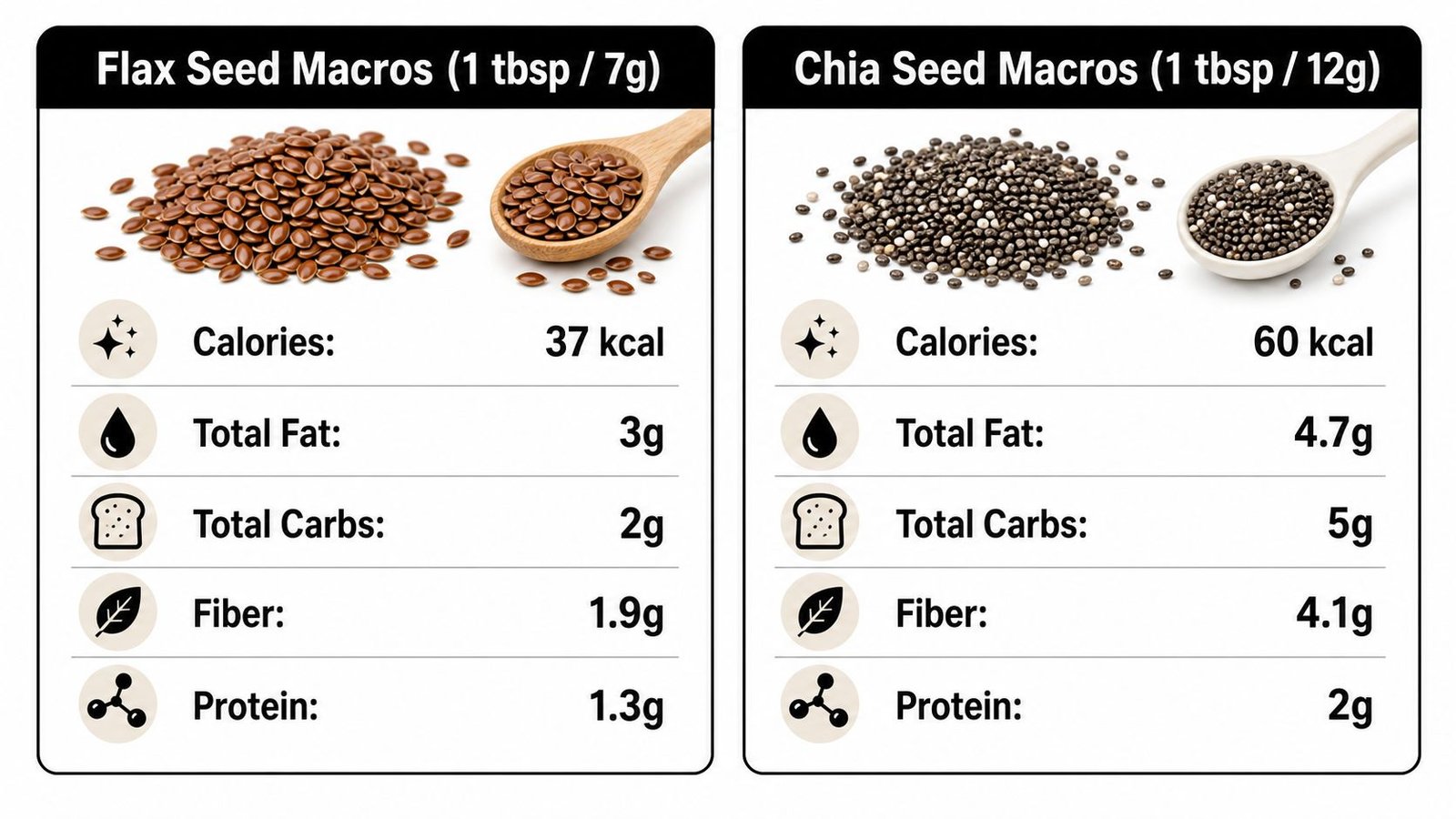
You log breakfast as 320 calories, hit your fiber target, and move on. Later, hunger shows up early and the meal did less work than the app suggested. With flax and chia, that gap often comes from the form you ate, not the seed name you picked.
What changes in the log
For tracking, the biggest mistake is treating all flax entries as interchangeable. They are not.
Whole flax and ground flax can show similar numbers in an app, but they are not equally useful in real meals. If you ate ground flax in oats or a smoothie, logging ground flax is a solid entry. If you sprinkled whole flax on yogurt, the label may overstate what you took in because the seed coat can pass through without being fully broken down. Chia is simpler to log because whole chia is still a practical, usable form.
That matters in apps like PlateBird because accuracy is not only about calories. It is also about matching the entry to the form that your body could realistically use.
A practical way to log it
Use the most specific entry available:
- Ground flaxseed if you blended it, baked with it, or stirred in meal.
- Whole flaxseed if you used it as-is.
- Dry chia seeds if you sprinkled them in.
- Soaked chia seeds or chia pudding if liquid changed the volume and serving size.
The chia calories do not change much just because the seeds were soaked, but the portion often does. That is where people get sloppy. They log “2 tablespoons chia” after eating a full bowl of pudding made with several servings, or they log the finished volume instead of the dry seed amount. For flax, the problem is different. People often log the nutrition profile they want, while eating a form that is less available in practice.
If you want clean data, log the seed by form first, then by amount. “Flax” is too vague to be useful.
Where people mislog these seeds
I see three repeat errors:
- Logging whole flax as ground flax. That makes the food log look better than the meal really was.
- Logging soaked chia by bowl size instead of dry seed amount. The gel adds volume, not a new macro profile.
- Using generic database entries. “Seeds, mixed” or “flax/chia blend” works for rough tracking, not for precise intake.
Fiber adds one more layer. Two foods can look close in calories and still behave differently in appetite, digestion, and fullness. If you are trying to make sense of that, this breakdown of how fiber calories are counted in food tracking apps helps.
The simplest system
For clients who want reliable logs without overthinking it, I keep it simple.
Use chia when convenience and consistent tracking matter most. Use flax when you specifically want flax, and buy it ground or grind it before eating. Then choose the matching entry every time.
That approach keeps your food log closer to real intake, which is the whole point of tracking in the first place.
Which Seed Is Right for You A Goal-Based Guide
You buy one bag of seeds with good intentions, add it to breakfast for a week, then stop using it because the prep, texture, or logging gets annoying. That pattern matters more than small nutrition differences on paper. The right pick is the seed you will prepare in a way your body can use, and log in a way that matches what you ate.
If your goal is staying full longer
Choose chia.
Chia is usually the easier appetite-management tool because it absorbs liquid, adds bulk, and fits into foods people already repeat, like yogurt bowls, overnight oats, and puddings. That matters in real meals. A seed that swells in the bowl often feels more substantial than one that disappears into the recipe.
It is also easier to log consistently because you can measure the dry amount before soaking and reuse that entry each time.
If your goal is more non-dairy calcium
Choose chia.
As noted earlier, chia has a clear edge here. If dairy is low in your routine, or you are trying to build calcium intake from plant foods you will eat often, chia is usually the simpler choice to keep in rotation.
If your goal is maximizing ALA omega-3 intake
Choose flax, but only if you use ground flax.
This is the trade-off many comparisons skip. Flax can look better on a nutrition panel, but whole flax often passes through with limited payoff. Ground flax is the version that makes the nutrition label more relevant to your actual intake. If you are buying flax for omega-3s and logging it in PlateBird, the entry should match the form you ate. Whole and ground are not interchangeable in practice.
If your goal is the easiest daily habit
Choose chia.
Chia asks less from you. You can stir it into oats, yogurt, or a shake without thinking much about prep. Flax asks for one extra decision. Was it ground? Did you grind it? If the answer is no, I would not count on it as your main seed habit.
If your goal is baking or smoothies
Pick based on texture and prep tolerance.
- Ground flax blends in better when you want a mild, nutty addition without much visual change.
- Chia works better when you want thickening, structure, or a spoonable texture.
- Whole chia is usually fine in recipes. Whole flax is the version I see clients overestimate most.
A food that fits your routine beats one that looks slightly better on paper but keeps getting used the wrong way.
My coach's shorthand
If a client says, “I only want one seed in the house,” I usually keep the decision simple:
- Hunger support and calcium priority: chia
- ALA omega-3 priority, if you will use it ground: flax
- Fast breakfasts with less friction: chia
- Smoothies, muffins, or oats where ground seed disappears easily: flax
- Batch-prepped breakfasts you want to repeat and log accurately: chia, especially if you already use a meal prep system for repeatable breakfasts
One practical note. If you store both, keep the setup simple so you keep using them. A sealed pantry system helps, and this guide for kitchen food storage is a good reference for container choice.
The short version is simple. Choose chia for convenience, repeat use, and easier logging. Choose flax when you specifically want flax's strengths and are willing to buy it ground or grind it before eating.
Proper Storage to Preserve Nutritional Power
Storage matters more with these seeds than people think, especially once flax is ground.
Ground flax is more delicate because exposing more surface area also exposes those fats to air, light, and off-flavors. I tell clients to keep it in an airtight container and move it to the refrigerator or freezer after opening. Chia is less fussy in day-to-day use, but it still does better when stored cool, dry, and sealed well.
Simple storage rules
- Keep containers airtight: Less air exposure helps protect flavor.
- Limit light exposure: Opaque containers or a darker cabinet help.
- Refrigerate ground flax: This is the one I'm strict about.
- Smell before using: If it smells bitter, sharp, or off, skip it.
If you're reworking your pantry setup, this guide for kitchen food storage is useful for thinking through container choice.
For people who batch breakfasts or prep ingredients ahead, this overview of how to meal prep can help you build seed use into a system that's easy to repeat.
Frequently Asked Questions About Flax and Chia
A common real-life scenario is this: someone logs “1 tablespoon chia” or “1 tablespoon flax” in PlateBird, adds it to yogurt or a smoothie, and assumes the nutrition is settled. The part that gets missed is form. Whole chia, soaked chia, whole flax, and ground flax can behave differently in the bowl and in your body, so the most accurate answer usually depends on how you ate it.
Can you eat both flax and chia?
Yes. That works well for a lot of people.
Use chia when you want an easy whole-seed option that thickens oats, yogurt, or pudding. Use ground flax when you want flax's nutrition in a form your body can access more reliably. In practice, many clients do best with both because each seed fits a different meal.
Is one better for weight loss?
The better seed is the one you will use consistently and log accurately.
Chia often helps with meal satisfaction because it absorbs liquid and adds bulk. Ground flax can fit a fat-loss plan just as well, especially in smoothies, oatmeal, or baking, but it takes more intention because whole flax is less useful nutritionally. If your food log says flax but you regularly use whole seeds and don't absorb much of them, your app entry can look cleaner than your real intake.
Do I need to soak chia?
No, but soaking changes both texture and how you use it.
Soaked chia turns into more of a gel, which works well in pudding, overnight oats, and thicker smoothies. Dry chia is easier to sprinkle into yogurt, oatmeal, or salad. Logging matters here too. A tablespoon of dry chia and a tablespoon of soaked chia are not the same volume once water is added, so log the dry amount you started with if you want your entry to stay accurate.
Do I need to grind flax every time?
Flax needs to be ground, or bought ground, if you want to get much from it nutritionally.
Whole flax often passes through with limited breakdown. That is the practical difference people miss. If you log flax regularly in PlateBird, log the form you used. “Ground flax” is a more honest entry than “flax seeds” if that is what went into your meal.
Which one works better in smoothies?
Ground flax blends in more smoothly. Chia creates more thickness, especially if it sits for a few minutes.
That trade-off matters. If you want a drinkable smoothie, flax is usually easier. If you want something closer to a spoonable shake that holds you longer, chia can do that job better.
Are there side effects?
The usual issue is tolerance.
A sudden jump in fiber can leave you bloated, gassy, or constipated if fluid intake is low. Start small and give your digestion a few days to adjust. This matters even more with chia because people sometimes add a large amount once they see how small the dry seeds look before they expand.
Does the time of day I eat them matter?
No. The best time is the meal you repeat consistently.
Breakfast is common because both seeds fit oats, yogurt, and smoothies, but lunch or dinner works too. I usually tell clients to put them where they improve adherence, not where they look healthiest on paper.
What's the biggest mistake people make when choosing between these seeds?
They treat them as nutritionally identical no matter the form.
That is where decisions go off track. Chia is often used whole and still works well that way. Flax usually needs grinding to make sense as a daily habit. If you ignore that difference, you can overestimate what you are getting from flax and underappreciate how much chia changes texture, fullness, and portion logging once it absorbs liquid.
If you want your food log to reflect what you ate, and not just what you meant to eat, PlateBird makes that process much easier. You can type meals in plain language, log recurring breakfasts quickly, and keep your calorie and macro tracking consistent without turning every seed, smoothie, or oatmeal bowl into a spreadsheet.