- Where the gap actually comes from
- The specific errors and what they cost
- Why calorie-dense ingredients fool you more than others
- How to get closer without becoming obsessive
- Specific fixes for meal preppers and plant-based eaters
- Building a habit that holds up over time
- What accuracy actually looks like in practice
- Frequently asked questions
How to Stop Underestimating Calories in Home-Cooked Meals
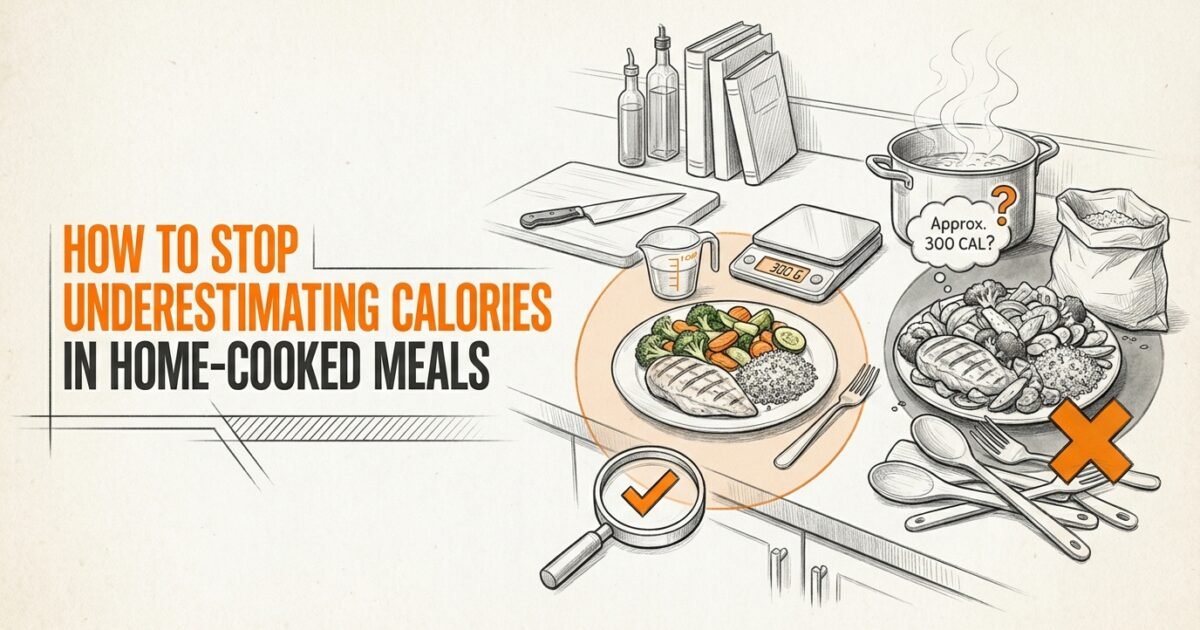
You spent 45 minutes cooking a chicken stir-fry, weighed nothing, eyeballed the oil, and logged it as 480 calories. It was probably closer to 700. That gap is not laziness. It is a structural problem with how home cooking and calorie estimation interact.
The complication is that home meals are not like restaurant meals with fixed recipes. You pour, you taste, you adjust. Every small decision adds up in ways that are genuinely hard to see in the moment. How to stop underestimating calories in home-cooked meals is not about obsessing over every gram. It is about knowing where the big errors hide.
The fixes are not complicated. A few habit shifts and one honest look at the usual blind spots will get you within a reasonable range most of the time. That range is enough to make real progress.
Where the gap actually comes from
The underestimation problem in home cooking is not random. It clusters around a handful of specific ingredients and habits. Once you know the pattern, you can stop being surprised by it.
Oil is the easiest calorie to miss
A tablespoon of olive oil adds about 120 calories. Home cooks pour from the bottle, which means they are adding 1.5 to 2.5 tablespoons without realizing it. That is 180 to 300 calories before the food even hits the pan.
Cooking spray is not a free pass either. A one-second spray is the labeled serving. People spray for three to four seconds, adding 30 to 60 extra calories per use. Small. But it happens at every meal.
Volume measures lie about dense foods
A cup of cooked rice sounds like a fixed amount. It is not. Depending on how tightly you pack it and how much water the rice absorbed, the same cup can swing by 25 grams or more. At roughly 1.3 calories per gram for cooked white rice, that is a 30-calorie error from one ingredient, one meal.
Nuts are worse. A quarter cup of almonds looks modest. It can be anywhere from 28 grams to 45 grams depending on how you fill the cup. The difference is about 100 calories. Do that with cashews on a salad and you have a significant miscalculation from one topping.
Snacking during cooking does not count in logs
Tasting the sauce, eating a handful of shredded cheese, finishing the last few bites of pasta before plating. These are real calories. They do not feel like a meal, so they rarely get logged. A conservative estimate for cook-time snacking is 100 to 200 calories per cooking session. Over a week, that is 700 to 1,400 calories that simply disappear from the record.

The specific errors and what they cost
It helps to see these errors side by side. The numbers below are realistic ranges based on common home cooking habits, not worst-case scenarios.
| Error | Typical underestimate | Why it happens |
|---|---|---|
| Pouring oil by eye | 120-300 calories | Bottle pours faster than expected |
| Cup vs gram mismatch (rice, oats) | 25-50 calories per serving | Packing density varies every time |
| Cheese by the pinch | 50-150 calories | Dense food, small visual footprint |
| Nut butter from the jar | 100-200 calories | Spoon dips are never one tablespoon |
| Snacking while cooking | 100-200 calories | Not perceived as a meal |
| Recipe tweaks without recalculating | 10-20% of total meal | Substitutions feel minor, are not |
| Forgetting beverages | 50-200 calories | Drinks feel separate from the meal |
Add these up on a single day and you can easily be 400 to 600 calories off without doing anything that feels like a mistake. That is not a willpower problem. It is a visibility problem.
Why calorie-dense ingredients fool you more than others
Your brain uses visual volume as a proxy for calories. That works fine for lettuce. It fails badly for almonds, avocado, tahini, and cheese. These foods pack a lot of energy into a small physical space.
The density gap is bigger than you think
A handful of walnuts, maybe 30 grams, is around 200 calories. A handful of baby carrots, also around 30 grams, is about 12 calories. They look similar in your palm. The calorie difference is 16 to 1. Your visual system has no way to detect that ratio.
Avocado is another one. Half an avocado is roughly 120 calories. A full avocado on toast, which feels like a light meal, can be 350 to 400 calories before you add anything else. Not a problem if you know it. A consistent underestimate if you do not.
Sauces accumulate in ways that are hard to see
Tahini dressing, peanut sauce, and creamy vinaigrettes are all calorie-dense. Two tablespoons of tahini is about 180 calories. A generous pour of peanut sauce on a noodle bowl can add 250 to 350 calories depending on the recipe. These feel like condiments. They behave like side dishes.
The foods that fool your intuition most are the ones that taste light. Tahini, olive oil, and nut-based dressings feel clean and healthy, which makes it easy to underestimate how much energy they carry.
How to get closer without becoming obsessive
You do not need to weigh every gram of every meal forever. You need to build enough calibration that your estimates get into a reasonable range. Here is a practical sequence for doing that.
Weigh your oil for one week
This is the highest-return habit change. Use a kitchen scale and measure your oil in grams for seven days. One tablespoon of olive oil is about 14 grams. After a week, you will have a real sense of how much you actually pour. People discover they use 1.5 to 2 times what they thought.
You do not need to weigh it forever. One week builds the reference point. After that, your pours become more honest.
Log your recipe once, use it repeatedly
If you make the same meals on rotation, the work of calculating them accurately only needs to happen once. Build a recipe in a tracking tool with the actual gram weights of each ingredient. Save it. Every time you make that meal again, the log is already done and accurate.
This is where batch-logging your common recipes pays off. The upfront effort is maybe 10 minutes. The ongoing benefit is zero effort for every repeat meal.
Use a photo or text log for one-off meals
For meals you do not make regularly, describing what you ate in plain language or snapping a photo gives you a fast, usable estimate. It is not going to be perfect. It will be closer than guessing, and it takes under 60 seconds. That trade-off is worth it on a busy weeknight.
A rough log you actually do is more useful than a precise log you skip because it takes too long.
Account for beverages separately
A glass of orange juice at breakfast is about 110 calories. A latte with whole milk is around 180 calories. Forgetting beverages can add 10 to 15% to your daily intake without touching a single meal. Log them as their own entries, not as part of the food.
Specific fixes for meal preppers and plant-based eaters
Two groups tend to have patterns that make underestimation worse. If you meal prep or eat mostly plants, a few targeted adjustments help more than generic advice.
Pre-portion your batches before they go in the fridge
Cooking a big batch of grain bowls or lentil soup and then scooping from the pot each day is a reliable way to accumulate errors. The first serving might be 400 calories. The fourth might be 550. Portion into containers right after cooking, when the total weight is known. Divide by the number of containers. Each serving is now a fixed number.
This approach, described in more detail in the plant-based macros guide, is helpful when your meals include multiple calorie-dense ingredients like chickpeas, tahini, and olive oil in the same bowl.
Watch the nut and seed additions
Plant-based meals often include almonds, hemp seeds, pumpkin seeds, or cashews as protein boosters. These are good foods. They are also easy to over-add. A 50-gram portion of mixed nuts is about 290 calories. That is a meaningful chunk of a meal’s calorie budget. Weigh them at least occasionally so your mental model stays calibrated.
Hemp seeds are a common one to check. Three tablespoons is the labeled serving at about 170 calories. People add more than that to a smoothie or grain bowl without measuring.
In my experience, plant-based eaters tend to be more careful about protein tracking and less careful about fat tracking. Nuts, seeds, and oils are where the gap usually lives.
Post-workout snacking deserves its own log entry
If you train at home and eat something after a workout, that snack needs to be logged separately from your next full meal. A handful of trail mix, a protein bar, or some peanut butter on rice cakes can add 200 to 400 calories. It does not feel like a meal. It counts the same way.
The relationship between eating behavior and energy intake tracking suggests that unplanned eating episodes are a consistent source of underreporting. Post-workout snacks fall into exactly this category.

Building a habit that holds up over time
Tracking every gram of every meal is not sustainable. The goal is not perfect accuracy. It is getting close enough, consistently enough, that you can see real patterns in your intake.
Aim for consistent, not perfect
A useful heuristic is the 80% rule. If you log accurately 80% of the time, you have enough data to spot trends. You will notice when oil use creeps up over a few weeks. You will see that your Tuesday dinners are reliably higher than you thought. Those patterns are actionable. A single perfect log is not.
The most common calorie tracking mistakes tend to cluster around the all-or-nothing approach. People track perfectly for two weeks, burn out, and stop entirely. Consistent imperfect tracking beats sporadic perfect tracking every time.
Do a weekly review, not a daily audit
Once a week, look at your logs and ask three questions. Where did oil show up that you might have missed? Did any meals look low compared to how full you felt? Were there any cooking sessions where you ate while cooking but did not log it?
This review takes about five minutes. It catches the slow drift that happens when small errors compound over days. A 150-calorie daily underestimate is invisible on Monday. By Sunday, it is 1,050 calories.
Use AI-based logging when manual entry feels like too much
On days when you have cooked something complicated or you are just tired, a photo or text description is better than skipping the log entirely. Typing “chicken thigh, roasted potatoes, green beans, olive oil” into PlateBird takes about 10 seconds and gives you a working estimate for protein, carbs, and fat without any manual lookup.
The most common reason people stop tracking is that it feels like too much work on hard days. Removing the friction on those days is what keeps the habit alive.
The version of tracking that survives a busy Wednesday is the one that actually helps you. The version that only works on calm Sunday mornings does not.
What accuracy actually looks like in practice
Getting your home meal estimates within 10 to 15% of actual is a realistic and useful target. At 2,000 calories per day, that means being within 200 to 300 calories. That range is enough to see whether you are eating at a deficit, at maintenance, or above it.
The realistic accuracy range for different methods
- Eyeballing with no reference: You are likely off by 20 to 50% on any given meal, which compounds badly over a week.
- Volume measures with cups and spoons: Better, but still off by 10 to 25% for dense foods like grains, nuts, and cheese.
- Weighing in grams: Gets you to within 5 to 10% for meals, which is close enough to make real decisions.
- Photo or text AI logging: Lands somewhere between volume measures and gram weighing depending on the meal’s complexity.
- Pre-portioned batch meals: Once the recipe is calculated correctly, repeat accuracy is very high with no ongoing effort.
Knowing your personal error patterns matters more than knowing the average
Your errors are not random. If you cook with a lot of oil, that is your main blind spot. If you snack heavily while cooking, that is yours. If you add generous tahini to everything, that is the one to watch.
A week of careful logging, even imperfect, will show you where your personal gap lives. After that, you can focus your attention there instead of trying to be precise about everything at once.
Simplifying your approach to homemade meal tracking usually means identifying two or three high-impact changes rather than overhauling everything. Fix the oil. Weigh the nuts. Log the snacking. Those three alone can close the gap for home cooks.
The bigger lesson is straightforward. Home cooking gives you control over your ingredients, but that control only helps your calorie awareness if you account for what actually goes in. You are not at the mercy of the gap. You just need to know where to look.
PlateBird automatically calculates your calories, protein, carbs, and fat from text or photos. Just type what you ate or snap a picture. No manual logging, no barcode scanning. Free to download.
Frequently asked questions
How much do home cooks typically underestimate their calorie intake?
The range is wide. For meals with calorie-dense ingredients like oils, nuts, and cheese, underestimates of 20 to 50% per meal are common. Over a full day, that can mean 300 to 700 calories going unaccounted for. The gap is largest when people eyeball oils and eat while cooking without logging it.
Do I need a food scale to track calories accurately at home?
A scale helps a lot for dense foods like nuts, cheese, and grains. For vegetables and proteins, volume estimates are close enough. A useful middle ground is to weigh the ingredients you know are easy to over-add, like oil and nut butter, and estimate the rest. You do not need to weigh everything to get meaningfully more accurate.
What are the biggest sources of hidden calories in home cooking?
- Cooking oil added directly from the bottle, often 1.5 to 2 tablespoons instead of one, adds 180 to 300 calories.
- Cheese, nuts, and seeds look small but carry 100 to 200 calories in a portion that fits in one hand.
- Tasting and snacking during cooking adds 100 to 200 calories that rarely get logged.
- Drinks alongside the meal, including juice, lattes, and flavored waters, add 50 to 200 calories that feel separate from food.
- Sauces and dressings made with tahini, peanut butter, or cream add 150 to 350 calories per generous serving.
Does PlateBird work for homemade meals without a recipe?
Yes. You can type a plain description of what you ate, something like “salmon fillet, roasted sweet potato, steamed broccoli, olive oil,” and get a calorie and macro breakdown without entering a formal recipe. For meals you make repeatedly, saving the description speeds up future logs. It works best when you include the main protein, any starchy base, vegetables, and fats or sauces.
How do I track a recipe I modified partway through cooking?
Log the ingredients as you actually used them, not as the original recipe lists them. If you added more oil, doubled the cheese, or swapped chicken breast for thighs, those changes matter. A useful habit is to note substitutions as you make them rather than trying to reconstruct the meal after eating. Even a rough adjustment is more accurate than logging the original recipe unchanged. The most common tracking mistake with recipes is logging the template version instead of what actually went into the pot.