- The Short Answer About Vomiting and Calories
- How Your Body Absorbs Calories Before You Can React
- What Clinical Research Reveals About Purging and Calorie Retention
- Common Misconceptions About Undoing a Meal
- The Real Health Risks That Go Beyond Calorie Counts
- A Healthier Approach to Tracking What You Eat
- When to Reach Out for Professional Support
Yes, if you vomit after eating, most of the calories still count. In a clinical study, people retained about 1,128 kcal after smaller binges and about 1,209 kcal after larger binges, which means purging did not wipe out the meal's energy.
If you're asking because you feel stuck in a guilt loop, you're not alone. If you're asking out of curiosity, the short answer still matters because the body starts handling food long before it leaves the stomach.
The Short Answer About Vomiting and Calories
The honest answer to if you vomit do the calories count is yes, most of them do. Vomiting can remove some food from the stomach, but it does not erase a meal, and it doesn't reliably cancel out the energy your body has already begun absorbing.
That's because digestion doesn't wait for a perfect moment. It starts moving the second food enters your mouth and continues as it travels down the digestive tract. By the time someone tries to vomit, part of the meal has already been broken down, absorbed, or made ready for absorption.
A simple way to think about it is this. Food is not sitting in one sealed container that you can empty on command. It's moving through a system that begins processing it immediately, which is why the timing of vomiting matters far less than many assume.
If this question is tied to guilt after overeating, the urge to “fix” the moment can feel intense. If it's tied to repeated purging, that's a sign to take the issue seriously and look at the pattern, not just the calories. For a broader frame on energy needs and intake, you can also look at how total daily energy expenditure works.
Bottom line: vomiting is not a reliable way to undo eating, and the body keeps a meaningful share of the calories.
How Your Body Absorbs Calories Before You Can React
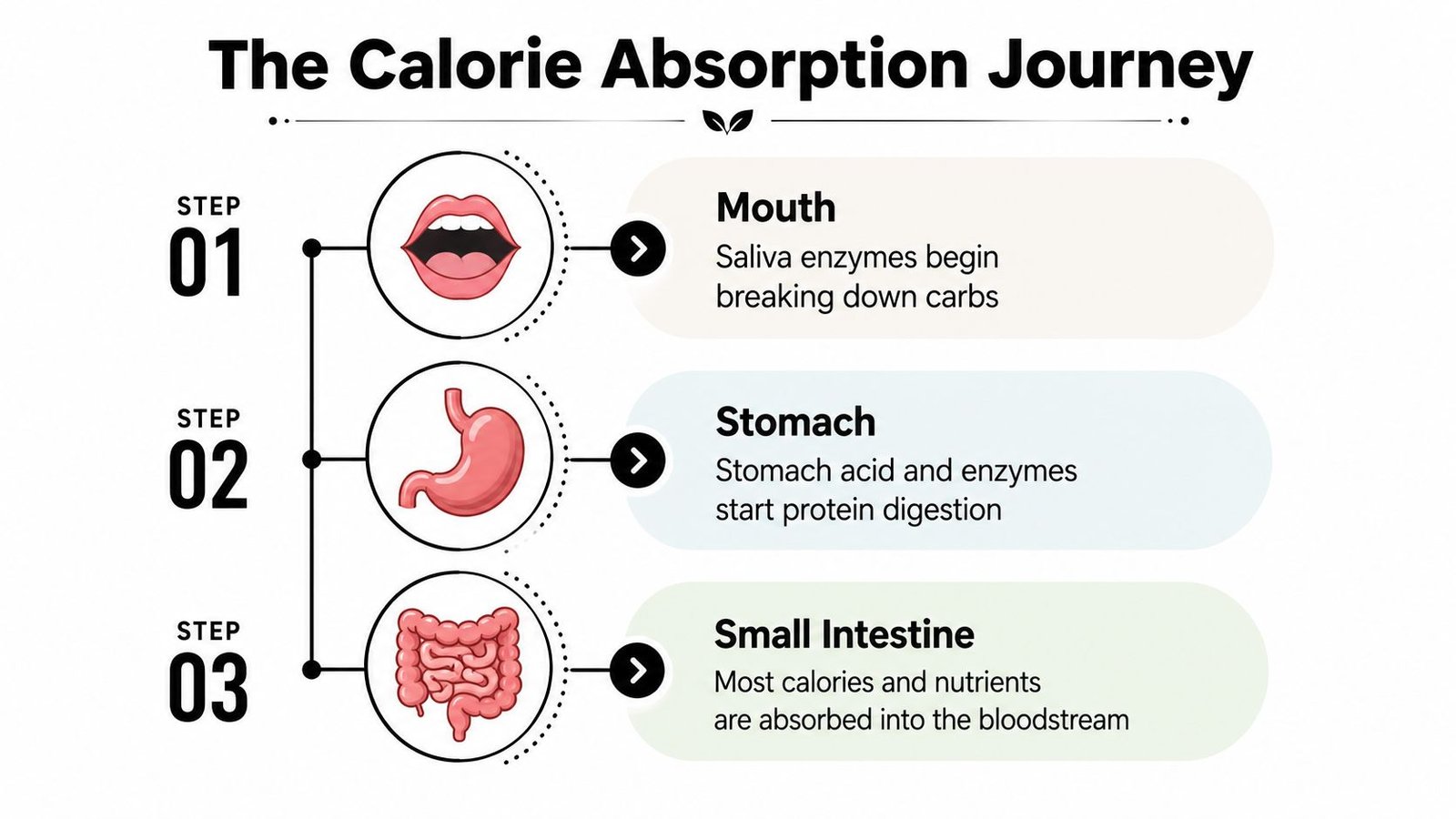
The mouth starts the process early
Chewing is not just mechanical. Saliva contains enzymes that begin breaking down carbohydrates as soon as you start eating, which means the body is already working on the meal before it reaches the stomach. That early start is one reason vomiting can't reverse the entire calorie load.
Food also doesn't move in a straight line where nothing happens until the end. It begins changing form immediately, and that change matters because the body can only absorb nutrients after digestion has started. For readers who get confused about “fiber” and calorie absorption, this explanation of fiber's calories is useful background.
The stomach keeps digestion moving
Once food reaches the stomach, acid and enzymes continue breaking it down. Some nutrients can pass along quickly, and some simple compounds don't wait very long to begin entering the bloodstream. That's why the body can't be treated like a bucket you empty after the fact.
Think of digestion like a conveyor belt. The moment food enters, the belt starts moving, and every minute more material gets processed. Vomiting is like trying to stop the belt after several packages have already left the line.
The small intestine does most of the heavy lifting
The small intestine is the main site where calories and nutrients enter the bloodstream. By the time food gets there, a lot of the work is already underway. That is why the idea of “I can just throw it up and start over” doesn't match how physiology works.
The practical takeaway is simple. Timing helps less than people think because absorption is already in motion. Even if vomiting happens soon after eating, it arrives after digestion has begun and after the body has already claimed part of the meal.
Practical rule: the earlier digestion starts, the less control you have over how many calories are still absorbed.
What Clinical Research Reveals About Purging and Calorie Retention
The clearest data point comes from a clinical study of 17 normal-weight patients with bulimia. After smaller binges averaging 1,549 kcal, participants still retained a mean of 1,128 kcal. After larger binges averaging 3,530 kcal, they retained a similar mean of 1,209 kcal. The pattern is the important part, because retention stayed in roughly the same range even when intake more than doubled, as reported in the study on calorie retention after self-induced vomiting.
Why that pattern matters
If vomiting scaled cleanly with binge size, you'd expect much lower retention after a larger purge. That did not happen. Instead, the body still held onto a substantial amount of energy, which is strong evidence that purging does not erase most of a meal's calories.
Independent eating-disorder education guidance says the same thing in practical terms. Vomiting cannot remove all ingested calories because absorption begins before food even reaches the stomach, and the guidance estimates vomiting can remove only up to about half of calories eaten, meaning roughly half to two-thirds may still be absorbed, as outlined in this health information sheet on vomiting and your health.
What this means in real life
A person may feel lighter after purging because fluid is lost, but that is not the same as removing energy from the meal. The body has already processed part of what was eaten, and the remaining calories still matter.
That's why purging fails as a calorie-control strategy. It creates the illusion of control while leaving the body with a large share of the intake anyway.
Common Misconceptions About Undoing a Meal
One of the most persistent myths is that vomiting immediately after eating removes most or all of the calories. The physiology doesn't support that idea. Digestion starts early, and the clinical data above shows that even when people purged after large binges, they still retained a similar amount of energy.
The “reset button” myth
A meal doesn't reset just because the stomach empties. By the time vomiting happens, food has already started moving through the digestive system, and the body has already extracted part of it. That's why the mental math of “eat, then purge, then move on” breaks down in practice.
Another misconception is that purging is a harmless workaround, especially if someone only does it sometimes. In reality, the body still pays a cost, and the food still counts to a meaningful degree. The strategy is both unreliable and physically harmful.
If you're trying to understand how disordered eating can show up in different bodies and life contexts, this resource on understanding male eating disorders may help broaden the picture. Disordered eating isn't limited to one gender, one body type, or one pattern of behavior.
Reality check: vomiting may reduce some calories, but it does not remove the meal, and it never makes the body start from zero.
Why the scale can mislead people
A lower weight after vomiting usually reflects fluid loss, not fat loss. That temporary drop can be emotionally powerful, which is one reason the behavior can become reinforcing. But the number on the scale is not proof that the meal was “undone.”
The myth persists because the effect feels immediate. The biology, though, is less dramatic and much less forgiving.
The Real Health Risks That Go Beyond Calorie Counts
Purging is dangerous even before you talk about calories. Repeated vomiting can disturb electrolytes, which matters because the heart depends on stable levels of those minerals to keep a steady rhythm. It can also expose teeth to stomach acid, which wears down enamel over time and makes dental problems more likely.
The esophagus is another vulnerable area. Stomach acid can irritate and injure the lining, and repeated force can cause tears or chronic inflammation. Those are not abstract risks, they're direct physical consequences of putting acid where it doesn't belong.
The body's signals get scrambled too
Purging can make hunger and fullness cues harder to trust. Someone may eat in secret, feel shame after eating, then purge again because the cycle starts to feel automatic. That loop can make it much harder to build a calm relationship with food.
The emotional cost matters here. Shame, secrecy, and fear of judgment often deepen the behavior, which is why this pattern deserves attention even when the person says they're “fine most of the time.”
If you want a practical place to start, it can help to find eating disorder warning signs and compare them with what's happening in daily life. A pattern is easier to name when you can see it clearly.
Health first: even if purging removed every calorie, the damage to the body would still make it a harmful strategy.
A Healthier Approach to Tracking What You Eat
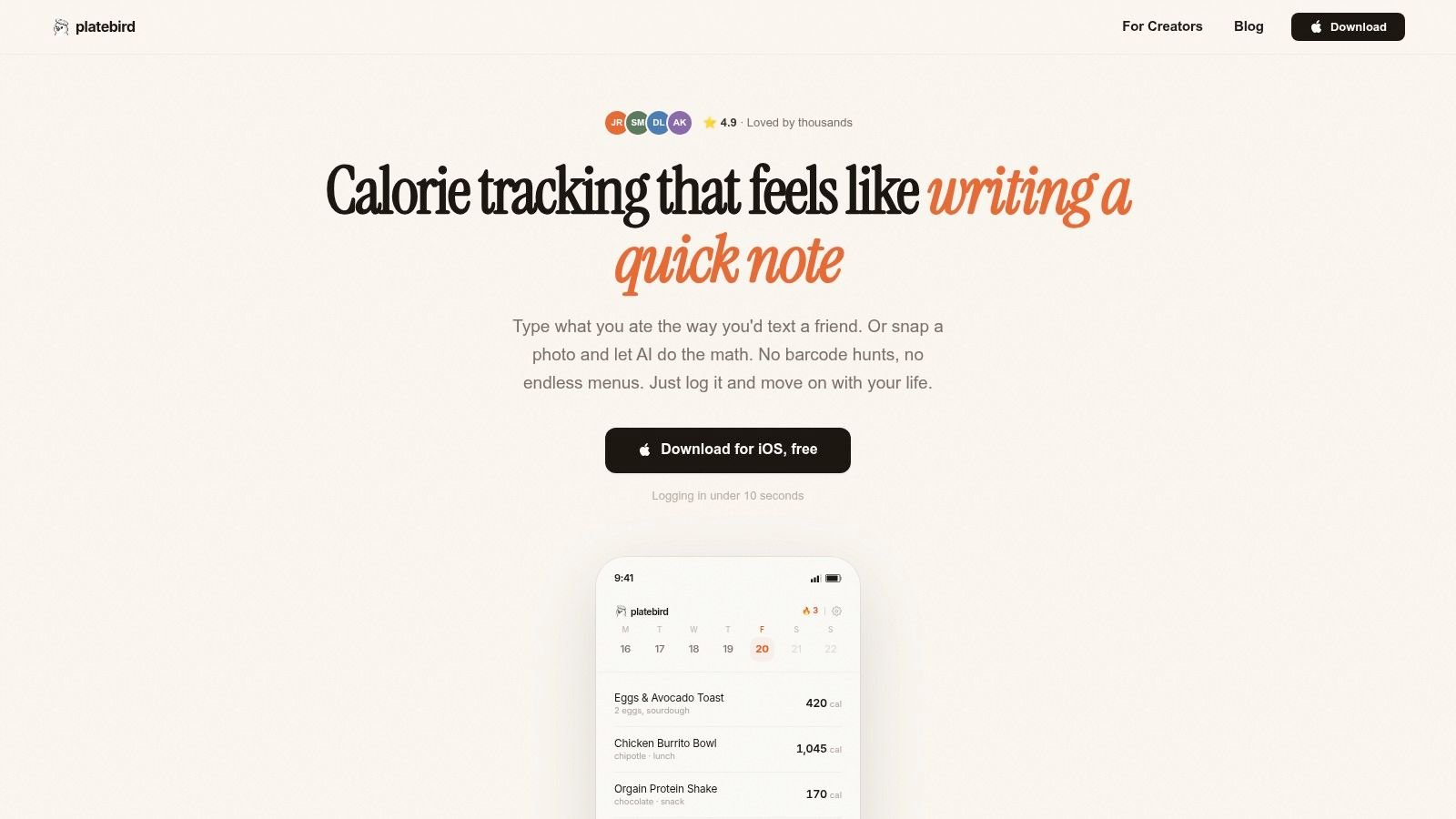
One reason people feel driven to “undo” a meal is that tracking itself feels too hard. When logging food is clunky, guilt fills the gap. A lower-friction approach can reduce that pressure by making awareness feel simple instead of punishing.
Tools like how to count calories matter most when they're easy to use in the moment. PlateBird is one option that lets you type a quick meal description or snap a photo, then logs calories and macros without forcing you to scan every barcode or search endless menus. That kind of speed can make the difference between logging and giving up.
Small habits that actually stick
Start with the least annoying version of logging. Type what you ate in plain language, save repeat meals, and use simple portion cues when you don't have exact measurements. If you drink coffee, juice, soda, or alcohol, log those too because beverages are easy to overlook.
You don't need perfect data to build awareness. You need enough consistency that the food decisions become visible before guilt takes over.
If you prefer a quick routine, log right before you eat or right after the meal ends. That habit can reduce the urge to mentally erase the food later, because the meal is already recorded and no longer floating around as a source of panic.
The goal is not punishment. The goal is a system that helps you notice patterns early enough that you don't feel pushed toward extreme responses.
When to Reach Out for Professional Support
If vomiting after meals happens more than once in a while, that's worth taking seriously. The same is true if you feel intense guilt after eating, hide food-related habits from other people, or notice that your relationship with food is starting to control your day.
A simple way to think about it is this. If the question if you vomit do the calories count keeps showing up alongside shame, secrecy, or repeated purging, the problem is no longer just about calories. It's about safety and support.
What a next step can look like
Start with a primary care doctor if that feels easiest. You can also reach out to an eating-disorder helpline or look for a registered dietitian who works with disordered eating. For a broader overview of care options, this guide to eating disorder treatment can help you understand what support may look like.
Here's the part people often need to hear plainly. Seeking help is not overreacting. It's a sensible response when a behavior keeps repeating and starts shaping how you eat, think, and feel.
If you're in that place, choose one step today. Save a support resource, tell one trusted person, or book the appointment you've been postponing.
PlateBird is built to make food logging feel fast enough to use in real life, whether you type a meal or snap a photo. If you're trying to reduce guilt-driven eating patterns and track intake without turning every meal into a project, visit PlateBird and try a simpler way to log what you eat.