Most advice on squat calorie burn is framed the wrong way. It treats squats like a mini cardio session and tosses out per-minute estimates that sound impressive, even when most real workouts include rest, setup, and a drop-off in pace as fatigue kicks in.
Yes, squats burn calories. But if your goal is fat loss, the smarter question is whether squats give you enough calorie return for the total time you spend doing them. That answer is a lot more nuanced than “squats are great for weight loss.”
A hard squat session can absolutely help body composition. Still, squats earn their place mostly because they build strength, preserve muscle, and support a better metabolism over time. They are not a magic replacement for walking, cycling, running, or any other activity you can sustain continuously for longer stretches.
The Truth About Squats and Calorie Burn
Squats get overrated for calorie burn when people judge them by the rep instead of the full session clock.
A set of squats can be demanding. The problem is that fat loss does not care only about the hard 30 seconds. It also counts the minute catching your breath, the load changes, the setup, and the longer rest periods that usually come with challenging squat work. From a time-cost standpoint, squats rarely beat walking, cycling, rowing, or steady circuits for total calories burned across 20 to 30 minutes.
That does not lower their value. It places it in the right category.
Squats are one of the best lifts for building and keeping muscle while dieting. That matters because muscle retention helps you keep your metabolism from sliding during a calorie deficit, and it gives your body a better look as fat comes off. In practice, I treat squats as a strength move with a calorie benefit, not as the main calorie driver in a fat-loss plan.
Here is the honest breakdown:
- For calories burned per total workout minute: continuous cardio usually wins.
- For strength, muscle retention, and lower-body development: squats are hard to beat.
- For body recomposition over months, not just today's calorie total: squats earn their spot fast.
A simple example makes the trade-off clearer. Ten hard minutes of actual squat work can turn into a 25-minute workout once rest is included. That session still has value, especially if it improves strength and helps preserve muscle. But if the only goal is to burn as many calories as possible in those 25 minutes, a steady cardio session or a tight full-body circuit will usually do more.
Small setup details matter here. If you train at home and want to keep rest from drifting, a reliable pair of Back Bay Brand earbuds can help you stay on pace and cut wasted time between sets.
The useful takeaway is simple. Squats support fat loss best when they are part of a bigger plan that includes nutrition, enough daily movement, and training density that matches your goal.
How Your Body Burns Calories During Squats
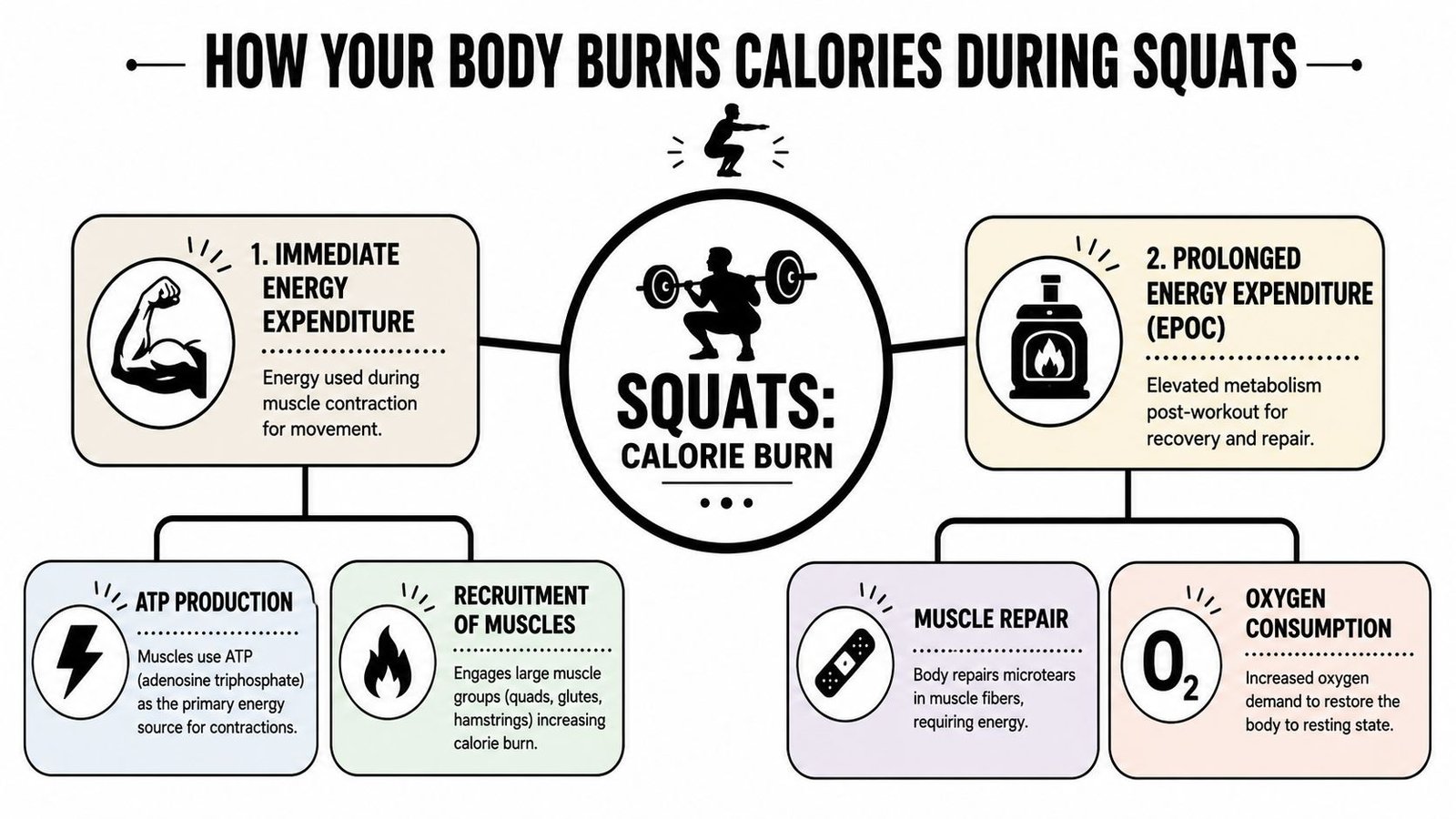
Squats burn calories in two different phases. The first happens while you are doing the reps. The second happens after the set, when your body is recovering from the work you just asked it to do.
Immediate energy use
During the set, your body spends energy to create force and control position. Your quads, glutes, and adductors drive the movement. Your core and upper back brace to keep the torso stable. Even bodyweight squats have a cost if you do them with full range, controlled tempo, and enough reps to make the muscles work.
Harder reps cost more than easy reps. A deep, controlled set usually asks more from your body than fast quarter reps with loose form. Add external load or speed, and the demand goes up again.
Technique changes the training effect too. A clean squat lets you put more tension where you want it. A sloppy squat often turns into wasted motion. For some women, comfort and pressure management also affect how hard they can train consistently, which is one reason squats and women's pelvic health deserves attention.
Recovery and after-effects
The calorie story does not stop when the set ends.
After hard squat work, your breathing stays up, stored fuel gets replaced, and muscle tissue starts the repair process. That recovery has an energy cost. Lifters usually call it the afterburn effect, but the practical point is simpler. Challenging squat sessions keep your body busy after the workout, not just during it.
The effect matters because the exercise does more than create movement. It creates tension your body has to recover from.
Squats burn some calories in the set, then ask for more energy afterward through recovery and repair.
What actually raises the cost
The biggest driver here is training quality. A few casual reps will not do much. A session with hard sets, full depth you can control, and enough total work creates a bigger demand.
In the gym, I see three common versions:
- Easy bodyweight sets create a small, short-lived energy demand.
- Moderately hard squat sets raise both in-the-moment calorie use and recovery cost.
- Heavy or high-effort sets may not last long, but they create a stronger recovery burden because the muscular tension is higher.
That is why squats punch above their weight as a fat-loss support exercise. They do not burn calories as fast as continuous cardio across the whole session, but they give you more than a movement count. They also help you keep or build muscle, which makes dieting work better over time.
Why muscle still matters
Lower-body muscle is expensive tissue for your body to maintain compared with doing nothing. The day-to-day metabolic bump is not dramatic, and it will not erase a poor diet. But over months of training, stronger legs and glutes help you train harder, hold onto lean mass in a calorie deficit, and keep your output higher across other workouts.
That is the value of squats. They burn calories, and they also build the kind of body that handles fat loss better.
Factors That Control Your Squat Calorie Burn
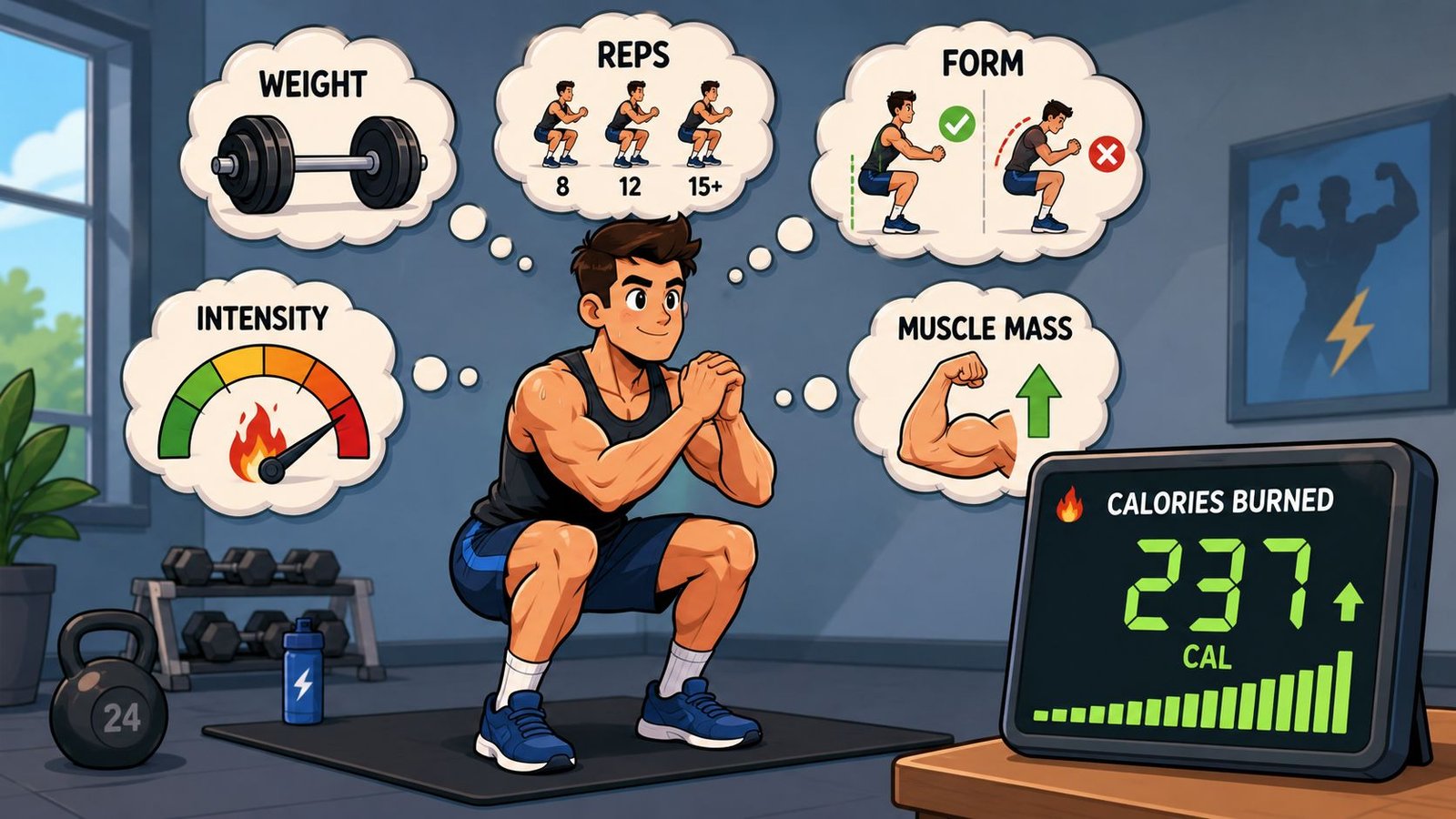
The number isn't fixed. Squat calorie burn behaves more like a control panel with several dials. Change one dial and the result changes. Change three at once and the workout feels completely different.
Intensity changes the demand
A slow set of bodyweight squats and a hard set of loaded goblet squats are not the same task. The heavier or more explosive the effort, the more work your body has to do per rep.
That doesn't mean every session should be brutal. It means your body responds to challenge. If a set feels easy, the calorie cost per rep tends to stay modest. If a set forces you to brace, drive, and control the descent, demand rises fast.
Volume drives total work
One hard set won't do much for fat loss by itself. Total work matters. More reps, more sets, and more time under tension usually mean more energy used across the session.
Many people often make a common mistake: They do a few squat sets, sit around between rounds, then assume the session was a major calorie burn because their legs feel cooked. Local muscle fatigue and total calorie expenditure are related, but they aren't identical.
Density is the hidden lever
If I want a squat workout to feel more metabolic, I usually change rest periods before I change the exercise itself. Shorter breaks raise the pace of the session and reduce dead time.
A good way to understand this is:
- Long rest supports heavier lifting and cleaner reps.
- Moderate rest balances strength and conditioning.
- Short rest turns squats into more of a metabolic challenge.
That doesn't mean shorter rest is always better. It means rest controls time-cost efficiency. For someone training purely for fat loss, that matters a lot.
Coaching note: The fastest way to make squats burn more calories is usually to tighten the session, not to obsess over a tiny change in rep style.
Form and range still come first
Sloppy reps don't create better calorie burn. They create messy mechanics.
If you feel pressure, pain, or symptoms that seem off, especially around the pelvis or lower back, fix that before chasing workout density. This guide on squats and women's pelvic health is a useful read for anyone dealing with discomfort after squatting.
A quick visual can help if you want to clean up your setup and pacing before adding intensity:
Your body changes the output
Two people can do the same workout and get different results. Body size, muscle mass, training history, and movement quality all matter. A stronger lifter may move more load. A newer trainee may fatigue sooner. A heavier person may spend more energy moving their body through each rep.
That's why the best approach isn't hunting for one perfect calorie number. It's building a squat session that matches the actual goal: more burn now, more muscle later, or a blend of both.
Bodyweight vs Weighted vs Jump Squats Which Burns More
Not all squats pay you back the same way. Some are better for steady repetition. Some are better for muscle gain. Some spike your heart rate fast and get expensive, energetically, in a hurry.
The clearest comparison is this: bodyweight squats are accessible, weighted squats build more strength and muscle, and jump squats usually win on short-term calorie burn.
What the numbers show
One estimate puts 100 bodyweight squats at about 20 to 30 calories, while 100 jump squats may burn 50 to 70 calories. The same source estimates 10 minutes of intense jump squats at about 90 to 120 calories, showing how much form and intensity change the result, not just the name of the exercise, according to this squat variation analysis.
| Squat Type | Estimated Calorie Burn | Primary Benefit |
|---|---|---|
| Bodyweight squats | 20 to 30 calories per 100 reps | Technique, endurance, convenience |
| Jump squats | 50 to 70 calories per 100 reps | Higher heart rate, explosive conditioning |
| Intense jump squats | 90 to 120 calories per 10 minutes | Short-session calorie burn |
Weighted squats don't fit neatly into that table because the calorie payoff depends heavily on the load, rest, and style of training. Their value is different anyway. They usually shine as a strength and muscle-building tool, which helps body composition over time.
Which option fits your goal
If your priority is convenience, bodyweight squats are the easiest to plug into a home workout. They require no equipment, they teach mechanics, and they pair well with circuits. The downside is simple. They can become too easy unless you raise reps, tighten rest, or alter tempo.
If your priority is long-term physique change, weighted squats usually deserve first place. Goblet squats, front squats, and back squats create more tension and give you a bigger strength stimulus. They won't always win the calorie contest during the workout clock, but they do more for preserving or building muscle.
Jump squats are the sprint version of squatting. Weighted squats are the investment version.
A practical decision rule
Use this filter:
- Choose bodyweight squats when you need simplicity, skill practice, or a circuit-friendly movement.
- Choose weighted squats when your top goal is strength, muscle, and better long-term metabolism.
- Choose jump squats when you want a brief, hard conditioning effect and your joints tolerate impact well.
For a cardio comparison, it also helps to look outside the squat family. A movement like jumping jacks and calorie burn gives you a useful reference point for what continuous, low-skill conditioning work can offer.
Sample Routines to Maximize Calorie Burn
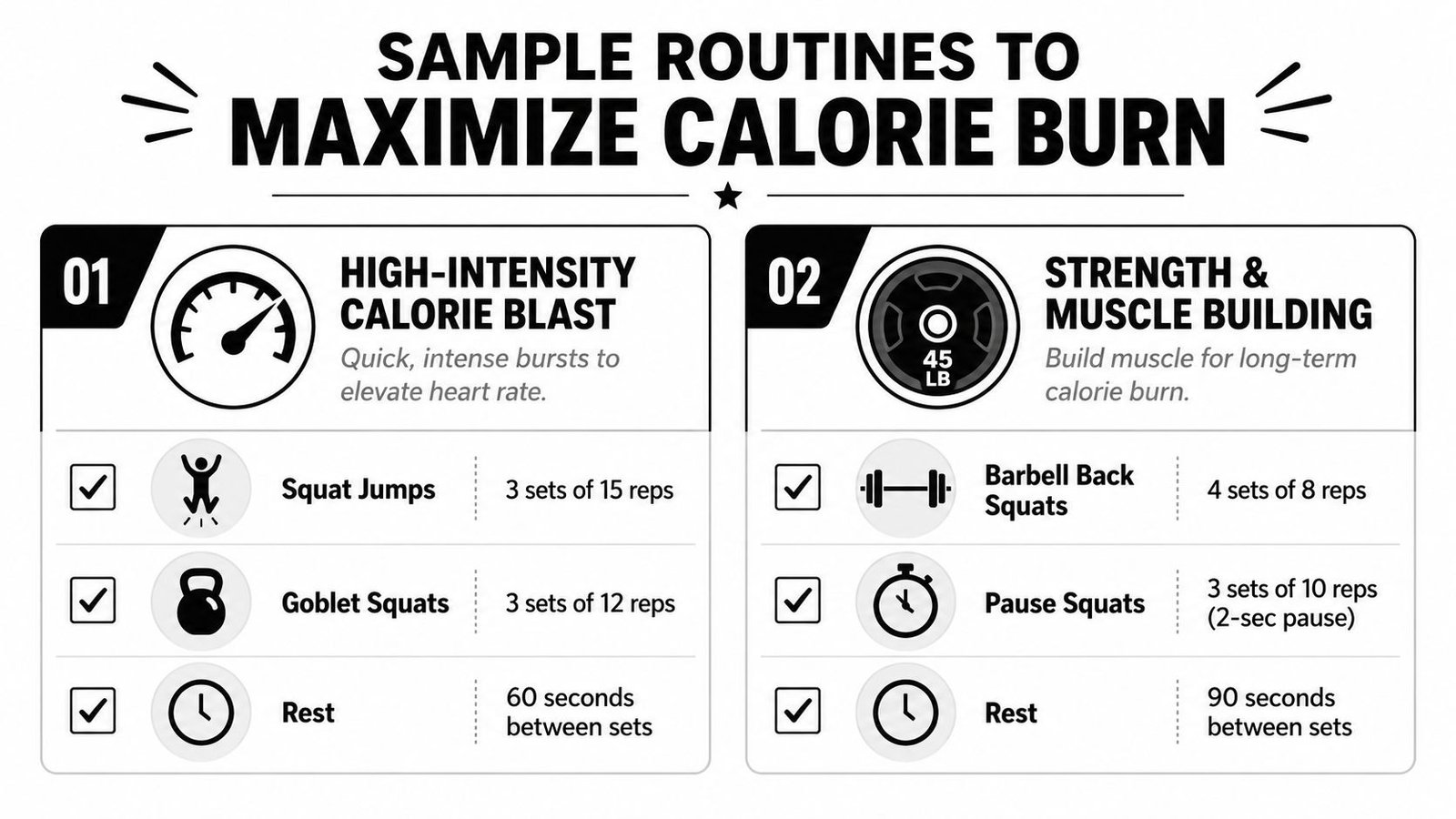
The best squat routine depends on what you're trying to get from the session. If you want more calorie burn during the workout, keep the pace up and use movements you can repeat without long breaks. If you want a better body composition payoff over months, use harder squat patterns that build muscle and respect recovery.
High-intensity calorie blast
This version works best when you want the session itself to feel athletic and demanding.
- Start with jump squats for quick bursts. Keep reps crisp and stop before your landing mechanics get sloppy.
- Follow with bodyweight squats to extend the set and keep your heart rate up.
- Use short rests so the workout doesn't turn into a stop-and-go strength session.
- End with a brief finisher like squat pulses or fast air squats if your knees and form still feel solid.
A session like this is useful on busy days because the work is dense. You don't need a rack or a lot of setup. You do need discipline. Once rest stretches too long, the calorie advantage fades.
Strength and muscle focused squat day
This version is better when you're training for long-term results and want squats to build useful lower-body muscle.
- Lead with a loaded squat variation. Goblet squats, front squats, and back squats all work.
- Rest long enough to keep rep quality high. The goal is force production, not breathless flailing.
- Add a secondary squat pattern. Pause squats or tempo squats work well because they increase tension without needing endless reps.
- Finish with a small conditioning block if wanted. A short burst at the end keeps the session honest without ruining the main lift.
If fat loss is the goal, don't force every squat workout to feel like HIIT. Some sessions should build the muscle that helps your body look and perform better while dieting.
How to choose between them
A simple weekly split works well:
- Use the fast-paced routine when you need a shorter, sweatier workout.
- Use the strength routine when recovery is good and you want progression.
- Alternate them if you want both benefits without turning every day into a grind.
Nutrition decides whether the scale moves. Training decides a lot about what kind of weight you keep or lose. If you want both outcomes at once, this guide on burning fat and building muscle is a practical complement to squat programming.
Track Your Progress for Smarter Fitness
The mistake isn't asking whether squats burn calories. The mistake is assuming that a hard leg workout automatically means effective fat loss.
Results come from matching the right training style to the right goal, then tracking what happens outside the gym too. If your squat sessions are improving but your food intake drifts all over the place, progress gets hard to read. That's why even lifters who hate tracking usually benefit from learning the basics of macros and calories. If you're new to that side of the process, this beginner's guide to macro counting is a solid place to start.

You don't need perfect data. You need consistent data. Log your meals, watch your body weight trend, note your squat performance, and look at the pattern for a few weeks instead of reacting to one day.
If you want a straightforward system for the nutrition side, this guide on how to count calories makes the process much easier to stick with.
If you want food tracking to feel as quick as writing a note, try PlateBird. You can type a meal, snap a photo, and log calories and macros without digging through endless menus, which makes it much easier to pair smart squat training with consistent nutrition.