A 155-pound person burns about 10 calories per minute doing jumping jacks. This article will show you the simple formula to estimate your personal burn rate and how to get more useful results by pairing exercise with smarter food tracking.
If you're squeezing in movement between meetings, after school drop-off, or before dinner, jumping jacks are one of the fastest ways to turn a few spare minutes into real work. No gym. No equipment. No setup. Just your body, a little floor space, and enough energy to get moving.
That simplicity is exactly why people ask about jumping jack calories so often. They want to know whether a short burst counts. It does. But the number you burn isn't one universal answer. Your body weight, pace, and workout length all change the total.
The encouraging part is that the math isn't mysterious. Once you understand the basic pattern, you can stop guessing and start using jumping jacks as a practical tool instead of a random warm-up.
The 10-Minute Workout That Actually Works
You glance at the clock between meetings, school pickup, or dinner prep and find a ten-minute gap. That window is big enough for jumping jacks to raise your heart rate, work several muscle groups at once, and add a meaningful chunk to your daily energy output.
That matters because exercise is only half of the calorie story. A short workout can increase calories out, but results come from matching that effort with a realistic view of calories in. If you are not sure how food energy works, this guide to how many calories are in a gram of protein, carbs, and fat makes the nutrition side much easier to understand.
Why this move earns a spot in busy routines
Jumping jacks are simple, but they are not light work. Your arms travel overhead, your legs move out and in, and your body has to coordinate that rhythm over and over. That repeated full-body motion works like revving a car engine for a few minutes. You use more fuel because more parts are working at the same time.
They are also one of the easiest bodyweight exercises to add to real life. You can do them in a bedroom, office, garage, or backyard. You can use them as a quick cardio block, a warm-up before strength training, or a movement break that wakes you up faster than another scroll through your phone.
Practical rule: If you have ten minutes and no plan, start moving. A simple set of jumping jacks beats waiting for the "perfect" workout.
What a 10-minute session can do
A short session will not do everything. It can do enough to matter.
That is the key idea. Ten minutes of steady jumping jacks can raise your breathing, challenge your coordination, and contribute to the energy deficit many people want for fat loss. Just as important, it gives you a workout you can repeat consistently. Consistency beats the occasional heroic session.
Many learn jumping jacks as kids, which can make the exercise seem too basic to count. Basic does not mean ineffective. Walking is basic. Squatting down to stand up is basic. Useful movement patterns often look simple on the surface because they do not need much setup to work.
A helpful mental shortcut is to treat jumping jacks as a moderate-to-vigorous cardio tool, not just a warm-up. The exact calorie number depends on your size, pace, and workout length, but the bigger lesson is practical. If you use ten spare minutes for movement and pair that habit with better meal tracking, you are working both sides of the energy balance equation instead of guessing at either one.
The Simple Math Behind Your Calorie Burn
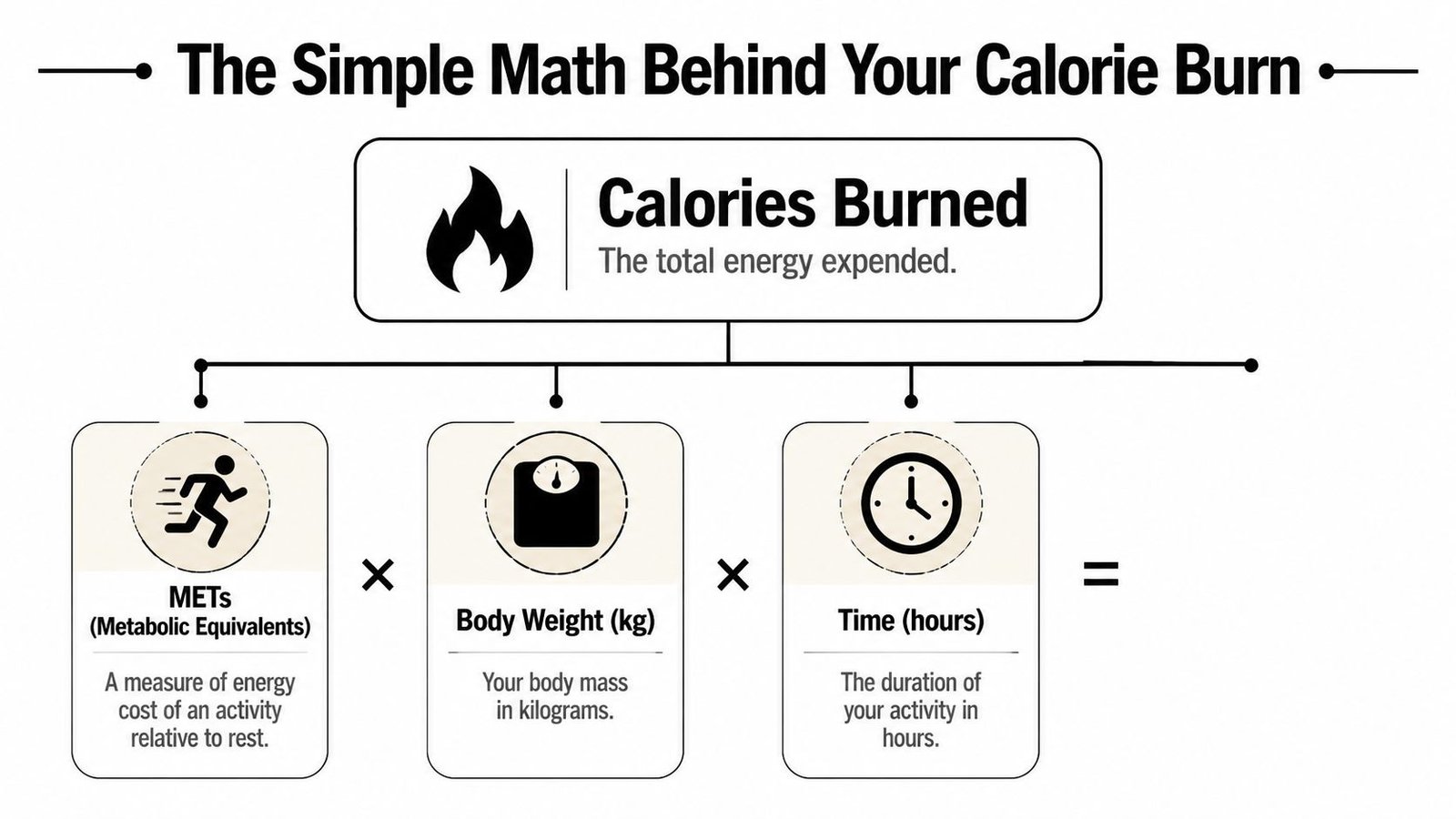
Calorie burn is less mysterious when you break it into three simple parts:
METs × body weight in kilograms × time in hours = calories burned
What METs mean in real life
A MET is a shorthand for exercise intensity. It compares what your body uses during an activity with what it uses at rest.
Here is the easy way to read it. Resting is the baseline. A higher MET means you are working several times harder than that baseline, so you burn energy faster. METs work like the speed dial on effort. Turn the dial up, and each minute costs more energy.
For jumping jacks, the exact calorie total still changes from person to person. The formula stays the same, but your body weight, pace, and workout length all shift the final number.
A practical way to use the formula
You do not need to love math for this to help. Just read the formula like a simple checklist:
- METs tell you how demanding the movement is.
- Body weight affects how much energy your body uses to do that movement.
- Time determines how long you keep paying that energy cost.
That is why two people can finish the same jumping jack workout and see different calorie estimates. Same movement. Different body size, pace, or duration.
A kitchen example helps here. Calories burned are one side of the budget. Calories eaten are the other. If you want real progress, you need both numbers to make sense together, which is why it helps to learn how calories in food are counted by grams. Exercise tells you what is going out. Your meals tell you what is coming in.
Why estimates are still useful
Some readers get frustrated because no calculator can give a perfect number. That is normal.
A calorie estimate is like using a map instead of guessing directions. It may not tell you the exact step where you will stop, but it gets you much closer than winging it. If you know your workout burned an estimated amount and you track what you ate that day, you can make better decisions without chasing precision that no wearable or formula can fully promise.
That is the bigger lesson. Jumping jacks are not just about a single calorie number. They are one part of your full energy balance, and that full picture is what helps you lose fat, maintain weight, or understand what your body is doing.
Jumping Jack Calorie Chart by Weight and Duration
You finish a set of jumping jacks, breathing hard, and wonder whether that was 30 calories or 130. A chart helps because it turns a fuzzy guess into a usable range.
The main pattern is simple. Heavier bodies usually burn more calories doing the same movement for the same amount of time, because more mass has to be moved on every rep. It works like carrying a heavier backpack up the same flight of stairs. The route did not change, but the energy cost did.
Estimated calories burned doing jumping jacks
| Body Weight | 1 Minute | 10 Minutes | 20 Minutes | 30 Minutes |
|---|---|---|---|---|
| 120 lbs | about 8 | about 80 | about 160 | about 240 |
| 155 lbs | about 10 | about 100 | about 200 | about 300 |
| 185 lbs | about 12 | about 120 | about 240 | about 360 |
| 250 lbs | about 16 | about 160 | about 320 | about 480 |
These are estimates, not exact readings. They reflect commonly cited reference points discussed earlier in the article, then scaled by time so you can scan the table quickly.
How to use the chart without overthinking it
Start with the row closest to your current body weight. Then match it to the amount of time you spent doing jumping jacks, not the total workout time if you took long breaks.
If your weight falls between two rows, use the middle as a reasonable estimate. For example, someone between 155 and 185 pounds will usually land somewhere between those two calorie ranges.
That is enough accuracy for real-world planning.
A chart like this becomes much more useful when you connect it to food intake. If a 10-minute session burns about 100 calories for you, that gives you context for the meals and snacks around it. Exercise is one side of the energy equation. Food is the other. If your goal is body recomposition, this guide on burning fat while building muscle helps you pair training with nutrition instead of treating them as separate projects.
What this chart can and cannot tell you
The table gives you a baseline. It does not account for how high you jump, how fast you move, how much rest you take, or whether you are doing crisp full-range reps or casual half-reps.
Two people can use the same row and still finish with different results. One person may keep a steady, athletic rhythm. Another may pause every few reps. The movement name is the same, but the effort level is not.
If you want cleaner estimates during timed sets, Fitness GM's interval timer insights can help you structure work and rest so your session is easier to measure.
Use the chart as a starting line. Then compare it with your meals, your weekly workout routine, and your results over time. That is how calorie estimates become useful in real life.
How to Supercharge Your Calorie Burn
The chart gives you a baseline. Your habits determine whether you stay there or push beyond it.
Move with more intent
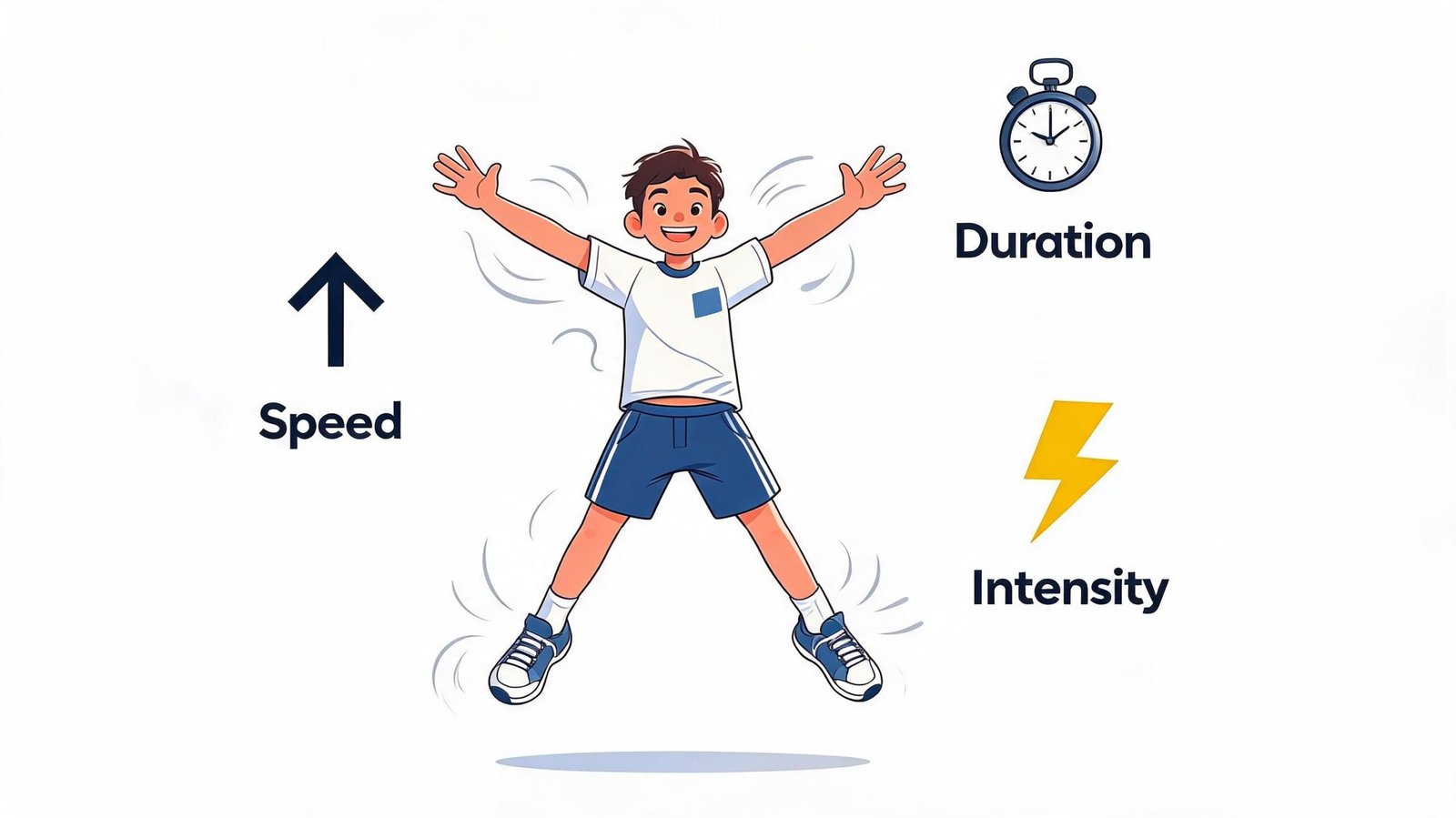
The first lever is intensity. If your arms drift halfway up and your feet barely leave the floor, the movement becomes easier and your calorie burn usually drops. If you snap your arms overhead, jump with purpose, and keep a brisk rhythm, the session gets much more demanding.
The second lever is range of motion. Good jumping jacks aren't tiny hops. They use your full body. Reach tall. Land softly. Return to center under control.
The third lever is structure. Steady jumping jacks work well, but intervals often help people maintain better effort because they know a rest period is coming.
A simple pattern many people like is work-rest cycling. If you want help pacing those rounds, Fitness GM's interval timer insights can make timed sessions easier to follow without constantly checking the clock.
Try these workout styles
- For beginners: Do short rounds with relaxed recovery. Focus on rhythm and landing softly.
- For intermediate exercisers: Alternate faster rounds and slower rounds to keep your heart rate up.
- For variety: Rotate standard jacks with seal jacks or star-style jacks so the workout feels less repetitive.
If your broader goal is body recomposition, cardio and strength training need to work together. PlateBird also has a practical guide on burning fat while building muscle that fits well with this approach.
A sample interval session
Use this kind of workout when you want more intensity without dragging the session out:
- Warm up gently: Start with easy jumping jacks and a few shoulder circles.
- Work hard: Do 30 seconds of strong, full-range jumping jacks.
- Recover: Rest or march in place for 30 seconds.
- Repeat: Continue for several rounds based on your fitness level.
That rhythm works because it keeps the quality high. Individuals typically move better in bursts than they do during one long, sloppy set.
Here's a follow-along option if you want a visual pace to match:
Form fixes that matter
A few coaching cues can make jumping jacks feel smoother:
- Land softly: Think quiet feet, not pounding feet.
- Keep your chest up: Don't fold forward when you get tired.
- Use your arms fully: Half-reps often turn into half-effort.
- Choose the low-impact version if needed: Step one foot out at a time instead of jumping.
You don't need fancy tricks. Better reps usually beat more reps.
Track Your Workouts and Meals with PlateBird
A lot of people overestimate what exercise can do by itself. Jumping jacks burn calories, yes, but fat loss comes from your total energy balance, not from one sweaty session.
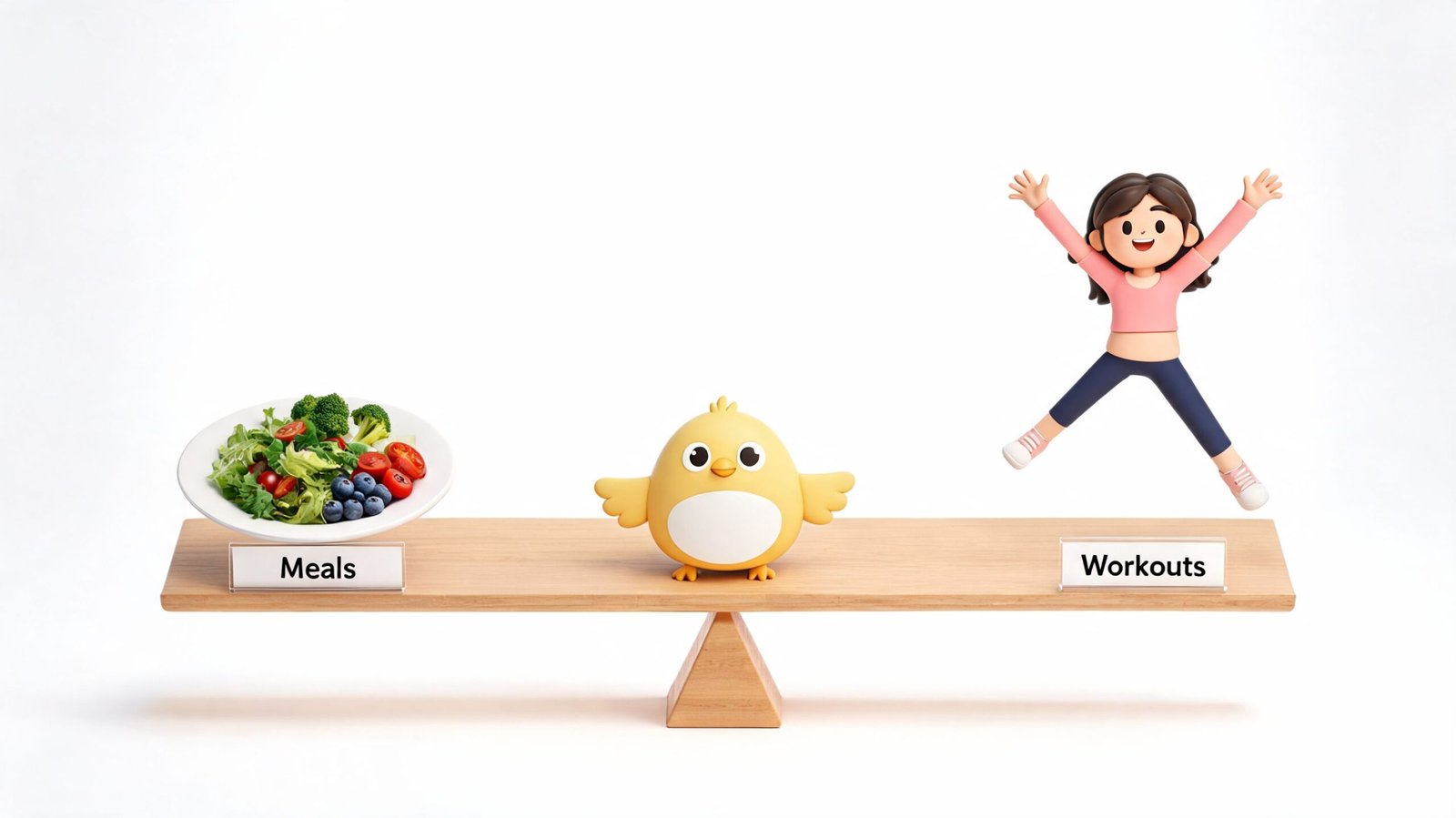
That matters because the volume required to lose weight through jumping jacks alone is bigger than often realized. There is a clear dose-response curve where approximately 17,500 to 24,500 jumping jacks are required to lose one pound of body weight, according to RitFit's analysis of jumping jack volume and calorie deficit. That same source notes that logging both a 250-calorie food reduction and a 250-calorie workout creates a daily 500-calorie deficit, which is much more manageable than relying on exercise alone.
Why this changes the way you think about workouts
That number isn't meant to discourage you. It's meant to clarify the job each tool does.
Exercise helps you increase calories out. Food choices shape calories in. When you combine them, the process becomes more realistic and more sustainable.
A short jumping jack session can absolutely support fat loss. It just works best when it's part of a bigger system instead of being asked to do all the heavy lifting alone.
A balanced deficit is usually easier to repeat than an all-exercise approach. Repeatable beats heroic.
What tracking should show you
A good tracker should answer questions like these:
- How much did I burn today? Enough to understand your activity without guessing.
- What did I eat? Clearly enough to see where calories and macros are coming from.
- Where is my deficit coming from? Mostly food, mostly exercise, or a mix of both.
That last point is where many people finally get traction. They stop treating workouts like punishment for meals and start seeing both sides of the equation.
If you're comparing tools, FitCentral has a helpful piece on how to evaluate nutrition coaching software, especially if you care about simplicity and consistency rather than just feature lists.
Why less friction matters
Failure isn't typically due to a lack of motivation. Rather, individuals stop because tracking feels annoying.
That's why fast logging is valuable. If you can quickly record meals and workouts in one place, you're more likely to spot patterns, adjust earlier, and stay honest with yourself. PlateBird is built around that low-friction approach, and if macros matter to your goal, its guide to the best macro tracking app explains what to look for in a tool you'll keep using.
The big picture is simple. Jumping jack calories matter. Meal calories matter too. Results usually come from managing both.
Your Jumping Jack Questions Answered
How many jumping jacks do I need to lose one pound
If you're trying to lose a pound through jumping jacks alone, the requirement is high. Verified estimates place it at about 17,500 to 24,500 jumping jacks for one pound of body weight loss, and other verified guidance notes that because one pound of body fat is about 3,500 calories, the total exercise volume adds up quickly when exercise is the only lever. That's why a combined approach usually makes more sense than trying to out-jump your diet.
Are jumping jacks bad for your knees
Not automatically. For many people, they're fine when done with soft landings, controlled rhythm, and reasonable volume. Problems usually show up when someone rushes, slams into the floor, or keeps pushing through pain.
If your knees, ankles, or hips feel irritated, switch to a low-impact jack. Step one foot out at a time while lifting your arms overhead. You still get the coordination and cardio effect without the same landing stress.
Can I do jumping jacks every day
You can if your body tolerates them well and the volume matches your recovery. Short sessions often fit daily routines better than long all-out workouts.
Pay attention to warning signs like lingering joint soreness, unusual fatigue, or sloppy form. If those show up, rotate in walking, cycling, or lower-impact cardio and let your body recover.
Do faster jumping jacks always burn more calories
Usually, more effort raises the energy demand, but faster isn't always better if form falls apart. Good reps with full arm movement and controlled landings often beat frantic reps that look busy but waste motion.
A useful test is whether you can maintain rhythm, posture, and soft landings while still breathing hard. If yes, you're probably in a productive zone.
If you want an easier way to connect your workouts with what you eat, PlateBird helps you track both sides of the equation without turning logging into a chore. You can record meals quickly, keep an eye on calories and macros, and make your jumping jack workouts part of a plan you can stick with.