
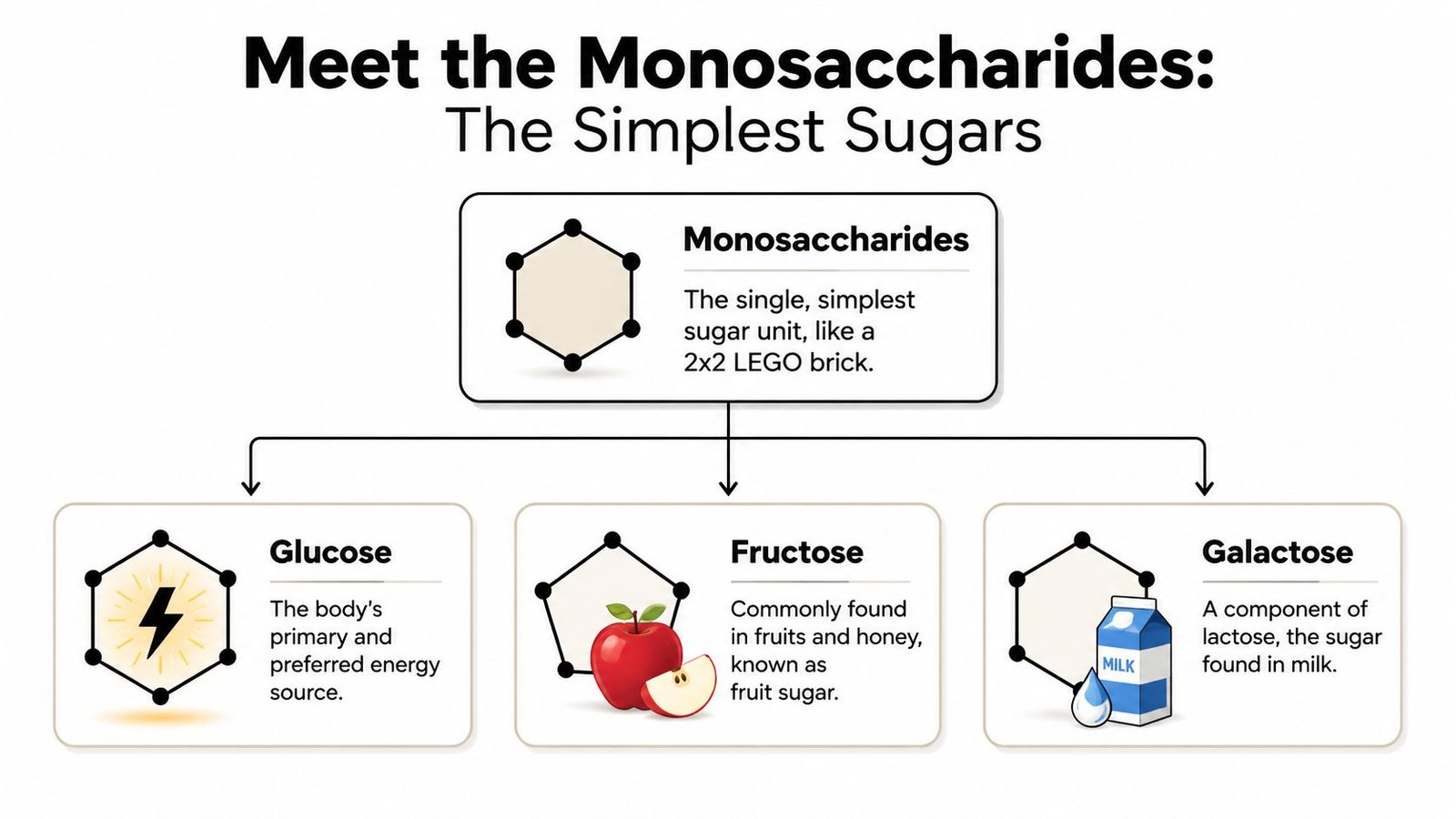
Monosaccharides are the building blocks of carbohydrates. The most common ones in food, glucose, fructose, and galactose, are single-sugar units with the exact formula C₆H₁₂O₆, a bit like single LEGO bricks that can snap together into bigger carbohydrate structures.
If you've ever looked at a nutrition label, seen “carbs,” “sugar,” and “fiber,” and thought, “I know these are related, but what's the difference?” you're not alone. It's commonly heard that carbs are “broken down into sugar,” but that skips the useful part: how tiny sugar units connect, why some carbs hit fast and others feel steadier, and why logging a bowl of rice is easier said than done.
That's where the building-block idea helps. Once you see carbohydrates as small pieces linked into bigger chains, a lot of nutrition advice starts making more sense. Fruit, milk, bread, beans, pasta, and fiber-rich vegetables stop feeling like random carb categories and start feeling like different versions of the same basic chemistry.
The LEGO Bricks of Your Energy Source
A carbohydrate starts small. Very small.
Think about building a LEGO castle. You don't begin with towers and walls. You begin with one brick in your hand. Carbohydrates work the same way. Their smallest units are the simple pieces that everything else is built from.
Carbohydrates are the most abundant biomolecules on Earth, and they share a basic chemical pattern where carbon, hydrogen, and oxygen appear in an approximate 1:2:1 ratio, which is why they're often described as hydrates of carbon according to this carbohydrate chemistry overview. That may sound abstract, but the useful takeaway is simple: carbs have a repeatable structure that lets nature build them into quick fuels, storage forms, and sturdy plant materials.
One small unit, many big jobs
That single “brick” is called a monosaccharide. When many of these units connect, they can form short pairs like table sugar or long chains like starch.
That's why one category, “carbohydrates,” includes foods that behave very differently in real life:
- Fruit gives you naturally occurring simple sugars.
- Milk contains a sugar built from smaller units joined together.
- Rice and pasta mostly deliver long chains of glucose units.
- Vegetables and plant fibers can contain chains your body can't fully break down.
Carbs aren't one thing. They're a family of structures built from the same small parts.
Why this matters outside the classroom
This isn't just chemistry trivia. It explains why some foods feel like quick fuel and others keep you full longer. It also explains why “carbs” can be hard to track in mixed meals. A banana, a bowl of oatmeal, and lentil pasta all contain carbohydrates, but not in the same form.
When people ask what are building blocks of carbohydrates, they're usually really asking a more practical question: “What am I eating when I eat carbs?” The answer starts with single sugar units, then moves outward into the foods on your plate and the way your body handles them.
Meet the Monosaccharides The Simplest Sugars
The word monosaccharide breaks down neatly. “Mono” means one. “Saccharide” means sugar. So a monosaccharide is one sugar unit, the most basic carbohydrate form.
The three names you'll see most often
In everyday nutrition, three monosaccharides matter most: glucose, fructose, and galactose. They're all dietary monosaccharides, and they're all hexoses, which means they each contain 6 carbon atoms. They also share the same molecular formula, C₆H₁₂O₆, while having different structural arrangements, as described in LibreTexts' carbohydrate overview.
Here's the practical version:
| Monosaccharide | What to remember | Everyday association |
|---|---|---|
| Glucose | Your body's key immediate fuel | Blood sugar, starch breakdown |
| Fructose | Often called fruit sugar | Fruit and honey |
| Galactose | Less common alone | Part of milk sugar |
Glucose stands out because it's the most abundant monosaccharide in nature and the exclusive monomeric unit for major energy-storage polysaccharides. In plain English, when plants and animals store carbohydrate energy in large chains, glucose is the repeat piece they use.
Same formula, different shape
This part trips people up. If glucose, fructose, and galactose all have C₆H₁₂O₆, how can they be different?
The answer is shape. The atoms are arranged differently, and that changes how each sugar behaves. It's like having three LEGO builds made from the same number of pieces. Same total parts, different final structure.
Practical rule: When two sugars share a formula, don't assume they act the same. Structure changes function.
That's one reason fruit doesn't feel the same as a spoonful of table sugar, and milk sugar behaves differently again.
A quick note on other monosaccharides
Not every monosaccharide has six carbons. Some are smaller. Ribose, for example, is a pentose, which means it has 5 carbon atoms, and it plays an important role in nucleic acid structure in the same LibreTexts reference. But for the carbs commonly tracked in meals, the big three are the hexoses above.
If you want a food-first look at one of these sugars, this guide on fructose in fruits is a useful companion because it connects the chemistry term to foods people eat.
Building Bigger Chains Disaccharides and Polysaccharides
A single monosaccharide is just the start. Carbohydrates become more interesting when those units link together.
When two monosaccharides join, they form a disaccharide. When hundreds of monosaccharide units connect, they form a polysaccharide, also called a glycan. According to BioExplorer's explanation of carbohydrate building blocks, monosaccharides undergo condensation reactions to form disaccharides such as sucrose, lactose, and maltose, or polymerize into energy-storage forms like starch and glycogen.
The link that holds sugars together
The connection between sugar units is called a glycosidic bond.
That bond matters more than commonly understood. It's not just glue. Its orientation helps determine whether your enzymes can break it apart efficiently. In that same BioExplorer reference, the upward or downward orientation of the glycosidic bond affects enzyme specificity for hydrolysis.
That's a science-heavy sentence, so here's the plain version: your body can only cut certain carbohydrate links with the tools it has.
Common examples that show the pattern
A few familiar names make this easier:
- Sucrose is a disaccharide. It's made when one glucose unit joins one fructose unit.
- Lactose is also a disaccharide. It combines one glucose unit with one galactose unit.
- Maltose is another disaccharide formed from monosaccharide units linked together.
- Starch is a polysaccharide made from many glucose units.
- Glycogen is another glucose-based polysaccharide used for energy storage in animals.
Here's the big idea in one line:
One sugar unit gives you a monosaccharide. Two linked units give you a disaccharide. Long chains give you polysaccharides.
Why larger chains change the eating experience
A long chain doesn't behave like a single sugar unit. It usually takes more digestive work. That changes how quickly the carbohydrate becomes available for use.
This is why a spoonful of sugar and a serving of pasta may both count as carbohydrate, but they don't feel identical in the body. Their structure is different from the start. One arrives as a small, simple form. The other arrives as a larger assembly that has to be dismantled.
That's the core answer to what are building blocks of carbohydrates. They're monosaccharides, but what matters in real life is how many are linked together and what kind of bonds connect them.
Carbohydrates on Your Plate Common Food Examples
Once you move from chemistry terms to food, carbohydrates become much easier to spot. You can think of meals as collections of different carb structures.
Starch in everyday foods
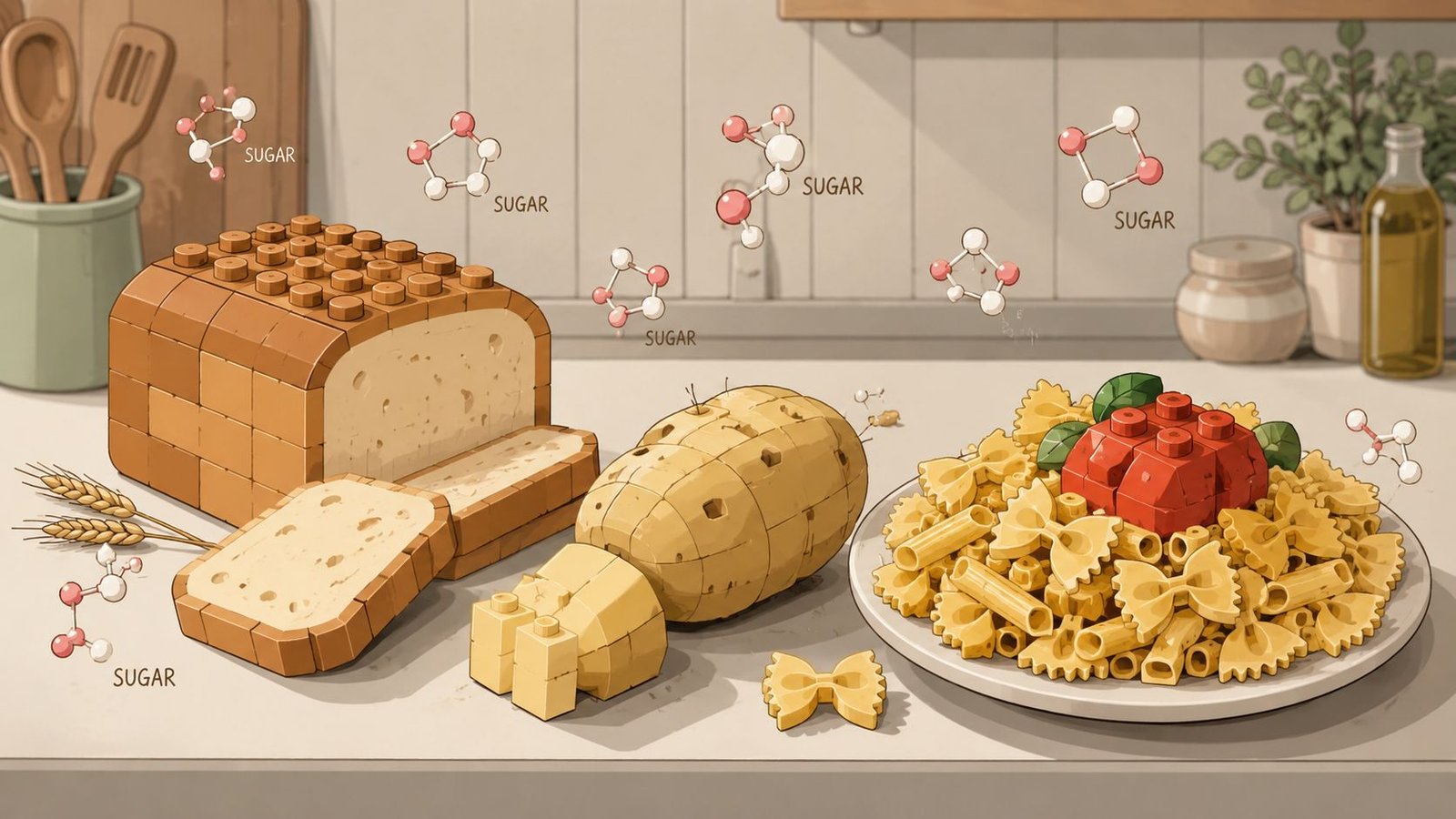
Starch is how plants store energy. If you eat potatoes, rice, pasta, bread, oats, or many beans, you're usually eating plant-made chains of glucose.
That's why these foods often sit in the “energy foods” category. They're built to store fuel.
Glycogen inside the body
Glycogen is the animal storage version. It's also made from glucose units, but you don't usually think of it as a food source. It matters because your body stores glucose this way for later use.
If you exercise, skip meals for a while, or move through the day, your body draws on stored energy. Glycogen is part of that process.
Cellulose and fiber
Cellulose is another carbohydrate, but it plays a structural role in plants. It helps give plant tissues rigidity. In food, that connects closely to dietary fiber.
Humans don't break down fiber the same way they break down starch. That's one reason crunchy vegetables, beans, whole plant foods, and other fiber-containing foods can feel more filling and behave differently in digestion.
A practical way to sort plate foods is this:
- Soft, starchy foods like rice, bread, and pasta are usually rich in digestible glucose chains.
- Fruits and milk-containing foods can bring simpler sugar forms or shorter combinations.
- Fibrous plant foods add carbohydrate structure that your body handles differently.
If a plant food feels “dense and fuel-like,” it often leans starch. If it feels “bulky and rough,” it often brings more fiber structure.
For readers trying to build better routines, this kind of sorting is often more useful than memorizing chemistry terms. It helps with meal choices, fullness, and consistency. If you're also working on broader improving eating habits, seeing carbs by food pattern instead of fear can make daily decisions simpler.
If you want a practical food list to match these categories, this roundup of complex carbohydrate foods can help connect the science to grocery shopping and meal prep.
From Plate to Power Digestion and Blood Sugar
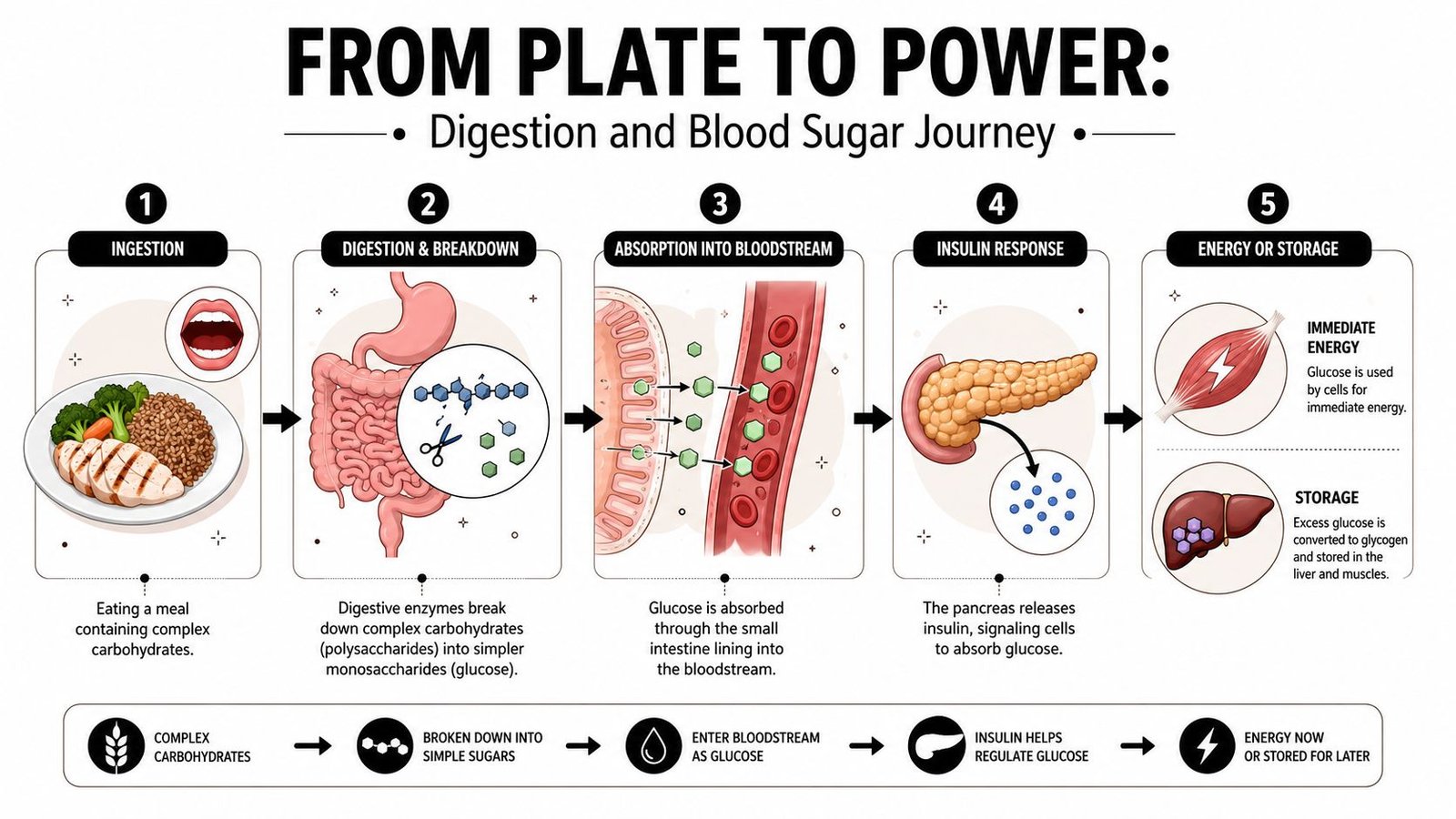
The body can't absorb a bowl of pasta as a whole chain. It has to break that chain down first.
What digestion is trying to do
The digestive goal is simple. Turn bigger carbohydrate structures into units small enough to absorb, mainly glucose.
That's why the building-block idea matters. Foods that start as monosaccharides or small sugar pairs need less breakdown. Foods that arrive as long starch chains need more processing before they can contribute to blood glucose.
According to KTH's carbohydrate overview, simple carbohydrates such as mono- and disaccharides cause a rapid rise in blood sugar and insulin secretion, while complex carbohydrates such as oligo- and polysaccharides require prolonged digestion, leading to a gradual blood glucose increase. The same source notes a recommended dietary intake of 45–65% total carbohydrates and 200–300 g/day for healthy adults.
A simple meal-by-meal comparison
Think of two lunches.
Lunch one is a sugary drink and a pastry. Lunch two is rice, beans, vegetables, and chicken. Both may contain carbohydrate, but they don't present that carbohydrate in the same way.
The first meal leans heavily on simpler forms that are available quickly. The second meal includes more structure and takes more work to digest. That often translates into a steadier release.
Here's the broad pattern:
| Carb type | Structure | Typical blood sugar effect |
|---|---|---|
| Simple carbs | Single sugars or short combinations | Faster rise |
| Complex carbs | Longer chains | More gradual rise |
| Fiber | Carbohydrate structure humans don't fully hydrolyze | Minimal direct blood sugar rise |
Where fiber fits
This is one of the biggest points of confusion. Fiber is still a carbohydrate. It just isn't handled like digestible starch.
The CODEX Alimentarius standard described in that same KTH source defines fibers as carbohydrate polymers containing 10 or more monosaccharide units that humans lack the enzymes to hydrolyze. That's why fiber doesn't function like a standard energy carb even though it belongs to the carbohydrate family.
Fiber isn't “not a carb.” It's a carb your body treats differently because you don't have the enzymes to fully break its structure apart.
That distinction matters in real meals. A high-fiber bean dish and a low-fiber refined starch may show similar total carbs on paper, but they won't necessarily feel the same in hunger, digestion, or blood sugar response.
For people curious about the digestion side of the story, especially where enzymes and gut support fit into the bigger picture, these RxGainz insights on gut health add helpful context.
A quick visual can make the journey easier to picture:
Why this matters for energy and appetite
Most nutrition advice gets more useful when you connect it to structure.
If a meal contains more simple sugars, your body can access those carbs quickly. If a meal contains more complex carbohydrate and fiber, the process is slower and usually steadier. Neither label makes a food automatically “good” or “bad,” but the structure gives you clues about how it may affect energy, fullness, and planning.
That's especially useful if you're trying to avoid the classic cycle of eating something fast, feeling good for a short stretch, then getting hungry again sooner than expected.
Tracking Your Blocks The Modern Way
Knowing the science is one thing. Logging a real dinner is another.
A nutrition label on plain bread is easy. A homemade burrito bowl with rice, beans, roasted vegetables, salsa, avocado, and a handful of toppings is where people get stuck. Most guides explain that carbs are made of smaller units, but they stop before the part that matters most in real life: how to track mixed meals without turning dinner into homework.
Where tracking breaks down
This is a real gap in nutrition education. The Rockefeller carbohydrate background resource notes that dietary guidelines recommend 130 g of carbs daily for brain function, yet many people struggle to map starch-heavy foods like rice and pasta to their macro goals when they don't have simple logging tools.
That's why people often mis-log homemade meals. They can identify the obvious carb source, like rice or bread, but miss the difference between digestible starch and fiber-rich ingredients in the same bowl.
Common friction points look like this:
- Mixed dishes: Chili, soups, casseroles, and stir-fries combine several carb sources at once.
- No barcode: Restaurant meals, family dinners, and meal prep containers don't come with easy scan data.
- Fiber confusion: Many trackers show total carbs, but users don't always know how to interpret fiber-rich foods.
- Portion estimating: A scoop of rice is easy to underestimate, and sauces complicate the picture.
The hardest carbs to track aren't candy or soda. They're ordinary mixed meals that contain several kinds of carbohydrate at once.
A simpler approach for everyday meals
Digital tools help. Instead of manually breaking every ingredient into its chemistry category, a modern carb counter can turn a practical description into a usable estimate.
If your lunch is “salmon, rice, broccoli, olive oil,” you need a tool that treats that like a normal human meal, not a lab exercise. If your dinner is “turkey chili with beans and shredded cheese,” you need help estimating the starch-heavy parts and separating them from lower-carb ingredients.

A free tool like this carb counter from PlateBird is useful because it closes the gap between textbook carb categories and the food people eat. That matters most for busy professionals, first-time trackers, and anyone who wants consistency without spending extra time decoding every plate.
The science still matters. But in daily life, the win is being able to look at a meal and say, “I know where the main carb blocks are, and I can log them without guessing wildly.”
If you want a faster way to turn meals into usable carb and macro data, PlateBird makes logging feel closer to sending a text than filling out a spreadsheet. You can type what you ate, snap a photo, and get a practical breakdown that helps you apply the science without the friction.