
You can feel a realistic goal slipping the moment it becomes a vague promise. The workout app goes untouched, the meal plan turns into guesswork, and the deadline is still far away enough to ignore. That's usually where people don't fail because they lack ambition, they fail because the goal was never built to survive a normal week.
Realistic goals are the ones that can take contact with real life. They are written down, measured, checked, and adjusted before frustration turns into abandonment. That's why the gap between “I want this” and “I'm still doing this on Friday” matters more than motivation on day one.
Why Most Goals Die Before They Start
The usual collapse happens when the goal is too blurry in practice. Someone decides on Sunday night to lose weight, get organized, or train for something meaningful, then Monday arrives with a full calendar, leftover takeout, and no system for deciding what matters first. By the time the first rough day hits, the goal has already turned into a mood instead of a plan.
That failure usually comes from weak execution, not weak ambition. A phrase like “get in shape” does not tell you what to do before breakfast, what to track after dinner, or what counts as success when you are tired and short on time.
A goal survives when it has enough friction reduction built into it. A reader who wants to change eating habits does better when the aim becomes concrete and trackable, and a resource like this guide to smarter food choices helps push the conversation toward decisions, not wishful thinking. The same logic applies to a multi-month fitness goal, where a calorie tracker such as PlateBird's setup guide for your first calorie goal can make the daily follow-through easier to handle.
Practical rule: if a goal cannot be described in one sentence that includes action, frequency, and a review point, it is probably still a wish.
Written goals matter because they force commitment into a form you can inspect. Research commonly reported from Dr. Gail Matthews' Dominican University work says writing goals down makes people more likely to achieve them, and weekly progress reporting improves success compared with not doing so, which is why the main enemy is untracked intention. The handoff from intention to execution has to be designed on purpose, or the week will design it for you instead. goal-setting statistics
The SMART Framework as a Reality Check
SMART isn't paperwork. It's a filter that keeps a goal from sneaking onto your calendar while still being too vague to execute. Used well, it turns a hopeful sentence into something you can test, schedule, and review.
Specific and measurable
Specific means the goal names the target, not just the category. “Eat better” is vague, while “cook dinner at home four nights a week” is specific enough to act on. Measurable means you can tell if you did it without arguing with yourself.
Unrealistic goals usually hide behind broad language. “Get healthier” sounds inspiring, but it doesn't tell you what changes Monday morning. A better version gives the behavior a shape, and that shape is what you can monitor.
Achievable and relevant
Achievable doesn't mean easy, it means possible within your current life. A person who has never tracked food before is usually setting up a stumble if the goal is perfect daily logging with no practice period. Relevant means the goal connects to something you care about, otherwise it becomes another task competing with everything else.
Brewer Science's SMART guidance also recommends separating lag measures from lead measures, because the goal should be tied to actions you can control day to day. Brewer Science's goal-setting guidance That distinction matters because relevance alone won't save a goal that doesn't fit your reality.
Time-bound
Time-bound means the deadline creates a review point, not a fantasy finish line. “Sometime this year” gives you an escape hatch. “By the end of 12 weeks” forces you to check whether the pace is honest.
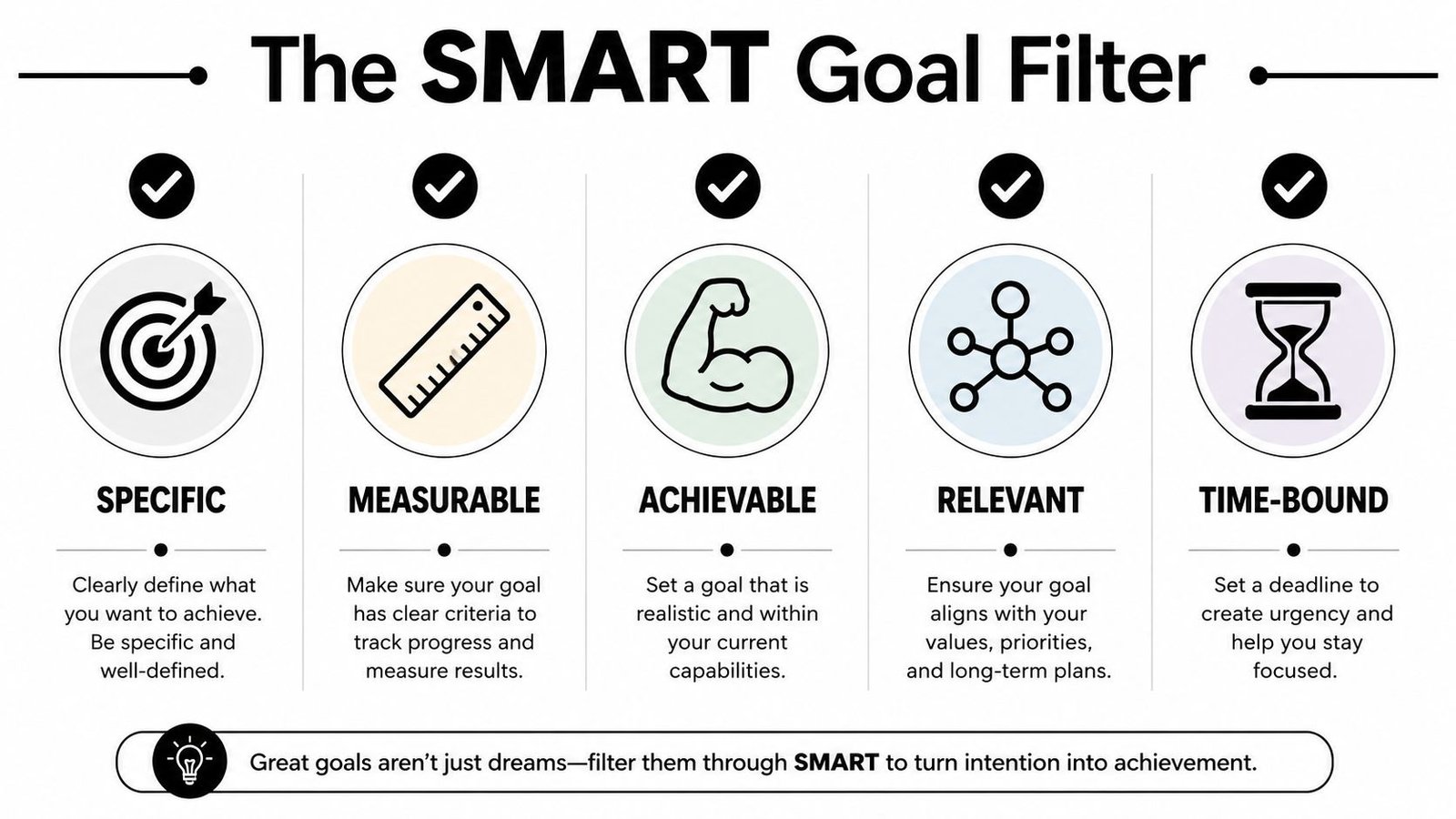
A weak goal becomes stronger when it passes all five filters at once. “I want to lose weight” becomes, “I will lose 10 pounds in 12 weeks by logging meals five days a week and reviewing progress every Sunday.” The exact number is less important than the structure, because the structure keeps the goal alive long enough to matter.
how to set your first calorie goal in PlateBird and adjust it
Lag Measures Versus Lead Measures
A lag measure is the result you care about after the fact. A lead measure is the behavior you can do today. If you confuse the two, you end up staring at outcomes that move slowly while ignoring the actions that move them.
| Goal Component | Lag Measure | Lead Measure |
|---|---|---|
| Fitness goal | Pounds lost by the end of 12 weeks | Meals logged five days a week |
| Nutrition goal | Hitting the target outcome | Protein target tracked on set days |
| Training goal | Final body composition or scale change | Weekly workouts completed |
The reason this distinction works is simple. You can't force the lag measure directly, but you can influence it through repeatable behavior. If the goal is to lose 10 pounds in 12 weeks, the daily win is not the scale reading. It's the meal log completed before dinner and the workout finished before the day gets chaotic.
That's where most plans break. They set the outcome, then leave the daily behavior to chance. A lead measure closes that gap by making the next action visible, trackable, and boring enough to repeat.
Useful test: if the action can't be done on a bad day, it's probably too ambitious to serve as a lead measure.
For fitness, one or two lead measures are usually enough. A person might track meals five days a week and hit a protein target on three of those days. Those aren't trophies, they're steering inputs, and steering inputs are what make the final target more likely to happen.
The best lead measures are small enough to repeat and specific enough to review. They should answer, “What do I do this week?” not, “What do I hope the scale says later?” That shift changes the goal from passive waiting to active management.
Breaking Big Goals Into a 12-Week Milestone Ladder
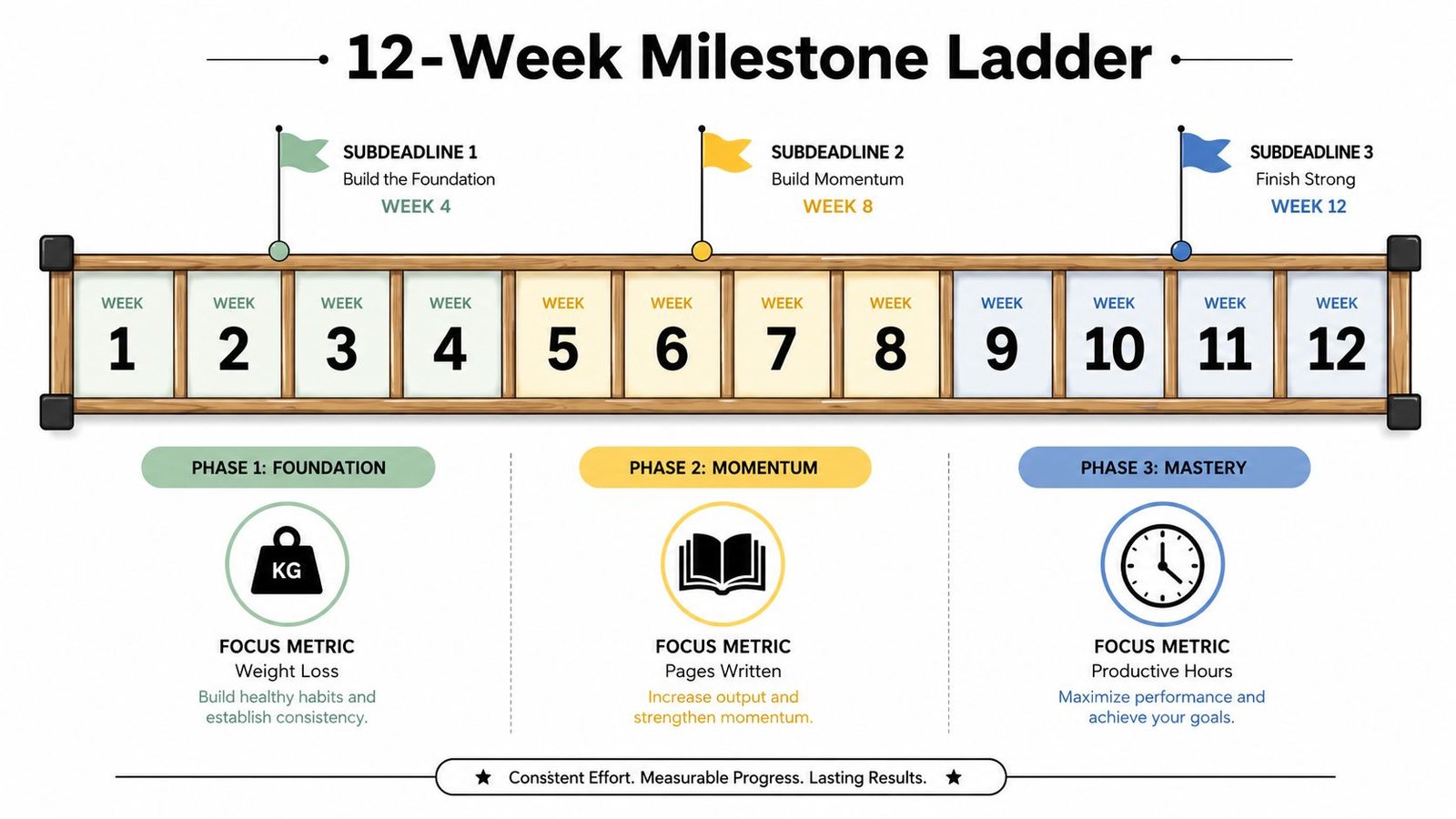
Big goals get realistic when they stop living as one long horizon. A 12-week ladder works because it creates three visible checkpoints instead of one distant finish line that's easy to ignore until the last month.
Build the ladder in three phases
Start by splitting the goal into Weeks 1 to 4, Weeks 5 to 8, and Weeks 9 to 12. Give each phase one subdeadline and one focal metric. If the goal is fitness-related, one phase might focus on consistency, the next on tightening execution, and the last on maintaining standards under normal life pressure.
The point isn't to create three different goals. It's to give the same goal three chances to be corrected before it drifts too far. A goal with milestones tells you early when the pace is wrong, the workload is too high, or the plan needs a smaller next step.
Choose the next smallest action
The first micro-goal should be small enough to complete inside a week without heroic effort. If your long-term target is stronger nutrition, the first week might involve logging every dinner. If your target is training consistency, the first micro-goal could be two sessions, not six.
That logic fits the advice to work from historical performance and milestones rather than wishful targets. Planning from a baseline, especially with patterns from prior weeks and months, makes the next step more credible than jumping straight to perfection. historical-data planning for realistic goals
Review weekly, then adjust honestly
A weekly review catches the moment when a plan stops matching reality. Use it to ask what slipped, what stayed easy, and what should change next week. If the plan is too loose, tighten it. If it's too tight, reduce the load before motivation collapses.
Entrepreneur's goal-setting formula also emphasizes breaking goals into smaller parts, listing required actions, sequencing them, and identifying obstacles before execution. Entrepreneur's 7-step goal-setting formula That's the difference between a goal that feels inspiring and a goal that can be lived.
how to lose 15 pounds in 3 months
Tracking Progress With Tools That Remove Friction
A goal only becomes real when the tracking routine is easier than skipping it. If the logging step feels like admin work, people stop doing it. If it takes under a minute and gives immediate feedback, it becomes part of the day.
The simplest win is to track the lead measure, not every possible detail. Someone aiming for more consistent nutrition doesn't need a perfect spreadsheet on day one. They need a fast way to see what they ate, whether the plan was followed, and what to repeat tomorrow.
A practical tracker works best when it turns ordinary meals into reusable entries. Type a meal once, save it, and use it again the next time that breakfast or lunch shows up. That saves attention for the key decision, which is whether the food supports the goal.

Make the tracker serve the goal
For a protein target, the useful habit is simple. Log the meal, check the protein total, and decide whether the next meal needs a correction. That turns tracking from record-keeping into feedback.
Video can help anchor that habit visually, especially for people who learn faster by seeing the workflow once than by reading a long setup guide.
The broader point is that the tracker should reduce decision fatigue, not add to it. Repeated meals should become one-tap shortcuts, and recurring logging should feel like a quick check-in, not a lecture.
If the log is easy, the review cadence gets easier too. A weekly glance at the pattern is enough to show whether the lead measures are happening often enough to support the lag measure later. For people who want a cleaner workflow, a simple meal tracker app can make that rhythm easier to maintain without turning every meal into a project.
Common Pitfalls and How to Dodge Them
A realistic goal is not a safe goal. It's a goal calibrated to your current constraints, and that means it can still be challenging. The mistake is thinking realism means shrinking ambition until nothing meaningful is left.
Vague targets
Vague goals fail because they create endless interpretation. “Do better with food” sounds kind, but it never tells you what counts as better. Reword it until you can point to the behavior, not the feeling.
Single distant deadlines
One far-off deadline invites procrastination. Subdeadlines fix that by forcing the goal to prove itself in smaller stages. If the first checkpoint is missed, the plan needs a correction, not a pep talk.
Ignoring real-life constraints
Busy parents, shift workers, and first-time trackers need smaller first steps than someone with a predictable schedule. That's the practical insight behind advice that says to start with the smallest possible step, then build a sequence of milestones rather than forcing a large target all at once. realistic goals for constrained schedules
Treating slip-ups as failure
A bad day is data, not a verdict. If the plan falls apart after one missed workout or one untracked meal, the problem is usually the recovery rule, not the person. That matters even more for people dealing with task paralysis, because starting can be the hardest part of the whole process, and this task paralysis help for ADHD can be a useful reference point when momentum keeps stalling.
If a goal only works on your best day, it isn't realistic yet.
Run a quick diagnostic on any current goal. Ask whether it has one clear action, one deadline, one recovery rule, and one tracking method. If any of those are missing, the goal is still under construction.
Your First 30 Days With a Realistic Goal
The first month should feel clear, not grand. Write the goal in SMART form, choose one or two lead measures, set the first four-week milestone, pick a tracking method, and lock in a weekly review day. That's enough to turn a wish into a working plan.
The most important habit is still the simplest one. Write the goal down, then look at it on a fixed cadence. Goals live longer when they're documented and revisited, not when they're remembered in passing.
A clean 30-day version looks like this, in order. Define the outcome. Choose the daily or weekly behaviors that drive it. Decide what counts as a win this week. Set a check-in. Repeat.
One sentence to keep near the top of the page: a realistic goal is written, measured, and reviewed before motivation disappears.
If the goal feels too easy, tighten the lead measures. If it feels too hard, reduce the first milestone until it can survive an ordinary week. The right goal should challenge you without making you dread the calendar.
By day 30, you're not asking whether the dream came true. You're asking whether the system is working well enough to deserve another month. That's the difference between a resolution and a plan.
If you want a faster way to turn a fitness or nutrition goal into something you can keep, PlateBird is built for exactly that kind of day-to-day follow-through. It makes logging feel quick enough to repeat, which is the whole point when realistic goals depend on tracking, lead measures, and a review habit that doesn't collapse by Thursday.