- Why the Math Matters Before the First Bite
- Estimating Your BMR the Honest Way
- Turning BMR Into TDEE With Activity Multipliers
- How Deficit Size Translates Into Weekly Loss
- Choosing a Deficit That Fits Your Starting Point
- Validating the Calculation With a Two-Week Baseline
- When to Adjust and When to Hold Steady
You're standing in front of a calculator, staring at a number like 1,500 calories, and the question isn't whether the math works. The question is whether that number has any relationship to your actual week, your actual hunger, and your actual scale trend.
That's where many get stuck. They treat calorie deficit calculation like a verdict, then get frustrated when a single weigh-in doesn't match the spreadsheet. A better approach is to treat the estimate as a starting hypothesis, then test it against real intake and real weight data.
At the core, the rule never changes. If energy intake stays below energy expenditure, you're in a deficit. A practical science-backed weight loss method is to set a target, log accurately, and adjust based on what your body does, not what the calculator hopes it does.
Why the Math Matters Before the First Bite
You can't out-talk physics. If you eat less energy than you burn, your body has to make up the difference from stored tissue, and that's the whole point of a calorie deficit.
What people usually want, though, is not the theory. They want to know whether the number on the screen is worth trusting before they start changing meals, buying smaller containers, and telling themselves they'll “be good” on weekdays. My blunt advice is this, trust the formula enough to start, but not enough to worship it.
A calculator is useful because it gives you a working target. It's not useful when it becomes a substitute for observation, because maintenance needs shift with body size, activity, and the way you move through the day. That's why the smartest guides start with energy balance, then refine the estimate with trend data.
Practical rule: your first calorie target is a test, not a verdict.
That's also why a solid daily calorie calculation guide shouldn't end at “eat 500 fewer calories.” It should tell you how to check whether that target is too high, too low, or just right once real life gets involved. The math gives you a direction. Your scale trend decides whether the direction was correct.
Estimating Your BMR the Honest Way
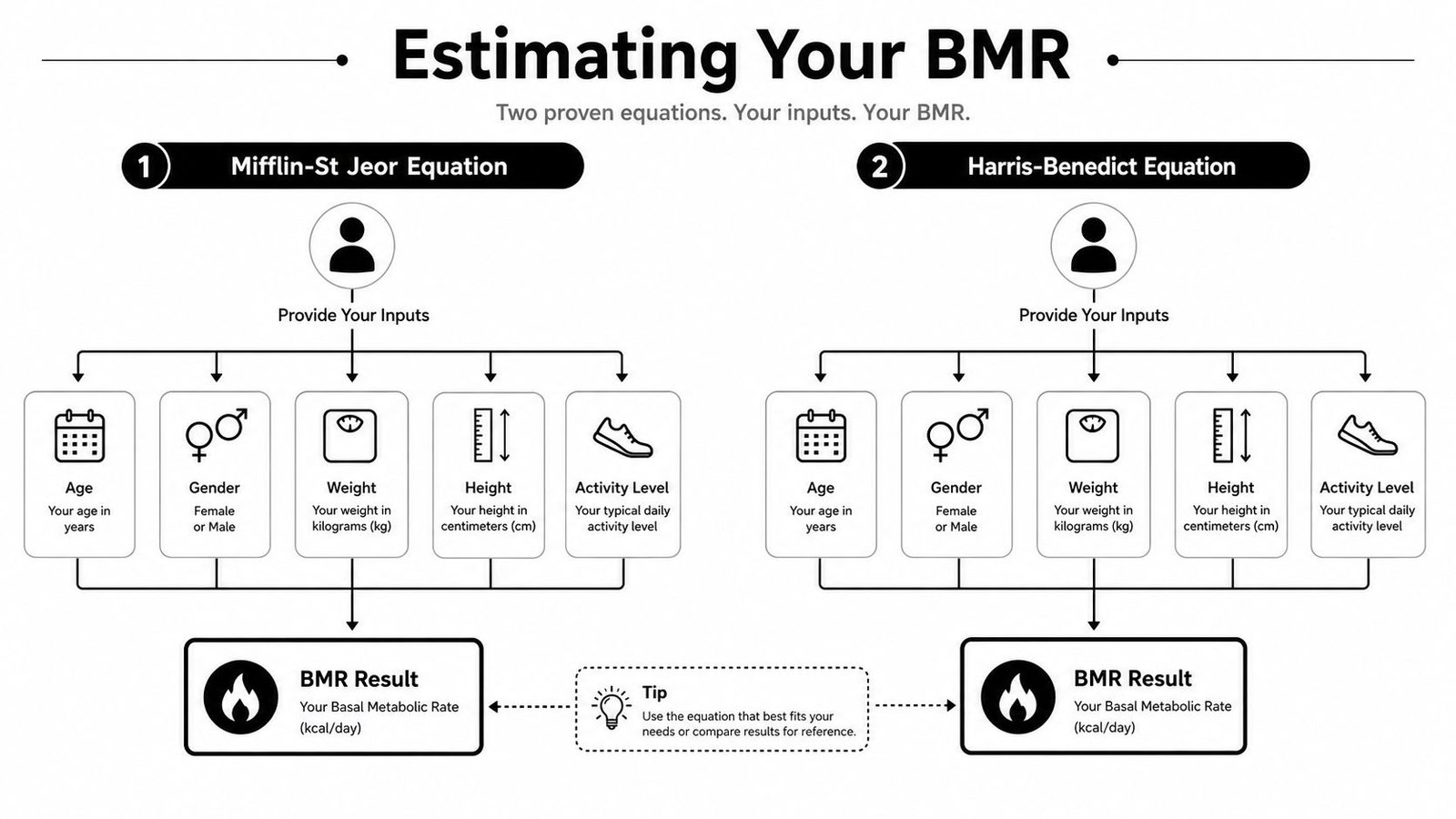
BMR, or Basal Metabolic Rate, is the energy your body burns just staying alive. Breathing, circulation, cell repair, and temperature control all come out of that bucket before you take a single step.
Most calculators use one of two equations, Mifflin-St Jeor or Harris-Benedict. You don't need to memorize both. You need to understand that they estimate a floor, not a personal truth carved into stone.
For a hypothetical 32-year-old, 75 kg person, age pushes the estimate down compared with a younger adult, body weight pushes it up, and sex and height shift the result further depending on which equation you use. The details matter, but not because the formula is magic. They matter because they prove that BMR is individualized enough to be useful, yet still rough enough to be treated as an estimate.
A simple way to think about it is this. If two people weigh the same but one is taller or carries more lean mass, they won't burn the same number of calories at rest. That's why BMR is a starting point, not the final number you diet from.
The only number that matters after BMR is the one that includes actual movement. Once you've got a reasonable resting estimate, stop fiddling with the equation and move on to activity.
A lot of people waste time trying to “perfect” BMR. Don't. A decent estimate plus honest activity data beats a polished guess every time.
Turning BMR Into TDEE With Activity Multipliers
BMR tells you what you burn lying still. TDEE, or Total Daily Energy Expenditure, is what you burn living your actual life, and that's the number you need before you subtract any deficit.
The activity multiplier is where people usually get too generous with themselves. A desk worker who lifts two evenings a week is not the same as someone on their feet all day. If you pick the flattering category, your deficit shrinks or disappears before you even start.
Standard Activity Multipliers Applied to BMR
| Activity Level | Weekly Movement | Multiplier |
|---|---|---|
| Sedentary | Little planned exercise, mostly sitting | 1.2 |
| Lightly active | Some movement, light exercise a few days | 1.375 |
| Moderately active | Regular training and mixed daily movement | 1.55 |
| Very active | Hard training and a busy, on-your-feet week | 1.725 |
| Extra active | Very high output, demanding schedule | 1.9 |
Use the band that matches your real week, not your aspirational one. If you sit most of the day, start conservative. You can always adjust upward later if your trend data proves you were underestimating your burn.
Pick the lower category when you're unsure. The cost of overestimating activity is a stalled cut and a lot of fake confidence.
If you want a clean explanation of maintenance calories, the TDEE guide from PlateBird is a practical companion to this step. The point is simple, TDEE is your maintenance number, and every deficit calculation depends on getting that baseline close enough to reality.
How Deficit Size Translates Into Weekly Loss
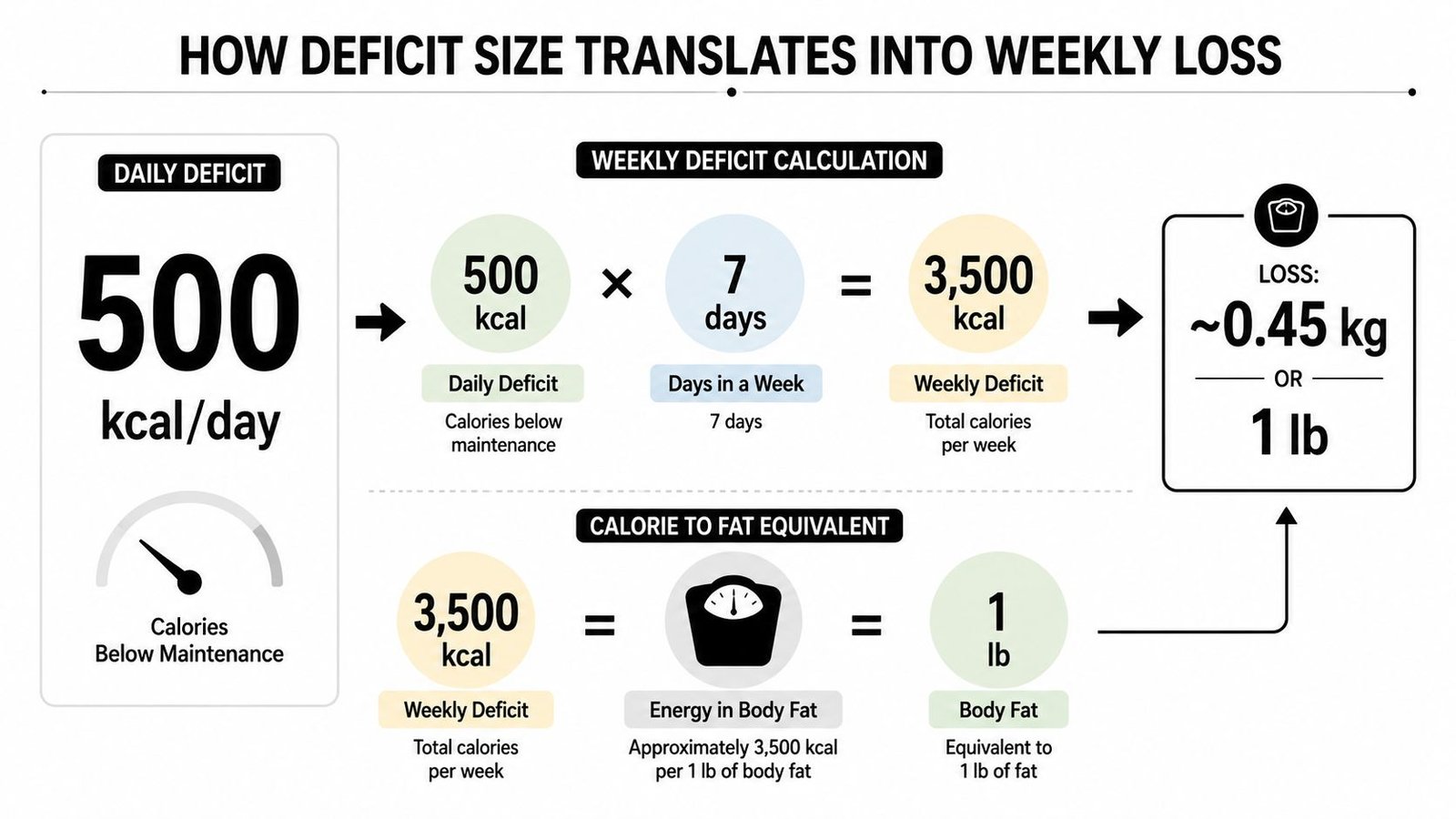
The math is straightforward. A 500 kcal/day deficit creates a 3,500 kcal weekly deficit because 500 × 7 = 3,500. Under the old U.S. rule of thumb, 3,500 kcal is about 1 lb of body fat, while the broader metric convention says 7,700 kcal is about 1 kg of body fat Gymkee.
That's why a 500 kcal/day cut is usually described as roughly 1 lb per week, or about 0.45 kg over time. The number is close enough to guide planning, but not so precise that you should panic if one week doesn't line up perfectly.
The problem is that the body doesn't work on a clean spreadsheet. Body mass changes as you lose weight, metabolism adapts, and water can obscure the trend. So a week that looks “off” on the scale isn't automatically a bad calculation, it may just be noisy data.
The better habit is to judge progress by weekly or rolling averages, not one dramatic weigh-in after a salty dinner or a hard training day. Daily weigh-ins can still help, but only if you compare them as a trend, not as isolated events.
A useful mindset is this:
Direction matters more than one data point.
If the scale is drifting down across several weeks, the deficit is doing its job. If it's flat, the plan needs a correction. If it's jumping around day to day, that's normal noise, not proof that the math failed.
Choosing a Deficit That Fits Your Starting Point
Not everyone should start with the same cut. A person with more body fat, a decent sleep routine, and strong meal discipline can usually tolerate a bigger deficit than someone who trains hard, has dieted repeatedly, or wants to keep performance sharp.
The most common sweet spot is still a 300 to 500 kcal/day reduction, because that's the range clinical guidance commonly associates with about 0.5 kg (1.1 lb) per week and better sustainability than aggressive restriction Harvard Health. That range works for a lot of people because it's big enough to matter and small enough to survive real life.
How I'd choose the cut
- Use 300 to 500 kcal/day if you're new to tracking, moderately active, or want a plan you can stick with for months.
- Stay on the smaller end if you've dieted hard before, lift frequently, or care about energy in the gym more than fast scale loss.
- Go deeper only when adherence is strong and you've got more body fat to lose, because the trade-off is more hunger and a higher chance of burnout.
- Avoid dramatic cuts if your day already feels demanding. The deficit has to fit the life you're living, not the one you wish you had.
Protein matters more than clever macro debates when calories fall. Active dieters usually do well keeping protein high, keeping fats high enough to stay comfortable, and letting carbs fill the rest based on preference and training needs. I'm deliberately not turning this into a carb war, because the only thing that really matters here is whether you can keep eating that way.
If you want a simple real-world example of a fixed calorie target, Yuve's vegan calorie guide is useful as a reference point for how an intake target gets translated into meals. The point is not that one number suits everyone. The point is that your deficit should protect protein, preserve enough dietary fat, and leave room for food you'll regularly repeat.
Validating the Calculation With a Two-Week Baseline
The cleanest way to find your real maintenance is boring, and boring works. Eat at the estimated maintenance target for 1 to 2 weeks, log your food, and track your body weight regularly. If weight stays stable, that intake is probably close to true maintenance, which is exactly the workflow a clinical guide recommends before cutting by about 300 to 500 kcal/day BodyClinic.
That baseline matters because standard activity multipliers are only rough proxies. Your actual daily burn can be off enough to make the first estimate misleading, especially if you sit more than you think or move less once you start dieting.
What the scale is really telling you
Water retention can hide progress. Glycogen, sodium, menstrual-cycle shifts, and a hard training session can all move the scale without changing body fat in a meaningful way. That's why a single weigh-in is a bad judge of calorie deficit calculation.
Use trend data instead. A rolling average gives you a better read on whether intake is too high, too low, or about right. If your average weight is stable across the baseline period, your maintenance estimate is decent. If it trends up or down, the estimate needs correction before you cut.
The mistakes I see over and over
- Overestimating daily movement. The symptom is a target that looks reasonable but never produces loss. The cause is usually picking an activity multiplier that matches your ambition, not your week. The fix is to move one activity band lower and retest.
- Missing cooking oils, drinks, and bites. The symptom is “I'm in a deficit” with no scale response. The cause is under-logging small calorie sources. The fix is tighter logging for a short baseline window.
- Reacting to one bad weigh-in. The symptom is panic after a salty meal or a poor sleep night. The cause is treating noise like signal. The fix is to compare weekly averages, not single mornings.
- Cutting too hard too soon. The symptom is hunger, fatigue, and an urge to quit. The cause is choosing a deficit that fits the spreadsheet but not your life. The fix is a smaller cut and a longer runway.
XO's 2026 guide on medical reasons for not losing weight is a useful reminder that not every stall is a math problem. Sometimes the number is fine and the issue is the data you're feeding it.
For tracking, don't overcomplicate the log. A fast workflow matters more than perfect food database hygiene, and how to count calories should be simple enough that you can keep doing it on a tired Tuesday.
When to Adjust and When to Hold Steady
A stall isn't a failure if you know how to read it. If your average weight hasn't moved for three or more weeks, reduce calories a little or tighten logging before you slash anything. If you feel wrecked, constantly hungry, or flat in the gym, the deficit is probably too deep and needs to come up.
That's the part many individuals ignore. They keep pushing when the signal is telling them the plan is too aggressive, not too soft. Fat loss should be uncomfortable enough to work and easy enough to repeat.
Use symptoms as data
- Persistent hunger usually means the cut is too large or the meal structure is weak.
- Low gym performance often means recovery is underfed, especially if you train hard.
- Ongoing fatigue or irritability means adherence is about to crack.
- Cycle-related changes can distort the scale without proving the plan is wrong.
The adjustment rule is simple. If the trend is flat and your logging is honest, make a small change. If the trend is moving and you feel decent, hold steady. Constant tinkering makes people lose confidence faster than slow progress ever will.
That's where friction matters. PlateBird lets you type meals in plain English, snap a photo for ingredient recognition, and save recurring meals as shortcuts, so a full day's logging doesn't turn into an evening project. If you're trying to test a baseline and keep the math honest, that kind of low-friction intake tracking is exactly what keeps people from quitting in week two.
If you want calorie deficit calculation to stop feeling abstract, use a tool that makes logging fast enough to repeat. PlateBird turns plain-language meals and photos into calorie and macro totals, which makes it easier to test your maintenance target, adjust the deficit, and stay honest with the numbers. Try it if you want the math to live inside your actual routine instead of another abandoned spreadsheet.