- Why the Ab Wheel Feels Harder Than It Looks
- The Primary Core Muscles Doing the Work
- Why Your Lats, Shoulders, and Back Are on Fire
- The Biomechanics of Leverage and Range
- Matching the Variation to Your Training Level
- Programming the Ab Wheel for Real Results
- Common Mistakes That Shift Work Away from the Core
- Putting It All Together on Your Next Session
You kneel on the mat, grip the handles, and expect a harder crunch. The wheel moves forward only a short distance, yet your abs tighten, your shoulders start to shake, and your lower back threatens to arch. That first attempt feels confusing because the ab wheel isn't asking your trunk to curl repeatedly. It's asking your trunk to stay rigid while your body moves into a longer, less forgiving position.
That distinction explains the ab wheel muscles worked, the exercise's unusual difficulty, and the technique problems that frustrate new users. The rollout is best understood as a compound anti-extension exercise, where your core resists the pull toward spinal extension while your shoulders, chest, lats, and hips help control the moving lever.
Why the Ab Wheel Feels Harder Than It Looks
A rollout looks simple. Your hands hold two handles, the wheel moves across the floor, and your knees or feet stay planted. The challenge comes from what your body must prevent. As the wheel travels forward, your torso wants to sag toward the floor, so your abdominal wall has to create enough tension to keep your ribs, pelvis, and spine organized.
Think of the movement as a plank on wheels. A plank gives you a fixed base. The ab wheel removes that base and sends your hands farther away, increasing the distance your body must control. You aren't merely bringing your shoulders toward your knees as you would in a crunch. You're resisting the urge to extend through the lumbar spine.
Practical rule: The hardest part of the rollout isn't reaching the farthest point. It's reaching a distance you can control without losing your rib and pelvic position.
A 2006 peer-reviewed electromyographic analysis found that Power Wheel roll-outs produced the highest activation levels for the upper and lower rectus abdominis, internal oblique, and latissimus dorsi among the abdominal exercises tested. The same research highlighted roll-out, pike, and knee-up patterns as especially demanding for both abdominal and non-abdominal musculature, supporting the idea that the wheel is a whole anterior-chain drill rather than an isolation exercise. You can review the original findings in this peer-reviewed physical therapy analysis of abdominal exercises.
That whole-body demand is why your shoulders may burn before your abs feel fatigued. Your hands have to transmit force into the floor, your shoulder blades must remain controlled, and your trunk must resist a changing lever. If you want broader grip and upper-body preparation alongside core work, Evermost's grip training guide offers useful context for building control through the hands and forearms.
Start by rolling only as far as you can maintain a firm, slightly tucked pelvis. Stop before your lower back dips, return under control, and treat that distance as your current training range. The exercise becomes productive when the difficulty reflects muscular tension, not when the wheel travels far.
The Primary Core Muscles Doing the Work
The rectus abdominis is the headline muscle in the rollout, but its job differs from the repeated shortening you feel during a crunch. During the rollout, it helps hold the rib cage and pelvis in relationship while the body lengthens. It produces strong isometric tension to resist the lumbar extension created by the wheel moving forward.
The obliques provide the side-to-side control that keeps the torso from twisting or bending. Your internal and external obliques help prevent rotation and lateral flexion, especially if your hands aren't perfectly even or the floor changes the wheel's path. The transverse abdominis contributes as a deep stabilizer, helping create a firm abdominal brace rather than driving the visible movement by itself.
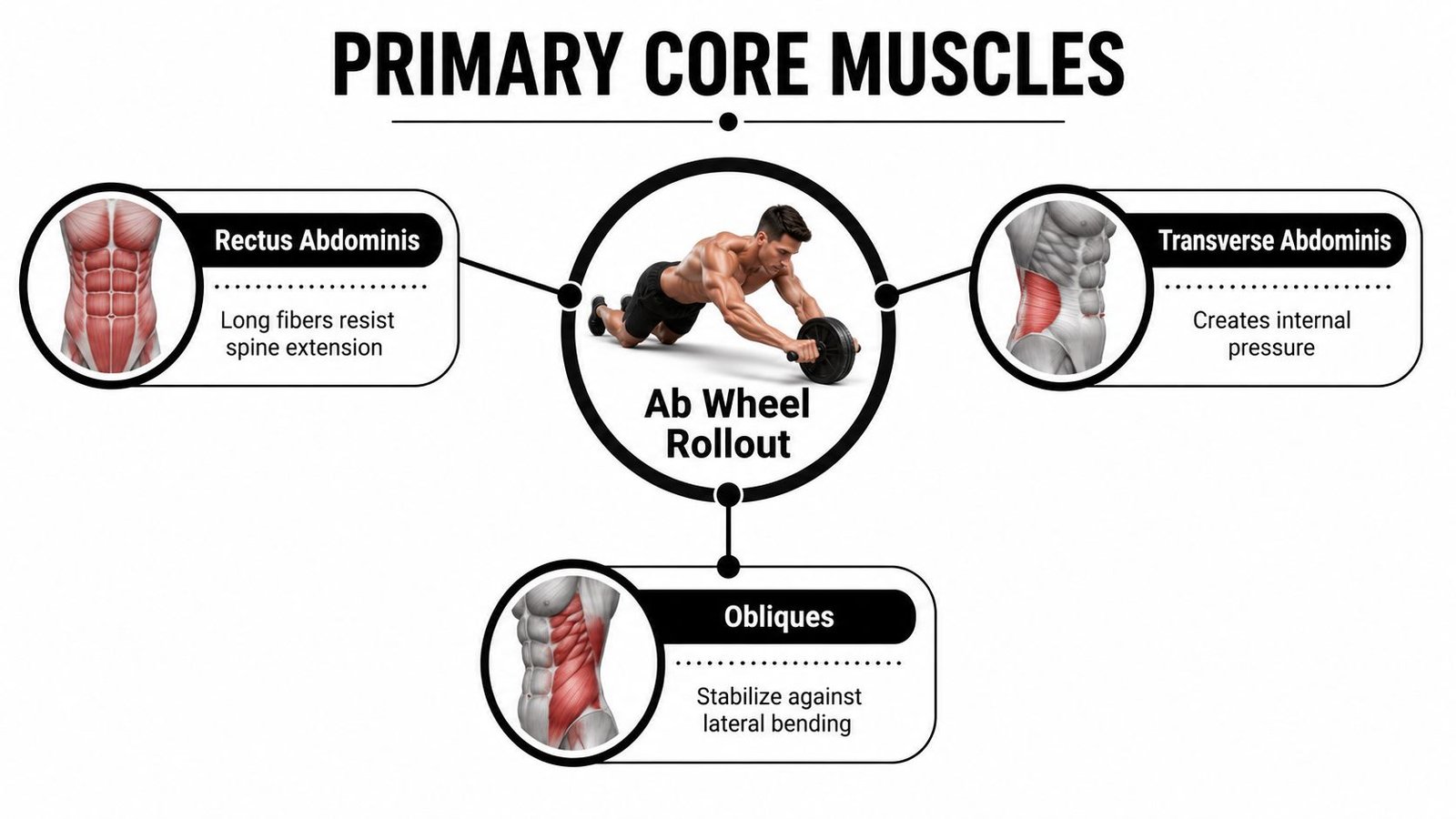
What each abdominal muscle is trying to prevent
Use these cues to connect anatomy with the sensation in your next repetition:
- Rectus abdominis: Keep the ribs from flaring as the wheel moves away. If your chest opens and your back arches, this muscle is losing the position it needs to control.
- Obliques: Keep your hips and shoulders facing the floor. A wheel that drifts to one side can expose a weakness in anti-rotation control.
- Transverse abdominis: Brace as though you're preparing for contact, without sucking your stomach inward or holding a hollow breath.
A 2015 study described the isometric ab wheel rollout as a combination of dynamic shoulder extension and isometric trunk flexion. It identified the pectoralis major, latissimus dorsi, and teres major as major movers, while the rectus abdominis and erector spinae stabilized the trunk isometrically. The study's description of the isometric ab wheel rollout and changing shoulder positions helps explain why the abdominal wall can work intensely without obvious spinal movement.
Independent technical reporting has also summarized high rectus-abdominis activation across kneeling and standing progressions, citing upper-rectus values of roughly 85% to 99% MVIC and lower-rectus values of roughly 78% to 93% MVIC. Those ranges come from technical reporting on ab-wheel biomechanics and muscle activation, and they shouldn't be treated as a promise that every lifter will experience identical activation. Your range, body position, control, and training history all change the demand.
For practical programming, pair rollouts with other core stability exercises that challenge bracing without repeating the same lever pattern. A controlled rollout should leave you feeling that your entire abdominal wall managed the position, not that your hips or lower back rescued the final portion.
Why Your Lats, Shoulders, and Back Are on Fire
The ab wheel connects your hands to your trunk through a moving support. That connection makes the upper body part of the exercise, even though many choose the wheel to train their abs.
Your latissimus dorsi helps control the wheel and contributes to bringing it back toward your body. The 2006 EMG analysis cited the latissimus dorsi among the muscles showing high activation in the rollout family, which is why a clean set can feel like a blend of pullover, plank, and shoulder-control work. Your lats aren't pulling the wheel backward like a cable row. They help keep the shoulder and trunk connected while the lever extends.
The shoulder girdle carries the moving end
The pectoralis major, anterior shoulder, and serratus anterior help manage the position of your arms and shoulder blades. The serratus anterior supports controlled movement of the scapula around the rib cage, while the chest and shoulder muscles help stabilize the upper limb against the floor.
A 2015 investigation described the pectoralis major, latissimus dorsi, and teres major as major movers during isometric rollouts. It also emphasized that shoulder angle changes the loading pattern, so two rollouts with the same apparent distance can feel different if the hands, elbows, or shoulders start in different positions. The published shoulder-angle study provides the research background for that distinction.
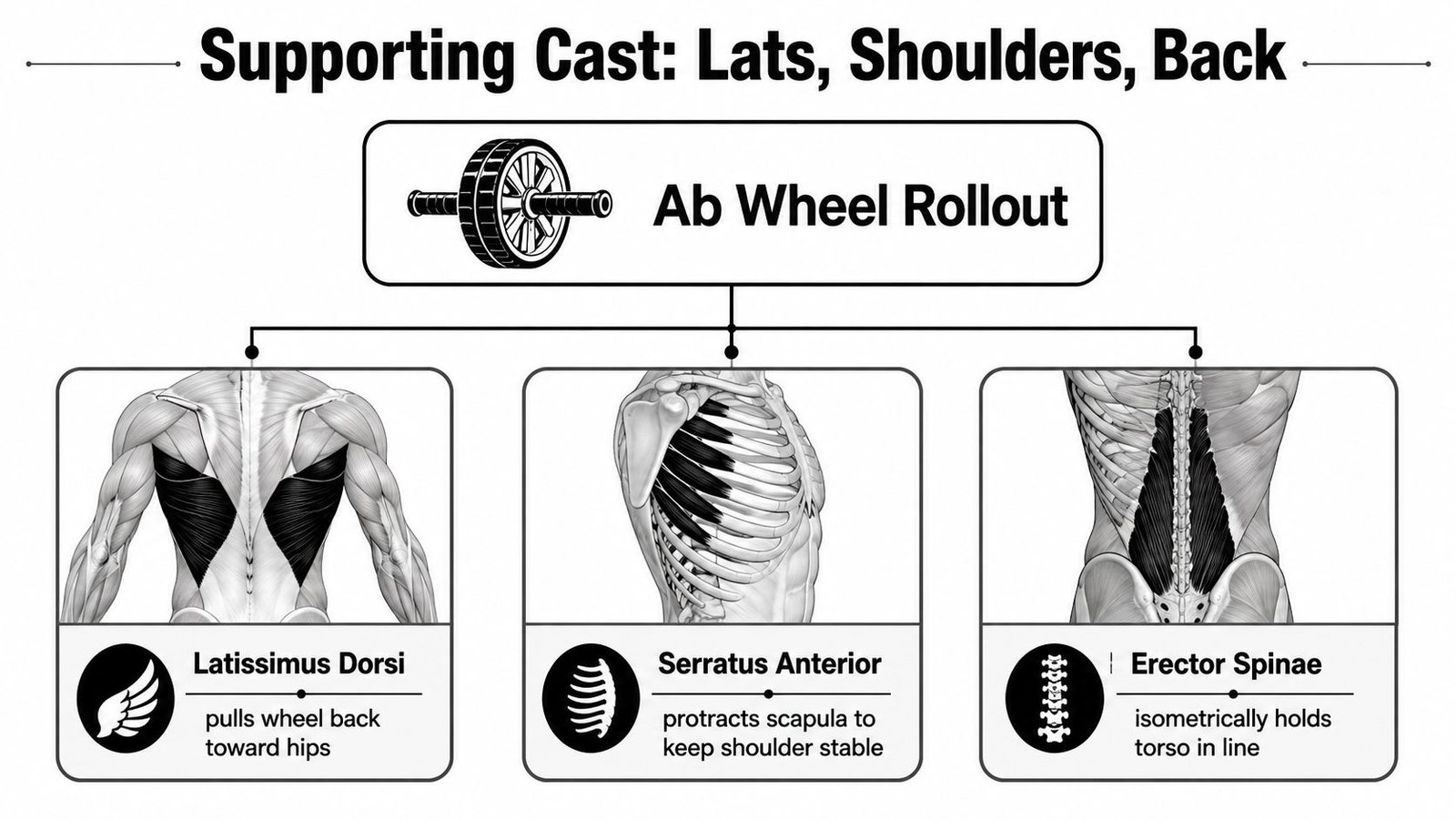
Your erector spinae works differently from the abs. Rather than trying to create the main forward movement, it helps hold the spine in position. The 2006 analysis found lumbar paraspinal activity stayed low and similar across the tested movements, which reinforces an important coaching point: a well-controlled rollout should challenge your trunk without turning the lower back into the primary driver.
The glutes and hip flexors also influence what you feel. Glute tension helps you maintain pelvic alignment, while the hip flexors can become more involved when you lose the brace and try to pull yourself back with the hips. If your shoulders collapse, elbows flare, or hips drop, the supporting muscles stop sharing the load efficiently.
A strong rollout feels like your hands, shoulders, lats, abs, and glutes are connected by one solid line.
That's why the wheel fits well beside planks, carries, and other whole-body bracing drills. It trains force transfer through the front of the body, not just repeated trunk flexion.
The Biomechanics of Leverage and Range
Two lifters can perform a kneeling rollout with the same equipment and experience completely different difficulty. The key difference is often range of motion, because the wheel's distance from the body changes the lever arm.
At the start, your center of mass sits relatively close to the support created by your hands and knees. As the wheel moves forward, your body lengthens and your center of mass moves farther from that support. The longer distance creates a larger extension moment at the spine, so your abdominal wall must produce more tension to prevent your torso from opening.
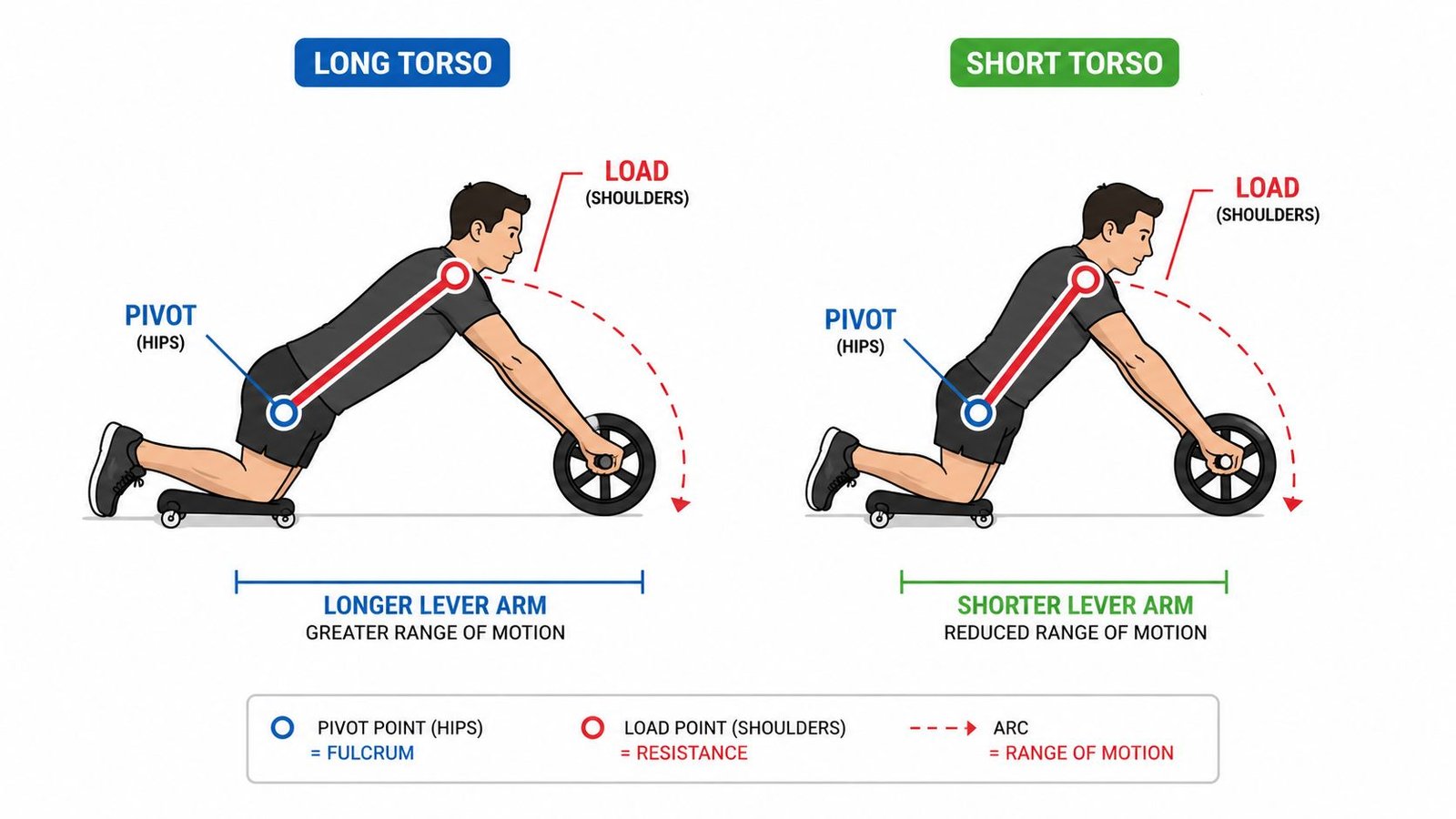
You can feel this immediately by comparing a short rollout with a deeper one. The first few inches may feel manageable because the lever remains short. Near your maximum controlled reach, the wheel sits farther away, your shoulders open more, and your core has to resist a stronger pull toward extension. The final position is often where technique breaks down.
Use range as your main difficulty dial
Set a floor marker, wall, or other physical limit so you can repeat a controlled distance. Your goal isn't to touch the floor with your chest. Your goal is to reach the farthest point where you can keep your ribs down, pelvis slightly tucked, glutes active, and elbows softly extended.
Standing rollouts begin with an even longer lever because your feet support the body while the wheel travels forward. That makes them a high-level progression, not a default test of toughness. Pike variations change the hip and shoulder relationship, and they can place a demanding combination of trunk and shoulder control into the movement.
A useful visual demonstration can reinforce how body position changes the rollout's challenge:
The same principle appears in other training choices. If you're comparing demanding movements by effort and positioning, this guide to how squats burn calories offers a useful reminder that mechanics matter more than the exercise's reputation.
Matching the Variation to Your Training Level
The best ab wheel variation is the one that lets you train the intended position repeatedly. A shorter range with a stable pelvis is more useful than a dramatic rollout that ends with a sagging back and a rushed return.
| Variation | Difficulty | Primary Emphasis | Watch Out For |
|---|---|---|---|
| Partial kneeling rollout | Accessible starting point | Bracing and short-range anti-extension | Rolling beyond your controlled limit |
| Full kneeling rollout | Challenging | Rectus abdominis, obliques, lats, and shoulder control | Arching at the farthest reach |
| Tall-kneeling rollout | More demanding | Longer lever and stronger trunk stiffness | Losing glute tension |
| Standing rollout | Advanced | Full-body anti-extension under a long lever | Dropping into the bottom position |
| Pike rollout | Advanced | Abdominal control with demanding shoulder and hip coordination | Letting the shoulders collapse |
| Single-arm rollout | Highly demanding | Anti-rotation and unilateral shoulder control | Twisting toward the loaded side |
Choose by your current failure pattern
If you're new to the wheel, begin with a partial kneeling rollout. Place a visual stop in front of the wheel and finish every repetition before your pelvis tips forward. Your first progression is not more repetitions. It's a slightly longer controlled range.
Most recreational lifters can build useful strength with a full kneeling rollout. Keep the knees on a pad, squeeze the glutes, and move slowly enough to feel where the lever becomes difficult. A tall-kneeling setup removes some assistance from the lower body and can expose whether you're relying on hip position to finish the movement.
Standing rollouts belong with advanced athletes who can already control a substantial kneeling range. Pike and single-arm versions add coordination demands rather than making the same movement longer, so they need a clear reason in your program. Single-arm work can challenge anti-rotation, while pike work can demand more from the shoulders and hips.
Your variation should make clean repetitions repeatable, not make ugly repetitions impressive.
Don't choose a version because it looks advanced on social media. Choose it because you can maintain the same rib, pelvis, and shoulder positions from the first repetition to the last. If you're comparing ab training with more familiar movements, this resource on how many calories are burned doing crunches can help clarify why exercise difficulty and energy expenditure aren't the same question.
Programming the Ab Wheel for Real Results
Ab wheel training works best when you treat each repetition as a strength practice. The lever becomes demanding quickly, so long burnout sets often turn into a sequence of compensations. Once your pelvis falls forward or your shoulders collapse, extra repetitions mainly rehearse the wrong pattern.
Use a simple progression built around quality:
- Pick a variation you can control. Start with a kneeling partial range if you can't keep your pelvis tucked through a longer rollout.
- Perform low-to-moderate repetition sets. Stop the set when your range shortens, your back arches, or your return becomes a hip-driven jerk.
- Control both directions. Roll out smoothly, pause briefly at your limit if you can hold position, then return without bouncing.
- Progress range before adding load. Make the wheel travel farther only when your current distance stays technically consistent.
- Keep sessions separated by recovery. Your abs, shoulders, and lats all contribute, so place the exercise where it won't undermine demanding upper-body or compound training.
A rollout can serve different purposes depending on where you place it. Early in a session, a small number of controlled sets can prepare you to brace for squats, deadlifts, presses, or carries. As an accessory, it can follow your main lifts when you want focused anti-extension work. As a finisher, use a conservative range rather than chasing fatigue that changes your position.
A practical session template
Choose a kneeling variation. Perform several controlled sets with a repetition count that leaves every rep looking alike, using a steady tempo and a deliberate return. Rest long enough to restore shoulder and trunk control, then record the distance you reached.
Next session, repeat that range. If you can complete all sets without an arch, twist, or shortened return, extend the range slightly in a later workout. If your technique deteriorates, keep the same distance or regress it. Progress is a better lever than exhaustion.
Common Mistakes That Shift Work Away from the Core
The ab wheel doesn't automatically train your abs well just because the movement feels difficult. Poor positioning can shift effort toward the hip flexors, shoulders, or lower back while reducing the trunk tension you want.
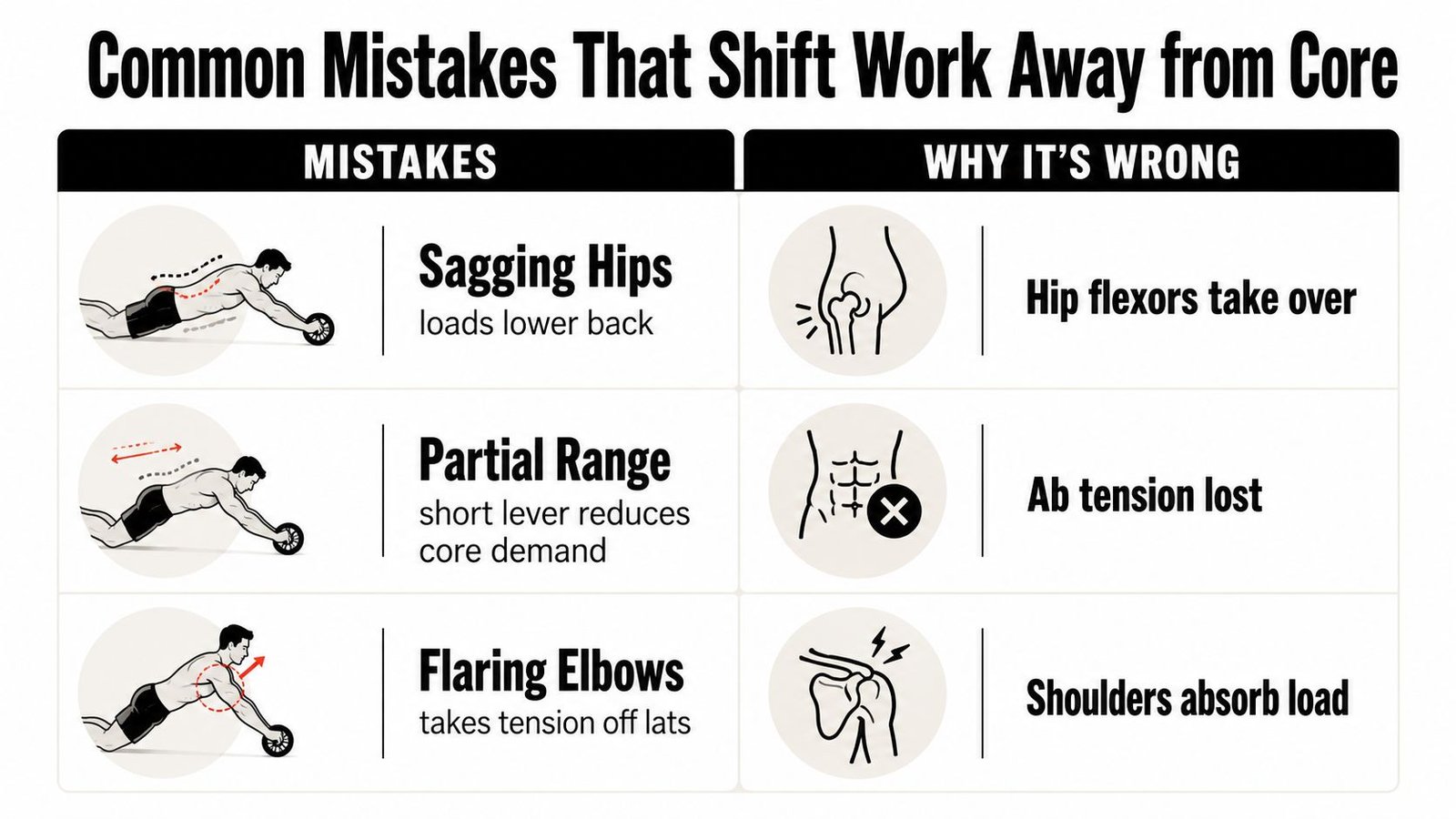
Sagging through the lumbar spine
This is the clearest sign that the lever has exceeded your current capacity. As the hips drop, the spine moves toward extension and the abdominal brace loses its organized position.
Self-check: Record a side view or stop at the point where your ribs flare and your lower back dips.
Fix: Shorten the range, squeeze the glutes, and think about bringing the front of your pelvis toward your ribs. The correction should happen before the wheel travels farther.
Driving with the hip flexors
Some lifters pull the wheel back by snapping the hips backward or folding at the hip. That may move the wheel, but it changes the exercise from controlled trunk resistance into a hip-dominant recovery.
Cue: Let the abdominal wall initiate the return while the hips and ribs move together. If the return feels like a sudden pike, the variation is probably too difficult.
Jerking the wheel
Momentum can hide a weak position at both ends of the repetition. A bounce at the bottom reduces the time you spend controlling the longest lever, while a fast pull back can make the set look stronger than it is.
Use a quiet wheel path and keep the handles moving at a pace you can stop. The 2006 research noted that rollout-type movements activate substantial extraneous musculature alongside the abdominal wall, so control matters when you want the abs to remain the limiting factor. The comparative abdominal-exercise paper provides the relevant context.
Going too deep too soon
A deeper range isn't automatically a better range. If you can't hold your torso position, the extra distance raises the demand without giving you a clean training stimulus.
Holding your breath
Bracing and breathing must work together. Take a controlled breath before the rollout, maintain pressure through the difficult portion, and breathe as you return without letting your ribs flare. If you can't coordinate that pattern, reduce the range and rebuild control.
The correct endpoint is the farthest position you can own, not the farthest position you can survive.
Putting It All Together on Your Next Session
Use this checklist before your next set:
- Set the position: Grip the handles, stack your shoulders over the wheel, squeeze your glutes, and keep the pelvis slightly tucked.
- Brace the trunk: Keep your ribs from flaring as the wheel moves away.
- Control the lever: Roll only to the range where your spine and pelvis stay organized.
- Share the load: Feel the rectus abdominis and obliques working with the lats, shoulders, chest, and glutes.
- Return smoothly: Don't jerk or pike the hips to finish the repetition.
- Progress patiently: Increase range before choosing a harder variation.
The ab wheel is a tool for resisting extension under a changing lever. That makes it useful for lifters who want stronger bracing, better force transfer, and more confidence controlling the trunk during demanding movements. If you're building a broader home routine, this five-pound weight workout can complement the wheel with lighter resistance and controlled movement.
Start with a range you can repeat cleanly, film one set from the side, and adjust the next session based on what your pelvis and ribs do.
PlateBird helps you support that training with fast calorie and macro logging, whether you type a meal such as “eggs toast coffee” or snap a photo of your plate. Visit PlateBird to make nutrition tracking easier to repeat alongside your strength work.