- The Surprising Truth About Crunches and Calorie Burn
- Understanding The Science of Exercise Calories
- Crunch Calorie Burn By The Numbers
- Why Your Actual Calorie Burn Might Vary
- How Crunches Compare To Other Core Work
- Making Every Crunch More Effective and Easy to Track
- Frequently Asked Questions About Crunches and Calories
- Conclusion The True Value of Crunches
If you're asking how many calories burned doing crunches, the honest answer is probably lower than social media made you expect.
That matters, because a lot of people do crunch after crunch hoping they'll burn off belly fat. Then they get frustrated when the scale doesn't move much, their midsection doesn't change quickly, and they start thinking crunches "don't work." Crunches do work. They just work in a different way than is commonly assumed.
The useful question isn't only "How many calories do crunches burn?" It's also why that number is modest, and what crunches are good for in a smart fitness plan.
The Surprising Truth About Crunches and Calorie Burn
Crunches feel harder than they burn.
That sounds backward at first, especially if your abs are shaking by rep 20. But that intense local burn can fool people into expecting a big calorie payoff. Crunches use energy, just less than many beginners assume because they involve a small area of the body and usually happen at a lower overall intensity than exercises like brisk walking, cycling, or circuit training.
A simple way to picture it is this. A crunch is like using one bright light in one room. Your abs are working hard, but your whole body is not drawing much power. Calorie burn climbs faster when more muscle mass joins the job.
So if your goal is fat loss, crunches should sit in the support role. They can strengthen your trunk, improve control, and help you train other movements better. The bigger drivers of body-fat change are your overall activity level, your training plan, and whether you spend time in a sustainable calorie deficit explained here or a calorie deficit.
Why people expect more from crunches
Many beginners judge an exercise by sensation. Crunches create a sharp, focused effort in the midsection, so they seem expensive from an energy standpoint. The body calculates that cost differently. Total calorie use depends more on how long you move, how hard you work overall, and how much muscle is involved across the whole body.
That is why crunches can leave your abs exhausted while still landing in the modest range for calorie burn.
A better way to judge their value
Crunches earn their place by building core endurance and awareness. If you want better posture, more control during lifts, and a stronger brace during daily movement, they can help. If you want a large calorie burn from a short workout, they are usually not the tool that gets you there.
Used the right way, crunches stop being disappointing and start being useful.
Understanding The Science of Exercise Calories
Crunches feel harder than their calorie burn suggests because your abs can be working hard while your whole body is doing relatively little.
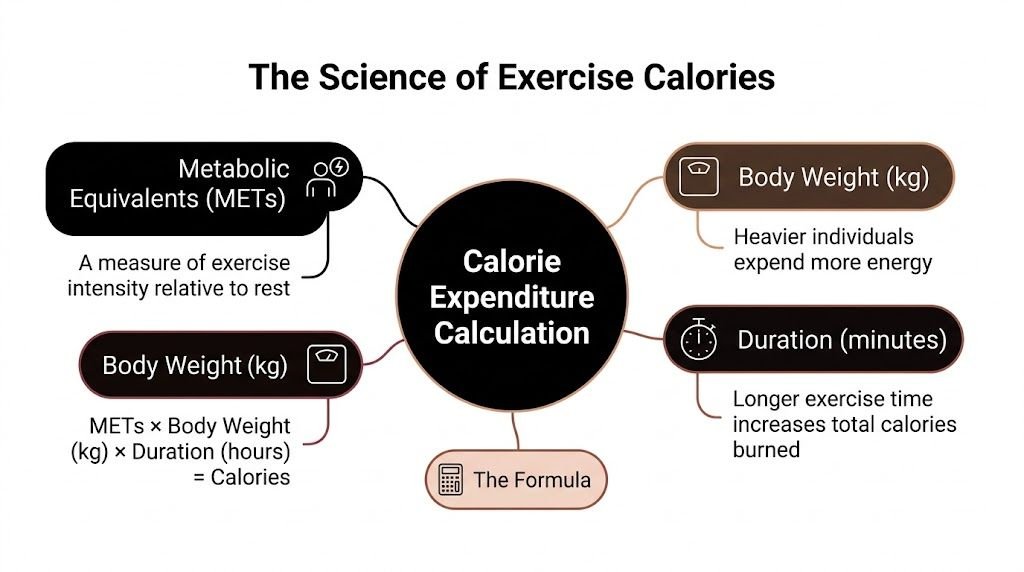
The key idea is MET, short for metabolic equivalent. A MET is a simple way exercise scientists rate how much energy an activity uses compared with resting. It works like a power setting. Resting is the baseline. Walking raises the setting a bit. Fast, full-body exercise raises it much more. Crunches usually stay on the lower end because the movement is short and the amount of muscle involved is limited.
The formula in plain English
Exercise calorie estimates often start with this formula:
Calories per minute = (MET × 3.5 × body weight in kg) / 200
At first glance, it looks like textbook material. It is just a recipe.
- MET is the intensity rating
- 3.5 is a standard physiology value used in exercise calculations
- Body weight in kg matters because moving more mass usually costs more energy
- 200 converts the result into calories burned per minute
You do not need to calculate this by hand every workout. What matters is the logic behind it. Calories rise when intensity goes up, when time adds up, and when more of your body has to contribute. Crunches check some of those boxes, but not as strongly as exercises that keep larger muscle groups working continuously.
Why this matters for fat loss
Expectations regarding calorie expenditure often miss the mark. A strong burn in your abs does not automatically mean a large energy cost overall. Local fatigue and total calorie burn are related, but they are not the same thing.
That distinction matters if your goal is fat loss. Crunches can support your training, but body-fat change still depends heavily on your total daily activity and an overall calorie deficit. If you want a plain-English breakdown of that energy balance, this guide to how a calorie deficit works for weight loss can help.
What to do with these numbers
MET-based calorie estimates are useful for setting expectations and comparing activities. They give you a reasonable range, not a guarantee for your exact body on your exact day.
That mindset helps in two ways. First, it keeps you from giving crunches a job they are not built for. Second, it lets you use them for what they do well, which is strengthening your trunk, improving control, and supporting bigger movements that tend to burn more energy overall.
Crunch Calorie Burn By The Numbers
Here is the part that surprises many beginners. Crunches usually burn fewer calories than the burn in your abs makes you expect.
The reason is simple. Crunches work a small area for a short range of motion, so the total energy cost stays modest even when the set feels tough. MET estimates, which are the standard way to estimate exercise calories, reflect total-body energy use, not just how hard one muscle group feels like it is working.
For a practical benchmark, a 155-pound person doing moderate crunches burns about 4.9 calories per minute, and 100 crunches comes out to about 16.6 calories at a pace of roughly 30 crunches per minute, as noted earlier.
Estimated Calories Burned Performing Crunches
| Body Weight | 5 Minutes | 10 Minutes | 15 Minutes | 30 Minutes |
|---|---|---|---|---|
| 125 lb | 22.5 | 45 | 67.5 | 135 |
| 155 lb | 24.5 | 49 | 73.5 | 147 |
| 185 lb | 33 | 66 | 99 | 198 |
Use the table as a range, not a promise.
A few useful patterns stand out:
- Body weight changes the estimate. A heavier person usually burns more calories doing the same amount of work.
- Minutes are easier to track than reps. Time gives you a cleaner estimate because rep speed and rest breaks can vary a lot.
- Crunches add calories slowly. They can support a workout, but they are not built to carry the calorie-burning load by themselves.
A helpful comparison is a car engine at idle versus on the highway. Your abs may feel like they are working hard during crunches, but your whole body is not demanding fuel the way it does during bigger, continuous movements.
What about 100 crunches
This number sounds bigger than it is. One hundred crunches can feel challenging, especially if your core is new to training, but the calorie total is still modest.
That is why crunches make more sense as a core-strengthening tool than a primary fat-loss strategy. Use them to build trunk control, improve exercise technique, and support larger movements in your training plan.
Why Your Actual Calorie Burn Might Vary
Standard calorie estimates are useful, but your body isn't a spreadsheet.
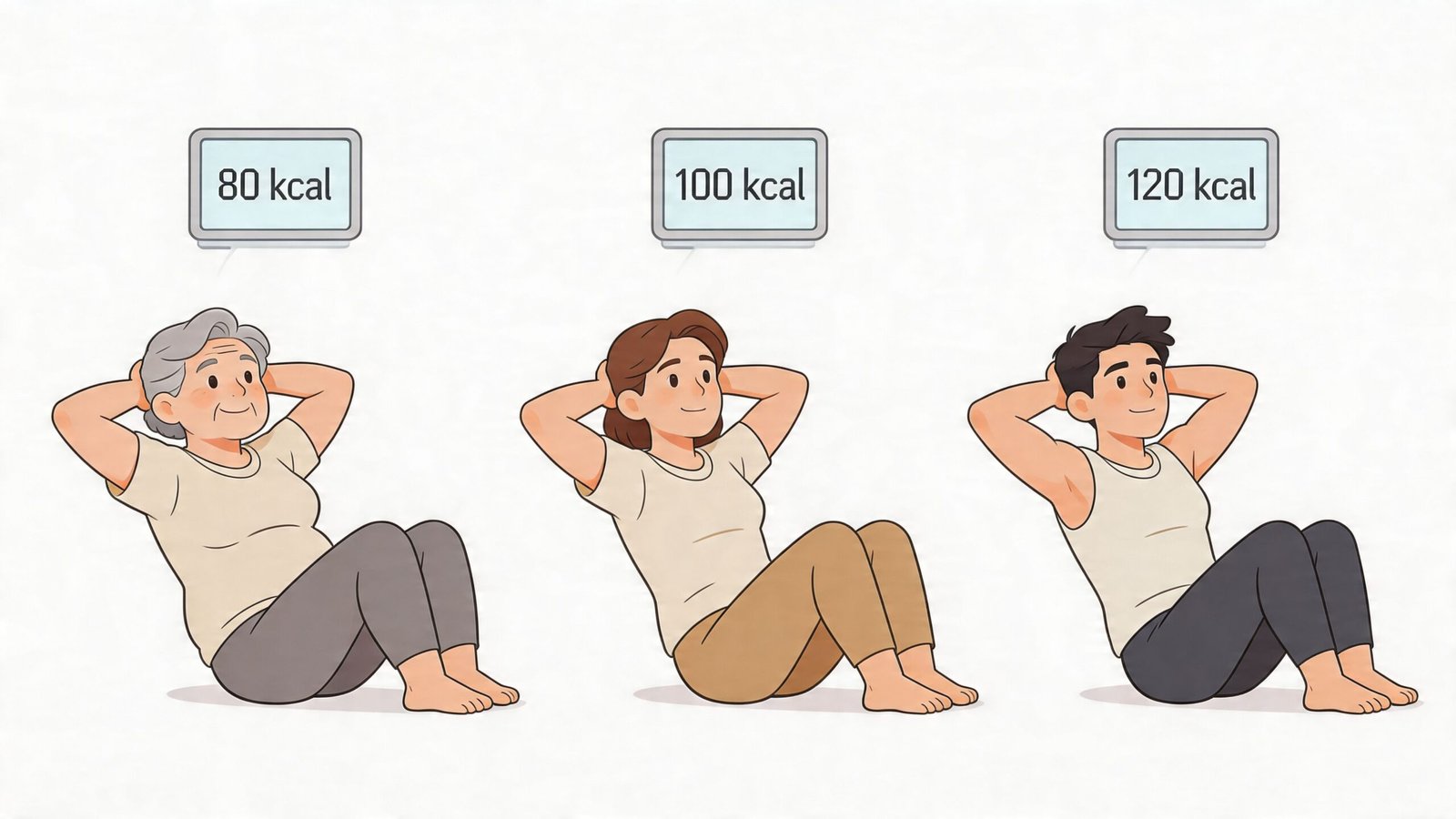
Two people can do the same number of crunches and get different results. One person moves with a full range of motion and controlled tempo. The other rushes, shortens each rep, and rests longer between sets. On paper the workout looks similar. In practice it isn't.
What changes the number
- Intensity: Faster, more forceful crunches usually raise energy use.
- Form quality: Better control can increase muscular involvement, especially when you avoid momentum.
- Rest periods: Long breaks lower the session's total calorie cost.
- Fitness level: A more efficient exerciser may use less energy for the same task.
- Body size and mechanics: Longer limbs, torso position, and movement style all change the effort.
A visual demo can help you spot those differences in pacing and control.
Why trackers don't always match
Your watch, your treadmill, and an online calculator all estimate differently. They use formulas and assumptions, not direct measurement of every bit of energy your body uses in real time.
That's why it's smarter to use calorie estimates as a range and judge progress by the bigger picture: consistency, strength gains, body composition changes, and how your routine feels over time.
How Crunches Compare To Other Core Work
A lot of people expect ab exercises to burn calories like cardio. That is usually the wrong comparison.
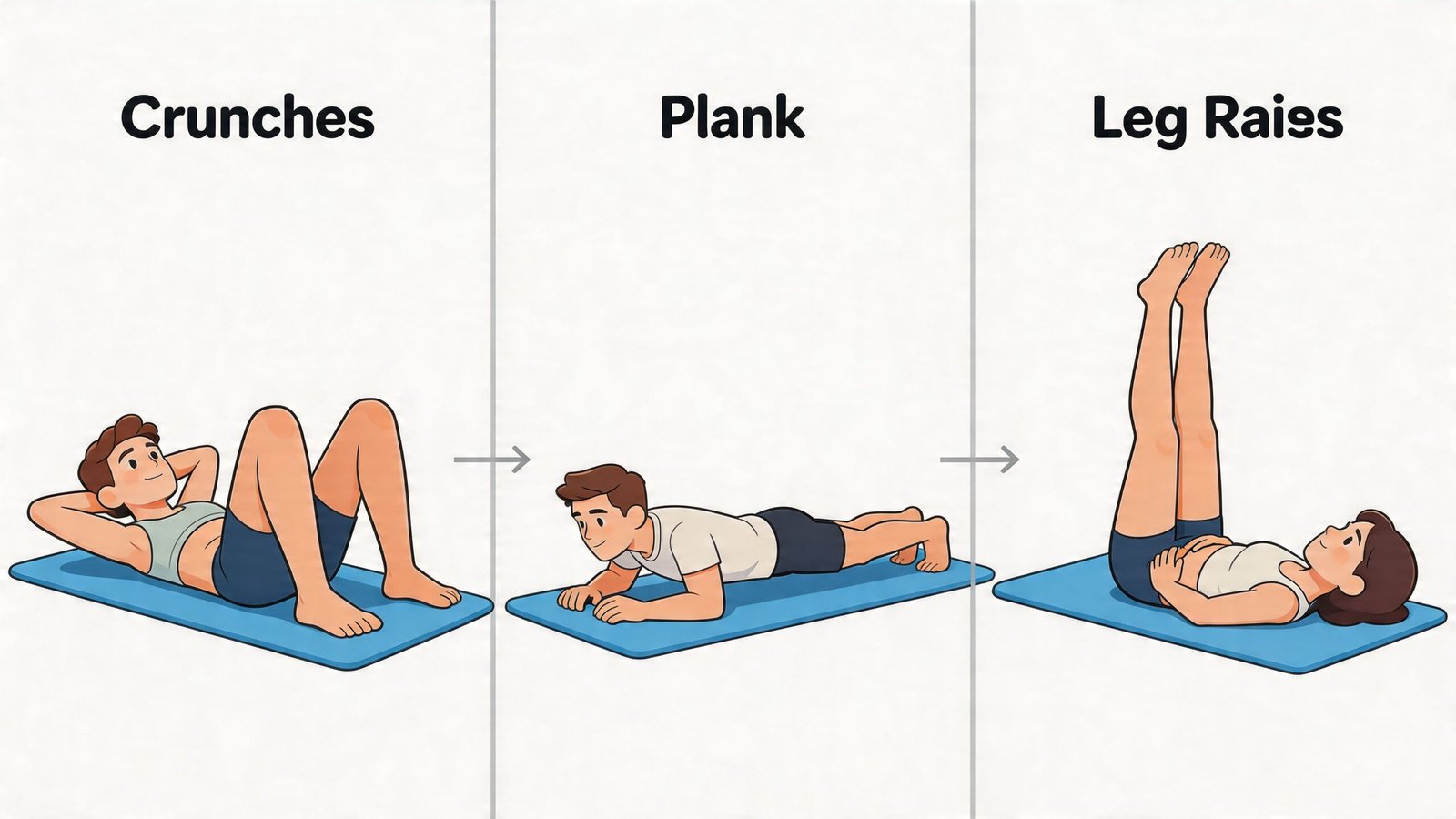
Crunches, planks, and leg raises all train your midsection, but they do different jobs. The better question is not "Which one burns the most calories?" The better question is "Which one gives my core the kind of strength and control I need?"
A simple way to see it is to compare a flashlight, a wrench, and a screwdriver. All three belong in a toolbox, but each solves a different problem. Core exercises work the same way.
A simple comparison
| Exercise | Main focus | Best for | Beginner friendly |
|---|---|---|---|
| Crunches | Trunk flexion | Upper ab emphasis and core endurance | Yes |
| Planks | Anti-extension stability | Bracing and posture control | Yes |
| Leg raises | Lower trunk control and hip flexor involvement | Moderate challenge for the front side of the core | Moderate |
| Bicycle crunches | Rotation plus flexion | Dynamic core work with more total movement | Moderate |
| Russian twists | Rotation | Oblique-focused training | Moderate |
As noted earlier, calorie differences between ab exercises are usually small. That makes sense once you understand METs. These movements use a limited amount of muscle mass compared with full-body exercises, so the energy cost stays modest even when your abs feel like they are working hard.
That last part trips people up. A strong muscle burn does not always mean high calorie burn. Your abs can feel smoked after a set of crunches because the local muscles are fatiguing, not because your whole body is using energy at the rate it would during rowing, brisk uphill walking, or burpees.
What each exercise gives you
Crunches are useful when you want to train spinal flexion in a simple, easy-to-learn pattern. They help many beginners feel their abs working without a lot of coordination demands.
Planks train your ability to resist movement. That matters for lifting, carrying, posture, and keeping your trunk stable while your arms and legs move.
Leg raises and bicycle crunches add more challenge through longer levers or rotation. Russian twists shift more of the focus toward rotational control and the obliques.
If your goal is a balanced core routine, variety usually beats doing one movement over and over.
How to choose based on your goal
Use crunches if your goal is:
- learning basic abdominal control
- adding direct ab work after bigger lifts
- building core endurance with simple technique
Use planks if your goal is:
- better bracing for squats, presses, and carries
- improving trunk stiffness and posture
- training stability with less spinal movement
Use leg raises, bicycle crunches, or twists if your goal is:
- challenging coordination
- adding rotation or lower trunk control
- making your core sessions more varied and engaging
If body composition is the bigger target, keep crunches in their proper place. They can strengthen your core, but they are not the engine of your calorie burn. For that, a broader plan with resistance training, daily movement, and nutrition works better. This guide on burning fat while building muscle explains how those pieces fit together.
If you track workouts with a watch, use the estimate as a rough reference, not a verdict on whether your session counted. A best health tracking smartwatch can help you log consistency, heart rate trends, and workout time, but it still cannot perfectly capture the value of focused core training.
A key benefit of crunches is a stronger, more capable midsection. That is a better reason to keep them in your program than chasing a calorie number they were never built to deliver.
Making Every Crunch More Effective and Easy to Track
More reps isn't always better. Better reps are better.
A lot of people crank through crunches with their neck, yank themselves upward, and count every tiny bounce as a rep. That pads the number, but it doesn't improve the quality of the work. If you want crunches to earn their place in your program, treat them like strength training, not a punishment.
Form cues that improve the exercise
Try these coaching cues:
- Keep your ribs down: Don't fling your chest upward. Think about curling your upper back off the floor.
- Exhale as you lift: That helps you brace and feel your abs working.
- Move slowly: Momentum steals work from the target muscles.
- Support your head lightly: Your hands are there to guide, not to pull.
- Stop before form breaks: Sloppy reps teach sloppy movement.
Ways to progress without mindless volume
You don't need endless crunches. You need a reason to make them harder.
- Slow the tempo. A slower lowering phase makes a basic crunch more demanding.
- Pause at the top. Hold the peak contraction briefly and remove the bounce.
- Add resistance. Weighted crunches can make fewer reps more productive.
- Change the angle. Decline variations can raise the challenge if your back tolerates them well.
Coach's note: If you can't feel your abs, don't add reps first. Clean up the movement first.
Track the habit, not just the burn
People often lose momentum at this point. They can tell you how many crunches they did, but not how that workout fits into the rest of their week.
A simple system helps. Log the workout, note the reps or time, and match that with your food intake so you can see your overall pattern. If you're using wearables, it can also help to compare them against guidance on choosing the best health tracking smartwatch so you know what your device is good at tracking and what it only estimates.
For the nutrition side, learning how to count calories can make your exercise efforts easier to place in context. Crunches don't have to burn a huge amount to be worth doing. They just need to fit your goal.
Frequently Asked Questions About Crunches and Calories
Can crunches burn belly fat
Crunches train the muscles on the front of your torso. They do not choose where your body loses fat.
That mismatch is why crunches frustrate so many beginners. You can get better at the exercise, feel your abs working, and still not see a flatter stomach right away. Fat loss depends on your overall calorie balance across the day and week, while crunches mainly improve local muscle strength and endurance.
A simple way to view it is this: crunches build the engine in one area, but body fat changes according to the fuel equation for your whole body.
How many crunches do I need to do to burn 100 calories
Usually, more than people expect.
As noted earlier, crunches have a modest MET value compared with bigger, full-body movements. That means each rep costs only a small amount of energy. Reaching 100 calories can take a very high number of reps, enough time for fatigue to set in, and form that often gets worse before the calorie total gets very impressive.
For many people, that is the key mindset shift. If your goal is fat loss, trying to "earn" 100 calories through crunches alone is usually not the most efficient plan. If your goal is a stronger core, a shorter, well-controlled ab session makes much more sense.
Is it better to do crunches fast or slow for calorie burn
A faster pace can raise effort a little, but speed also makes it easier to swing, bounce, and let your hip flexors take over.
A slower pace usually works better for learning control. You feel the abs do the job, you spend more time under tension, and you make each rep count. It works like using strict form in a biceps curl instead of tossing the weight around. The second option may look busier, but the first one trains the target muscle better.
If you care more about calorie burn than ab strength, your best move is often to keep crunches controlled and get most of your calorie expenditure from walking, cycling, rowing, or strength circuits.
Are crunches worth doing if they don't burn much
Yes, for the right reason.
Crunches are useful when you treat them as a core exercise, not as your main calorie-burning tool. They can help you learn spinal flexion, build awareness in the abdominals, and support a balanced program that also includes larger movements for total-body fitness.
That is the ultimate benefit. Crunches may burn a modest number of calories, but they can still help you get stronger, move better, and stay consistent with your plan.
Conclusion The True Value of Crunches
Crunches aren't fake. They're just misunderstood.
If you came here asking how many calories burned doing crunches, the practical answer is that the number is modest. Depending on body weight, pace, and time, crunches contribute to energy use, but they usually won't be the main driver of fat loss.
Their real value is different. Crunches help build a stronger, more capable core. They can improve control, support other exercises, and give your training plan a focused ab movement that beginners can learn quickly.
Use crunches for what they're good at. Build strength with them. Count any calorie burn as a bonus. That's the mindset that keeps your plan realistic and effective.
If you want an easier way to connect workouts with your daily nutrition, PlateBird makes calorie and macro tracking feel simple. You can type what you ate like a quick note or snap a photo of your meal, and the app calculates the details fast. That makes it easier to see how your food choices and workouts work together toward your goal.