- The Truth About Keeping a Food Diary for Weight Loss
- Setting Your Goals and Choosing Your Logging Method
- Mastering the Daily Log What to Track and How
- Turning Your Food Log into Actionable Insights
- How to Stay Consistent When Life Gets Busy
- Your Path Forward Your First Week of Mindful Eating
- Frequently Asked Questions About Food Diaries
You start a food diary on a Monday. Breakfast goes in neatly. Lunch too. By Wednesday, you're guessing portions, forgetting snacks, and wondering whether a splash of creamer is worth logging. By the weekend, the notebook is in a drawer or the app has one more abandoned streak.
That pattern is common. It doesn't mean you're lazy, and it doesn't mean a food diary for weight loss doesn't work. It usually means you were taught a version of tracking that's too slow, too rigid, and too easy to quit.
The people who succeed with food logging rarely do it like a lab experiment. They do it in a way that fits real life. They capture enough detail to stay honest, enough context to notice patterns, and enough consistency to keep going when work, kids, travel, or stress throw off the day.
The Truth About Keeping a Food Diary for Weight Loss
Many individuals don't quit food logging because it "doesn't work." They quit because the process becomes exhausting.
If you've ever tried to weigh every ingredient, search a giant food database for every meal, and remember every bite from your day, you already know the problem. The old model treats tracking like bookkeeping. Real eating doesn't happen that way.

Why this habit works when people stick with it
A food diary changes behavior because it interrupts autopilot. You stop eating on reflex and start noticing what happened.
That might sound simple, but simple is often what works. A 2008 Kaiser Permanente study found that people who kept a daily food diary lost twice as much weight as those who kept no records, and 69% of consistent trackers lost enough weight to significantly lower health risks, according to the Kaiser Permanente summary of the study.
That's not magic. That's awareness.
The diary isn't the problem
I've seen the same mistake over and over. People think they failed at tracking, when really they failed at using an unrealistic system.
A useful food diary for weight loss does three things:
- Creates accountability: You make fewer "I barely ate anything today" mistakes when the day is written down.
- Builds mindfulness: You notice habits like late-night grazing, skipped lunches, or stress snacking.
- Shows patterns: Weight loss gets easier when you can see what keeps repeating.
Practical rule: A food diary should help you notice your habits, not punish you for having them.
What doesn't work
Some methods almost guarantee dropout:
- Perfection-first tracking: If every meal has to be exact, logging becomes delayed, then avoided.
- All-or-nothing thinking: One missed meal becomes a missed day. One missed day becomes "I'll restart next week."
- Using the diary as self-criticism: Shame makes people hide from the log instead of learning from it.
The strongest shift you can make is this. Stop thinking of your diary as a compliance test. Start treating it like a mirror.
A good mirror doesn't insult you. It shows you what's there.
Setting Your Goals and Choosing Your Logging Method
A food diary works better when you know what you're trying to learn from it. "Lose weight" is too vague to guide daily decisions. You need a target that tells you what to log and what to look for.
Start with a goal you can actually use
The best goals are concrete enough to shape behavior. Instead of "eat better," pick something you can review at the end of a week.
Examples that work well:
- Weight-focused: Lose weight steadily while keeping meals structured and repeatable.
- Behavior-focused: Log meals consistently and reduce unplanned evening eating.
- Nutrition-focused: Hit a protein target more often and stop skipping breakfast.
If you're new to this, behavior goals usually beat outcome goals. You control whether you log lunch. You don't control what the scale does on any single morning.
Aim for a goal that guides today's meal choices, not one that only judges you weeks later.
Pick the method with the least friction
People spend too much time asking which tool is most accurate. The more useful question is which tool you'll still use on a busy Thursday.
Research summarized by the Ardmore Institute of Health notes that logging frequency matters more than precision, and that quick, consistent logging beats infrequent, detailed tracking. Their guidance emphasizes habit over perfection in food journaling for weight management in this daily food diary overview.
That changes how you should choose your method.
Your main options
Notebook
A paper diary is simple and distraction-free. It works well for people who like handwriting and don't want to open their phone at meals.
The downside is speed after the meal. Paper doesn't calculate anything, search common foods, or make repeats easy. If you eat similar breakfasts and lunches often, a notebook can feel repetitive fast.
Spreadsheet
A spreadsheet gives you structure. You can sort meals, review patterns, and customize columns for time, hunger, mood, and protein.
It works best for analytical people. It works poorly for anyone who already feels overloaded by admin tasks.
Mobile app
An app removes memory from the equation. You can log right after eating, repeat saved meals, and review the week without flipping pages.
That matters because friction kills adherence. If you want examples of how newer tools reduce that friction, this roundup on a photo food diary app shows where tracking is heading.
A quick decision filter
If you're not sure what to choose, use this:
- Choose paper if writing helps you slow down and notice what you're eating.
- Choose a spreadsheet if you like reviewing patterns and customizing categories.
- Choose an app if convenience will decide whether you log at all.
What to avoid on day one
Don't build a system so detailed that you need motivation just to open it.
Skip these early mistakes:
- Too many metrics: If you track calories, macros, fiber, water, mood, hunger, steps, and meal timing from day one, you'll burn out.
- A method that clashes with your schedule: A long manual process won't survive commuting, parenting, or shift work.
- The wrong identity: If you hate precision, don't force yourself into a precision-heavy system.
The best logging method is the one that feels boring in the best way. Quick. repeatable. easy to return to after a messy day.
Mastering the Daily Log What to Track and How
A useful log is detailed enough to reveal patterns, but simple enough that you can keep doing it. That's the balance.
You don't need a kitchen scale at every meal. You need a repeatable way to capture what happened while it's still fresh. If you're always "going to fill it in later," your diary turns into fiction.
The five things worth tracking
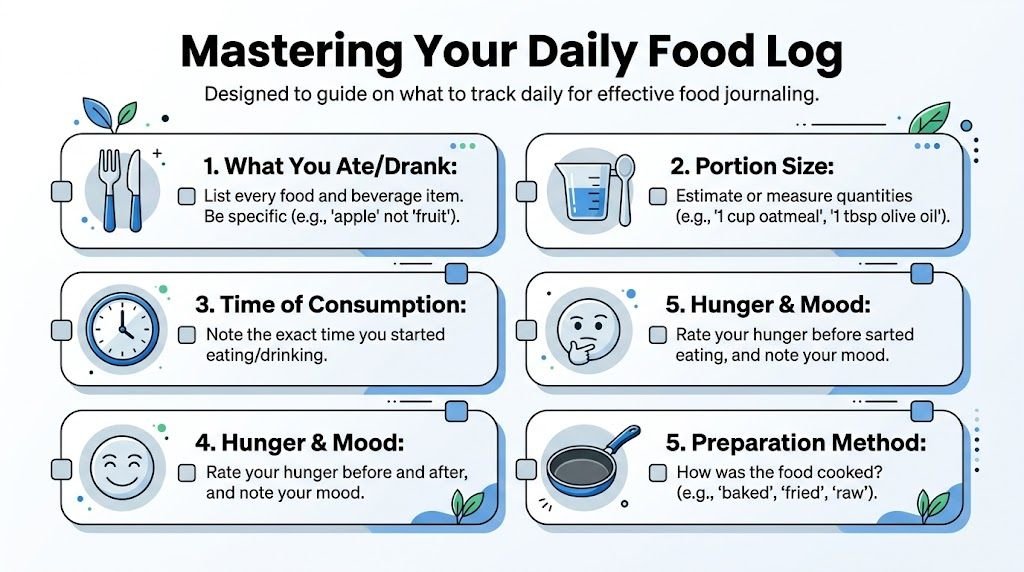
Start with these core entries.
What you ate and drank
Be specific enough that future you knows what happened. "Salad" is vague. "Chicken salad with ranch and croutons" is useful.Portion
Use estimates if needed. Cup, handful, palm, bowl, piece, spoonful. Precision can improve later. Honesty matters first.Time
Write when you started eating. That helps uncover long gaps, late-night patterns, or constant grazing.Context and mood
The diary offers more than calorie tracking. Michigan State University guidance highlights that logging the emotional and situational context of eating helps people understand why they eat, not just what they eat, in this article on using a food journal for weight loss success.A short note
Keep it brief. "Ate at desk." "Very hungry." "Picked at kids' leftovers." "Restaurant meal." "Felt stressed."
Good, better, best logging
Not every day needs the same level of detail.
| Sample Daily Food Diary Entry | ||||
|---|---|---|---|---|
| Time | Food & Drink | Portion | Context/Mood | Notes |
| 7:30 AM | Eggs, toast, coffee | 2 eggs, 2 slices toast, coffee with milk | Calm, moderately hungry | Ate at home before work |
| 12:45 PM | Chicken rice bowl, sparkling water | 1 bowl | Busy, very hungry | Ate quickly at desk |
| 3:30 PM | Granola bar | 1 bar | Stressed, not very hungry | Grabbed during meeting break |
| 7:00 PM | Salmon, potatoes, broccoli | 1 fillet, 1 potato, 1 cup broccoli | Relaxed, hungry | Family dinner |
| 9:15 PM | Ice cream | 1 bowl | Tired, wanted a treat | Watching TV |
Here's how to think about entry quality:
- Good: You logged the meal and portion roughly.
- Better: You logged the meal, portion, and time.
- Best: You logged the meal, portion, time, and the reason the meal unfolded the way it did.
Best isn't required every time. But context is often what explains the calories.
How to estimate portions without turning into a mathematician
Beginners often stall here. They think if they can't measure perfectly, they can't log usefully.
That's false.
Use practical estimates:
- A palm-sized piece for protein such as chicken or fish
- A fist-sized serving for rice, pasta, potatoes, or fruit
- A thumb-sized amount for oils, butter, dressings, or nut butter
- A handful for nuts, cereal, or snack foods
These estimates are enough to build awareness. If you cook often and want tighter calorie estimates for mixed dishes, this guide on how to calculate calories in homemade food can help you tighten things up without making every meal a project.
A rough log written today beats a perfect log you never get around to entering.
Timing changes what you learn
People often record only the food. They miss the sequence.
Meal timing can reveal problems like:
- Skipping breakfast and overeating later
- Long afternoon gaps that lead to snack attacks
- Cluster eating at night after under-eating earlier
- Weekend drift where structure disappears
When clients start writing the time down, they often notice the day wasn't "bad." It was unstructured. That's fixable.
Add one behavior marker
If you want your food diary for weight loss to become more insightful without becoming overwhelming, add one simple rating before each meal:
- hunger low, medium, or high
- mood calm, bored, stressed, tired, or social
That one line can explain a lot. You may notice you don't overeat because you're hungry. You overeat because you're depleted, distracted, or using food to change your state.
The daily rhythm that works
This pattern usually sticks:
- Log right after eating
- Use short entries
- Review once that night for missing items
- Correct only what's worth correcting
Don't spend ten minutes polishing breakfast. Keep moving.
The diary is supposed to support your life. It shouldn't become another thing you need recovery time from.
Turning Your Food Log into Actionable Insights
A food log only changes your body when it changes your decisions. That happens during review, not during data entry.
It's common to glance at calories and stop there. That's a missed opportunity. The better question is, "What keeps happening?"
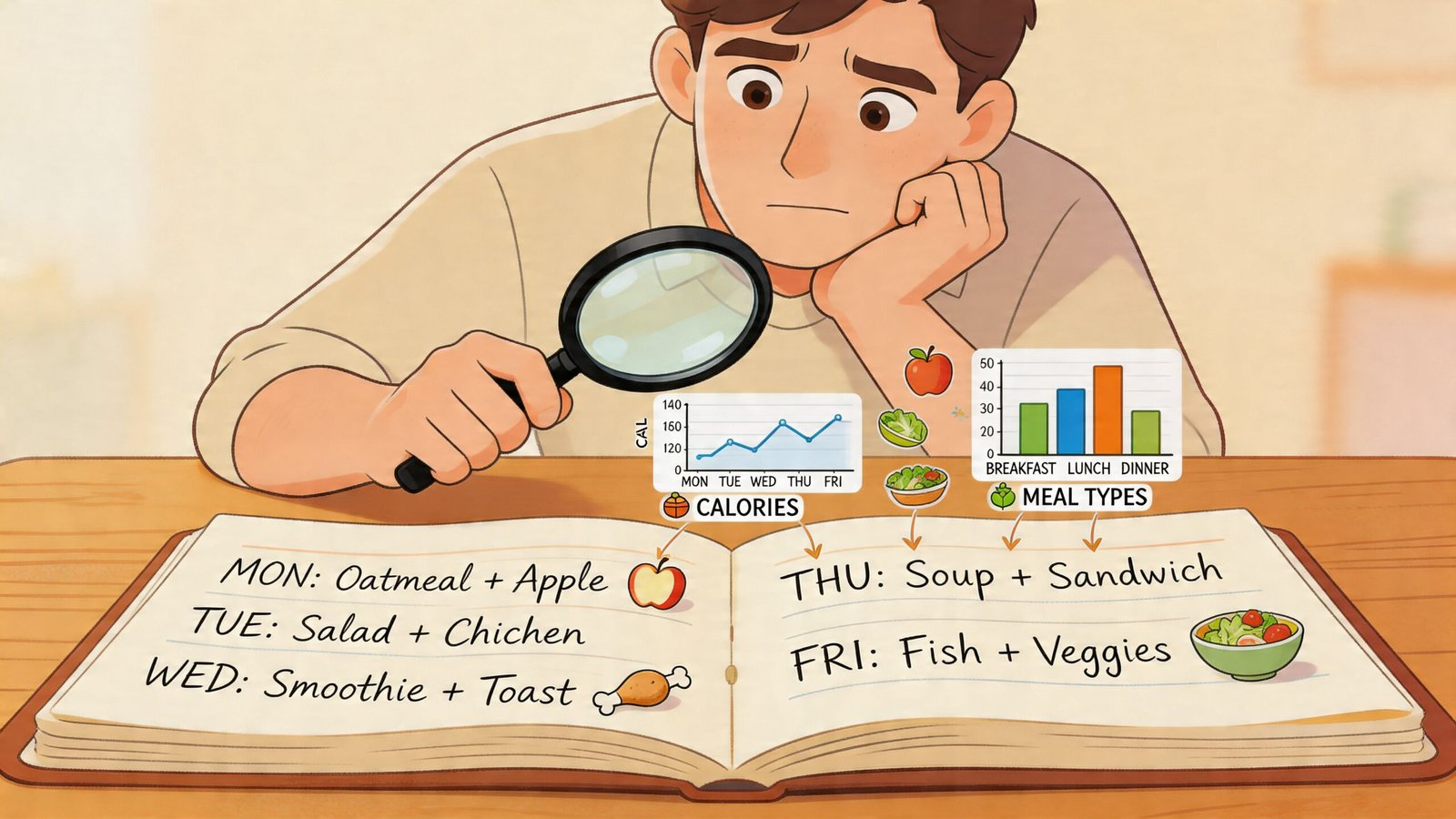
Look for patterns, not perfect days
A 2023 University of Connecticut study found that tracking on 30% of days correlated with over 3% body weight loss, while tracking on about 70% of days was linked with 10% loss, according to the University of Connecticut report on diet tracking thresholds.
That matters for review. You're not looking for an immaculate week. You're looking for enough evidence to spot the recurring issues.
Here are the patterns I tell people to hunt first:
- Meals skipped earlier, overeating later
- Low-protein meals that lead to constant snacking
- Weekend choices that don't match weekday structure
- Stress-driven eating at a predictable time
- Restaurant meals that subtly push the day off course
A weekly review that takes minutes
Set aside one short block each week. Don't do it emotionally. Do it like a coach.
Ask:
- Where did I get overly hungry?
- Which meals kept me full and steady?
- When did I eat without physical hunger?
- What situations made logging harder?
- Which one change would make next week easier?
You don't need a full diet overhaul. You need one useful adjustment.
If your diary only tells you what you ate, it's a record. If it tells you why the day went that way, it's a tool.
Connect food to the rest of the plan
Weight loss gets simpler when your diary is tied to your broader routine. If your entries show low energy, erratic hunger, and cravings after hard training days, your exercise structure may need attention too.
If that's your issue, this guide on balancing cardio and strength training for fat loss is worth reading alongside your meal review. Training and eating don't operate separately in real life.
When people also need a clearer understanding of energy balance, a plain-English explanation of what is calorie deficit helps connect the diary to the larger goal without making the process overly technical.
Turn patterns into decisions
The weekly review should end with one or two direct actions.
Examples:
- Add a real lunch because afternoon snacking keeps following a skimpy meal.
- Pre-plan one evening snack because "winging it" turns into multiple extras.
- Increase protein at breakfast because you get hungry too fast.
- Keep a simple restaurant default for workdays.
- Log immediately after dinner because late entries get forgotten.
A diary becomes powerful when it closes the loop. You log, review, adjust, repeat.
That's how awareness turns into weight loss. Not by tracking more data, but by making better decisions from the data you already have.
A short walkthrough can help if you learn better visually:
How to Stay Consistent When Life Gets Busy
Busy people don't fail because they care less. They fail because the tracking method asks too much at the exact moment life gets crowded.
That's why consistency isn't a motivation problem as often as it's a friction problem.

Stop aiming for seven perfect days
A 12-month study found that people who logged food 5 or more days per week lost an additional 7 pounds compared with inconsistent trackers, according to the PMC summary of the adherence study.
That should change your target. You don't need a flawless month. You need a repeatable week.
For busy adults, five solid days is often a smarter benchmark than trying to white-knuckle every single day.
The common reasons people quit
Perfectionism
This sounds disciplined, but it usually backfires. If you can't estimate the restaurant meal correctly, you postpone logging it. Then the day feels "ruined," so you stop.
Better move: log the best estimate and move on.
Time pressure
Traditional logging gets slow fast. Searching databases, entering ingredients one by one, and fixing brand mismatches can make one meal feel like admin work.
Busy people need less drag between eating and recording.
Forgetting
Most missed logs aren't rebellion. They're memory failures. If you're trying to reconstruct dinner at 10 PM, you'll miss details and eventually stop trusting your own entries.
Discouragement after a rough day
One overeating episode often triggers a second mistake. Not the eating itself, but refusing to log it.
That's where many diaries die.
The day you most want to avoid the diary is usually the day the diary would help you most.
What works in real life
The stronger habit is built around recovery, not streaks.
Use these rules:
- Log the next meal: If breakfast and lunch are missing, don't wait for tomorrow. Start with dinner.
- Use estimates fast: "Large burrito and chips" is enough for a hard day.
- Keep a fallback method: If detailed logging isn't happening, use a note in your phone.
- Review without drama: A rough day is information. It isn't a verdict.
Why modern tools matter
Old-school tracking asks for too many steps. Modern tools reduce the number of decisions between finishing a meal and recording it.
That's the core value of AI-driven logging. It lowers the effort needed to stay consistent. Instead of searching endlessly, people can type a plain description of the meal or use a photo-based workflow. That shift matters because habit strength often depends less on intention and more on whether the process feels easy enough to repeat tomorrow.
I'm skeptical of any tool that promises transformation while adding work. But I do believe in tools that remove friction. For food logging, speed matters. So does reuse. So does the ability to capture a meal before you forget it.
Build a system for chaotic days
Diaries are often set up for ideal days. That's a mistake. Build it for the days when meetings run long, your kid gets sick, the commute explodes, or dinner comes from a takeout bag.
A resilient system looks like this:
- Recurring meals saved mentally or digitally
- Fast entries instead of delayed perfect entries
- A visible reminder tied to meals
- A rule that missing one entry doesn't justify missing the next three
If you can keep tracking alive during imperfect weeks, the habit becomes durable. That's when a food diary for weight loss starts paying off.
Your Path Forward Your First Week of Mindful Eating
You don't need a stricter personality. You need a simpler process.
A good food diary for weight loss isn't built on obsession. It's built on awareness, repetition, and the willingness to be honest on ordinary days. The people who make progress aren't the ones who log with clinical precision forever. They're the ones who keep returning to the habit.
For your first week, keep the standard low enough that you'll do it.
A simple first-week challenge
Use this approach:
- Pick one method you won't dread opening.
- Log right after meals instead of trying to remember later.
- Track context at least once a day, especially when eating feels automatic.
- Review the week once and find one pattern, not ten.
- Change one thing for the next week.
That's enough.
Start with the next meal. Not next Monday, not after groceries, not when life calms down.
If your first week is messy, that's normal. Messy logs still teach you something. They show where the day gets away from you, where hunger spikes, and where your environment does the driving.
That information is useful. Use it.
The goal isn't to become the world's most disciplined tracker. The goal is to become someone who notices what they're doing early enough to change it.
Frequently Asked Questions About Food Diaries
Do I need to weigh every food?
No. Starting with simple estimates and consistent logging often yields better results. Weighing food can be helpful later if you want tighter portion awareness, but it shouldn't become the barrier that stops you from logging at all.
How do I log restaurant meals?
Write the best estimate you can. Include the main components, likely cooking method, and any obvious extras like sauces, drinks, chips, or dessert. Restaurant logging isn't about perfect math. It's about staying honest enough to see the pattern.
How long should I keep a food diary?
Long enough to learn your patterns and build steadier habits. Some people benefit from a focused period of regular logging, then shift to using it only during busy seasons, after travel, or when weight starts creeping up. The diary doesn't have to be permanent to be valuable.
What if I miss a few days?
Don't restart. Resume.
Missing days doesn't erase what you've learned. It only becomes a problem when a gap turns into abandonment. The fastest recovery is to log the next meal and continue as if that was always the plan.
Should I track mood and hunger too?
Yes, if you want deeper insight. Food alone tells you what happened. Mood and hunger help explain why it happened. Even a one-word note like "stressed" or "not hungry" can reveal habits you'd never catch from calories alone.
PlateBird makes food logging easier to stick with because it removes the tedious parts that make people quit. Instead of searching endlessly or entering every ingredient by hand, you can type what you ate or snap a photo and move on. If you want a faster, lower-friction way to build a food diary for weight loss, try PlateBird.