- The 1000-Calorie Dilemma Rapid Results Versus Real Risks
- Are You a Candidate for a 1000-Calorie Diet
- Crafting Your Nutrient-Dense 1000-Calorie Meal Plan
- Exercise on a Low-Calorie Plan Preserving Muscle and Energy
- Mastering Your Progress with PlateBird and Troubleshooting Plateaus
- The Exit Strategy Transitioning to a Sustainable Diet
Most advice about a 1000-calorie diet gets one thing wrong. It treats the plan like a menu problem.
It isn't. It's a risk-management problem.
Yes, you can lose weight on 1000 calories a day. But the right first question isn't “what should I eat?” It’s “should I be doing this at all, and if so, for how long?” A plan this aggressive can produce fast movement on the scale, but it also raises the odds of fatigue, muscle loss, nutrient gaps, and rebound eating if you treat it casually.
That’s why I don’t frame a 1000-calorie diet as a lifestyle. I frame it as a short-term intervention that needs clear entry rules, careful monitoring, and an exit strategy before you even begin.
The 1000-Calorie Dilemma Rapid Results Versus Real Risks
People search this topic because they want speed. That part is understandable. If progress has felt slow, a hard cut in calories can look like the cleanest way to force results.
The problem is that fast weight loss and sustainable weight loss are not the same thing.
In a randomized controlled trial, people assigned to a 1,000 kcal/day diet lost an average of 10.03 kg at 6 months, which was more than the 6.23 kg lost in the 1,500 kcal/day group. But the 1,000 kcal group also regained more weight in the following months, which captures the core trade-off of this approach: better short-term results, harder long-term maintenance (clinical trial details).
Bottom line: A 1000-calorie diet can work. It just doesn’t work casually.
A common failing of much online advice is its approach. It gives you low-calorie meal ideas without telling you whether your body, schedule, medical history, and stress level make this approach realistic. For some people, it’s an appropriate short-term strategy. For many others, it’s too aggressive and creates a cycle of strict dieting followed by overeating.
If you need a broader framework that includes medication, physician supervision, and alternatives to crash-style restriction, Pause Medical’s guide to comprehensive weight loss strategies is a useful starting point.
A second issue is that people often confuse “1000 calories” with “a calorie deficit.” Those are not interchangeable. A calorie target has to be judged against your maintenance needs, activity, body size, and medical context. If you need a simple primer on that foundation, review how a calorie deficit works in practice.
Why this approach feels harder than the math suggests
On paper, eating less should be simple. In real life, aggressive calorie restriction changes hunger, energy, training quality, food focus, and recovery.
That’s why the most responsible way to talk about how to lose weight on 1000 calories a day is not as a quick fix. It’s as a temporary, structured method with clear guardrails. If you skip the guardrails, the plan usually turns into a pendulum. Restrict hard, feel depleted, lose control, restart.
Are You a Candidate for a 1000-Calorie Diet
Before food choices, check whether this plan fits your situation at all.
Clinical guidance around very-low-calorie approaches is clear on the main point: diets around 1000 kcal/day are generally reserved for people with a BMI over 30 and ideally done under medical supervision, with use often limited to 4 to 12 weeks before shifting to a more moderate deficit (guideline summary).
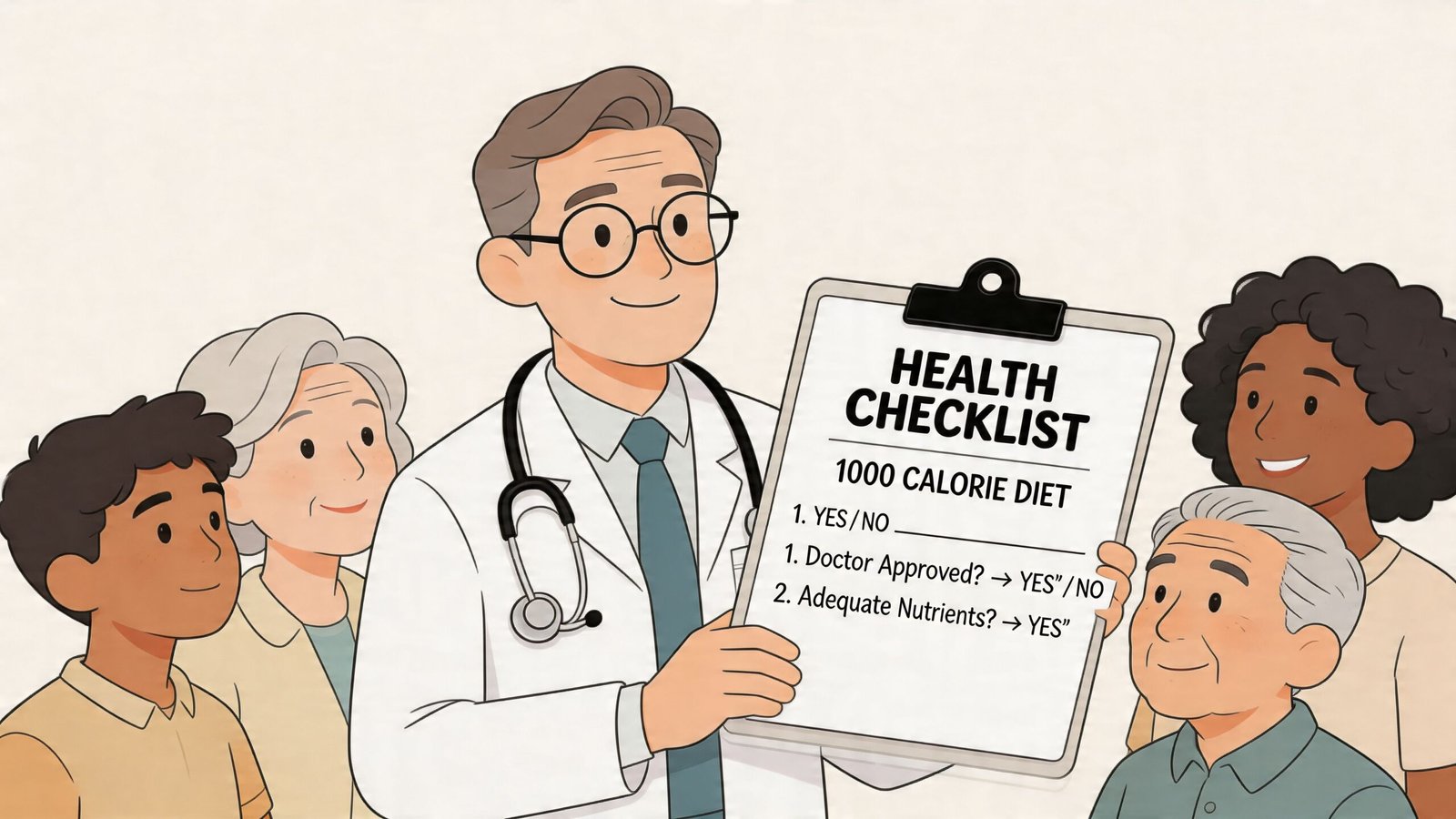
That means this is not the default option for someone who just wants to “clean things up” after a few indulgent weeks. It’s a more serious cut.
Start with your actual energy needs
You don't need a perfect lab measurement to understand whether 1000 calories is aggressive for you. You do need honesty.
Use this quick self-check:
Estimate your BMR
Your basal metabolic rate is the energy your body uses at rest.Estimate your TDEE
Your total daily energy expenditure includes basic body functions plus movement, exercise, and daily activity.Compare that number to 1000
If your maintenance intake is well above that level, a 1000-calorie plan is a very large deficit. The bigger the gap, the harder recovery, hunger management, and muscle retention usually become.
You don't need exact formulas memorized to understand the practical point. If you’re active, larger-bodied, strength training regularly, or chasing performance in the gym, 1000 calories is almost always more aggressive than people expect.
If you’re unsure whether the target is appropriate, that uncertainty is itself a reason to ask your physician or registered dietitian before starting.
Red flags that make self-directed restriction a bad idea
Some people should not attempt this without direct medical oversight. Not “be careful.” Not “monitor closely.” Actual supervision.
Watch for these red flags:
Diabetes or blood sugar medication use
Large calorie cuts can change food timing and symptom patterns fast.History of an eating disorder or disordered eating
A rigid target can trigger obsession, rebound eating, or binge-restrict cycles.Pregnancy, postpartum recovery, or breastfeeding
Nutrition demands shift. Severe restriction is not the place to experiment.Thyroid disease or other endocrine issues
You need a clinician involved before cutting this hard.High training volume
If you lift hard, do endurance work, or have a physically demanding job, your risk of low energy availability rises quickly.Regular dizziness, fatigue, or frequent headaches even before dieting
Starting from a depleted place tends to amplify problems, not solve them.Multiple medications or known nutrient deficiencies
Restriction narrows your margin for error.
Questions to answer honestly before you begin
A 1000-calorie diet fails most often because the person wasn’t ready for its demands.
Ask yourself:
| Question | Why it matters |
|---|---|
| Can you follow a structured eating pattern without getting obsessive? | Precision helps, but rigidity can backfire. |
| Can you prepare most of your meals? | Restaurant eating makes a tight calorie budget much harder to control. |
| Can you prioritize sleep? | Poor sleep drives hunger and weakens restraint. |
| Are you willing to stop if symptoms worsen? | Stubbornness is not a fat-loss skill. |
Who may be better served by a different approach
A moderate calorie deficit is often smarter if you:
- Need long-term adherence more than quick scale change
- Are already leaner and trying to get “extra shredded”
- Struggle with all-or-nothing thinking around food
- Have a job or family schedule that makes meal planning inconsistent
For these people, a 1000-calorie plan often creates more friction than progress. They don’t need a harder diet. They need a more repeatable one.
A practical candidate checklist
You may be a more reasonable candidate if all of the following are true:
- You have significant weight to lose
- Your clinician agrees the approach is appropriate
- You understand it’s temporary
- You can monitor protein, meal quality, and symptoms carefully
- You’re willing to transition out of it instead of staying there indefinitely
That last point matters. A 1000-calorie plan without a defined stopping point usually drifts into under-fueling, burnout, and rebound behavior.
Crafting Your Nutrient-Dense 1000-Calorie Meal Plan
A 1000-calorie diet only works on paper if every calorie pulls its weight.
That means the usual “just eat smaller portions” advice isn’t enough. On a budget this tight, food quality matters more because there’s less room for low-satiety extras, liquid calories, or random snacking. You need a plan built around protein, fiber, produce, and repeatable meals.
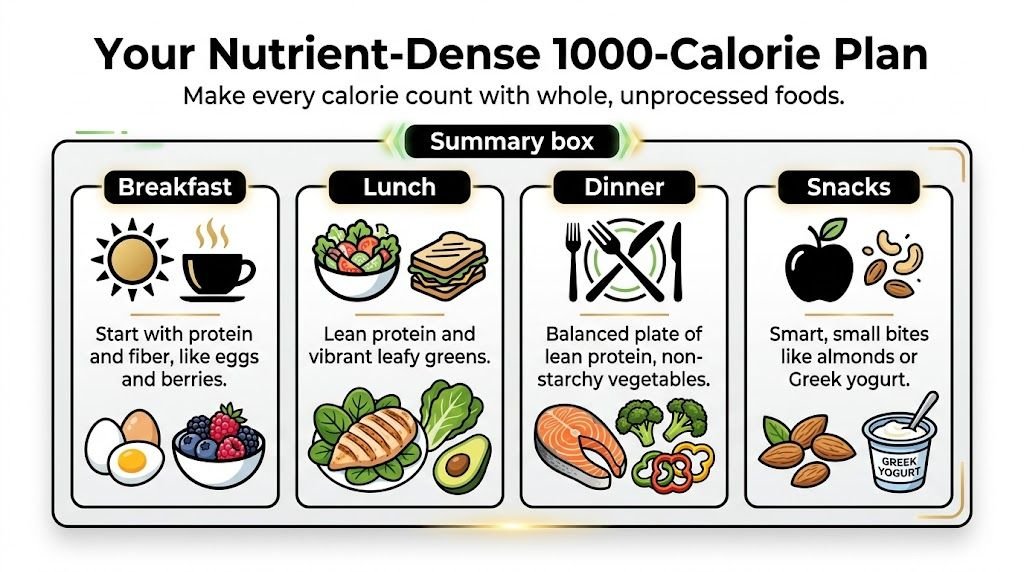
For muscle retention, protein is the top priority. Recent guidance highlighted in meal-planning coverage recommends aiming for 1.6 g of protein per kg of body weight. For a 70 kg person, that comes to 112 g of protein, or 448 calories, which makes protein the single most important macro to track on a 1000-calorie plan (protein planning reference).
Build the day around protein first
When calories are low, I don’t start with carbs or fats. I start with protein anchors.
That might look like:
- eggs or egg whites
- Greek yogurt or cottage cheese
- chicken breast or turkey
- tuna or salmon
- tofu, tempeh, or edamame
- protein powder when whole food alone won’t cover the target
A helpful rule is to decide your protein source first for each meal, then fill the rest with vegetables, fruit, legumes, or a modest starch depending on preference and training needs.
Practical rule: If a meal is low in protein, it probably won’t keep you full for long on 1000 calories.
Don’t waste calories on foods that disappear fast
A small handful of calorie-dense foods can consume a huge share of your budget without helping satiety much. That doesn’t make those foods “bad.” It just means they’re expensive in a plan this tight.
Use them carefully:
- Oils and dressings can turn a lean meal into a calorie-heavy one.
- Nut butters and nuts are nutritious, but portions get out of hand easily.
- Granola, smoothies, and specialty coffees often vanish before your appetite notices.
- Restaurant meals are hard to budget accurately when calories are limited.
For many people, the best 1000-calorie meal plan is boring in a good way. Repetitive enough to be manageable. Flexible enough to avoid rebellion.
A practical format is to build three meals plus one small snack, or two larger meals plus two protein-centered snacks, depending on hunger patterns.
For meal prep ideas that make high-protein eating easier during busy weeks, this guide to high-protein meal prep is useful.
A simple plate formula
You don’t need a perfect macro split to make this workable. You do need structure.
Use this basic formula for most meals:
Protein first
A lean protein source should be the center of the plate.High-volume vegetables next
Think broccoli, spinach, zucchini, cucumber, mushrooms, cauliflower, peppers, salad greens.Add a controlled carb or healthy fat if it improves adherence
Berries, beans, quinoa, oats, potato, avocado, or olive oil can fit. The point is measured amounts, not guessing.
Here’s a short visual break before the sample plan.
Sample 3-Day Nutrient-Dense 1000-Calorie Meal Plan
The examples below are templates, not medical prescriptions. Portions need adjusting based on your body size, protein target, and hunger tolerance.
| Meal | Day 1 Example | Day 2 Example | Day 3 Example |
|---|---|---|---|
| Breakfast | Greek yogurt bowl with berries and chia, plus egg whites | Cottage cheese with sliced cucumber and cherry tomatoes, plus a boiled egg | Protein shake with unsweetened milk alternative, berries, and a side of scrambled eggs |
| Lunch | Grilled chicken salad with mixed greens, tomatoes, cucumber, and measured olive oil vinaigrette | Tuna lettuce wraps with chopped vegetables and a side of edamame | Turkey and vegetable stir-fry over cauliflower rice |
| Dinner | Baked salmon with broccoli and roasted zucchini | Lean ground turkey bowl with sautéed peppers, mushrooms, and a small serving of quinoa | White fish or tofu with green beans and a baked potato portion sized to fit the day |
| Snack | Plain Greek yogurt or a small apple with a protein side | Cottage cheese or a measured serving of almonds | Edamame, yogurt, or a simple protein shake |
What works better than most “diet foods”
The foods that usually perform best on this kind of plan have three traits. They’re filling, easy to portion, and hard to overeat quickly.
Good staples include:
- Eggs and egg whites
- Plain Greek yogurt
- Chicken breast, turkey, tuna, white fish
- Tofu and edamame
- Leafy greens and cruciferous vegetables
- Berries
- Beans in measured portions
- Low-calorie soups built around lean protein and vegetables
Common planning mistakes
A lot of 1000-calorie diets fail because the menu looks “clean” but not functional.
Watch for these errors:
Too little protein
This makes hunger worse and raises the odds of losing lean mass.Too much reliance on salads without substance
Lettuce isn’t a meal. Build the salad around protein and volume.Drinking calories without noticing
Fancy coffee, juice, and even healthy smoothies can crowd out better food choices.Saving all calories for one meal
Some people do fine with this, but many end up ravenous and lose control at night.
A good 1000-calorie plan should feel structured, not punishing. If it leaves you thinking about food all day, the setup needs work.
Exercise on a Low-Calorie Plan Preserving Muscle and Energy
The biggest training mistake on a 1000-calorie diet is trying to outwork the restriction.
People slash calories, then pile on hard cardio because they want faster results. That usually backfires. Recovery drops, energy falls, workouts get worse, and the body has even less reason to hold onto muscle.

In clinical settings, a 1000 kcal/day diet is often paired with progressive resistance training 3 times per week to help protect lean mass. Without that support, people can lose up to 25% of total weight lost from muscle, which raises the risk of regain (clinical practice discussion).
Your goal is retention, not calorie burn
On low calories, exercise has a different job. Its main purpose is to tell your body, “Keep this tissue. It’s still needed.”
That’s why resistance training matters more than trying to torch extra calories on machines.
A better setup looks like this:
Lift weights or do resistance work
Focus on basic movement patterns like squats, hinges, pushes, pulls, and loaded carries.Keep the volume sensible
You want enough stimulus to maintain muscle, not so much that you dig a recovery hole.Use walking and easy movement for support
Gentle activity helps mood, routine, and appetite regulation without beating you up.
If you want extra reading on training choices that support body composition, OBF Gyms has a solid collection of strategies to lose fat without losing muscle.
What to avoid while calories are very low
In this context, restraint beats ambition.
Avoid turning this phase into a fitness challenge with endless add-ons:
| Better choice | Riskier choice on 1000 calories |
|---|---|
| Short resistance sessions | High-volume training blocks |
| Walking | Daily punishing cardio |
| Mobility work | Extra HIIT layered on fatigue |
| Recovery focus | Training through dizziness or poor sleep |
The body reads severe dieting plus high training stress as one big stress load. More effort isn't always the answer; better targeting often is.
For a practical overview of how training and nutrition can work together, this guide on burning fat and building muscle covers the bigger picture.
Train to preserve function. Don’t train to prove toughness.
Mastering Your Progress with PlateBird and Troubleshooting Plateaus
A stalled scale on a 1000-calorie diet doesn’t always mean your body “stopped responding.” Most of the time, something practical is going on.
A common pattern looks like this. Someone starts strong, eats very consistently for the first several days, then gets tired of measuring, starts eyeballing portions, grabs bites while cooking, loosens up on weekends, and still believes they’re eating the same amount. The plan feels identical. The intake usually isn’t.

That’s especially true for first-time trackers. Research summarized in beginner-focused coverage notes that people often underreport intake by 200 to 300 kcal, and those with baseline intakes over 2000 kcal/day may be more prone to regain. The practical fix is more precise logging with less friction, not more guilt (tracking challenge overview).
The hidden-calorie problem
On a tight calorie budget, little misses matter.
A splash of oil, a larger spoonful of peanut butter, finishing your child’s leftovers, a few handfuls of trail mix, two “healthy” coffees, and an uncounted sauce can erase the structure of the day fast. That doesn’t mean you failed. It means precision matters more when calories are low.
What often helps:
Log before you eat when possible
Pre-deciding reduces “I’ll remember later” errors.Keep repeat meals on rotation
Familiar meals are easier to portion and less mentally draining.Measure calorie-dense extras
Oils, nuts, cheese, dressings, and spreads deserve attention first.
When fatigue shows up
Fatigue on 1000 calories isn't surprising. But it still needs interpretation.
Use a quick troubleshooting lens:
If hunger is constant all day
Your meals may be too low in protein or too small in volume. Add more high-volume vegetables and make sure each meal has a real protein anchor.If workouts feel flat
The plan may be too aggressive for your activity level, or your meal timing around training may be poor.If you feel mentally drained and food-focused
That’s often a sign the plan is becoming too hard to sustain, not a sign that you need more discipline.If dizziness, weakness, or persistent headaches show up
Stop self-managing and talk with your clinician.
A true plateau is less common than a tracking problem, a stress problem, or a plan that’s too aggressive for the person following it.
What progress should actually look like
Progress on a strict diet is rarely linear. Water retention, digestion changes, restaurant meals, sleep disruption, menstrual cycle shifts, and sodium intake can all blur what the scale shows in the short term.
That means a useful check-in includes more than body weight:
| Sign to monitor | What it tells you |
|---|---|
| Hunger level | Whether the plan is structurally sustainable |
| Training performance | Whether muscle retention is being supported |
| Energy and mood | Whether the deficit is becoming disruptive |
| Meal consistency | Whether the issue is adherence rather than biology |
How to respond when the scale won’t move
If weight appears stuck, don’t cut calories lower first. Audit the basics.
Try this order:
- Tighten logging accuracy
- Review sauces, oils, drinks, and “tastes”
- Check whether protein has slipped
- Look at sleep and stress
- Consider whether you’ve stayed on the diet too long
That last point gets ignored. Some people don’t need a stricter plan. They need a planned transition.
The Exit Strategy Transitioning to a Sustainable Diet
A 1000-calorie diet should end on purpose, not by collapse.
The worst exit is emotional. You white-knuckle the plan until hunger, fatigue, boredom, or social pressure break it, then you swing back to “normal eating” with no structure. That’s the setup for rapid regain, because the body and the mind are both ready to overcorrect.
A better exit is gradual.
Why the transition matters
After a period of aggressive restriction, appetite often climbs before your judgment fully catches up. People interpret that as failure. It’s usually a predictable response to under-eating.
The answer is not to stay at 1000 calories longer than needed. The answer is to step intake back up in a controlled way.
A practical reverse-diet approach
Increase food slowly and keep the structure of the diet intact.
Use this framework:
Add 100 to 150 calories per week
Bring calories up gradually rather than jumping back to old habits.Keep protein high while calories rise
Protein remains the anchor during the transition.Add calories mostly from foods that improve adherence
A little more fruit, starch, legumes, dairy, or healthy fats usually works better than treating the increase like a cheat period.Watch hunger, training quality, and body weight trends together
One week of scale fluctuation doesn’t mean the transition is failing.Stop treating the end of the diet like a reward event
The first weeks after restriction need as much structure as the diet itself.
What to add first
The smartest calories to reintroduce are usually the ones that improve function and make the plan livable.
Good first additions include:
- A larger portion of potatoes, oats, rice, or beans
- An extra serving of fruit
- More dairy or another protein serving
- A measured amount of healthy fat if meals have felt unsatisfying
What usually works less well is jumping straight to highly palatable foods you were “waiting to have again.” That doesn’t make those foods forbidden. It just makes them poor first choices in a fragile transition phase.
The goal isn’t to stay in diet mode forever. The goal is to arrive at a level of eating you can repeat without constant friction.
Signs you’re transitioning well
You’re probably moving in the right direction if:
- Energy improves
- Training feels better
- Food preoccupation eases
- You can eat a bit more without immediately losing structure
- Your habits feel more normal, not more chaotic
The long-term target
A successful 1000-calorie phase is not defined only by how much weight you lose during it. It’s defined by whether you can keep enough of that progress without living like you’re still dieting hard.
That usually means ending at a more moderate intake, keeping your protein and meal structure strong, continuing resistance training, and letting consistency do the slower work.
If you want a calorie and macro tracker that makes this process less tedious, PlateBird is built for exactly that kind of real-life consistency. You can type simple meals like “eggs toast coffee” or snap a photo of your plate, log quickly, and keep your protein and calorie targets visible without turning food tracking into a second job.