- Is Tomato Juice a Low-Carb Choice?
- The Complete Carb Breakdown for Tomato Juice
- Quick Carb Reference for All Tomato Juice Types
- How Processing and Seasoning Change Carb Counts
- Comparing Carbs in Tomato Juice vs Other Drinks
- Using Tomato Juice on a Keto or Diabetic Diet
- How to Log Tomato Juice Instantly with PlateBird
- Frequently Asked Questions About Tomato Juice Carbs
An 8-ounce cup of canned tomato juice has 10.3 grams of total carbs and about 8 to 9 grams of net carbs, so yes, it’s a relatively low-carb beverage. If you’re standing in the kitchen with a glass in one hand and a food tracker in the other, tomato juice usually fits far more easily into your day than people expect.
That surprise happens a lot. People hear “juice” and assume it belongs in the same bucket as sweeter drinks that can eat up a carb budget fast. Tomato juice is different. It still has carbs, and those carbs still count, but the way tomatoes are processed, strained, seasoned, and blended changes the final number enough that label reading matters.
The bigger issue isn’t whether tomato juice has carbs. It does. Rather, the question is which kind you bought, how much you poured, and whether you’re tracking for general calorie awareness, a macro target, or a stricter plan like keto.
Is Tomato Juice a Low-Carb Choice?
A client grocery scenario comes up all the time. They pick up a can or bottle, see “100% juice,” and freeze for a second because they’re trying to lose weight, rein in sugar, or stay within a tighter carb ceiling. They want to know whether tomato juice is a smart choice or a sneaky one.
In practice, tomato juice usually lands on the smart side. The carb count is modest enough that many people can fit a serving into their day without trouble, especially compared with sweeter beverage options. For people who like savory drinks, that matters. You get flavor and convenience without taking a huge bite out of your carb budget.
What trips people up is context. If you’re building a day around lower-carb meals, tomato juice can fit. If you’re already spending carbs on bread, fruit, snacks, and a dessert later, it may feel less “cheap” from a macro standpoint.
Practical rule: Don’t judge tomato juice by the word “juice” alone. Judge it by the serving size and the ingredient list.
A second layer is appetite management. Tomato juice tends to feel more like food than a sweet drink. That can help some people stay on track between meals, especially if they want something savory instead of another coffee run or vending machine snack. If you’re tightening up your full snack routine, Skout Organic's snacking roadmap is a useful companion read because it frames how low-sugar, lower-carb choices work together across the day.
For shoppers who are still learning what counts as “low enough,” it helps to compare tomato juice with other foods low in carbs and sugar. Tomato juice won’t be the lowest-carb thing you consume, but it often sits in a very manageable middle ground.
What works in real life
- A measured serving works. Pour a standard cup, log it, and move on.
- Savory pairing works well. It fits better with eggs, cottage cheese, or a higher-protein breakfast than with a carb-heavy pastry.
- Mindless refills don’t work. One glass is one thing. Free-pouring from a big bottle can turn a modest carb choice into an unclear one fast.
The Complete Carb Breakdown for Tomato Juice
The cleanest reference point is a standard 8-ounce serving of canned tomato juice with salt added. That serving contains 10.3 grams of total carbohydrates, which is about 3.8 to 4% of the recommended daily intake on a 2,000-calorie diet, and it yields about 8 to 9 grams of net carbs after subtracting fiber according to the University of Rochester Medical Center tomato juice nutrition entry.
Those numbers matter because they give you a stable baseline. If you’re comparing brands, homemade blends, low-sodium versions, or vegetable cocktails, this is the benchmark to keep in your head.
What the carb number is made of
That same baseline serving includes fiber, which is why net carbs come in lower than total carbs. In practical tracking, total carbs tell you the full carbohydrate content, while net carbs are what many lower-carb eaters watch more closely.
If you’re new to the difference, this guide to how net carbs work gives the simple version. For tomato juice, the takeaway is straightforward: the listed total carb number isn’t the same as the number many keto or low-carb dieters count toward their tighter targets.
| Serving | Total carbs | Net carbs | What it means |
|---|---|---|---|
| 8 oz canned tomato juice with salt added | 10.3g | About 8 to 9g | Usually manageable for moderate low-carb plans |
Why this baseline helps
When people say “tomato juice is low carb,” they’re often speaking loosely. A coach’s job is to be more precise. Tomato juice is relatively low carb for a juice, not carb-free. That distinction keeps expectations realistic.
Track tomato juice like a meaningful carb source, not like water and not like dessert.
That mindset tends to work best. It keeps you from overreacting to the word “juice,” but it also stops you from waving off the carbs entirely. If you’re trying to hit a macro target closely, especially in a cutting phase, these are the kinds of entries that deserve accurate logging.
Quick Carb Reference for All Tomato Juice Types
The fastest way to understand carbs in tomato juice is to stop treating every bottle the same. Fresh juice, canned juice, and mixed vegetable cocktails can land differently because the formula changes.
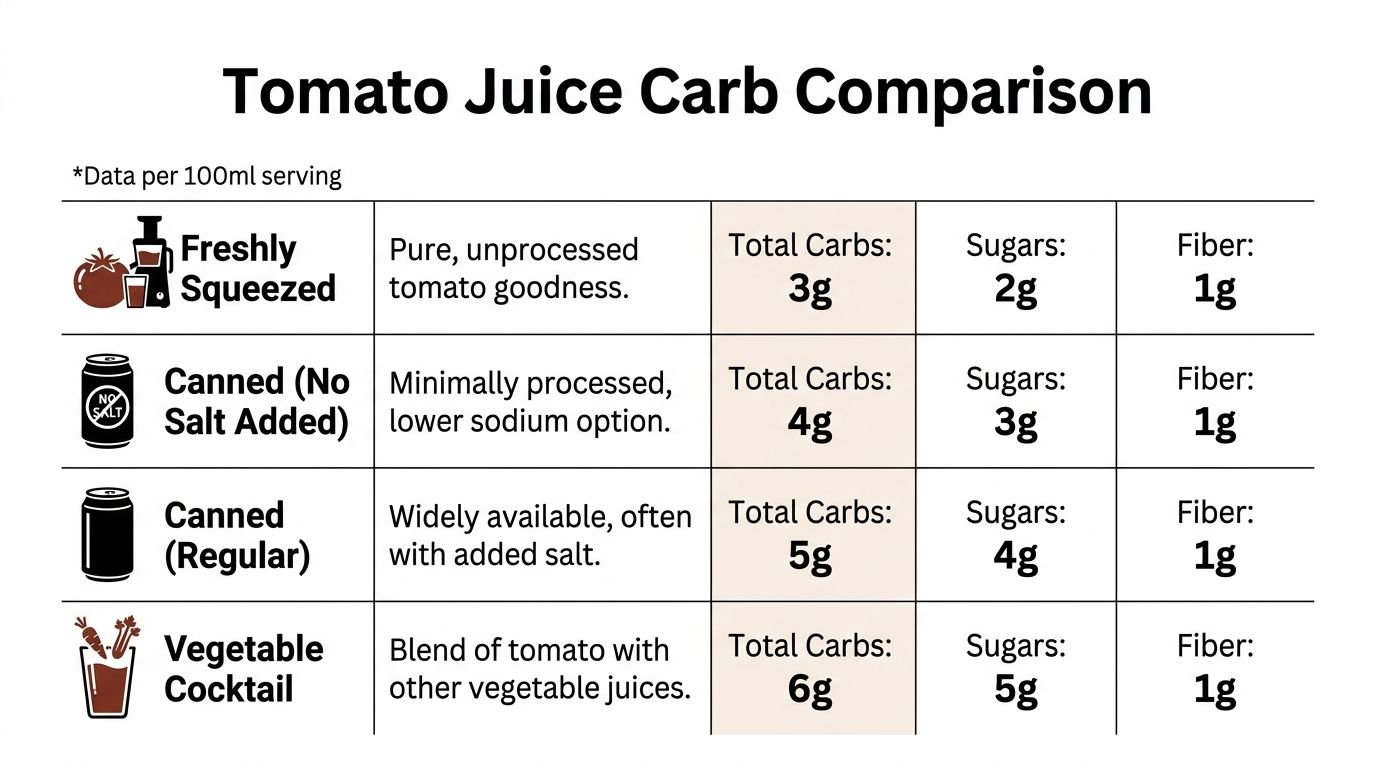
Here’s a quick comparison chart for common tomato-juice-style options. Use it as a label-reading aid, not as a substitute for checking the specific package in your hand.
| Juice Type | Total Carbs (g) | Dietary Fiber (g) | Sugars (g) | Net Carbs (g) |
|---|---|---|---|---|
| Standard canned tomato juice, 8 oz | 10.3 | about 1 to 2 | about 6.3 to 8.65 | about 8 to 9 |
| 100% tomato juice, 8 oz | similar to standard tomato juice | similar range | similar range | similar range |
| Freshly made at home | can vary | can vary | can vary | can vary |
| Seasoned vegetable cocktail such as V8-style blends | can vary based on blend | can vary | can vary | can vary |
The practical reading of this table
Standard canned tomato juice is the only category here with a firm cited baseline, so that’s your anchor. Once you move into homemade juice or vegetable cocktail territory, variation becomes the story. Some products are closer to plain tomato juice. Others pull in carrot, beet, celery, or other vegetable juices that shift the carb profile.
This is why people get confused about V8. They expect “tomato juice” numbers, but they’re often drinking a broader vegetable blend. That doesn’t automatically make it bad. It just means the carb count reflects more than tomatoes alone.
A simple shopping filter
Use this order when you compare products:
- First check the ingredient list. If it’s mostly tomato juice, the carb profile will usually stay closer to the standard baseline.
- Then check serving size. Labels often look friendlier when the serving is smaller than what you drink.
- Finally check whether it’s a blend. A vegetable cocktail can still be a good choice, but it’s not the same thing as plain tomato juice.
How Processing and Seasoning Change Carb Counts
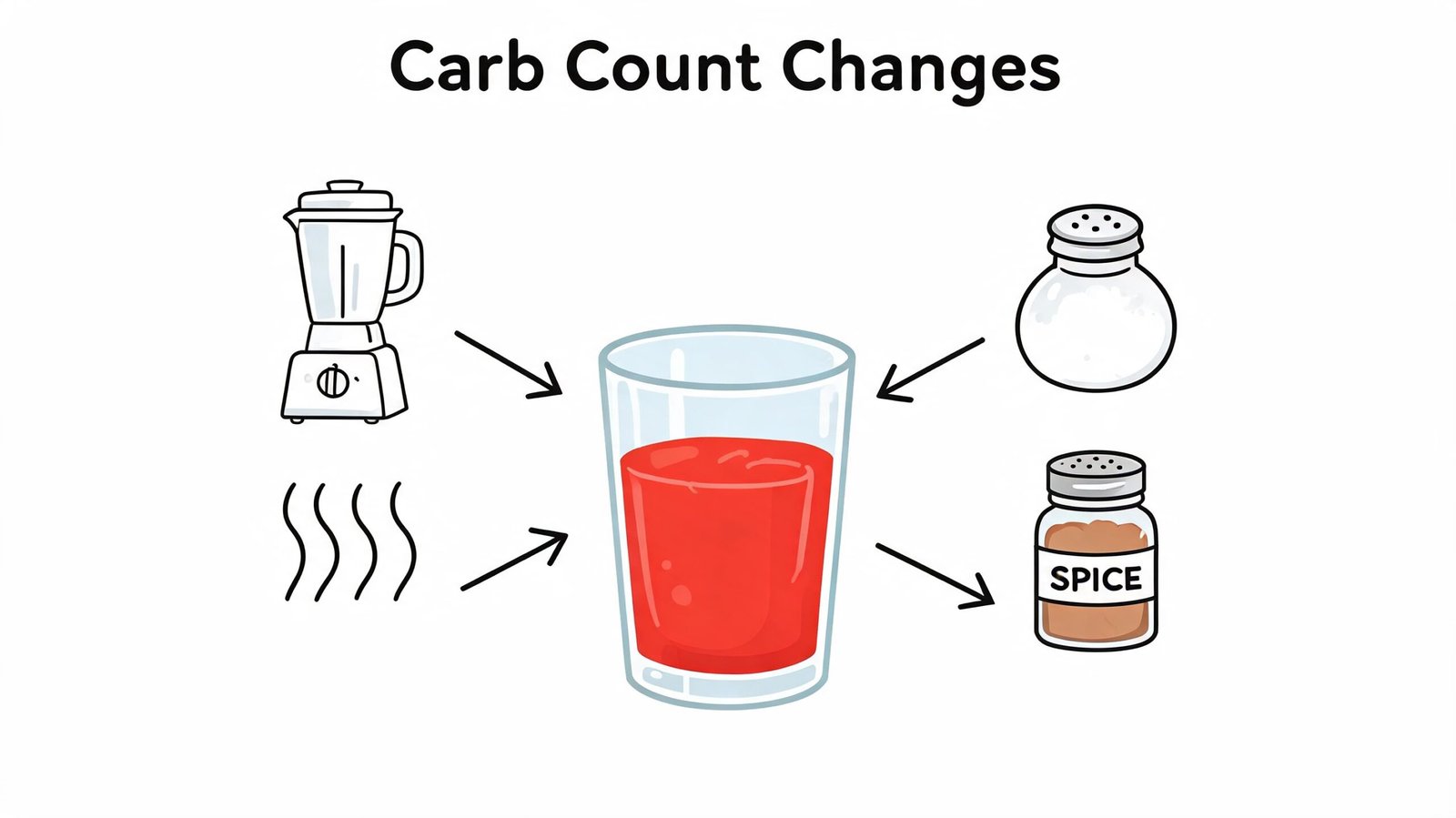
Processing changes tomato juice in ways people can taste, but also in ways they don’t always notice on the label. The biggest practical shifts come from how much pulp stays in, whether the juice is concentrated and reconstituted, and whether the product is seasoned or blended with other vegetable juices.
Why plain tomato juice and V8 aren’t interchangeable
When someone logs “tomato juice,” they often assume all savory red juice is basically the same. It isn’t. A V8-style drink is usually a vegetable cocktail, not just tomato juice. That means the carb count can move because the recipe includes other vegetable juices and seasonings.
The seasoning itself isn’t always the carb issue. The formula is. Once you blend multiple juices, you’re no longer looking at the same nutrition profile as a straightforward tomato product. That’s why “close enough” logging can become inaccurate.
If the front label says vegetable cocktail, log it as a blend, not as plain tomato juice.
What processing does behind the scenes
Commercial tomato juice is strained, heated, and packaged for shelf stability. Those steps don’t automatically make it high carb. But they do affect texture, fiber retention, and concentration.
A few trade-offs matter in practice:
- More straining usually means less fiber in the glass. Lower fiber can push net carbs closer to total carbs.
- Concentrate-based products can taste slightly different. Reconstitution can still produce a tomato juice that fits well in a lower-carb plan, but it may not match the mouthfeel of less processed versions.
- Seasoned versions can drift from the baseline. Once spices, extra vegetable juices, or flavoring systems get involved, the label matters more than assumptions.
What to do at the store
I usually tell clients to stop guessing from marketing language and use a short checklist.
- Read the first ingredients. Tomato juice from concentrate and tomato juice are not the same label line, even if both may be fine.
- Look for “100% tomato juice” if you want predictability. That keeps the product closer to what you meant to buy.
- Treat cocktails as their own category. They can work well, but they deserve separate logging.
What doesn’t work is assuming “savory” means negligible carbs. Savory drinks can still carry enough carbs to matter if you’re tracking closely.
Comparing Carbs in Tomato Juice vs Other Drinks
Tomato juice makes the most sense when you compare it with what people drink instead. That’s where it tends to shine. Against sweeter juices, it usually feels much easier to fit into a lower-carb day.
Against whole tomatoes, the story is a little different. Whole tomatoes give you the full food experience, including more chewing and usually a more intact structure. Juice is more convenient, but convenience often comes with less fiber staying in the glass than in the whole vegetable.
Tomato juice versus whole tomato
If your goal is fullness, a whole tomato often wins. If your goal is portability, shelf life, or getting something savory on the go, tomato juice is easier.
That trade-off matters for logging too. A whole tomato and a glass of tomato juice aren’t interchangeable just because they come from the same food. The carb experience is different because the form is different. Juice is faster to consume, which can make portion awareness more important.
Tomato juice versus sweeter juices
Tomato juice is usually the better fit for lower-carb eaters. You’re generally dealing with a savory product rather than a drink built around fruit sweetness. For many clients, that means fewer cravings and a steadier meal structure.
A simple pattern shows up in real life:
- Tomato juice works better when someone wants a drink that behaves more like a small snack or a savory side.
- Sweeter juices work worse when someone is trying to stay in control of hunger and keep carbs tighter.
- Water, coffee, and unsweetened tea still win when the goal is to keep carbs as low as possible.
If you like exploring drink options more broadly, including savory and region-specific choices, this guide to explore Japanese beverages is useful for thinking about how beverage culture shapes what we reach for.
Tomato juice isn’t the lowest-carb drink. It’s one of the more useful savory options for people who want something more substantial than flavored water.
That’s the best lens for comparison. It doesn’t beat zero-carb drinks on strict carb minimization, but it often beats sweeter juices on control and fit.
Using Tomato Juice on a Keto or Diabetic Diet
For keto and blood-sugar-conscious eating, tomato juice can work, but only when you treat it as a counted carb source rather than a freebie.
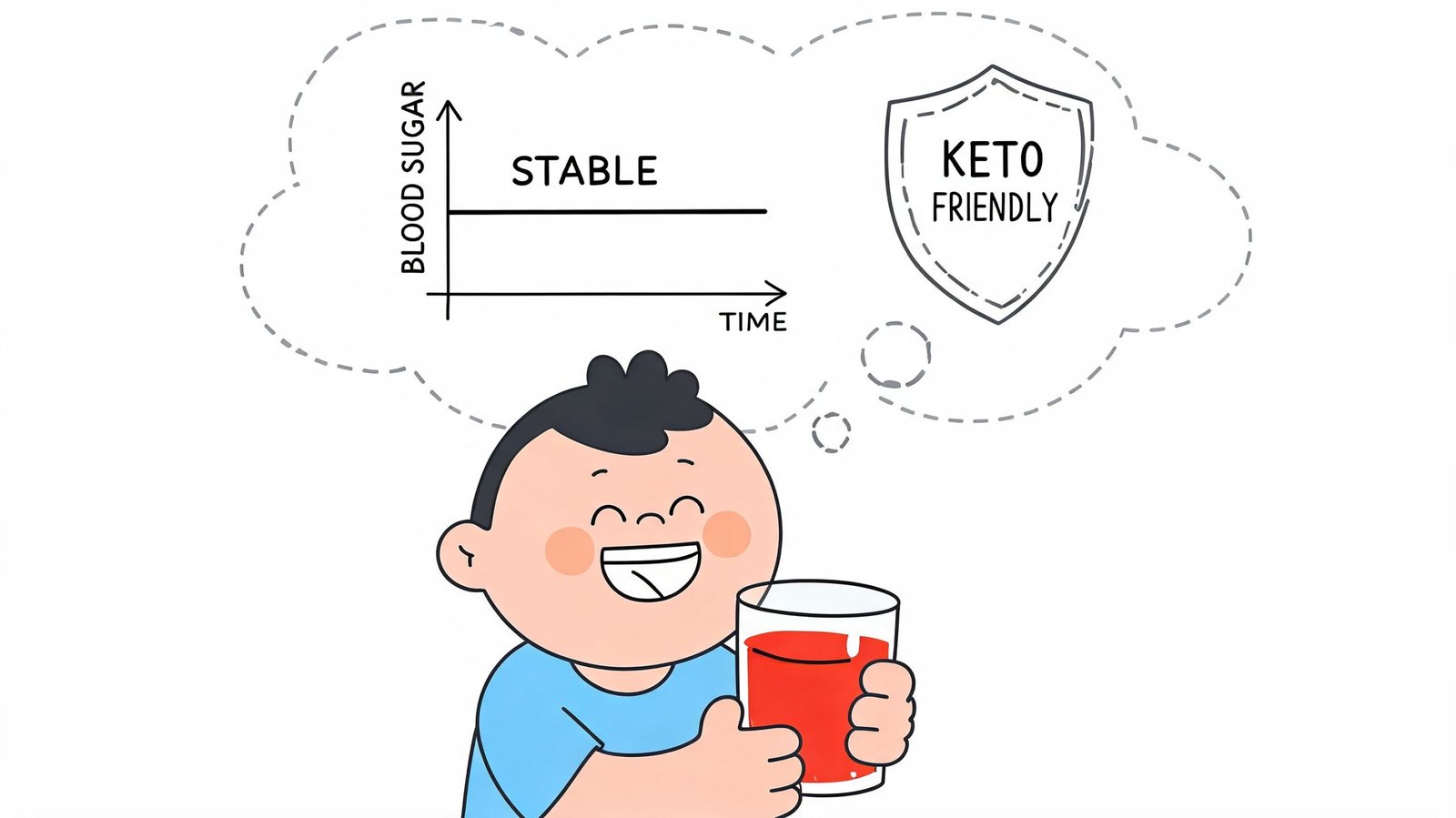
The reason it can still fit is its carb profile. Tomato juice contains about 8.6 to 10.3 grams of total carbs per cup, with about 84% of those carbs as simple sugars, 1 to 2 grams of insoluble fiber, zero starch, and a glycemic load of 2.51 according to Carb Manager’s tomato juice listing. That same entry notes 527mg of potassium, or 16% DV, per cup.
Why some keto eaters do well with it
A lot of keto plans fail on sustainability, not theory. People get bored, under-salted, or start missing foods that feel normal. Tomato juice can help because it gives a savory option that isn’t dessert-like and also contributes potassium, which can be useful on low-carb diets.
That doesn’t mean everyone should drink it daily. It means a measured serving can be easier to fit than many people assume, especially when the rest of the meal is protein-forward and low in starch.
A common good use case is pairing a small glass with eggs, turkey, tofu, or another protein-rich breakfast. A less effective use case is drinking it alongside toast, fruit, and a sweet coffee, then wondering why the meal feels carb-heavy.
Where diabetic and low-carb strategy overlap
The low glycemic load is the part many clients find reassuring. It suggests tomato juice is less likely to behave like a sharp sugar hit than sweeter drinks. That doesn’t replace medical advice, and it doesn’t make portion size irrelevant, but it does make tomato juice a more reasonable option than many juice aisle alternatives.
For people building out meals and recipes that stay lower in carbs overall, Smokey Rebel's ketogenic guide can be useful inspiration for fitting beverages into a broader meal pattern rather than treating drinks as separate.
Here’s a helpful explainer if you want a visual take on keto-friendly beverage thinking.
What works and what doesn’t
- Works well for keto. Measured portions, plain tomato juice, and using it intentionally with low-carb meals.
- Works well for blood sugar awareness. Choosing unsweetened, tomato-forward products and avoiding casual overpouring.
- Doesn’t work. Treating vegetable cocktails and plain tomato juice as identical, or using juice labels as a reason to stop checking ingredients.
How to Log Tomato Juice Instantly with PlateBird
Accurate tracking falls apart on small frictions. Tomato juice is a perfect example because it seems simple, but product type matters enough that lazy logging can throw off your day.
The fast way to log it
Type what you had. “1 cup canned tomato juice.” “Small glass low-sodium tomato juice.” “Cup of V8.” That level of detail matters because plain tomato juice and vegetable cocktail aren’t the same entry.
If you poured from a labeled container, use the package wording. If you made it at home, note that too. Homemade versions can vary a lot based on how much pulp stayed in and whether you added other vegetables.
A simple best-practice flow
- Log the exact drink category. Tomato juice, low-sodium tomato juice, or vegetable cocktail.
- Match the serving to what you drank. Don’t default to one cup if your glass was larger.
- Save repeats. If it’s your usual breakfast add-on, using a repeated entry reduces drift over time.
This matters more than people think. The biggest tomato-juice logging mistake isn’t forgetting it. It’s choosing a generic entry that doesn’t match the product.
A good log starts with the label name, not with your best guess.
When photo logging helps
Photo logging works best when the glass or container is visible and the meal context is clear. If you’re having tomato juice next to eggs and avocado, snapping the whole meal can speed things up and make the beverage less likely to get skipped.
If you track macros regularly, it’s worth comparing tools that reduce this kind of friction. This roundup of the best macro tracking app options is a useful place to evaluate what makes logging faster without getting sloppy.
What works is consistency. What doesn’t is pretending all red savory drinks are close enough.
Frequently Asked Questions About Tomato Juice Carbs
Does low-sodium tomato juice have fewer carbs
Not necessarily. Sodium and carbs are separate parts of the label. A low-sodium version may be a better fit if you’re watching salt, but you still need to check the carbohydrate line instead of assuming the whole nutrition profile changed in your favor.
Is 100 percent tomato juice better for lower-carb tracking
It’s usually better for predictability. If the drink is plainly tomato juice rather than a vegetable cocktail, you’re less likely to run into hidden variation from extra vegetable juices or flavor systems. For macro tracking, predictability is often more useful than marketing terms like “natural” or “clean.”
Why is V8 different from plain tomato juice
Because it’s generally formulated as a vegetable blend, not just tomato juice. That changes the final carb profile and is exactly why it should be logged as its own product category. The label name matters here.
Does homemade tomato juice have fewer carbs
Sometimes, but not reliably. Homemade juice can be thinner, pulpier, or blended with other vegetables depending on how you make it. Without a standardized recipe, the carb count is variable, so logging it as homemade is more honest than forcing it into a canned entry.
Does cooking with tomato juice change the carbs
Cooking changes concentration more than it changes the fact that carbs are still present. If tomato juice reduces during cooking, the flavor becomes more concentrated and the carbs per smaller final volume can feel denser. For soups, stews, and sauces, log the full recipe ingredients rather than trying to estimate the finished liquid by taste.
Is organic tomato juice lower in carbs
Organic tells you how the tomatoes were grown, not whether the carb count is lower. It may be a preference for other reasons, but it isn’t a shortcut to lower carbs.
What’s the smartest way to fit tomato juice into a lower-carb diet
Keep it intentional. Use a measured serving, choose a tomato-forward product, and pair it with protein or a lower-carb meal. The worst approach is drinking it casually while also stacking other carb sources around it.
Should you avoid tomato juice on keto
Not automatically. What matters is your daily carb budget and how the serving fits into it. Some keto eaters do fine with a carefully measured serving. Others would rather spend those carbs elsewhere. Both approaches can make sense.
Tomato juice is one of those foods that rewards precision. It’s not a problem food. It’s a product category where details matter more than people assume.
If you want to make that precision effortless, PlateBird is a practical way to log tomato juice and the rest of your meals without the usual friction. You can type what you ate in plain English or snap a photo, then keep your carbs, calories, and macros organized fast enough to stay consistent.