
Pushing a lawn mower can burn 350 to 450 calories per hour, which puts it in the same general territory as a solid moderate cardio session. If you've ever finished mowing sweaty, breathing harder, and wondering whether that yard work “counted,” the short answer is yes.
You can feel the difference the moment you shut the mower off. Your shirt’s damp. Your legs feel worked. Your hands and shoulders know they did something. Yet a lot of people still dismiss mowing as “just a chore” because it doesn’t happen in a gym.
That’s a missed opportunity.
The value of calories burned mowing lawn isn't just that it burns energy. It's that the effort changes a lot based on your body weight, your mower, and your yard. A flat lawn with a riding mower is one experience. A push mower on rough grass is another. If you’ve been searching for one magic number, that’s where most articles stop too soon.
Your Weekend Chore Is a Hidden Workout
A familiar weekend scene goes like this. You mow the lawn, come back inside, grab water, and think, “That had to be exercise.” You’re not imagining it. The work is real, and your body can tell.
What makes mowing interesting is that it sits in the sweet spot between daily life and structured fitness. You’re walking, steering, pushing, turning, stabilizing, and repeating that effort over and over. For a lot of people, that kind of movement feels more natural than forcing another treadmill session.
Why mowing feels harder than people expect
A mower doesn’t just move forward in a straight line. You stop, pivot, push through thicker patches, guide around trees, and keep your body balanced over changing ground. That creates a practical kind of full-body effort.
If you like listening to music or podcasts while you mow, it also helps to choose headphones suited for outdoor movement. This guide on noise isolation vs noise cancellation for workouts is useful because mowing adds engine noise, wind, and safety considerations that gym workouts don’t.
Practical rule: If a chore leaves you warm, breathing harder, and ready for a break, it probably deserves more respect than you’ve been giving it.
People often make the same mistake with core work too. They underestimate activity just because it’s familiar. The same thing happens when people compare mowing with ab work like crunch calorie burn. Familiar doesn’t mean ineffective.
The real question isn't whether it counts
The better question is how much it counts for you.
That depends on the details most generic articles skip. Your weight changes the math. A hand mower changes the effort. Hilly or uneven terrain can make the same amount of time feel much tougher. Once you understand those moving parts, calories burned mowing lawn becomes much easier to estimate without guessing.
The Science of Calorie Burn with METs
The simplest way to understand calorie burn is through METs, short for Metabolic Equivalent of Task. Think of a MET like a multiplier for how hard your body is working compared with rest.
If resting is the baseline, a higher MET means more energy used per minute. That’s why the same person can burn very different amounts doing different activities, even in the same half hour.
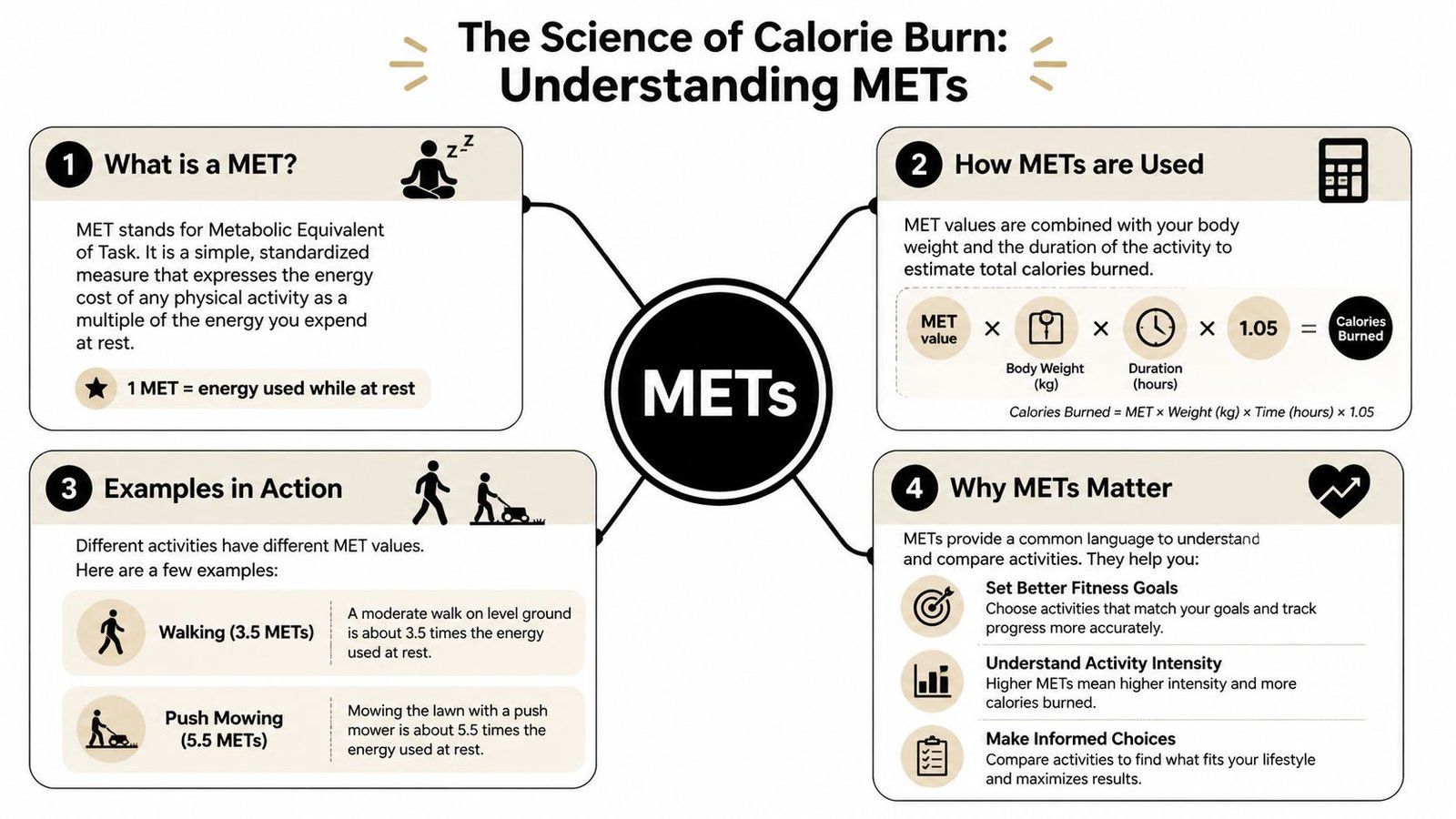
What MET means in plain English
For mowing, one verified benchmark is especially helpful. A push power mower at moderate to vigorous effort has a MET value of 5.0, and the calorie formula is (MET × body weight in kg × 3.5) ÷ 200. For a 79.5 kg (175 lb) person, that comes out to about 358 calories per hour, according to Fitness Volt’s mowing calorie breakdown.
That sounds technical, but it’s manageable when you break it apart.
- MET: how demanding the activity is
- Body weight in kg: your size affects energy use
- 3.5 and 200: constants used in the standard formula
- Time: once you get calories per minute, multiply by how long you mowed
A simple example
Say you weigh 175 pounds, which is about 79.5 kg. If you use the push mower MET of 5.0, the formula gives your calories per minute. Then you multiply that number by your mowing time.
That’s how you get the estimate of about 358 calories in an hour for that specific setup.
If you’re trying to connect this to fat loss, it helps to understand the bigger picture of energy balance too. This plain-language guide on what a calorie deficit is makes the connection between daily movement and weight change much easier to follow.
METs don't make the estimate perfect. They make it explainable.
Why this matters
There's a desire for one answer: “How many calories does mowing burn?” But METs show why there can’t be one universal number. The activity has a standard intensity range, yet your body weight and time still shape the result.
That’s good news. It means you don’t have to rely on random guesses from a watch or a search result. You can understand where the estimate comes from.
Key Factors That Change Your Calorie Burn
No two mowing sessions are identical. Even if two neighbors start at the same time, they may not finish with anything close to the same calorie burn.
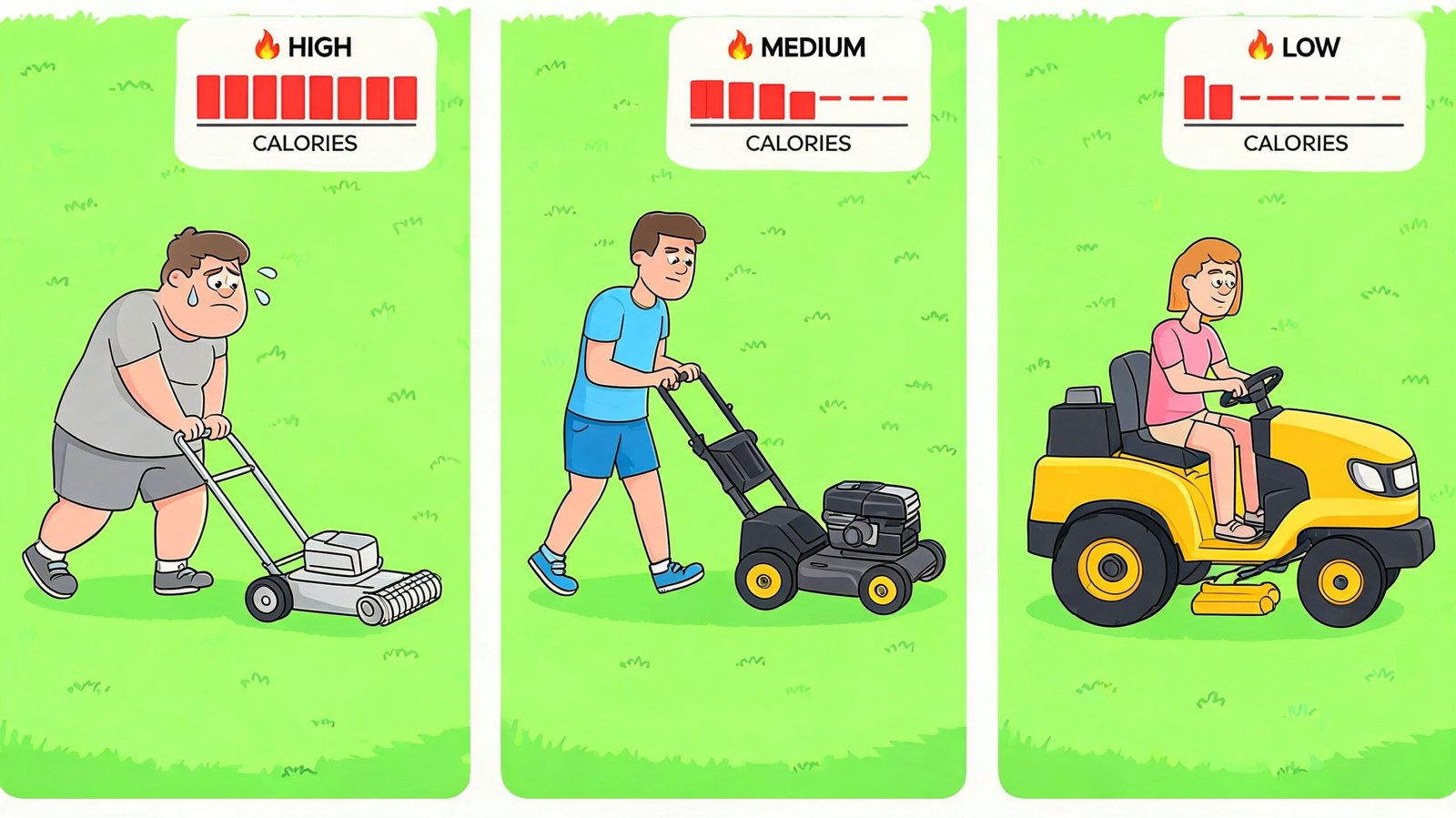
One verified comparison shows just how wide the range can be. Hand mowers burn 193 to 251 calories in 30 minutes, a light self-propelled mow burns about 330 calories in 45 minutes, and high-intensity mowing on rough terrain can burn 266 calories in 27 minutes, based on ABC Fit Connect’s mower-type comparison.
Your body weight changes the math
Heavier bodies generally use more energy to do the same task. That doesn’t mean “better” or “worse.” It just means the same walk, push, and turn cost different amounts of energy for different people.
This is one reason generic calorie numbers can feel off. A single estimate might be close for one person and noticeably wrong for another.
Mower type matters more than most people think
This is the biggest source of confusion.
A hand mower asks you to do nearly all the work. A push power mower still requires steady effort, but the machine helps with cutting. A self-propelled mower can reduce how much force you need to generate. A riding mower changes the task into a much lighter form of activity.
When people say “mowing burned me a ton of calories” or “mowing barely counts,” they may both be right because they’re talking about completely different setups.
Terrain can turn mowing into a tougher session
A smooth, flat yard feels one way. A sloped yard with dips, thick patches, and awkward turns feels very different. Uneven terrain increases how much your legs and core have to stabilize. Thick grass can make the mower fight back more. Tight spaces mean more starts, stops, and direction changes.
If your lawn includes hills, safety comes first. Barefoot Organics' steep hill guide is a helpful read because steeper mowing changes both effort and risk.
Here’s a real-world example of how effort can vary when conditions change:
Pace changes the workout feel
You don’t need to sprint behind a mower, but pace still matters. A relaxed, stop-and-chat mowing session won’t cost the same energy as a steady, continuous effort on a warm day with thick grass.
The most accurate estimate is the one that matches how you actually mowed, not how the label in your app describes lawn work in general.
Mowing Calorie Estimates at a Glance
If you don’t want to do the formula yourself, a shortcut table is the easiest way to estimate calories burned mowing lawn. The key is to treat these as reasonable estimates, not exact lab measurements.
The push mower numbers below are anchored to verified data showing about 358 calories per hour for a 175-pound person using a push power mower at moderate to vigorous effort from the earlier Fitness Volt reference. Riding mower estimates use the verified 175 to 225 calories per hour range from the Captain Calculator reference discussed later in this article. Self-propelled mower estimates are kept qualitative-to-practical by using the verified real-world example of a lighter-effort self-propelled mow as the middle ground.
Estimated Calories Burned Mowing Lawn 30 and 60 Minutes
| Body Weight | Push Mower 30 min / 60 min | Self-Propelled Mower 30 min / 60 min | Riding Mower 30 min / 60 min |
|---|---|---|---|
| 155 lb | about 160 to 180 / about 320 to 360 | lighter than push, moderate effort / lighter than push, moderate effort | about 90 to 110 / about 175 to 225 |
| 175 lb | about 180 / about 358 | about 220 / about 330 to 360 | about 90 to 110 / about 175 to 225 |
| 185 lb | somewhat higher than 175 lb / somewhat higher than 175 lb | somewhat higher than 175 lb / somewhat higher than 175 lb | about 90 to 110 / about 175 to 225 |
How to use the table
Start with the row closest to your body weight. Then choose the mower type that best matches what you used. If your yard is rough, hilly, or thick, lean toward the higher end of the estimate. If your mower does more of the work and your lawn is flat, stay conservative.
This is why calories burned mowing lawn works best as a range. It reflects what happens outside, not a made-up “average day” that fits nobody perfectly.
How Mowing Compares to Other Exercises
A lot of people trust exercise only when it looks like exercise. Running counts. Cycling counts. A chore in old sneakers doesn’t feel as official.
That mindset leaves useful movement on the table.
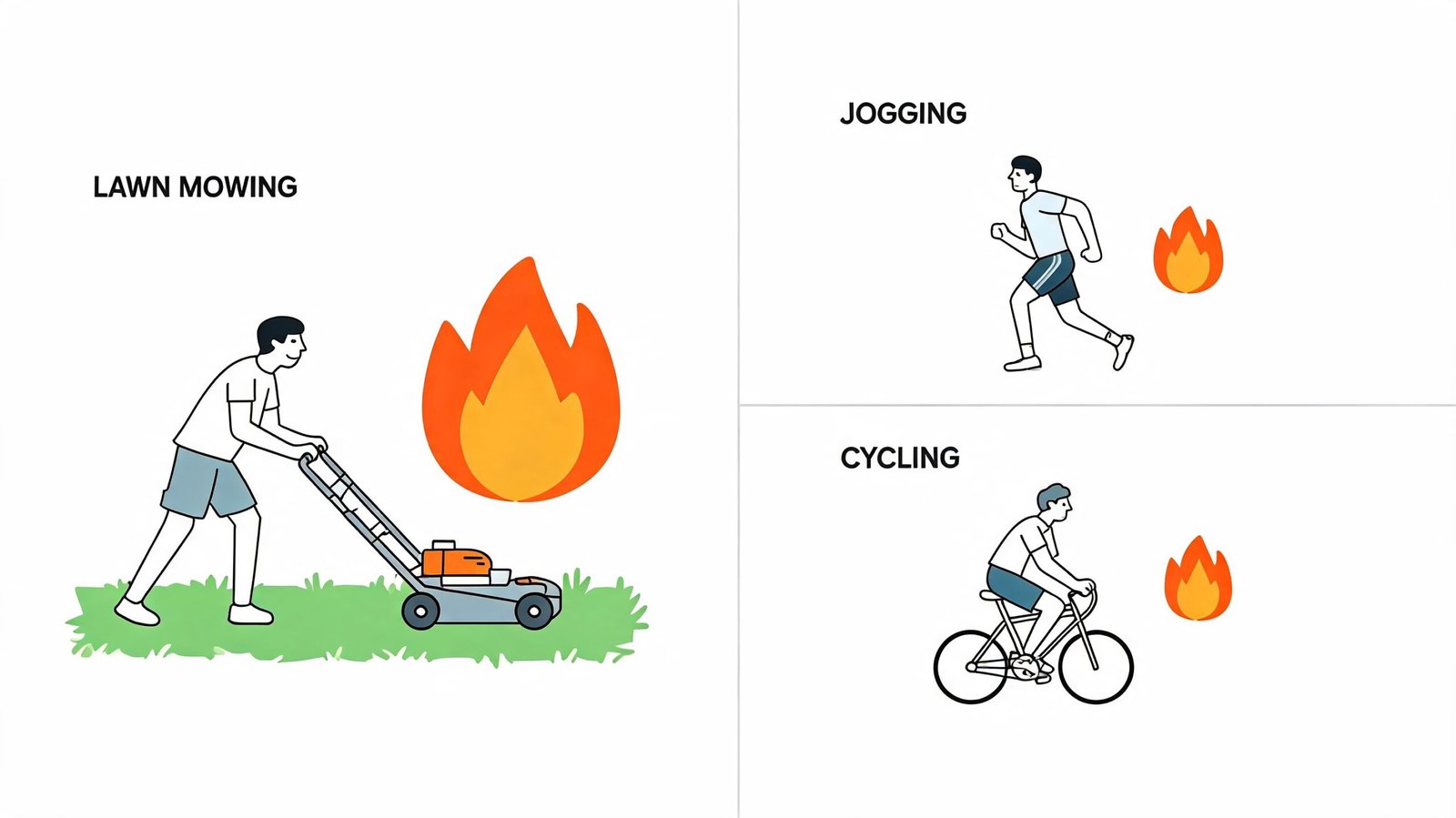
One of the clearest verified comparisons comes from Harvard Health data cited by Lose It. A 155-pound person burns 198 calories in 30 minutes using a hand mower, which puts it ahead of slow walking at 3.5 mph at about 150 calories in 30 minutes and also ahead of golf in that same low-intensity category, according to Lose It’s review of mowing calorie burn.
Where mowing fits on the effort scale
Mowing with effort lands closer to moderate cardio than to casual puttering around the yard. That’s why people often finish with the same signals they’d notice after a brisk walk. Increased breathing, warm muscles, and that “I did something” feeling.
That doesn’t mean every mowing session is equally demanding. A riding mower won’t feel like hand-mowing. But once you’re walking steadily and pushing resistance, mowing starts acting much more like exercise than people expect.
Why this comparison matters for motivation
Many adults struggle with consistency because workouts feel like one more thing to schedule. Mowing solves a piece of that problem. The task already needs to happen. If it also contributes to your activity, that lowers the barrier.
A few examples make this easier to frame:
- If you hate cardio machines: mowing can give you outdoor, purposeful movement instead.
- If you’re busy on weekends: a chore can double as training time.
- If you’re building a calorie deficit: activity that happens “for free” is easier to repeat than a plan that depends on perfect motivation.
You don't need every workout to look athletic. You need movement you can repeat.
What mowing doesn't replace
It isn’t a complete fitness plan by itself. You still benefit from strength training, mobility work, and structured exercise if those fit your goals. But mowing deserves a place in the conversation.
It’s not a fake workout. It’s a practical one.
How to Accurately Track Your Mowing Workout
Tracking mowing well comes down to one principle. Log the session you did.
A standard push mower can burn 350 to 450 calories per hour for the average person, and that makes it comparable to moderate cardio. The same reference also notes that logging “mow lawn 1hr” can offset a full meal’s worth of calories in a weight-loss plan, based on Captain Calculator’s lawn mowing calorie guide.
What to record right after you finish
Don’t wait until the evening when details get fuzzy. As soon as you’re done, note:
- Duration: How long were you mowing?
- Mower type: Hand, push power, self-propelled, or riding?
- Terrain: Flat and easy, or rough and hilly?
- Effort: Leisurely, steady, or hard?
Those four details do most of the heavy lifting for accuracy.
A simple way to keep your estimate honest
If you used a push mower on average terrain, a middle-of-the-road estimate usually makes sense. If your lawn was steep, overgrown, or physically demanding, use the higher end of the likely range. If you rode most of the time, keep the estimate modest.
Wearables can help, but they aren’t magic. If you use one, it’s worth comparing its output with practical guidance on the best fitness trackers for losing weight, especially since trackers can interpret stop-and-go yard work very differently.
Make your log more useful over time
You’ll get better estimates after a few sessions because patterns show up fast. Maybe your front yard is easy but the backyard always spikes your effort. Maybe self-propelled mowing feels much lighter than your old push mower did. That personal context matters.
If you’re already logging food, it helps to track activity with the same level of honesty. A straightforward guide to how to count calories can help if you want your activity and nutrition records to match up better.
Small tracking details create better decisions than flashy calorie numbers do.
The big win here isn’t chasing a perfect estimate. It’s recognizing that this chore contributes to your total energy burn and deserves to be logged accordingly.
If you want an easier way to connect workouts like mowing with the meals you eat, PlateBird makes calorie and macro tracking much faster. You can type meals in plain language or snap a photo, log food in seconds, and keep your daily intake clear enough that everyday activity, including yard work, becomes useful data instead of a guess.