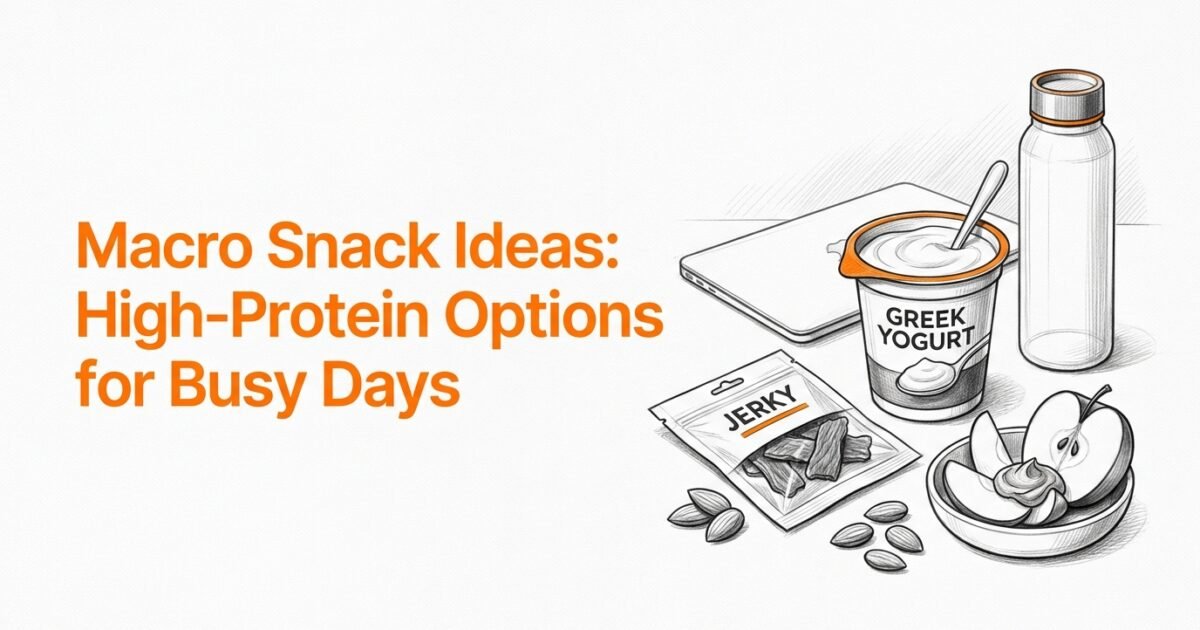
Macro Snack Ideas: High-Protein Options for Busy Days
You grabbed a handful of crackers at 3 p.m. because there was nothing else ready. An hour later you were hungrier than before, and you had no idea what you’d actually eaten. That’s the snack problem for people tracking macros: the food is convenient, but the nutrition is a mystery.
The bigger issue isn’t willpower. It’s that snacks rarely come with a plan. You’re not thinking about protein, fat, and carbs at 3 p.m. You’re thinking about getting through the afternoon.
Good macro snack ideas don’t require a nutrition degree. They require a short list of options you can reach for without thinking, with enough protein to keep you full and enough variety to stay interesting.
Why protein is the anchor of any good snack
You can build a snack around carbs, fat, or fiber, and each has a role. But protein does the most work when you’re trying to stay full between meals or support a workout.
A snack with 20 g of protein hits differently than one with 5 g. The difference shows up about 90 minutes later, when the first person is still focused and the second is hunting for something else to eat.
The target worth aiming for is 15 to 25 g of protein per snack. That range is enough to matter without turning a snack into a full meal. Below 10 g, you’re mostly just eating calories.
Fat and carbs still belong in the picture. Fat slows digestion and adds satisfaction. Carbs give you quick energy, which matters before a workout or a long afternoon meeting. The goal is balance, not elimination.
A snack that only hits one macro tends to leave a gap. The body notices what’s missing faster than you do.
Protein targets by situation
-
Pre-workout snack: aim for 15 to 20 g protein and 20 to 30 g carbs to fuel effort without feeling heavy.
-
Afternoon energy dip: 20 g protein with a small amount of fat holds better than pure carbs for the next 2 to 3 hours.
-
Post-workout recovery: 25 to 30 g protein within 60 minutes supports muscle repair after strength training.
-
Light evening snack: 10 to 15 g protein with minimal carbs keeps calories lower without leaving you hungry at midnight.

No-prep snacks you can build in under 5 minutes
You’re standing at the kitchen counter with 4 minutes before your next call. This is where most tracking habits fall apart. The snack has to be faster than the hunger.
These options require no cooking, minimal assembly, and give you a real macro breakdown you can log without guessing. We cover this topic in more depth in How to Photo-Log Macros for Plant-Based Family ….
Greek yogurt with protein powder
Plain Greek yogurt (170 g) already has 15 to 17 g of protein. Add half a scoop of whey or plant protein and you’re at 28 to 30 g total, around 200 to 220 calories. The fat stays low if you use 0% fat yogurt. This is one of the highest-protein snacks you can build without any cooking.
The trade-off: it needs refrigeration and a spoon. Not a desk snack. Not a car snack.
String cheese with baby carrots
Two sticks of string cheese give you roughly 14 to 16 g of protein and 10 g of fat. Add a handful of baby carrots (85 g) for 4 g of carbs and fiber. Total comes in around 190 to 200 calories. Portable combinations like this travel well in a bag and need no prep beyond pulling them out of the fridge.
Deli turkey roll-ups
Four slices of deli turkey (60 g) with a smear of mustard and a few strips of bell pepper. Around 80 to 90 calories, 14 g protein, 2 g fat, 3 g carbs. Fast. No tortilla needed. The protein-to-calorie ratio is hard to beat for a 2-minute snack.
|
Snack |
Calories |
Protein |
Carbs |
Fat |
|---|---|---|---|---|
|
Greek yogurt + half scoop protein |
210 |
30 g |
12 g |
2 g |
|
String cheese + baby carrots |
195 |
15 g |
8 g |
10 g |
|
Turkey roll-ups with mustard |
85 |
14 g |
3 g |
2 g |
|
Cottage cheese (150 g) |
130 |
18 g |
5 g |
3 g |
|
Hard-boiled eggs x2 |
140 |
12 g |
1 g |
10 g |
Plant-based snack options with real protein
Plant-based eating gets harder at snack time than at meals. Grab-and-go options are carb-heavy, and the protein sources that do exist often come with a lot of fat alongside them.
The options below solve that. They’re not substitutes for animal protein. They’re their own category, worth knowing.
Dry roasted edamame
Dry roasted edamame packs 11 g of protein per 100 calories. That’s a better ratio than nuts, which tend to run 5 to 6 g of protein per 100 calories while carrying 8 to 9 g of fat. A 28 g serving of edamame gives you about 13 g protein, 9 g carbs, and 4 g fat. Shelf-stable. Crunchy. Genuinely satisfying in a way that raw vegetables are not.
Roasted chickpeas
A 40 g serving of roasted chickpeas delivers 7 g protein, 18 g carbs, and 3 g fat for about 130 calories. The carb load is higher than edamame, which makes this a better pre-workout option than a low-carb snack. Season them yourself or buy them pre-seasoned. The texture holds up in a bag all day.
Chia pudding with a yogurt layer
Two tablespoons of chia seeds (28 g) in unsweetened almond milk, topped with a layer of plain soy yogurt. The chia contributes 5 g protein and 10 g fiber. The soy yogurt adds another 5 to 7 g. Total protein around 10 to 12 g, around 220 calories. It needs overnight prep, so it belongs in the meal prep category. But it’s worth building into a weekly rotation if you’re eating plant-based and struggling to hit protein targets.
Plant-based snacking works best when you stop trying to replicate animal protein and start building around what plants do well: fiber, complex carbs, and concentrated plant protein sources like legumes.

Meal prep snacks that last through the week
Prepping snacks on Sunday is the difference between eating well on Thursday and eating whatever was closest. The options below hold for 4 to 5 days in the fridge, batch well, and give you consistent macros every time.
Egg white bites
Baked in a muffin tin, egg white bites use about 6 egg whites per batch of 6 bites. Each bite comes in around 35 to 40 calories and 7 g protein. Add spinach, diced peppers, and a small amount of feta. The whole batch takes about 25 minutes including bake time. Batch-prepped protein bites like these are one of the most efficient ways to have a high-protein snack ready without thinking.
Greek yogurt bark
Spread 500 g of plain Greek yogurt on a parchment-lined tray. Add a handful of mixed berries and a tablespoon of crushed almonds. Freeze for 3 hours, then break into pieces. Each 100 g piece delivers roughly 10 g protein, 8 g carbs, 3 g fat, and about 100 calories. Greek yogurt bark feels like a treat. The macros say otherwise.
Cottage cheese fruit parfaits
Layer 150 g cottage cheese (18 g protein, 130 calories) with 80 g of sliced strawberries and a teaspoon of honey. Store in small jars. Holds for 3 days. The protein count is solid and the prep time is under 3 minutes per jar if you batch them.
The snacks you prep on Sunday are the ones you eat on Wednesday. Everything else is aspirational.
Snack options by goal and lifestyle
Not every snack works for every situation. A pre-workout option isn’t the same as a desk snack. A weight loss snack isn’t the same as a muscle-building one. The goal matters.
For weight loss
-
Beef jerky (28 g serving): 80 to 100 calories, 9 to 11 g protein, minimal fat if you choose a low-sugar variety. Salty, portable, and filling without a lot of volume.
-
Apple slices with 1 tablespoon of almond butter: 150 calories, 3 g protein, 8 g fat, 18 g carbs. The fat and fiber combination slows absorption and keeps hunger at bay longer than the apple alone.
-
Sargento Balanced Breaks: pre-portioned packs combining cheese, nuts, and dried fruit. Around 200 calories, 7 g protein, 11 g fat. Pre-portioned packs like these remove the guesswork from portion size entirely.
For home workouts
-
Fairlife Core Power shake (240 ml): 26 g protein, 5 g fat, 4 g carbs, 170 calories. Ready in seconds, no prep. Best used within 30 to 60 minutes after training.
-
Chicken skewers prepped in advance: 3 skewers with 90 g chicken breast give you 27 g protein and 120 calories. Pair with a small serving of rice (80 g cooked, 90 calories, 20 g carbs) for a complete post-workout snack.
For professionals eating at a desk
-
P3 portable protein packs (Oscar Mayer): around 180 calories, 13 g protein, 12 g fat. No refrigeration needed for short periods. Fits in a bag without leaking.
-
Single-serve cottage cheese cups (113 g): 90 calories, 13 g protein, 2 g fat. They don’t need to be kept cold for a few hours, which makes them usable in an office without a full kitchen.
Where tracking usually breaks down
You can know exactly what to eat and still end up with inaccurate numbers. The mistake usually isn’t the food choice. It’s the logging.
Portion drift
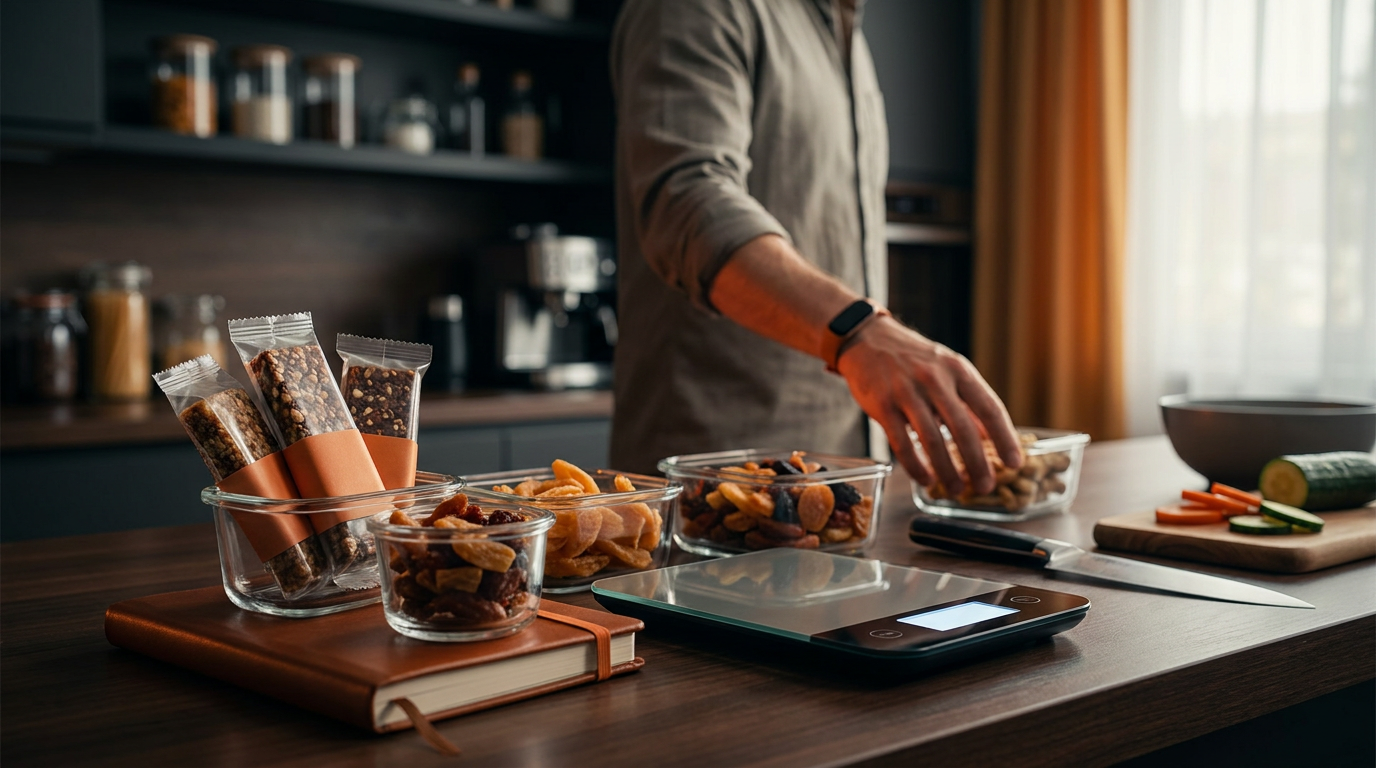
A tablespoon of peanut butter is 95 calories and 8 g fat. A generous tablespoon is closer to 150 calories and 12 g fat. That 55-calorie gap across two snacks a day adds up to 385 calories over a week. Pre-portioned options eliminate this. When you can’t use pre-portioned packs, use a small scale. It takes 10 seconds and removes the main source of snack tracking error.
Forgetting fat
Fat is easy to undercount because it hides in small amounts. A tablespoon of olive oil is 120 calories. A small handful of mixed nuts (30 g) is 180 calories and 16 g fat. If you’re logging protein and carbs but skimming over fat, your totals will be consistently short. Underestimating calories in home-cooked meals covers this pattern in more detail.
Skipping the log entirely
In my experience, the snack that doesn’t get logged is always the one that matters. It’s usually the unplanned one, eaten standing up, that adds 200 to 300 calories to a day that looked fine on paper. A useful heuristic is to log before you eat, not after. It takes 20 seconds and makes the habit stick.
If photo logging fits better into your routine than typing, PlateBird reads the image and returns a macro breakdown without any manual entry. No barcode. No database search. Just a photo. You might also find our guide on Best AI Nutrition Tracking Apps: Photo-Log Macr… helpful.
The log you skip is the one that explains why the week didn’t go as planned. Logging after the fact is better than not logging at all, but logging before removes the temptation to round down.
Frequently Asked Questions
What’s a realistic protein target for a snack?
For adults eating 3 meals and 1 to 2 snacks a day, 15 to 25 g of protein per snack is a useful range. Below 10 g, the snack doesn’t do much to manage hunger. Above 30 g, you’re edging into meal territory. The right number depends on your total daily protein target and how it’s spread across meals.
What are the best store-bought high-protein snacks?
Oikos Pro yogurt (200 g) delivers 20 g protein for around 130 calories. P3 protein packs average 13 g protein and travel without refrigeration for a few hours. Fairlife Core Power shakes hit 26 g protein in 240 ml.
Can I hit 30 g of protein in a single snack?
Yes, without much effort. Plain Greek yogurt (170 g) plus half a scoop of protein powder gets you there at around 200 to 220 calories. A Fairlife shake alone is close at 26 g. Two hard-boiled eggs plus a single-serve cottage cheese cup gives you roughly 24 to 25 g. The yogurt-plus-powder combination is the most calorie-efficient route.
What are good plant-based swaps for cheese or meat in snacks?
Dry roasted edamame replaces cheese as a crunchy, portable protein source at 11 g protein per 100 calories. Firm tofu (100 g) gives 8 g protein and works in savory snack plates. Roasted chickpeas replace crackers with better protein.
How do I track snacks accurately without weighing everything?
Pre-portioned packs remove the need for a scale entirely. For home snacks, using a consistent vessel (same bowl, same spoon) keeps portions stable even without measuring. Photo-based logging tools can also read a snack plate from a single image, which removes the manual entry step.
Snacking well isn’t about finding perfect foods. It’s about having 5 to 6 reliable options you can reach for without math, with macros you actually know.
If you want snack tracking to feel automatic instead of tedious, try PlateBird free. You can type ‘Greek yogurt and edamame’ or snap a photo of your snack plate, and get a protein, carb, and fat breakdown instantly. For the no-prep, grab-and-go snacks in this article, that 10-second log is the only step between eating and knowing exactly where you stand.