- What bulking actually requires for lean muscle gain
- How to set your calories before you set your macros
- The macro split that supports muscle growth
- What to eat when you are trying to bulk without overthinking it
- Why tracking your intake makes bulking more predictable
- How PlateBird fits into a low-friction bulking routine
- Common bulking mistakes that slow progress
- Frequently asked questions
You mapped out a bulk three weeks ago. You set a calorie goal, picked a protein target, and told yourself this time you’d stay consistent. Then a busy Tuesday hit, you skipped lunch, ate a random dinner, and had no idea whether you hit 2,800 calories or 1,900. Sound familiar?
That gap between intention and actual intake is where bulks quietly fall apart. Not from bad programming. Not from the wrong split. From inconsistency in the kitchen, compounded day after day until the scale hasn’t moved in a month.
Bulking Made Easy: Hitting Your Macros for Muscle Gain with PlateBird doesn’t require a nutrition degree or a meal prep Sunday that eats your weekend. It requires a clear framework, repeatable food choices, and a way to track that doesn’t feel like a second job. This guide covers all three.
What bulking actually requires for lean muscle gain
Define the surplus before anything else
Bulking is a controlled calorie surplus aimed at building muscle. That word controlled matters. A surplus of 200 to 300 calories per day supports muscle growth without adding excessive fat. A surplus of 700 or 800 calories per day moves the scale faster, but most of that gain will be fat, not muscle.
The body can only synthesize a limited amount of new muscle tissue per week regardless of how much you eat. Eating far beyond that ceiling doesn’t speed up muscle growth. It just adds body fat you’ll need to cut later.
Why macros matter, but calories set the floor
You can have a perfect macro split and still gain nothing if total calories are too low. Calories are the foundation. Macros are the architecture built on top. Get the calorie number right first, then fine-tune protein, carbs, and fat.
A useful heuristic: if your weight hasn’t moved in two weeks despite consistent eating, the surplus is probably too small. Add 150 to 200 calories per day and reassess after another two weeks.
A bulk that stalls is almost always a calorie problem before it’s a macro problem. Fix the floor first, then adjust the details.

How to set your calories before you set your macros
Start with maintenance, then add
Maintenance calories are the number you need to hold your current weight steady. A rough starting estimate for a moderately active adult is bodyweight in pounds multiplied by 15 to 16. So if you weigh 170 lb, maintenance sits around 2,550 to 2,720 calories per day.
From there, add 200 to 300 calories to create a moderate surplus for muscle growth. That puts a 170 lb lifter at roughly 2,750 to 3,000 calories per day as a starting point. Not a fixed number. A starting point.
Use weekly trends, not daily numbers
One day of eating 400 calories over target won’t derail a bulk. One week of consistently eating 400 calories under target will. Weigh yourself every morning under similar conditions and look at the 7-day average. That average tells you whether the surplus is working.
If the average weight rises by 0.25 to 0.5 lb per week, the surplus is in a reasonable range. If it’s flat, add calories. If it’s climbing faster than 1 lb per week for several weeks, pull back slightly. Adjust based on trends, not individual meals.
Weekly averages are more reliable than daily weigh-ins. One heavy dinner can add 2 lb of water weight by morning. The trend across 7 days tells the real story.
The macro split that supports muscle growth
Protein comes first, every time
Protein is the macro most directly tied to muscle repair and growth. A target of 0.7 to 1 g of protein per pound of bodyweight is a widely used starting range. For a 170 lb lifter, that’s 120 to 170 g of protein per day. At 4 calories per gram, 150 g of protein accounts for 600 calories of your daily target.
Set protein first. It’s non-negotiable. The remaining calories get split between carbs and fat based on your preferences and training schedule.
Carbs and fats fill the rest
Carbohydrates are the primary fuel for resistance training. Higher training volume generally supports higher carb intake. Fat is important for hormone production and overall health, and it shouldn’t drop below about 0.35 g per pound of bodyweight. For a 170 lb lifter, that’s a floor of roughly 60 g of fat per day.
Once protein and fat minimums are set, carbs fill the remaining calorie gap. That’s the order: protein, fat floor, carbs to target.
| Macro | Role in a bulk | Starting target (170 lb lifter) |
|---|---|---|
| Protein | Muscle repair and growth | 150 g per day (600 kcal) |
| Fat | Hormone support, joint health | 65 to 80 g per day (585 to 720 kcal) |
| Carbohydrates | Training fuel, glycogen replenishment | Remaining calories (approx. 300 to 400 g) |
A simple framework you can repeat weekly
Set your calorie target. Assign 150 g protein. Assign 70 g fat. Divide the remaining calories by 4 to get your carb grams. Write those three numbers down. Use them for at least two weeks before changing anything. Consistency over two weeks gives you actual data. Changing the plan every four days gives you nothing useful.
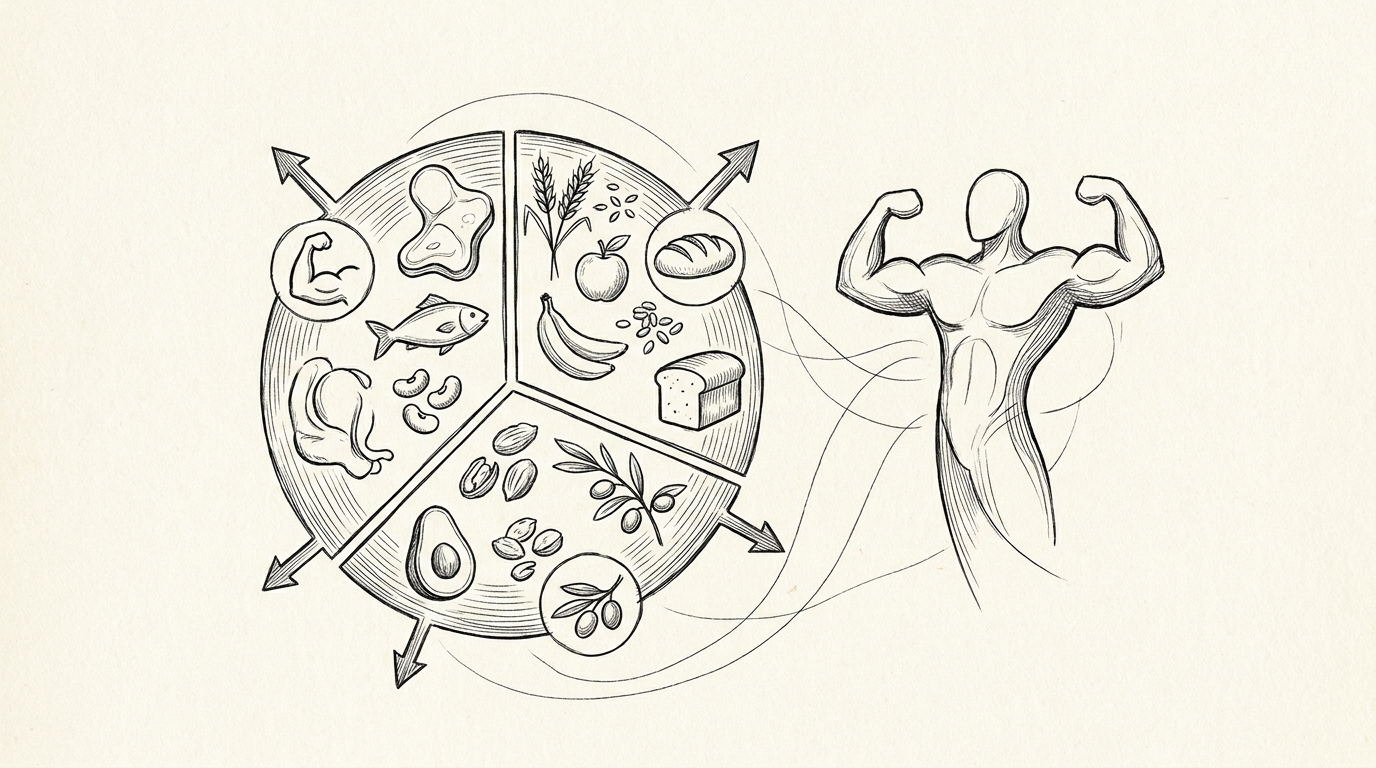
What to eat when you are trying to bulk without overthinking it
Build around repeatable anchor meals
The easiest bulk is one built on four or five meals you can make without thinking. Not because variety is bad, but because familiar meals are easier to estimate, faster to prepare, and less likely to get skipped on a busy Tuesday. Pick two or three breakfasts that hit roughly 40 to 50 g protein and 600 to 700 calories. Rotate them.
A simple example: 4 whole eggs plus 150 g of Greek yogurt plus 80 g of oats with a banana. That’s close to 700 calories, 45 g protein, 85 g carbs, and 20 g fat. Repeatable. Fast. Easy to log.
Calorie-dense foods reduce volume stress
When appetite is the limiting factor, calorie-dense foods are your friend. Peanut butter, olive oil, full-fat dairy, nuts, rice, and pasta all pack more calories per gram than leafy greens or plain chicken breast. Adding 2 tablespoons of peanut butter to a meal adds roughly 190 calories and 8 g of protein with almost no extra volume.
Liquid calories work too. A shake made from 300 ml of whole milk, one banana, 30 g of whey protein, and a tablespoon of almond butter comes to around 500 calories and 40 g of protein. Drinks don’t trigger the same fullness response as solid food, which makes them useful when you’re struggling to hit your target.
- Oats are one of the most calorie-dense breakfast bases. A 100 g dry serving gives you about 380 calories and 13 g of protein before you add anything.
- Chicken thighs have more calories per gram than chicken breast, which makes them easier to use when you need to hit a higher target without eating a larger portion.
- Rice is a simple carb anchor. 200 g of cooked white rice adds about 260 calories and 5 g of protein with minimal prep time.
- Whole eggs give you both protein and fat in a single food. Three eggs contribute roughly 210 calories, 18 g protein, and 15 g fat.
- Greek yogurt (full fat) is one of the easiest high-protein snacks. A 200 g serving provides 18 to 20 g of protein and around 200 calories.
Why tracking your intake makes bulking more predictable
The gap between planned and actual
In my experience, when people who stall on a bulk actually log for a week, they find they’re 300 to 500 calories short on most days. Not because they’re lying to themselves. Because estimating without tracking is genuinely hard, especially for mixed meals and restaurant food.
Tracking closes that gap. It turns a guess into a data point. Over two weeks of consistent logging, you can see whether your actual intake matches your plan. That comparison is where beginners find their first real answer to why the scale isn’t moving.
Friction is the enemy of consistency
Manual logging slows things down. Searching a database, selecting a portion size, adjusting grams, confirming the entry. For a single meal that takes 3 to 5 minutes. Multiply that by four meals per day and it becomes a chore. Chores get skipped.
Photo-based or text-based tracking removes that friction. You describe or photograph what you ate, and the estimate is generated automatically. No barcode scanning. No database hunting. That speed difference is small per meal and large over a month of daily logging.
If logging feels like a second job, you will do it less often. The tracking method that survives a busy week is more valuable than the one that’s theoretically more precise.

How PlateBird fits into a low-friction bulking routine
Text or photo, no manual entry required
PlateBird automatically calculates your calories, protein, carbs, and fat from text or photos. Just type what you ate or snap a picture. No manual logging, no barcode scanning. You type “chicken thighs, rice, broccoli” or snap a picture of your plate, and it returns a calorie and macro breakdown automatically.
For bulking specifically, that speed matters. You’re eating more often, potentially more food per sitting, and you need a logging method that doesn’t add 15 minutes of admin to each meal. Snap, type, review, move on.
Consistency over perfection
No tracking tool gives you perfect numbers. Portion estimation has inherent variance. But a consistent estimate every day is far more useful than a precise log three days a week and nothing on the other four. A pattern I see is that people who use faster logging methods end up with better weekly data than people who use more detailed tools but abandon them mid-week.
Common bulking mistakes that slow progress
Overshooting the surplus
A surplus of 600 or 700 calories per day might feel like faster progress on paper. In practice, a significant portion of that extra intake gets stored as fat rather than converted to muscle. The result is a bulk that requires a longer, harder cut afterward. A moderate surplus of 200 to 300 calories per day is slower but produces a better ratio of muscle to fat gained over a 12 to 16 week period.
Skipping meals on busy days
One skipped meal doesn’t ruin a bulk. A pattern of skipping meals on busy days creates a consistent calorie deficit that cancels out the surplus on other days. The weekly average drops, and the scale stops moving. Portable, calorie-dense snacks solve this. A bag with 50 g of mixed nuts and a protein bar covers roughly 450 calories and 20 g of protein with zero prep time.
Changing the plan before the data arrives
Changing macros every few days means you never collect enough data to know whether the plan was working. A useful heuristic: run any new macro target for at least 14 days before adjusting. Two weeks of consistent logging gives you a meaningful weight trend. Four days gives you noise. Patience here is not passive. It’s the mechanism that makes the system work.
- Jumping from one macro split to another every week means you’re always starting over without a baseline to compare against.
- Eating inconsistently on weekends and then trying to compensate Monday through Friday creates a cycle that’s hard to track and harder to sustain.
- Relying on memory instead of logging for high-calorie meals is where the biggest estimation errors accumulate. Restaurant meals in particular are easy to undercount by 300 to 500 calories.
A bulk fails faster from inconsistency than from one bad meal. The plan you can repeat on a tired Thursday is worth more than the perfect plan you only follow on motivated Mondays.
Frequently asked questions
How fast should my weight increase during a bulk?
A gain of 0.25 to 0.5 lb per week is a reasonable target for natural lifters. That works out to roughly 1 to 2 lb per month. Faster than that and a larger share of the gain is likely fat. Slower than that and the surplus is probably too small. Track weekly averages, not daily weigh-ins, to get a reliable signal.
Does carb timing matter for muscle growth?
Carb timing has a smaller effect than total daily carb intake. Getting enough carbohydrates across the day matters more than the exact timing around your workout. That said, eating a carb-containing meal or snack within a couple of hours before training can support performance, and a post-workout meal with both protein and carbs supports recovery. Don’t overthink it.
How often should I reassess my macros during a bulk?
Reassess every 2 to 4 weeks based on your weekly weight trend. If weight is flat for two consecutive weeks, add 150 to 200 calories, primarily from carbs. If weight is climbing faster than 1 lb per week for three or more weeks, reduce the surplus slightly. Avoid making changes more frequently than every two weeks. You need a trend, not a snapshot.
Can I bulk without tracking macros at all?
Some people gain muscle without formal tracking by eating consistently and adjusting based on scale trends. The risk is that without any data, it’s easy to overestimate intake on good days and underestimate it on bad ones. Informal tracking, like logging a few anchor meals and estimating the rest, is a middle ground that works for some lifters. Full tracking gives you more information to act on. The right approach depends on your tolerance for detail.
What’s a good high-protein snack for hitting macros on busy days?
Portable options that require no prep include Greek yogurt (18 to 20 g protein per 200 g serving), cottage cheese (around 14 g per 100 g), hard-boiled eggs (6 g per egg), and protein bars (20 to 25 g protein per bar). Mixed nuts add calories and fat quickly if you need to close a calorie gap late in the day.
Bulking is not complicated in theory. Eat enough, hit your protein, stay consistent. The part that breaks down is execution across a normal week with real schedule pressure, variable appetite, and meals you didn’t prepare yourself.
If you want hitting your macros for muscle gain to feel straightforward instead of exhausting, download PlateBird and log your next meal by typing or photographing it. No database, no barcodes, no manual entry. Just a running total of where you stand against your bulk targets, updated in seconds.