- Why home workouts stall even when training is consistent
- The four numbers that matter for home fitness
- How AI-assisted logging removes the friction
- Where AI estimates help and where judgment still matters
- A simple weekly routine that actually sticks
- Who gets the most from this kind of tracking
- How to turn meal data into better workout results
- Frequently asked questions
You finish a 40-minute home workout, feel good about it, then eat a meal you guessed at. Three weeks later the scale hasn’t moved and you’re not sure if the problem is the training or the food. That’s a familiar pattern for anyone doing home workouts without tracking nutrition alongside them.
Most home fitness advice stops at the workout itself. Reps, sets, rest periods — all covered. What you ate before, during, or after? Usually left to guesswork. And guesswork, even well-intentioned guesswork, tends to drift.
This guide shows how home workout enthusiasts reach their fitness goals by connecting training effort to what they actually eat. Not through obsessive logging, but through a consistent, low-friction system that gives you enough data to make better decisions each week.
Why home workouts stall even when training is consistent
The missing half of the equation
You can follow a workout program perfectly for 6 weeks and still see no change in body composition. That’s not a failure of effort. It’s usually a mismatch between calories consumed and calories needed for the goal you’re chasing.
Fat loss requires a calorie deficit. Muscle gain requires a surplus, usually paired with enough protein. Maintenance requires hitting a fairly stable intake day to day. None of those outcomes happen reliably without some awareness of what you’re eating.
Training at home has become more effective as tools and information have improved, but the nutrition side remains the piece many people skip. Not because they don’t care, but because tracking food has historically been slow and annoying.
Why the kitchen matters as much as the workout space
A 45-minute bodyweight session might burn somewhere in the range of 200 to 350 calories depending on your weight and intensity. A single tablespoon of peanut butter is about 90 calories. A handful of mixed nuts can easily hit 170 calories. The math is unforgiving if you’re not paying attention.
That doesn’t mean you need to count every gram forever. It means that for the period when you’re trying to change something, having a rough picture of intake is genuinely useful. Weekly averages tell you more than any single day.
The goal isn’t perfect data. The goal is enough data to notice patterns and adjust before a week of drift becomes a month of stalled progress.
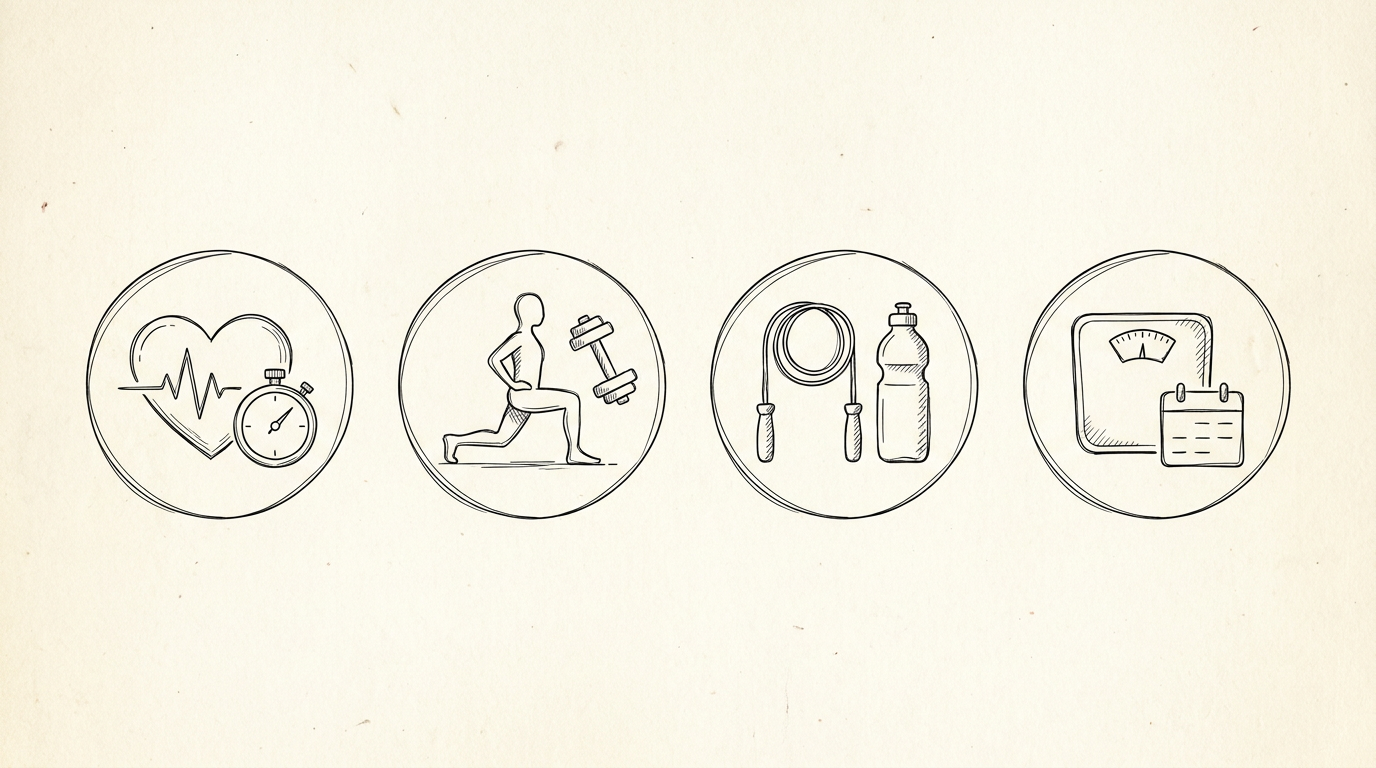
The four numbers that matter for home fitness
Calories: the foundation
Total calorie intake sets your energy balance. Everything else sits on top of this number. A useful starting point for active adults is somewhere between 1,600 and 2,400 calories per day, depending on body size, age, and activity level. Getting this number roughly right matters more than optimizing any single macro.
If you want to lose fat, a deficit of around 300 to 500 calories per day from your maintenance level produces steady progress without wrecking energy or recovery. If you want to build muscle, a modest surplus of 200 to 300 calories is usually enough.
Protein: the one worth prioritizing first
For anyone doing resistance training at home, protein is the macro worth tracking carefully. It supports muscle repair, keeps you fuller between meals, and has a higher thermic effect than carbs or fat, meaning your body uses more energy to process it.
A reasonable target is somewhere between 0.7 and 1 gram of protein per pound of bodyweight. For a 160-pound person, that’s 112 to 160 grams per day. Without tracking, people often fall short of this range without realizing it.
App-based approaches to fitness work partly because they give you feedback loops that are otherwise invisible. Protein is a good example: you don’t know you’re under-eating it until you start measuring.
Carbs and fat: support roles
Carbohydrates fuel your workouts. If you train fasted or under-fueled, you’ll notice it in performance and recovery. Fat supports hormone function and makes food satisfying. Neither macro needs to be extreme in either direction for home exercisers.
A split of roughly 40% carbs, 30% protein, and 30% fat works as a starting framework. Adjust from there based on how you feel during training and how full you stay between meals. That’s a heuristic, not a rule — your preferences and schedule will shape the actual numbers.
How AI-assisted logging removes the friction
Why manual logging breaks down
Traditional calorie tracking asks you to search a database, find the right food entry, estimate a portion in grams or ounces, and repeat for every ingredient. For a simple meal, that might take 3 to 5 minutes. For a mixed dish or a restaurant plate, it can take 10 minutes or more.
That friction compounds. Miss a meal entry, feel guilty, fall off the habit entirely. It’s a common pattern. AI-driven fitness tools have gained traction partly because they reduce the gap between intention and action, and meal logging is no different.
Text and photo logging in practice
The alternative is describing what you ate in plain language or taking a photo of your plate. Type “two scrambled eggs with a slice of sourdough toast and a tablespoon of butter” and get back an estimate of roughly 380 calories, 20 grams of protein, 28 grams of carbs, and 22 grams of fat. No database search. No barcode.
That kind of entry takes under 30 seconds. When logging takes 30 seconds instead of 5 minutes, you actually do it. Consistency matters more than precision here.
A fast, rough log you keep doing beats a perfect log you abandon after day four.
Where PlateBird fits into this workflow
PlateBird automatically calculates your calories, protein, carbs, and fat from text or photos. Just type what you ate or snap a picture. No manual logging, no barcode scanning. For home workout routines where the day is already full, that speed difference is what keeps the habit alive.
If you’re already tracking calories in any form, the process of setting and adjusting your calorie goal is worth reading through before you start.

Where AI estimates help and where judgment still matters
What the app gets right
For whole foods and simple meals, AI-based estimates are close enough to be useful. A chicken breast, a cup of rice, a handful of broccoli — these are well-understood foods with consistent nutritional profiles. The estimate you get back will be in the right range.
The value isn’t precision. It’s pattern recognition over time. If your average daily intake over 7 days is consistently 400 calories above your goal, that’s actionable information. You don’t need laboratory accuracy to see that.
Where you still need to think
Cooking oil is the biggest blind spot. A tablespoon of olive oil adds 120 calories. If you’re pan-frying in 2 tablespoons of oil and not logging it, that’s 240 calories missing from your daily total. Sauces, dressings, and condiments have the same problem.
Restaurant meals are harder to estimate because portion sizes vary and preparation methods aren’t visible. A restaurant pasta dish might be 600 calories or 1,200 calories depending on the restaurant and the serving size. In my experience, erring on the higher end when guessing restaurant meals keeps weekly averages more honest.
Mixed dishes — stews, curries, casseroles — are also harder for photo-based tools to parse accurately. For these, a text description with your best estimate of ingredients works better than a photo alone.
Treat AI calorie estimates as a fast decision aid, not a lab measurement. The weekly pattern matters more than any single meal entry.
A simple weekly routine that actually sticks
Log as you go, not at the end of the day
Trying to reconstruct everything you ate at 9pm is a recipe for underestimating. Memory compresses food. The snack you grabbed at 3pm, the extra handful of nuts, the splash of cream in your coffee — these disappear when you’re recalling from memory hours later.
Logging right after eating takes the same amount of time but produces far more accurate data. It also makes the habit feel lighter because you’re not carrying a mental list all day.
Use repeat meals to speed things up
People eat the same 10 to 15 meals on rotation. If you log your standard breakfast once and save it, every subsequent entry takes a few seconds. The same applies to your post-workout meal, your usual lunch, your go-to snacks.
Building a small library of repeat entries is one of the fastest ways to make tracking feel automatic rather than effortful. You’re not rebuilding from scratch every day.
Review weekly, not daily
Daily calorie numbers fluctuate for reasons that have nothing to do with fat gain or loss: water retention, sodium intake, meal timing, digestion. Reacting to a single high day creates unnecessary stress and often leads to overcorrection.
A useful heuristic is to check your 7-day average at the end of each week. If it’s consistently above your goal, reduce portion sizes on the meals that are easiest to adjust. If it’s below, add a snack or increase a portion. Small adjustments compound over 4 to 6 weeks.

Who gets the most from this kind of tracking
The home exerciser who trains but doesn’t track food
If you’ve been doing home workouts consistently for 4 or more weeks and haven’t seen the body composition change you expected, nutrition is almost certainly the gap. Not the workout programming. The food.
You don’t need to track forever. A period of 4 to 8 weeks of consistent logging usually gives you enough information to understand your default eating patterns and make lasting adjustments without needing to log every meal indefinitely.
The person who’s tried tracking before and quit
If manual logging burned you out, the friction was the problem, not the concept. Photo and text-based logging takes a fraction of the time. The habit becomes sustainable when the cost of doing it is low enough to survive a busy Tuesday.
For those who eat out regularly, tracking macros at restaurants is a specific skill worth building separately. It’s doable, just requires a slightly different approach than home meals.
The lifter focused on protein targets
If your primary goal is building or preserving muscle during home training, protein tracking alone is often enough to start. Hit your daily protein target of 0.7 to 1 gram per pound of bodyweight, keep calories roughly in range, and let the rest sort itself out.
Tracking just protein is less overwhelming than tracking everything at once. It gives you one clear number to aim for each day and builds the logging habit before you layer in more detail.
How to turn meal data into better workout results
Spot the patterns that affect energy
After 2 to 3 weeks of logging, patterns become visible. Low-carb days often correlate with flat, sluggish workouts. Days where protein is under 100 grams often feel harder to recover from. These aren’t universal rules — they’re your patterns, specific to how your body responds.
That’s the real value of consistent logging. Not the daily number, but the ability to look back across 14 or 21 days and see what conditions produce your best training sessions.
Adjust protein first when recovery stalls
If your workouts feel fine but soreness lingers longer than expected, protein is the first variable to check. A useful starting point: if you’re under 100 grams per day and training 4 or more times per week, adding a 25 to 30 gram protein source (a Greek yogurt, a scoop of protein powder, 100 grams of chicken) to one meal is the simplest lever to pull.
Don’t overhaul everything at once. Change one variable, give it 10 to 14 days, and see what shifts. That’s slower than it sounds, but it’s how you learn what actually works for you rather than what works in theory.
In my experience, the people who make the most consistent progress are the ones who change one thing at a time and wait long enough to see the result before changing something else.
Keep the system simple enough to sustain
Nutrition tracking should support your training, not compete with it for mental energy. If logging starts to feel like a second job, simplify. Drop to tracking protein only. Log 5 days instead of 7. Use photo logging for complex meals and text for simple ones.
The system that produces results is the one you keep using at the end of a long week, not the one that’s theoretically optimal. Sustainability beats precision every time.
Frequently asked questions
Are AI calorie estimates accurate enough for fitness goals?
For everyday meals, yes. The estimates are close enough to give you useful weekly averages. Where they fall short is with hidden calories: cooking oils, sauces, restaurant portion variation. A useful approach is to log consistently and treat the weekly average as your real data point rather than reacting to any single meal estimate.
How do I handle snacks and small bites that feel too minor to log?
Log them anyway, even roughly. A 20-calorie bite here and a 100-calorie snack there can add up to 300 to 400 untracked calories across a day. Text logging makes this fast: “a small handful of almonds” or “two bites of cheese” takes 5 seconds to type and keeps your daily picture honest.
How much protein do I actually need if I’m doing home workouts?
A useful starting range is 0.7 to 1 gram per pound of bodyweight. For a 150-pound person, that’s 105 to 150 grams per day. If you’re newer to training or not doing heavy resistance work, the lower end of that range is fine. If you’re training 4 or more days per week with progressive overload, aim closer to the upper end.
Can I use AI meal tracking without becoming obsessive about numbers?
Yes, and the key is reviewing weekly averages rather than reacting to daily totals. One high-calorie day doesn’t undo a week of good eating. If you find yourself anxious about individual meals, zoom out to the 7-day view and ask whether the trend is moving in the right direction. That perspective reduces the emotional charge of any single number.
How long do I need to track before I can stop?
In my experience, 4 to 8 weeks of consistent logging gives you enough information to understand your default patterns. After that, you can maintain progress by logging loosely or just tracking protein. Some prefer to keep logging because the data is useful. Neither approach is wrong — it depends on how much structure you need to stay on track.
Nutrition tracking works best when it’s fast enough to fit into real life. If you want logging to feel like a 30-second habit instead of a 10-minute chore, try PlateBird — type what you ate or snap a photo and get your calories, protein, carbs, and fat back instantly. For home workout routines where consistency is everything, that speed is what keeps the habit going week after week.