- Why calorie tracking speeds up weight loss when you actually stick to it
- How automated logging changes the daily effort
- The meal habits that make automated tracking more effective
- What simplified tracking research shows
- Common mistakes that slow weight loss even with an AI tracker
- A simple daily routine for faster progress
- When automated tracking is enough and when to get extra help
- Frequently asked questions
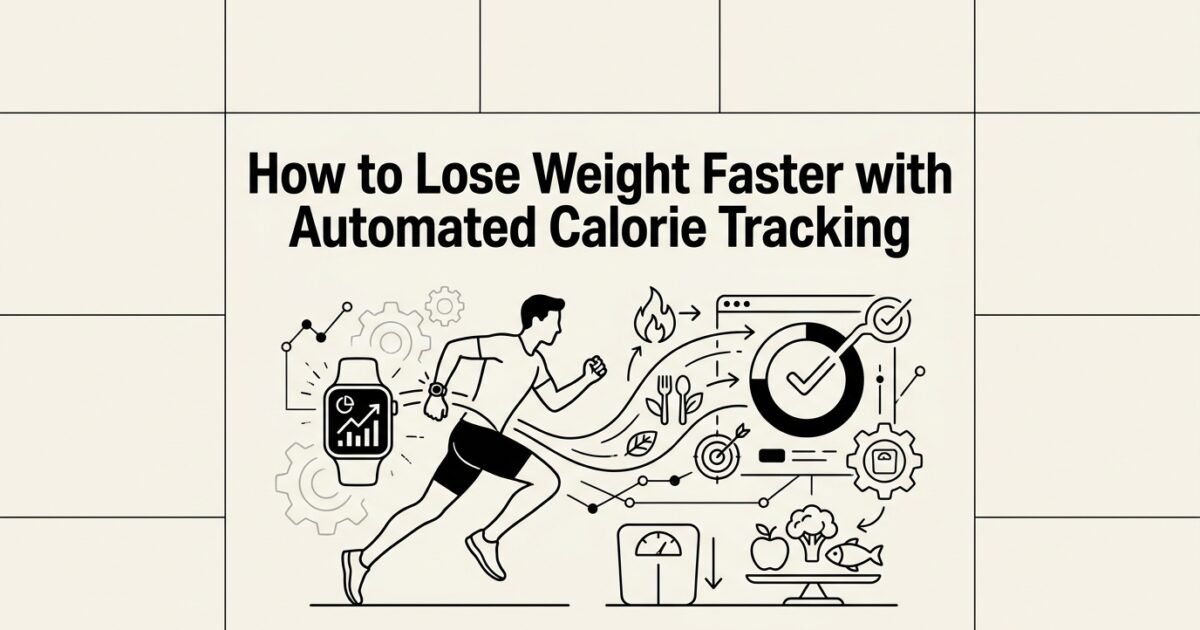
How to Lose Weight Faster with Automated Calorie Tracking
You downloaded a calorie tracker three weeks ago, logged every meal for the first five days, then quietly stopped. Not because the goal changed. Because typing out every ingredient in a chicken stir-fry at 8 p.m. felt like a second job.
That friction is the real reason weight loss stalls. Not willpower. Not the plan itself. The logging process becomes a barrier, and once you skip one meal, skipping the next feels easier.
How to lose weight faster with automated calorie tracking comes down to removing that barrier. Cut the time cost of logging to almost nothing, and consistency becomes the default rather than the exception.
Why calorie tracking speeds up weight loss when you actually stick to it
The deficit is still the mechanism
Weight loss comes down to eating fewer calories than you burn. That part has not changed. A sustainable deficit of 500 calories per day produces roughly 1 pound of loss per week without the rebound that comes from aggressive restriction.
The problem is not understanding the math. The problem is measuring it accurately enough, steadily enough, to let the math work.
Manual logging breaks down under pressure
In my experience, most people can sustain manual food logging for 4 to 7 days before the effort starts to feel disproportionate. A busy Tuesday, a lunch meeting, a meal someone else cooked, and the streak breaks.
Once the streak breaks, the data disappears. Without data, you are guessing. Guessing tends to underestimate calories, especially for calorie-dense foods like oils, nuts, and sauces.
The fastest weight-loss plan is the one you can repeat every day, not the most precise one you abandon after a week.
Adherence matters more than accuracy
A useful heuristic from behavioral research on dietary tracking: logging 80% of meals regularly beats logging 100% of meals for one week and then nothing. The cumulative data from consistent, approximate tracking gives you something to act on. Sporadic perfect logging gives you nothing.
Simplified tracking approaches can still produce clinically meaningful weight loss when paired with self-monitoring habits. The key word is simplified.
How automated logging changes the daily effort
Text logging takes 10 seconds
Instead of searching a database, scrolling through results, and adjusting serving sizes, you type a plain description: “grilled salmon fillet, roasted broccoli, olive oil.” The AI interprets the meal and returns calorie and macro estimates in seconds.
That difference matters. A 10-second log happens after every meal. A 4-minute database search gets skipped when you are tired or busy.
Photo logging works for mixed meals and restaurant food
Restaurant meals are the hardest to log manually because the ingredients are invisible. A photo-based approach lets you snap a picture of the plate and get an estimate without needing the kitchen’s recipe. The estimate will not be exact, but it will be close enough to keep your daily total meaningful.
If you eat out regularly, this matters. Skipping restaurant meals in your log because they are hard to track is one of the most common ways a calorie deficit disappears on paper while staying intact in your head.
Automation works because it removes the excuse to skip logging, not because it produces perfect numbers.
The goal is a complete picture, not a perfect one
An automated log with 90% accuracy across every meal is more useful than a manual log with 99% accuracy on three meals and nothing else. The gaps in a manual log are invisible. You do not know what you missed. A consistent automated log shows you the full day, even if individual entries have small rounding errors.
The meal habits that make automated tracking more effective
Build meals around protein and fiber first
Higher-protein meals slow digestion and keep hunger lower during a calorie deficit. A meal with 30 grams of protein tends to hold you longer than a meal with 10 grams at the same calorie count. Fiber works similarly: vegetables, legumes, and whole grains add volume without adding many calories.
A practical target is 25 to 35 grams of protein per main meal. That number is achievable with chicken breast (31 grams per 100 grams cooked), Greek yogurt (17 grams per 170-gram serving), or eggs (6 grams per egg).
Watch the small add-ons, not just the main dish
Oils, sauces, dressings, and drinks are where calorie estimates go wrong most often. A tablespoon of olive oil adds 120 calories. A standard pour of Caesar dressing can add 160 calories or more. These are easy to underestimate in a photo or text description if you do not call them out explicitly.
When you log a meal, mention the extras: “with a drizzle of olive oil” or “with ranch dressing on the side.” That one habit closes the biggest gap in automated estimates.
Use a food scale for the foods that matter most
A food scale improves portion accuracy compared with visual estimation, especially for calorie-dense foods. You do not need to weigh everything. Weighing nuts, oils, cheese, and nut butters, where a small visual error equals 100 to 200 extra calories, covers most of the risk.
For lower-calorie foods like leafy greens, cucumbers, or berries, visual estimates are close enough. Spend your precision where it pays off.
What simplified tracking research shows
Self-monitoring is linked to better outcomes
Research on remote dietary monitoring shows that consistent self-monitoring, including regular self-weighing, is one of the strongest behavioral predictors of weight-loss maintenance. The mechanism is simple: when you see the data, you make better decisions. When the data disappears, so does the feedback loop.
This is not about obsessing over numbers. It is about keeping the feedback loop intact so small drifts get caught before they become large ones.
Simplified methods still produce real results
A useful pattern from behavioral nutrition work: simplified tracking, where people log meals in plain language rather than weighing and measuring everything, can still produce meaningful weight loss when the habit is consistent. The calorie estimates do not need to be exact. They need to be close enough, often enough, to keep the overall trend visible.
Harvard Health notes that even rough calorie awareness, applied reliably, helps people make better food choices over time. The act of logging itself changes behavior.
Behavioral simplicity beats a perfect plan that you abandon after two weeks.

Common mistakes that slow weight loss even with an AI tracker
Underestimating portions on calorie-dense foods
Visual estimation is least reliable for foods that pack many calories into a small volume. A “handful” of almonds can range from 150 to 280 calories depending on the handful. A “drizzle” of olive oil can mean 60 calories or 200 calories.
For these foods specifically, weighing once or twice builds a mental reference point. After that, your estimates get much closer.
Ignoring liquid calories
A standard latte with whole milk adds 180 calories. A glass of orange juice adds 110 calories. Two glasses of wine can add 250 calories or more. None of these feel like a meal, so they often get left out of the log.
If you drink anything other than water, coffee, or plain tea, log it. Liquid calories are real calories, and they are among the easiest to forget.
Weekend drift
A pattern I see often: people log steadily Monday through Friday, then stop on weekends. If Friday dinner through Sunday dinner goes unlogged, that is roughly 9 meals with no data. Weekend eating tends to be higher in calories than weekday eating. Skipping those logs removes the feedback exactly when it is most needed.
| Mistake | Why it happens | Simple fix |
|---|---|---|
| Skipping oil and sauces in logs | They feel like minor additions | Name them explicitly in every log entry |
| Not logging drinks | Liquids do not feel like food | Log anything with calories immediately after drinking |
| Weekend logging gaps | Routine breaks on unstructured days | Log before eating, not after, on weekends |
| Trusting package serving sizes | Labels imply one serving equals one package | Check the serving count on the label before logging |
| Stopping after a bad day | One missed day feels like failure | Resume the next meal, not the next Monday |
A simple daily routine for faster progress
Log immediately, not later
The longer you wait after eating, the less accurate the log. Portion sizes shrink in memory. Add-ons get forgotten. Logging within 5 minutes of finishing a meal, or even before eating, keeps the data close to reality.
With text or photo logging, the time cost is low enough that “I’ll do it later” stops being a reasonable excuse. Later almost always means never.
Review your totals once per day
A daily review does not need to take more than 2 minutes. Look at your total calories and protein for the day. If one meal is higher than expected, note what caused it. That single habit builds pattern recognition faster than any other tracking behavior.
You are not looking for perfection. You are looking for the one or two habits that account for most of the gap between your goal and your actual intake.
Small daily corrections add up faster than large weekly resets that never quite happen.
Change one thing at a time
If your data shows you are regularly 300 calories over your goal, pick the single biggest source and adjust it. Not everything at once. Swapping a daily 400-calorie snack for a 150-calorie option closes most of that gap without requiring a complete diet overhaul.
One change, sustained for 2 to 3 weeks, becomes a habit. Then you find the next one. This is slower to set up than a full diet reset, but the results hold.
When automated tracking is enough and when to get extra help
Tracking is a tool, not a treatment
Automated calorie tracking works well for people who have a clear weight-loss goal, a reasonable deficit target, and no underlying health conditions that affect metabolism or nutritional needs. It is a feedback tool. It shows you what you ate and how it compares to your goal.
It does not replace medical guidance for conditions like thyroid disorders, PCOS, or disordered eating patterns. If your progress stalls for more than 4 to 6 weeks despite consistent logging and a genuine deficit, talking to a registered dietitian is worth the time.
Plateaus are normal and manageable
A weight-loss plateau after 6 to 8 weeks of consistent progress is common. The body adapts. At that point, the options are: reduce calories by another 100 to 200 per day, increase activity, or adjust the macro split.
The tracker gives you the data to make that call. Without consistent logging, a plateau is invisible until it has lasted months.
If the plan feels unsustainable, change the plan
A 1,200-calorie target that leaves you hungry by 3 p.m. every day is not a discipline problem. It is a plan problem. A sustainable deficit is one you can maintain without constant hunger or restriction that feels punishing.
The tracker shows you whether your actual intake matches your goal. If you are reliably 400 calories under your target and still not losing weight, something else is happening and a professional can help identify it.
Frequently asked questions
Do you need to weigh your food every time?
No. Weighing everything is accurate but unsustainable for most people. A useful approach is to weigh calorie-dense foods, such as nuts, oils, cheese, and nut butters, where visual estimation is least reliable. For lower-calorie foods like vegetables and fruits, visual estimates are close enough. Weigh strategically, not obsessively.
Is photo logging accurate enough for fat loss?
In my experience, photo logging is accurate enough when you are consistent. The estimates will not match a food scale, but they will be close enough to keep your daily total meaningful. The bigger risk is not the photo’s accuracy, it is forgetting to log at all. Consistent approximate data beats perfect data that stops after day 5. We cover this topic in more depth in Best AI Nutrition Tracking Apps: Photo-Log Macr….
How long does it take to see results with consistent tracking?
A realistic timeline: with a genuine 500-calorie daily deficit maintained steadily, most people see measurable scale movement within 2 to 3 weeks. The first week often includes water-weight changes that can look dramatic. Actual fat loss becomes visible over 4 to 6 weeks of consistent tracking and eating. Progress is rarely linear, but the trend over 4 weeks is almost always informative.
What if I forget to log a meal?
Log the next one. Do not try to reconstruct what you missed from memory, and do not wait until tomorrow to restart. A single missed meal in an otherwise complete log is a minor gap. Stopping the log because of one missed meal turns a small gap into a week of missing data. Resume immediately. The habit is more important than the streak.
Does tracking calories mean I have to eat less of everything?
No. Tracking shows you where your calories are actually coming from, which is often different from where you assume they come from. Calorie awareness lets you make targeted adjustments rather than restricting everything. A common outcome is realizing that two or three specific habits, such as a daily flavored coffee drink or a large evening snack, account for most of the gap. Fix those, and the rest of the day can stay largely the same.
Consistency is the variable that separates people who lose weight from people who plan to. The tracking method that takes 10 seconds per meal is the one you will actually use on a Wednesday night when you are tired. If you want automated calorie tracking to feel like a natural part of your day rather than a chore, try PlateBird, type or photograph what you just ate, and let the numbers take care of themselves while you focus on the one habit that actually moves the scale: showing up again tomorrow. You might also find our guide on Intermittent Fasting and Macro Tracking: A Plat… helpful.