
A standard 8-piece California roll usually lands around 250 to 400 calories, and some full rolls run roughly 250 to 420 calories depending on size and ingredients. That's why the same “healthy sushi choice” can feel light at one restaurant and surprisingly heavy at another.
You're probably here because you're staring at a sushi menu, a takeout container, or your calorie tracker and realizing the numbers don't line up. One app gives you one answer, the restaurant label gives you another, and neither tells you whether your roll was packed with extra rice, bigger avocado slices, sesame, or mayo. California rolls aren't hard to enjoy. They're just harder to log accurately than one might expect.
Your Guide to California Roll Calories
A California roll looks simple. Rice, seaweed, imitation crab, avocado, maybe cucumber. But in practice, the calorie total changes a lot from one version to the next.
That's not guesswork. Virginia Tech's dining nutrition label lists one California roll at 276 calories, while the same body of verified menu data also includes an 8-slice California sushi roll at 418 calories, and a typical restaurant-style estimate of about 250 to 300 calories for 8 pieces. Put together, that gives a practical real-world range of roughly 250 to 420 calories for a full roll.
That spread matters if you're trying to lose fat, hit macros, or avoid the cycle of being “good” all day and then feeling guilty over sushi at dinner. Overeating occurs not because of the sushi selection itself, but from a misjudgment of the portion.
Practical rule: Don't ask only “How many calories are in a California roll?” Ask “How big was the roll, and what did they put in it?”
If you've ever logged one generic entry and hoped for the best, you're not alone. Sushi is one of those foods where standard entries often break down fast. Piece count, roll diameter, sauce, and rice thickness all matter. That's why a more useful skill is learning how to estimate your specific order. If you want a broader method for foods like this, PlateBird's guide on how to count calories is a solid starting point.
The Nutritional Profile of a California Roll
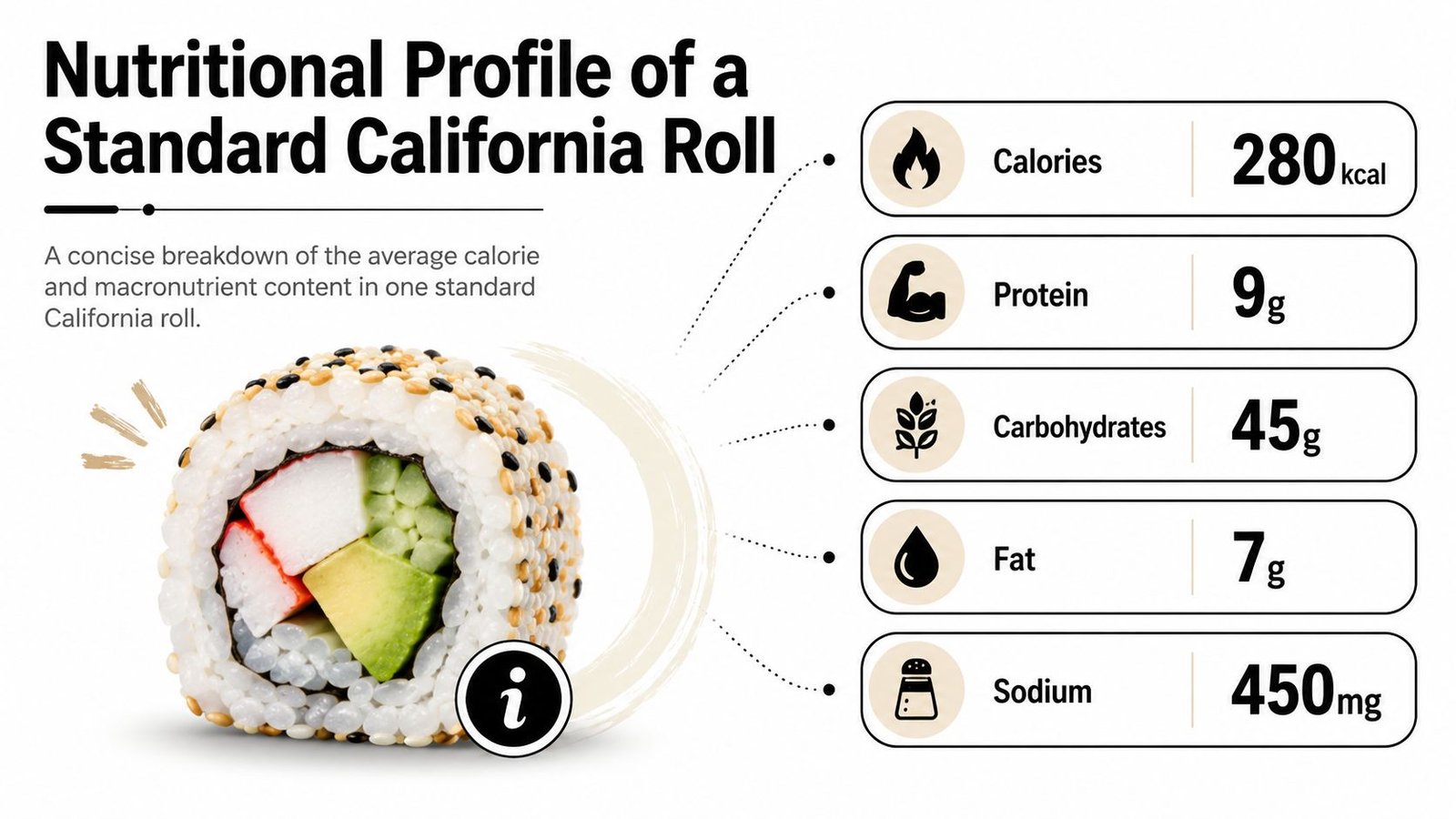
You sit down for sushi, log “California roll,” and see an entry that looks surprisingly low. The catch is serving size. CalorieKing's California sushi roll entry lists 129 calories for 2 pieces, defined as 1/4 roll, along with 4.7 g fat, 19.1 g carbs, and 3 g protein. That same entry also shows how easy it is to undercount if you miss the portion description.
What those numbers mean in real life
A California roll usually lands in the moderate-calorie range, but the macros matter just as much as the total. Most of the calories come from sushi rice, with smaller contributions from imitation crab, avocado, and any mayo-based mix in the filling. Protein is present, but not in a high amount. If your goal is fullness or muscle support, that matters.
This is why I rarely recommend judging sushi by calories alone. Two rolls with a similar calorie total can feel very different afterward if one is mostly rice and the other includes more fish or a side of edamame.
A practical baseline to use
If you do not have a restaurant nutrition label, use a simple framework instead of chasing one “perfect” number:
- Per 2 pieces: about 129 calories is one reasonable reference point from the source above
- Per piece: usually a modest amount, but the exact number depends heavily on cut size and rice thickness
- Per full roll: often much higher than people expect because the logged serving is commonly only part of the roll
That last point is where tracking breaks down. Sushi is notoriously hard to log because databases may list pieces, fractions of a roll, or weights that do not match what arrived at your table. If you want a more accurate method for restaurant meals, PlateBird's guide to estimating calories when eating out gives a practical system you can use in a minute or two.
A California roll fits well in a balanced meal. It usually does not provide enough protein on its own to make that meal especially filling.
The practical takeaway is simple. Use calorie entries as a starting point, then sanity-check the portion in front of you. If the roll is thick, tightly packed, or made with extra avocado or mayo, log higher. If it is a smaller, cleaner roll, log closer to the baseline.
Why California Roll Calories Are So Variable
The biggest reason people get confused by calories in a California roll sushi is that the roll name stays the same while the build changes underneath it.
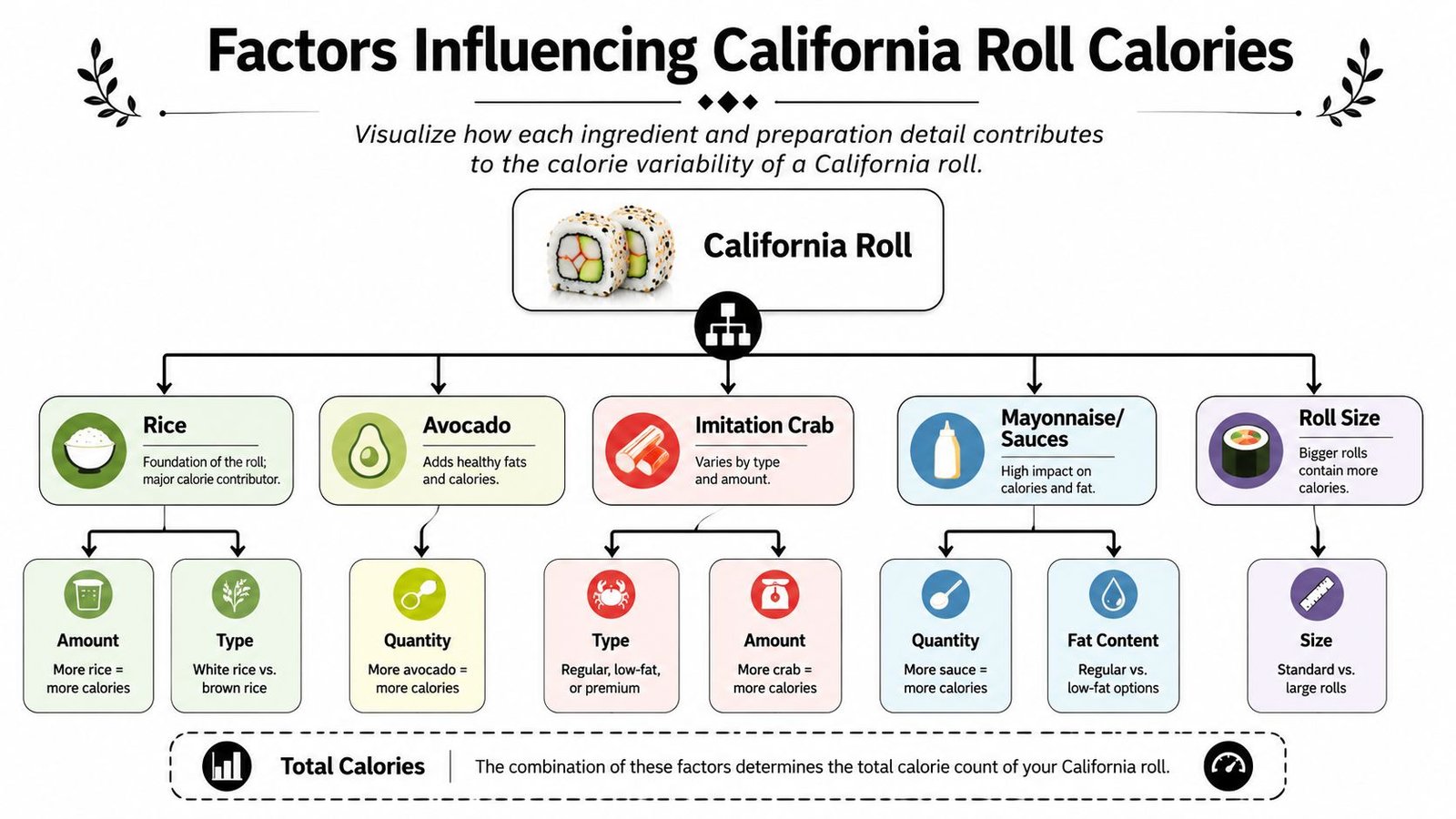
Tomo Restaurant's nutrition explainer shows the problem clearly. A standard 8-piece roll can range from about 237 to 300 kcal in restaurant writeups, a packaged 10-piece roll is 240 kcal, and a university cafeteria label lists 8 slices at 418 kcal. That means the same named food can differ by nearly 2x depending on portion and preparation. The same source also points to the main drivers: rice, mayo, masago, and surimi.
Rice changes more than people think
Rice is usually the largest calorie contributor in a California roll. Not because rice is “bad,” but because sushi rice is dense, packed tightly, and often makes up most of the roll's volume.
A thin, compact roll can feel modest. A larger restaurant roll with a thick rice layer can push calories up fast even before sauces enter the picture.
Add-ons quietly raise the total
Avocado is nutritious and satisfying, but more avocado means more calories. Mayo-based sauces do the same thing faster because they add fat without adding much volume. Sesame and masago aren't usually the main driver alone, but they can still nudge the total upward.
A quick visual can help if you want to get better at spotting these differences.
What to look for before you log it
When I teach clients how to estimate sushi, I tell them to stop asking whether it's a California roll and start asking what kind of California roll it is.
- Check the roll size. A bigger diameter usually means more rice.
- Look for glossy toppings or drizzles. That often signals sauce.
- Notice the filling ratio. More avocado and surimi can shift the total.
- Count the pieces, then inspect the cut. Eight large pieces aren't the same as eight slim ones.
If you eat out a lot, PlateBird's guide on how to estimate calories when eating out is useful because it focuses on this exact problem. Restaurant food often resists one-size-fits-all entries.
How California Rolls Compare to Other Sushi
A California roll often occupies a central position on the sushi menu. It's usually lighter than heavily dressed specialty rolls, but it isn't the leanest choice if your main goal is protein per calorie.
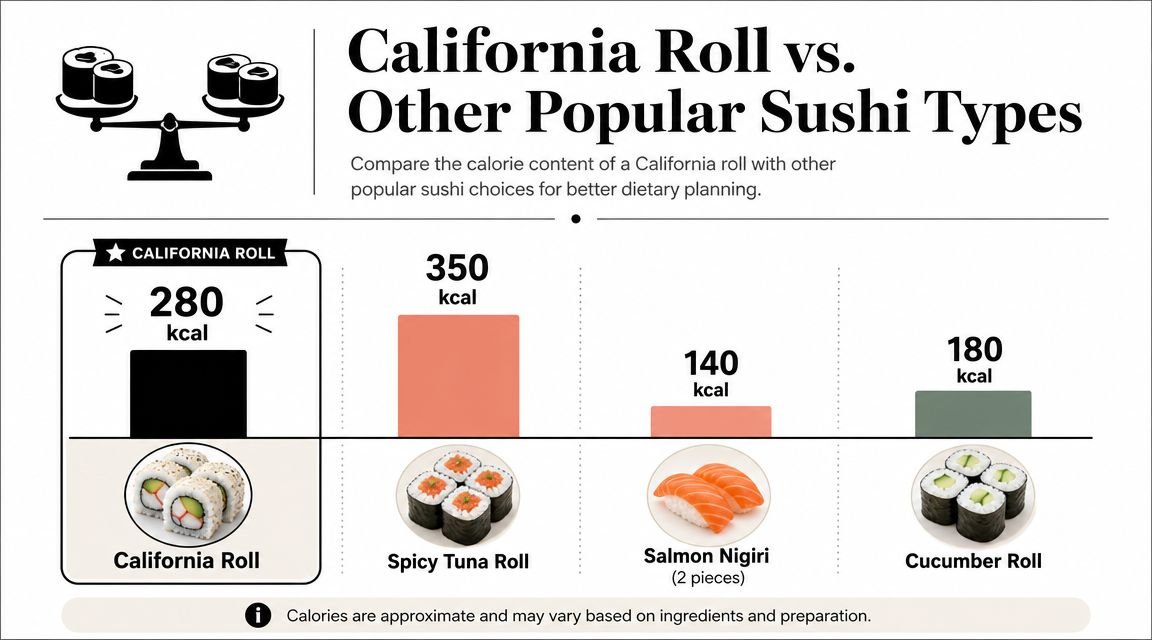
A simple menu comparison
Here's the practical way to approach this:
| Sushi choice | What usually drives the calories | Best for |
|---|---|---|
| California roll | Rice, avocado, imitation crab, possible sesame or sauce | A familiar moderate option |
| Spicy tuna roll | Mayo-style spicy mixture can raise calorie density | People who want flavor and don't mind a richer roll |
| Shrimp tempura roll | Fried shrimp and crunchy add-ons | More indulgent meals |
| Salmon or tuna nigiri | Smaller rice portion with fish on top | People prioritizing protein and simpler ingredients |
| Cucumber roll | Mostly rice plus cucumber, minimal rich add-ons | A lighter side order |
California rolls often work well when someone wants sushi that feels approachable and satisfying without jumping straight to fried or heavily sauced options. But if your goal is to maximize protein, nigiri or sashimi often does the job more efficiently.
The real trade-off
A California roll usually gives you a softer, more carb-forward meal. Nigiri or sashimi tends to be more direct. You see the fish, you get less filler, and it's easier to understand what you're eating.
If a client wants “healthy sushi,” I don't automatically say “order a California roll.” I ask whether they want fullness, lower sodium, more protein, or just a lighter meal that still feels fun.
If you want a broader menu lens, this guide for caterers on sashimi sushi is a useful read because it explains the practical difference between sushi styles in a way that helps with ordering decisions, not just definitions.
Tips for Ordering a Healthier Sushi Meal
A healthier sushi meal isn't always the one with the lowest calorie count. For many people, the smarter question is whether the meal supports fullness, protein goals, and a reasonable sodium load.
Arise's California roll nutrition breakdown shows why that matters. One breakdown lists roughly 28.9 g carbs and 6.75 g protein per roll, another lists 45 g carbs and 9 g protein, and one typical estimate puts sodium at 769 mg per roll. That's a useful reminder that California rolls are often moderate in calories, moderate to low in protein, and potentially significant in sodium.
What works better than calorie obsession
If you're trying to lose weight, don't assume sushi is automatically light. If you're trying to build muscle, don't assume one roll gives you enough protein for a meal. Those are different problems, and both show up with California rolls.
Here are the adjustments that usually help most:
- Ask for sauce on the side. This keeps the meal flexible. You can still enjoy the flavor without losing control of the total.
- Pair the roll with a protein-forward item. Sashimi, extra fish, or another simple protein choice can make the meal more satisfying.
- Watch the soy sauce habit. If sodium is a concern, this matters as much as the roll itself.
- Choose simpler rolls more often. A plain roll plus a protein side usually works better than stacking rich specialty rolls.
Better ordering patterns
Some combinations tend to work well:
- For fat loss: A California roll can fit, especially if you skip extra mayo-heavy additions and build the rest of the meal carefully.
- For gym goals: Use the roll as a carb source, not your only protein source.
- For general wellness: Keep variety, but pay attention to sodium and how sauces change the meal.
“Healthy” sushi usually comes from the full order, not one menu item in isolation.
That mindset keeps people from treating a single California roll as either perfect diet food or a mistake. It's neither. It's a flexible option that works best when you order around its strengths and limits.
Log Your Sushi in Seconds with PlateBird
California rolls are exactly the kind of food that expose the weakness of manual logging. You know what you ate, but the details that affect the calorie total often aren't obvious enough to enter cleanly. Was it a compact grocery-store roll, or a large restaurant roll with extra rice and mayo? Did it have sesame, masago, or spicy sauce mixed in?
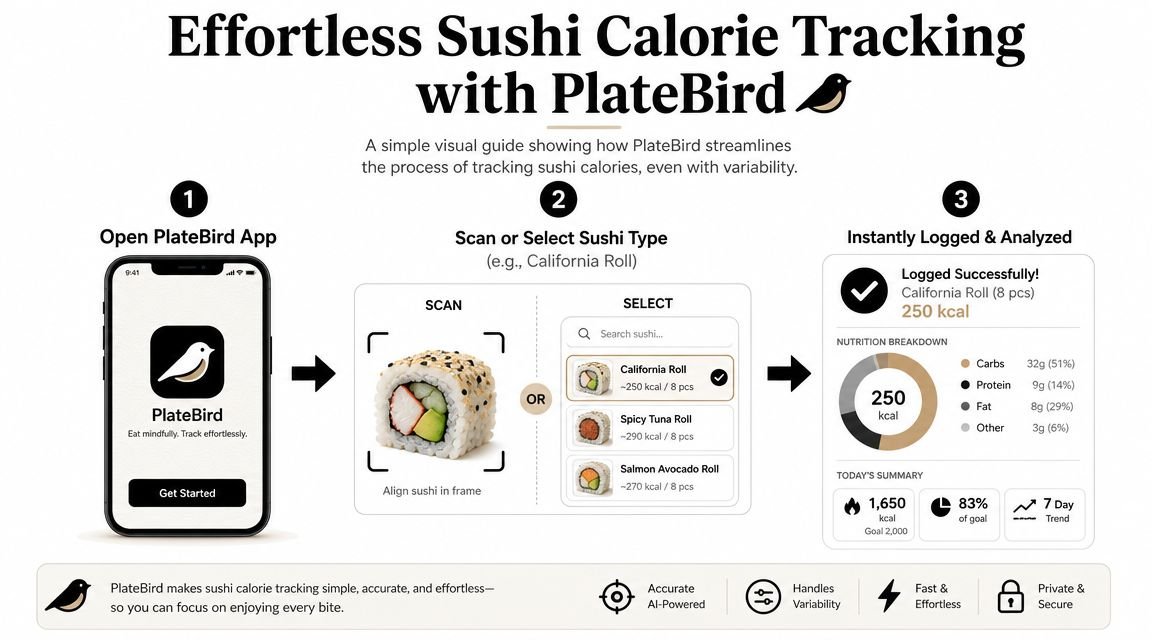
That's why simple logging tools matter most with foods like sushi. PlateBird lets you type a real-world entry such as “8 piece California roll with avocado and spicy mayo” and get an estimate without digging through endless database entries. If you want to see how that works, the AI calorie counter shows the core idea.
Why this is useful for sushi
Sushi isn't hard because the food is complicated. It's hard because portions vary and labels are inconsistent. A tool that accepts natural language is better suited to that than forcing you to pick one generic “California roll” entry and hope it matches.
Photo logging helps too. With sushi, the visual details matter. Piece count, size, sauces, and side items all shape the entry. That makes image-based logging especially practical for takeout trays and restaurant plates.
A better fit for how people actually order
Modern restaurant ordering keeps getting more digital, which helps with convenience but not always with nutrition clarity. If you're interested in how menus themselves are changing, this contactless menu QR code guide gives helpful context on the way restaurants present choices today.
For tracking, speed is key. If logging sushi feels annoying, logging often stops. A tool that works from a sentence or a quick photo removes the friction that usually causes under-logging or rough guesswork.
If you want a faster way to track meals like sushi without playing database roulette, try PlateBird. You can type what you ate or snap a photo, and the app handles the calorie and macro estimate in seconds.