- Why Pre Workout Nutrition Matters More Than You Think
- The Building Blocks of a Smart Pre Workout Meal
- Matching Fuel to Your Workout Type
- Timing Your Meal So Your Stomach Cooperates
- Hydration and Supplements Worth Considering
- Sample Meals and Quick Swaps for Real Schedules
- Tracking What Fuels You and FAQ
At 5:45 a.m., the gym bag is already by the door, your shoes are tied, and the kitchen is the last obstacle between you and the first set. You've got two minutes to decide whether to eat oatmeal, grab a banana, sip coffee, or just go. That tiny decision can make the difference between a session that feels flat and one where your first warm-up set wakes up the body.
A common approach to pre workout nutrition is following a rigid routine, leading to confusion when the same meal supports one session but hinders the next. A more effective mindset is straightforward: fuel should align with the specific session ahead. Often, the best strategy for how to fix groggy mornings isn't another stimulant, but rather mastering the fundamentals before training and adapting them to your personal schedule and digestive needs.
Why Pre Workout Nutrition Matters More Than You Think
A lifter who trains underfed usually does not feel an obvious crash. The signs are quieter, a little more effort on the first reps, less patience between sets, and focus that slips sooner than it should. Pre-workout food matters because the body can only work with what is on hand, not with what you planned to eat later.
The International Society of Sports Nutrition's position statement lays out the logic clearly. It recommends 1–2 g of carbohydrate per kg of body mass and 0.15–0.25 g of protein per kg about 3–4 hours before competition, because carbohydrate is the main fuel for moderate-to-high intensity exercise and timing affects comfort as well as performance ISSN position stand. For a 70 kg athlete, that works out to roughly 70–140 g of carbohydrate and 10.5–17.5 g of protein in that window ISSN position stand.
Fuel changes how hard the session feels
Pre workout nutrition works like paying part of the session cost before you arrive. If the tank is fuller, the workout tends to feel less expensive once intensity rises. That does not mean every training day needs a large meal, but it does mean planning usually pays off.
Survey data from endurance athletes show that pre-training fuel is already part of many routines, just not in a consistent way. In one study, 36.4% consumed carbohydrate-containing foods or drinks before almost every morning workout, 36.0% did so only some of the time, and 27.6% reported never or rarely doing so survey study. The same study found 89.0% used at least some kind of dietary supplement, including coffee or tea, within 1 hour before exercise survey study.
That pattern says a lot. Many lifters and athletes have already moved past the old habit of always training fasted, but they still often choose fuel by routine instead of by the session in front of them. A heavy squat day, a long conditioning workout, and a short mobility session do not ask the body for the same thing, so they should not be fed the same way.
Practical rule: if the workout matters, the fuel plan matters too.
That rule matters even more on groggy mornings, when time is tight and appetite is low. If you need a simple starting point, how to fix groggy mornings is often less about forcing more caffeine and more about getting the first part of the day set up so training does not start from behind.
A smarter filter is simple. Ask what you are about to do, how long it will last, and how hard it will feel. A long run, a heavy lift, and a quick mobility session place very different demands on the body, so they should not get the same pre-workout plate.
The Building Blocks of a Smart Pre Workout Meal
A smart pre workout nutrition plan starts with three moving parts, carbohydrates, protein, and fluid. The easiest way to understand them is as a job split, not a menu rule. Carbs are the fuel that helps you keep output steady, protein supports muscle tissue, and hydration helps the whole system function without getting sluggish.
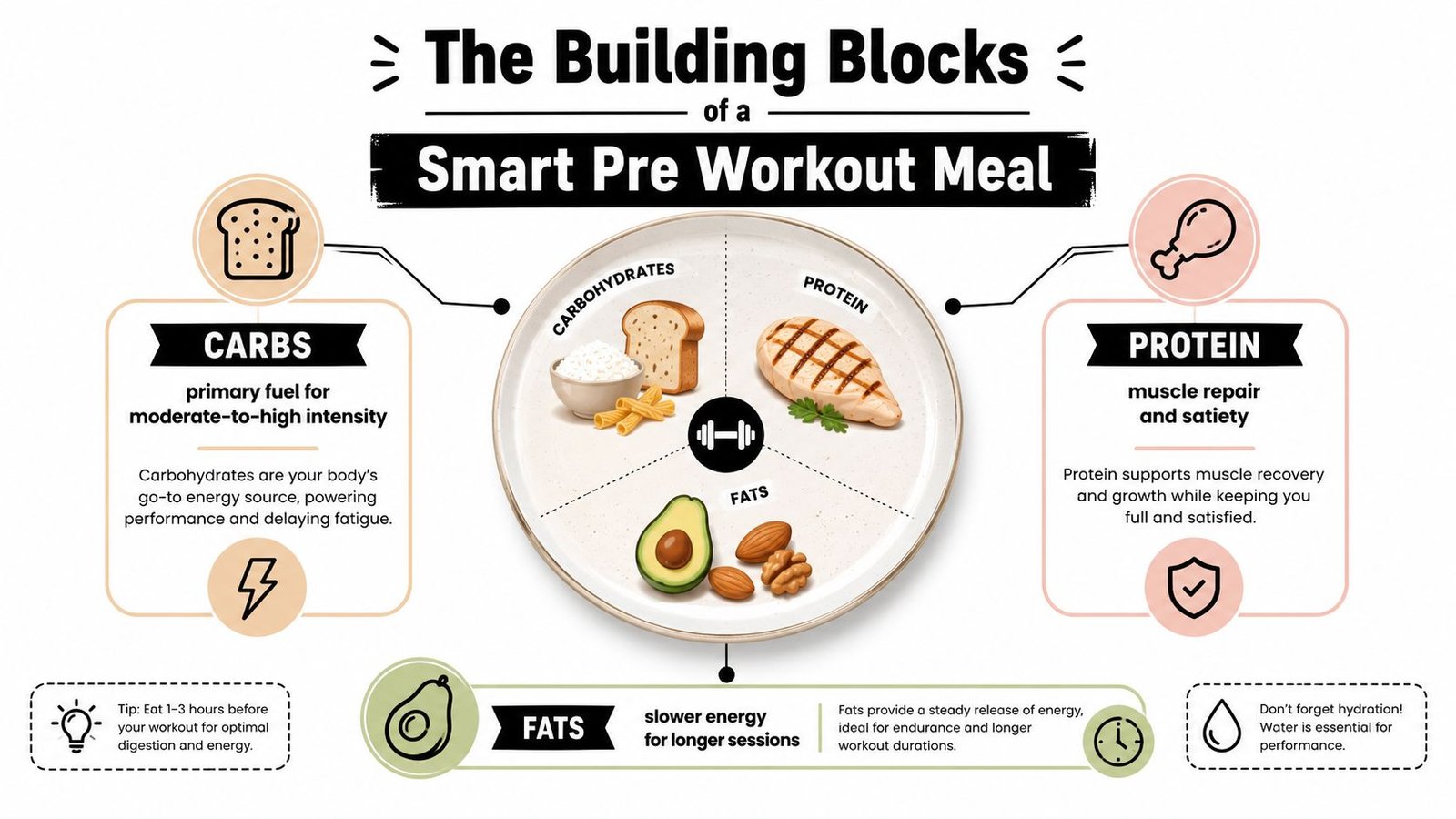
A practical anchor point from the International Society of Sports Nutrition is 1–2 g of carbohydrate per kg of body mass and 0.15–0.25 g of protein per kg about 3–4 hours before exercise ISSN position stand. The same statement says the best pre-exercise meal depends on workout duration and fitness level, which is why there is no single breakfast that fits every trainee ISSN position stand.
Carbs do the heavy lifting
Carbohydrate is the main fuel source when intensity climbs. That is why oats, rice, bread, fruit, and potatoes often show up in better pre-training meals, especially before a long or demanding session. If you want a broader starting point, a complex carbohydrates list of foods makes it easier to stock the kitchen without guessing at every meal.
Protein matters too, just in a different lane. It does not replace carbohydrate as the main workout fuel, but it helps support muscle tissue and recovery while the session is underway. A practical protein-packed home cooking guide can make repeatable meals easier to build, especially when mornings are rushed and improvising leads to random choices.
Why fat and fiber change the timing
Fat and fiber are not the problem. Timing is. Both slow digestion, which can be helpful when you want to stay full for hours, but irritating when you are heading to the gym soon. A heavy nut butter sandwich, a greasy breakfast, or a very large salad may feel fine at lunch and sit like a brick before squats.
Food closer to training should usually get simpler, not more ambitious.
That is why a meal farther from training can include more volume, more fiber, and more variety, while a meal close to the session usually works best when it is smaller and easier to digest. The same ingredients can be a good breakfast and a bad last-minute pre-lift meal, depending on how much time your stomach has to do its work.
Matching Fuel to Your Workout Type
A useful pre workout nutrition plan starts with the workout, not the calendar. A 75-minute run, a lower-body strength day, a short HIIT circuit, and a casual walk all use fuel differently. If the advice ignores that, it sounds tidy but doesn't fit real training.
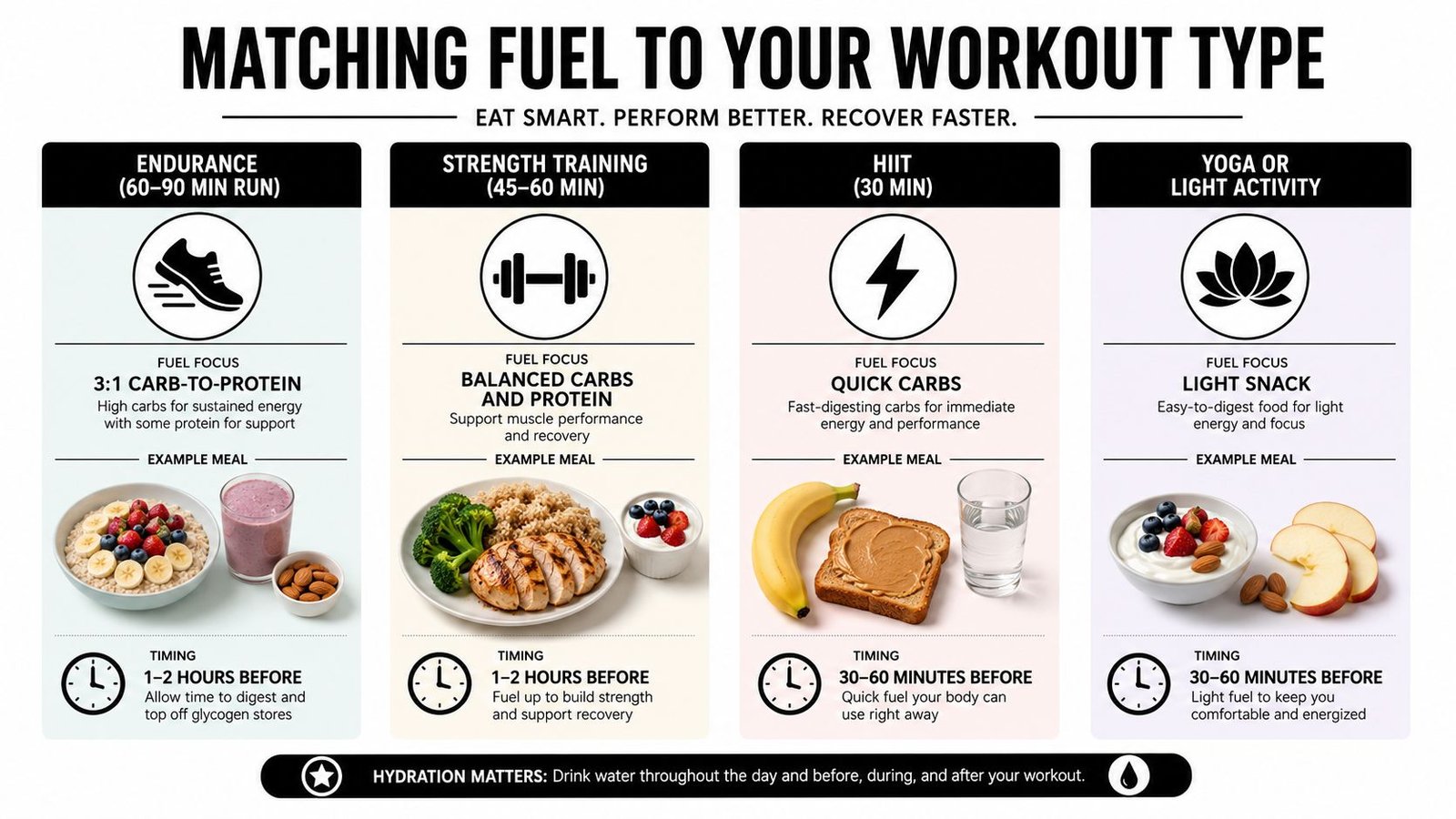
For endurance work, carbohydrate is the priority because the session is asking for sustained output. For resistance training, carbohydrate still matters, but protein moves closer to center stage because the goal is to protect muscle and support recovery. For shorter or moderate lifting sessions, carbohydrate intake is often rarely a limiter, while higher-volume lifting may benefit more from pre-workout carbs and a small protein dose around 0.3 g/kg, according to the review cited in the brief Macrofactor review.
Four scenarios, four different answers
A steady-state run or ride usually wants the most carb-heavy setup. The food needs to be practical, not fancy, because the job is to keep energy stable through a longer effort.
A heavy lifting session wants a more balanced plate. Think carbs plus protein, not carbs alone. The food supports performance, but it also sets up recovery between sets and after the workout.
A HIIT session is where too much food too close to training backfires quickly. The gut doesn't have much time to settle, so a smaller, simpler pre-workout snack tends to work better than a full meal.
A walk, yoga, or light mobility session barely needs special treatment. Normal breakfast or a light snack is usually enough, because the workout doesn't ask for the same fuel load.
The table below keeps that logic straight.
| Workout type | Carb focus | Protein focus | Best timing |
|---|---|---|---|
| Endurance | High | Modest | Earlier, with a fuller meal |
| Strength training | Moderate to high | Important | Several hours out or a smaller snack closer in |
| HIIT | Quick, easy carbs | Light | Close to the session |
| Yoga or light activity | Low to moderate | Optional | Normal meal timing works |
Useful shortcut: longer and harder sessions usually need more carbs, while shorter sessions tolerate less food.
A lot of confusion disappears once you stop asking, “What is the best pre-workout meal?” and start asking, “What does this session demand?” That question is more annoying, but it's also more accurate.
Timing Your Meal So Your Stomach Cooperates
The stomach has a vote, whether the training plan acknowledges it or not. A meal that looks perfect on paper can still ruin a session if it's too large, too fatty, or too fibrous for the time available. Timing is less about rules and more about matching meal size to the clock.
Three to four hours out, the body can handle a normal meal. That's the window for oats, rice, eggs, chicken, potatoes, and fruit, because there's enough time for digestion to happen without a rush. The ISSN guidance points to this window for a reason, it gives enough lead time for carbohydrate and protein to be useful without causing a comfort problem ISSN position stand.
The shorter the window, the simpler the meal
One to two hours out, shrink the meal. Choose simpler carbs, keep fiber lower, add a little protein, and don't load up on fat. That's the sweet spot for a banana with yogurt, rice cakes with honey, or cereal with milk when you still need something in the tank but don't have time for a full meal.
Under 30 minutes, think small and easy. A liquid snack or a mini carb hit usually makes more sense than trying to force a solid meal. Coffee can fit here too, but it should be treated as a fuel-adjacent choice rather than a meal replacement.
Practical rule: if training starts soon, dinner-style food is the wrong tool.
The reason is mechanical, not moral. Food close to exercise has less time to empty from the stomach, and higher-fat or higher-fiber meals often feel heavier for exactly that reason. If you've ever regretted eggs, beans, or a giant protein bowl before leg day, that's the problem you ran into.
A lot of trainees also assume they need to “eat more” right before a workout to make up for a lighter earlier meal. Usually, that just shifts the discomfort to the warm-up. If the session is close, keep the dose small and let the workout, not the stomach, do the work.
Hydration and Supplements Worth Considering
Hydration deserves more respect than it gets because it affects how the session feels before the first set even begins. The practical starting point is roughly 5–10 mL per kg of body mass in the 2–3 hours before training, then small sips as needed during the session, with more attention in heat and humidity. That's not a rigid script, it's a starting range that you can adjust to sweat rate and climate.
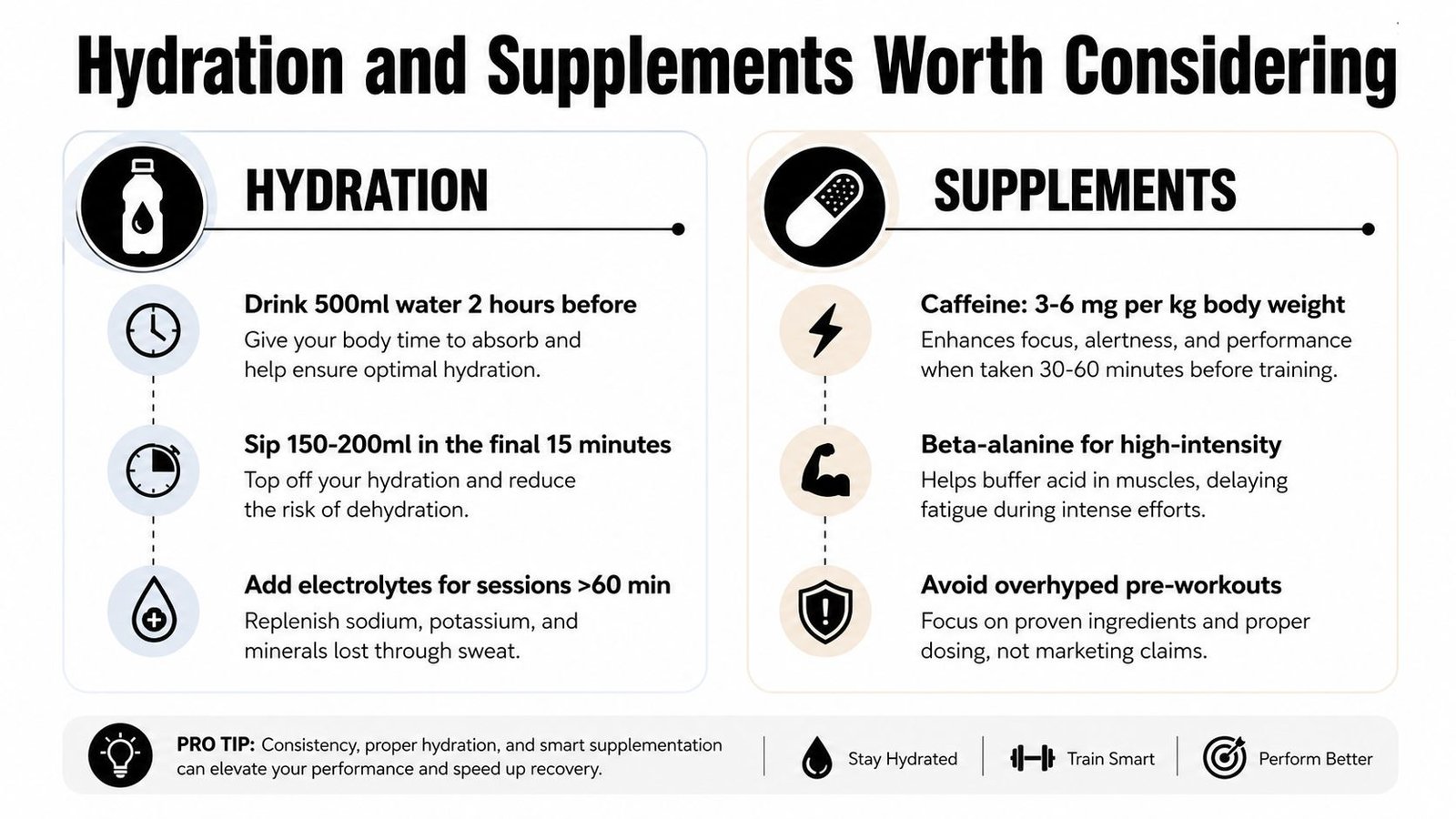
The supplement aisle, by contrast, rewards restraint. The brief's guidance is clear, caffeine is the most evidence-backed performance booster, creatine monohydrate is worth daily use regardless of timing, and multi-ingredient pre-workouts are not automatically better than simpler carbohydrate strategies. That's the right hierarchy for busy trainees, because it keeps the focus on what consistently helps.
The simplest stack usually wins
Coffee or tea before training works for many who tolerate caffeine, and it makes sense to use it when it supports alertness and effort. Creatine is a daily habit more than a timing trick, so the key question is consistency, not whether it's taken thirty minutes before a set.
Multi-ingredient blends are where people often pay for complexity they don't need. More ingredients can look impressive on a label while adding little practical benefit, especially if the person using it hasn't handled the basics of food, sleep, and hydration first. If you do buy a pre-workout product, third-party testing is the only filter that really matters, and the brief specifically points to NSF Certified for Sport or Informed Choice as the safety check.
The internal link below is useful if you're trying to make protein decisions around shake-based snacks and want to understand how those calories add up in practice: protein shake calories.
| What to prioritize | Why it matters |
|---|---|
| Fluids before training | Supports comfort and performance |
| Caffeine if tolerated | Helps alertness and effort |
| Creatine daily | Supports long-term training use |
| Third-party testing | Reduces supplement risk |
A good rule is to earn the right to add supplements. If the meal is poor, the hydration is sloppy, and the timing is random, a complicated powder won't rescue the session.
Sample Meals and Quick Swaps for Real Schedules
Three trainees walk into the same week with three different constraints. The right pre workout nutrition choice for each one isn't the same meal, it's the meal that fits their clock, their gut, and the session in front of them.
An early-morning lifter wakes up with barely enough time to move. A parent has a 40-minute gap between school drop-off and the gym. A runner trains later in the day, after work, with more time to eat but also more chances to get the meal wrong. The best answer for all three is not “eat exactly this,” it's “choose the smallest effective option that fits.”
Three real-world setups
The early-morning lifter usually does best with a tiny, simple option. A banana, a sports drink, or a small carb-focused shake can be enough to avoid that empty, sluggish feeling without sitting in the stomach like a brick.
The runner with more time can use a fuller meal. Oatmeal with banana and Greek yogurt, rice with eggs and fruit, or a turkey sandwich on white bread all make sense when there's enough time for digestion and the workout is longer.
The parent squeezed between tasks needs portable food that doesn't require a kitchen ceremony. Rice cakes with honey, a low-fiber cereal bowl, or a banana with whey can solve the problem without turning breakfast into a project.
The internal link below is useful if your main issue is keeping convenient options on hand instead of defaulting to whatever's easiest to grab: portable protein snacks.
A short list of swaps that actually help
- Use white rice instead of brown rice when the workout is soon and you want easier digestion.
- Choose fruit instead of a heavy granola bar when you need quick carbs without a dense, sticky snack.
- Keep beans and broccoli away from the pre-lift window if your stomach is sensitive to fiber before training.
- Use whey or milk-based protein when you want a small protein addition that doesn't make the meal feel oversized.
- Keep sports drink in the pantry for the days when solid food feels like too much.
The best pre-workout meal is often the one you can repeat without overthinking it.
That's the pattern to chase. The right meal is repeatable, portable, and boring in a good way, because consistency beats novelty when training is the priority.
Tracking What Fuels You and FAQ
The fastest way to learn your own best pre-workout pattern is to track it for a couple of weeks. Write down what you ate, how close it was to training, and how the session felt. You'll spot the difference between meals that leave you steady and meals that leave you heavy, flat, or queasy.
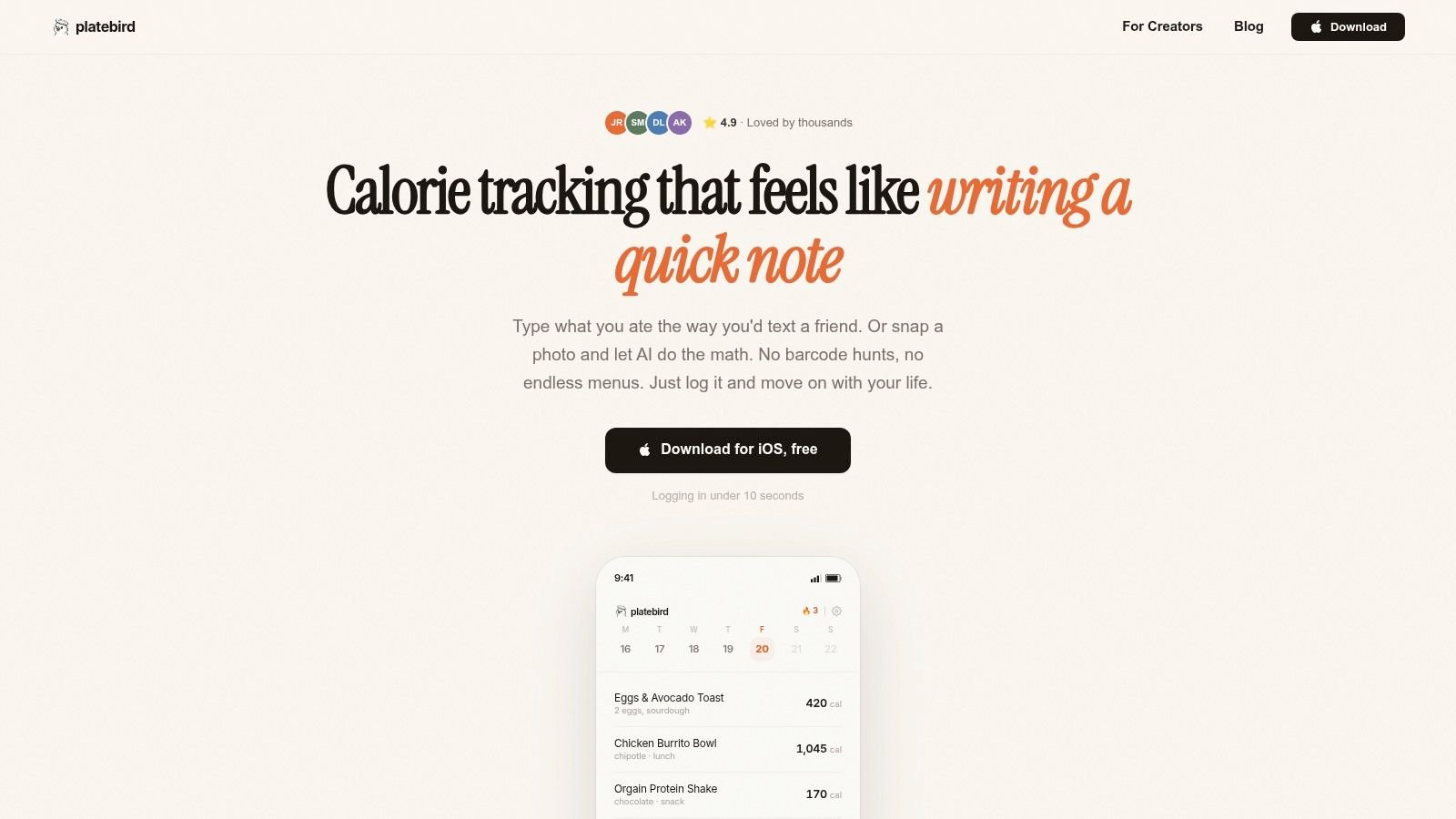
A quick logging habit makes that easier. Type the meal, snap the plate if you want a visual backup, and reuse the same breakfast or snack the next time the session feels good. That's usually enough data to stop guessing and start repeating what works.
FAQ
Is fasted training okay? Sometimes, yes, especially for short or lower-intensity work. If the session is hard, long, or important, fuel usually helps more than fasting.
What should I eat first thing in the morning? Keep it small and simple if you're training soon. A banana, toast, or a liquid carb snack is often easier than a large breakfast.
Are pre-workout supplements safe? Only if you choose them carefully and use third-party tested products. The problem isn't just the active ingredients, it's the label claims and product quality.
What if I'm cutting fat? Keep the session supported, then adjust portion size instead of stripping out all fuel. Training quality still matters when calories are lower.
PlateBird makes this part simpler by letting you log meals by typing what you ate, snapping a photo, and saving the meals that helped your workouts feel best. If you want a faster way to see which pre workout nutrition choices support your training, visit PlateBird and try it on your next gym day.