A protein shake does break a fast from a metabolic standpoint because it contains calories and protein, and even 10g of protein can spike insulin by 20 to 50% within 30 minutes. That insulin response turns down fasting processes like ketosis and autophagy, so if you're fasting for those benefits, the shake ends the fast.
You're probably here because the situation feels annoyingly familiar. You finished a morning workout, your stomach is starting to talk, and there's a tub of whey in the kitchen that seems like the obvious move. Or maybe you're trying intermittent fasting for fat loss, but you're also worried about losing muscle and don't want your fasting plan to sabotage your training.
That tension is real. Fasting and protein can work together, but only if you use them for the right purpose at the right time.
If your question is, can you drink protein shakes while fasting, the strict answer is no. But if your real question is, “How do I fast without hurting my strength, recovery, or body composition goals?” then the better answer is more nuanced. The timing matters. Your reason for fasting matters. The type of fast matters too.
The Question Every Faster Asks
You wake up, skip breakfast, get through the hardest part of the morning, and maybe even squeeze in a workout before lunch. Then the debate starts.
Should you stay strict and keep fasting?
Or should you drink the shake because muscle recovery matters too?
The word fasting often leads to confusion, as it's frequently used as if it means one thing. It doesn't. Some people fast because they want fat loss. Others care most about appetite control, routine, or blood sugar stability. Some want the deeper fasting benefits tied to the low-insulin, no-calorie state.
That's why the answer can feel confusing online. One person says protein is fine because it helps them stay on track. Another says any calories ruin the fast. In practice, both are talking about different goals.
The simple answer
If you're asking about a clean fast, protein shakes are out. Protein shakes break a fast because they provide calories and amino acids that trigger insulin. According to The Healthy's explanation of protein shakes and fasting, typical shakes deliver 20 to 30g of protein and 100 to 300 calories, which is enough to halt ketosis and autophagy in a fasting window.
That's the metabolic answer.
The more useful answer
The more helpful question is this: what are you trying to get out of the fast?
Practical rule: If your top goal is staying in a true fasted state, skip the shake. If your top goal is muscle retention or workout recovery, use the shake when your eating window opens.
That distinction clears up most of the confusion.
Many readers do not require a lecture on purity. They need a plan they can follow. If your schedule, training, and hunger all collide around noon, you do not need guilt. You need to know what the shake does, what it interrupts, and when it becomes a useful tool instead of a mistake.
The Metabolic No Why Protein Shakes Break a Fast
You make it to hour 14 of your fast, mix a scoop of whey with water, and wonder if that still counts. It feels light. It may even fit your calories for the day. But metabolically, your body no longer reads that moment as fasting.
Fasting is a low-input state. Insulin stays lower, stored fuel becomes easier to access, and cellular cleanup processes rise in the background. A protein shake changes those signals because protein is not neutral. It is nutrition with a job to do.
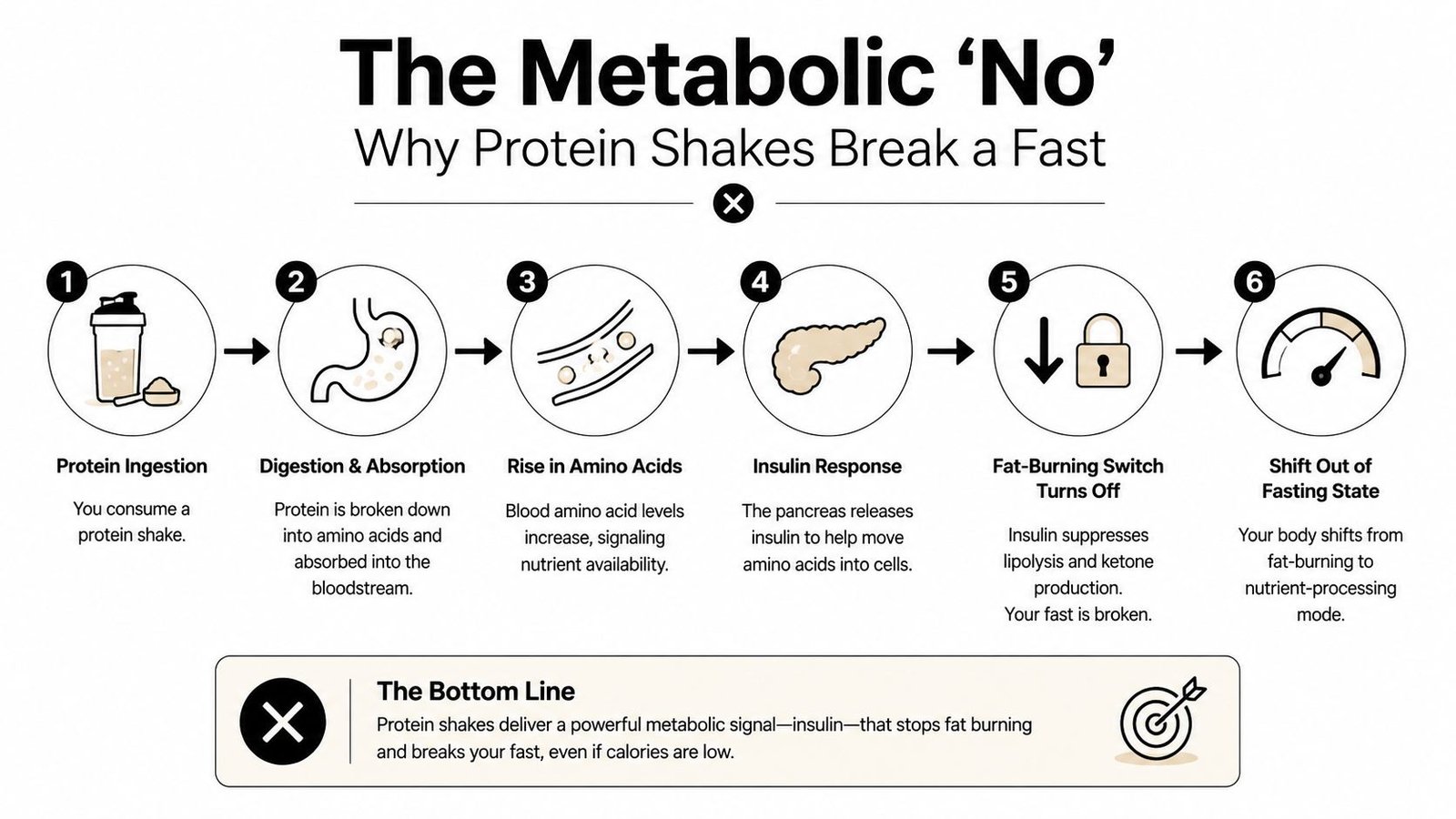
Protein sends a fed signal
Protein is built from amino acids, and some of them are especially good at announcing that food has arrived. Leucine is the best-known example. It helps switch on muscle protein synthesis, which is useful after training, but it also pushes your body toward a fed state instead of a fasting state.
That matters because fasting and feeding ask your body to do different jobs. During a fast, your body is more focused on maintenance and fuel release. After protein comes in, the priority shifts toward repair, growth, and storage. Autumn Elle Nutrition's discussion of protein and fasting notes that leucine activates mTOR, a pathway associated with feeding signals, and that autophagy tends to rise later in a fast.
A simple way to picture it is a house switching from cleaning mode to delivery mode. You were in the middle of taking out the trash and organizing the rooms. Then a shipment arrives at the front door, and now the house has to stop and deal with new supplies.
Insulin is part of the shift
Protein also raises insulin. Many readers only associate insulin with carbs or sugar, but amino acids can stimulate it too. Once that happens, your body gets a clear message that incoming nutrients are available, and the pace of fat release and fat oxidation can drop.
The sequence is straightforward:
- You drink the shake
- Amino acids enter the bloodstream
- Insulin rises
- Fat use slows
- Fasting-related cleanup gets reduced
- Your body shifts toward a fed state
That is why a protein shake in water still breaks a fast. Water adds no calories, but it does not cancel the metabolic signal from the protein.
Why this matters for fat loss or muscle gain
For a strict fast, this is a clear no. If your goal is autophagy, ketosis, or keeping insulin low for the full fasting window, protein works against that goal.
For body composition, the answer needs more nuance. Protein is helpful for keeping muscle while losing fat, especially if you train hard or struggle to hit your protein target in a shorter eating window. The key is timing. Put the shake at the start of your eating window or after training, not in the middle of the fast.
Quality matters too. A fast-breaking shake should help you hit your protein target without turning into a dessert. Use this protein powder quality chart to compare options that fit your calories, digestion, and goals. If your main target is fat loss, these practical tips for protein and weight management can help you choose a shake that supports the plan instead of adding extra calories.
The short version is simple. A protein shake breaks a fast metabolically. The better question is whether breaking the fast at that moment helps or hurts your goal.
Aligning Shakes with Your Fasting Goals
The fastest way to get frustrated with fasting is to follow rules that don't match your goal.
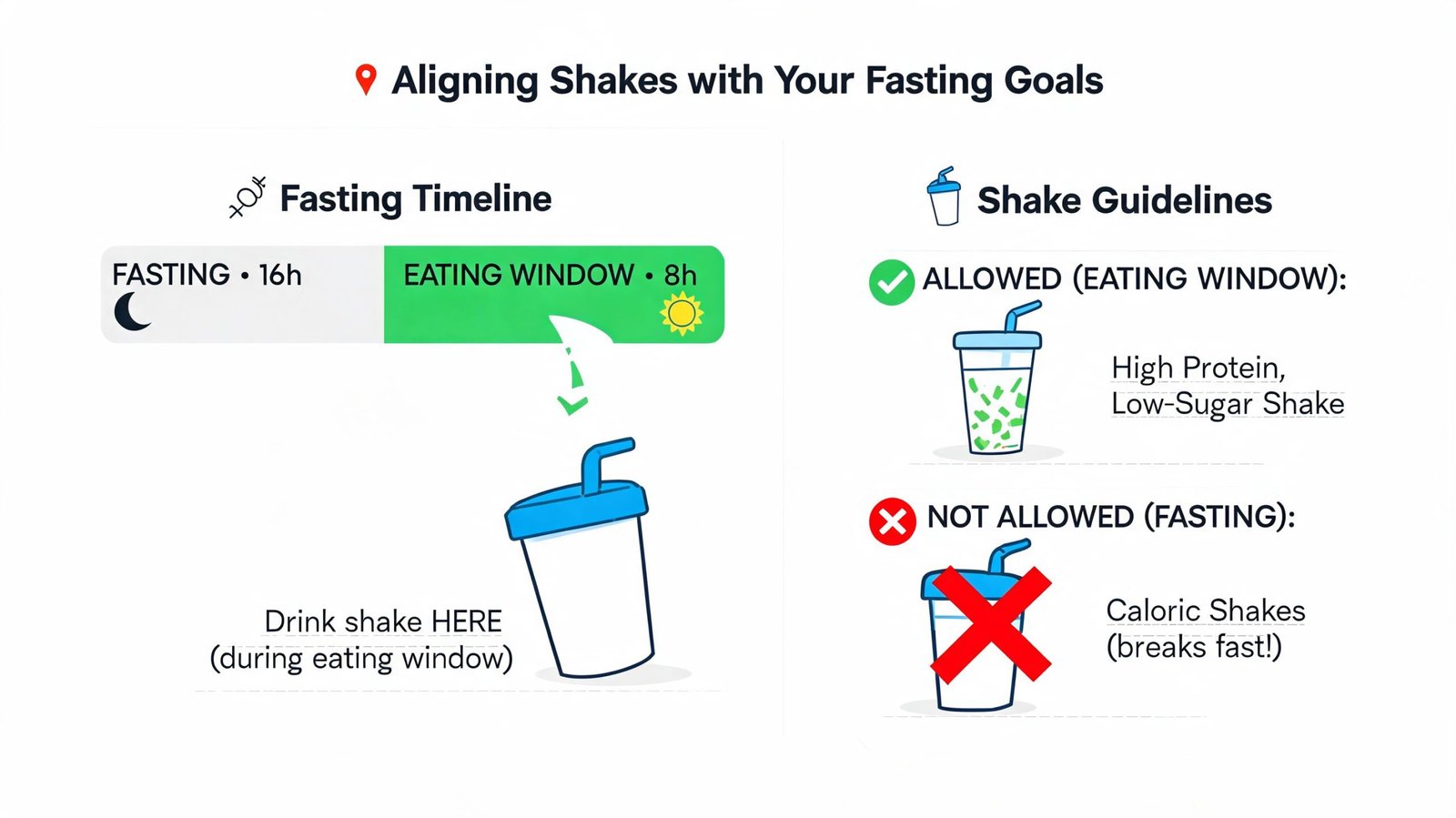
If you want the strict fasting benefits tied to low insulin and autophagy, then a protein shake is a poor fit during the fast. But if your goal is to lose fat while keeping muscle, a shake can become a smart tool once the fasting window ends.
If you care most about autophagy
This group needs a simple rule. No protein during the fast.
Protein's whole job is to signal building, repair, and feeding. That works against the empty-state physiology many fasting purists want. If that's your lane, save the shake for later and keep your fasting period limited to zero-calorie options.
If you care most about fat loss and muscle retention
Nuance matters. The question isn't whether protein shakes are “good” or “bad.” The question is whether they're timed well.
According to Welltech's overview of protein shakes during fasting, a 2023 meta-analysis in the Journal of the International Society of Sports Nutrition found that high protein intake at 1.6 to 2.2g/kg bodyweight, timed immediately after the fast, preserved muscle during calorie deficits 27% more than lower-protein diets in time-restricted feeding.
That's a big deal for anyone training in a calorie deficit. You may not want protein in the fasting window, but you probably do want it as soon as the eating window opens, especially after training.
If you lift, run, or train hard while fasting, the shake works best as a deliberate first step into your eating window, not as a sneaky fast-friendly drink.
For many people, that looks like a simple bookend strategy:
- Fast normally
- Train near the end of the fast if that feels good
- Open the eating window with protein
- Build the rest of the meals around whole-food protein and carbs
Use the goal to choose the rule
If you're trying to tighten up your nutrition, it helps to pair this with practical tips for protein and weight management so your shake fits into the bigger picture instead of becoming a random extra.
And if you're comparing powders, digestibility, or amino acid profiles, a protein quality chart can help you choose a powder that matches how you eat and train.
The mistake isn't using protein. The mistake is using it at a time that conflicts with the result you want.
How Protein Shakes Affect Different Fasts
You can follow a fasting plan and still get very different results depending on what kind of fast you are doing. A protein shake fits very differently into a water fast, a standard intermittent fasting schedule, and a fasting-mimicking approach.
The easiest way to sort the confusion out is to ask one question first. What is the fast designed to do?
If your goal is a water fast, the rules are simple. Water fasts are built around no calorie intake, so a protein shake does not belong inside that fasting window.
If your goal is intermittent fasting, timing matters more than the shake itself. The shake ends the fast, but it can still be useful if your bigger priority is muscle retention, workout recovery, or hitting your daily protein target once the eating window begins.
If your goal is a fasting-mimicking diet, the answer is usually no unless the plan specifically includes it. That style works more like a tightly measured script than a flexible eating schedule, so adding a shake can throw off the intended setup.
If you want a broader refresher on common fasting styles, this overview of fasts to support wellness is useful because it helps you identify what kind of plan you're following before you decide where shakes fit.
Protein Shakes and Your Fasting Style
| Fasting Type | Can You Drink a Protein Shake? | Reason |
|---|---|---|
| Water fast | No | The goal is no caloric intake, and a shake shifts your body out of that fasting state. |
| Intermittent fasting such as 16/8 | Yes, but only once the fast is over | The shake starts your eating window, which can still work well if you are prioritizing fat loss with muscle maintenance. |
| Fasting-mimicking diet | Usually no | This approach depends on a very specific intake pattern, so an extra shake usually does not fit unless the plan allows it. |
Where people get mixed up
The biggest mix-up happens with 16/8 fasting. Someone finishes a morning workout, drinks a shake at 10 a.m., and wonders whether they are still "doing intermittent fasting."
They are still following an intermittent fasting routine. Their fast just ended at 10 a.m.
That distinction matters because it helps you match the tool to the goal. If your main goal is strict fasting benefits, keep the shake outside the fasting window. If your main goal is preserving muscle while dieting, opening the eating window with protein may be the better tradeoff.
Protein during a fast works like flipping the body from "waiting" mode to "feeding" mode. That is why the better question is not whether shakes are good or bad. It is whether that timing helps your result.
For PlateBird users, this is a practical tracking decision. Log the shake as the first item in your eating window, then check whether it helps you reach your daily protein target without pushing calories higher than planned. If you need ideas that make the shake feel more like real food, these recipes with protein powder can help you turn it into a meal or snack that fits your day.
The Smart Way to Use Protein Shakes with Fasting
Once you stop asking whether the shake is “allowed” and start asking when it works best, fasting gets much easier to manage.
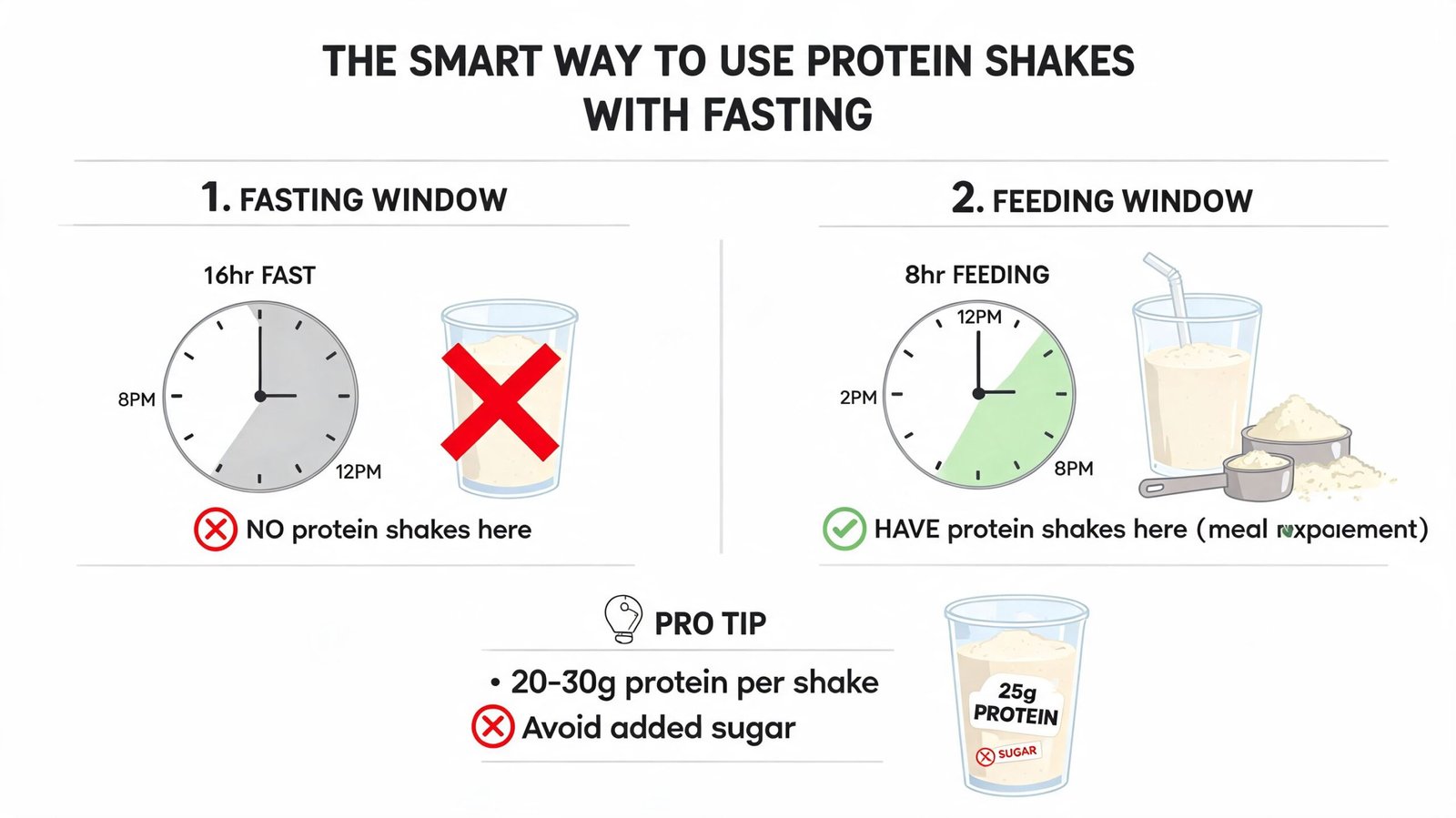
For active people, the best use of a protein shake is usually right after the fast ends. Cal AI's discussion of intermittent fasting and shakes notes that whey protein can reduce glucose spikes from a later meal by 20 to 30% if consumed pre-breakfast after the fasting period, and that the body absorbs up to about 25g of protein at once. The same source also points to 1.6 to 2.2g/kg as a useful daily protein range for active individuals.
A simple playbook
End the fast first
Don't try to make the shake “fast-friendly.” If you drink it, count it as the start of your eating window.Use the shake early in the eating window
This works especially well after training or on busy mornings when a full meal isn't realistic.Keep building the day around real meals
A shake is a tool, not your whole protein strategy. Individuals generally thrive when the shake supports meals instead of replacing them all day.
Pick the shake for the job
Not every protein powder feels the same in real life.
- Whey works well for speed: It's a practical option when you want something quick after a fast or workout.
- Plant protein can still work: Some people prefer it for digestion or personal preference, even if the texture and satiety can feel different.
- Added extras matter: If a powder is loaded with sweeteners, mix-ins, or turns into a dessert, it may still fit your eating window, but it stops being the simple post-fast tool you intended.
Make timing easier
If your fasting schedule moves around, a simple tool helps. The Pretty Progress fasting calculator can help you figure out exactly when your eating window opens so you're not guessing when the shake belongs.
And if you're unsure how much protein, carbs, and fat you should aim for, a guide on what your macros should be makes the shake easier to place within the rest of the day.
A good fasting routine isn't fragile. It works because you know when to stay strict and when to fuel on purpose.
That's the desired balance. Keep the fast clean. Then use protein decisively when the fast is over.
Quick Answers to Your Fasting and Protein Questions
Can I drink a protein shake with water and still be fasting
No. Water doesn't cancel out the protein. The shake still delivers amino acids and calories, so it ends the fasted state.
What if my goal is fat loss, not autophagy
Then the shake may still fit your plan well. The key is to use it at the start of your eating window, not halfway through your fast.
Is black coffee different from a protein shake
Yes. A protein shake contains protein and calories. Black coffee in clean fasting approaches is usually treated differently because it doesn't provide the same fed-state signal.
Should I break my fast with a shake or a full meal
That depends on your day. A shake works well when you need speed, convenience, or post-workout protein. A full meal may be better if you want more fullness and a calmer eating rhythm.
Is whey better than plant protein for fasting
Neither one is “fasting-safe” during the fast. Both break the fast if they provide protein. The better choice is the one you digest well and can use consistently once your eating window opens.
Do I need a protein shake if I'm already eating enough protein
Probably not. Shakes help with convenience. They're useful when your schedule is tight, your appetite is low, or you struggle to reach your protein target through meals alone.
Can I use protein shakes every day with intermittent fasting
Yes, as long as they fit your eating window and your overall diet. They work best as support, not as a replacement for a varied diet built around whole foods.
What's the biggest mistake people make
Treating a shake like it somehow “doesn't count” because it feels light. Liquid calories still count. Liquid protein still breaks the fast.
If you want fasting and protein intake to feel simple in real life, PlateBird helps you log meals the fast way. You can type what you ate or snap a photo, track your protein and macros without digging through a giant food database, and make sure that post-fast shake actually fits your daily plan.