
Running a mile burns about 100 calories for an average person, but that number is only a rough shortcut. A more useful estimate is 0.71 calories per pound of body weight per mile, which means a 150-pound person burns about 106.5 calories, a 180-pound person about 127.8, and a 200-pound person about 142.
That's why the most common advice on this topic is both helpful and misleading. It gives you a fast answer, but not your answer.
If you've ever searched how many calories does running a mile burn, seen “100 calories,” and wondered why your watch showed something different, the confusion makes sense. Calorie burn during running is surprisingly simple at the core, then slightly more nuanced around the edges. Distance matters a lot. Body weight matters most. Then a few smaller factors adjust the final number.
The good news is that you don't need a lab test or a complicated spreadsheet to estimate it well. You just need one strong rule, a little context, and a way to track it consistently.
The 100 Calorie per Mile Myth
The 100-calorie-per-mile rule stuck around because it's easy to remember. For a lot of casual conversations, it works well enough. If someone asks for a ballpark estimate, “about 100 calories” is a decent place to start.
The trouble starts when people treat it like a fixed law.
For one runner, that estimate may land close to reality. For another, it can undershoot or overshoot enough to matter, especially if they're tracking weight loss, trying to fuel training properly, or comparing runs over time. A mile isn't like a prepaid purchase with the same cost for everyone. Your body has to move your own mass over that distance, and that changes the energy bill.
Why the myth survives
Simple fitness advice spreads fast because it feels usable. “One mile equals 100 calories” is much easier to remember than a body-weight-based formula. But ease and accuracy aren't always the same thing.
A better way to think about it is this:
- The 100 number is an average. It's not a personal reading.
- Your body weight shifts the estimate. That's the main reason the number changes from person to person.
- Running pace matters less than is commonly believed. For a mile, the distance itself drives most of the calorie cost.
Practical rule: Use 100 calories per mile as a conversational shortcut, not as your personal calculator.
There's also a common misunderstanding hidden inside the myth. It is often assumed that running faster must burn dramatically more calories per mile. In reality, the evidence cited later in this article points in a different direction. For a given mile, speed doesn't change the total as much as is commonly expected.
What a better answer looks like
A useful estimate should do two things. It should be simple enough that you'll use it, and accurate enough that it reflects your body.
That's where the 0.71 multiplier becomes so valuable. It gives you a personalized estimate without turning the whole topic into exercise physiology homework. You can use it before a run, after a run, or while checking whether your app's numbers look reasonable.
If the old rule says, “Everyone pays about the same,” the better rule says, “The cost depends mostly on what you're carrying.”
Why Your Body Weight Is the Biggest Factor
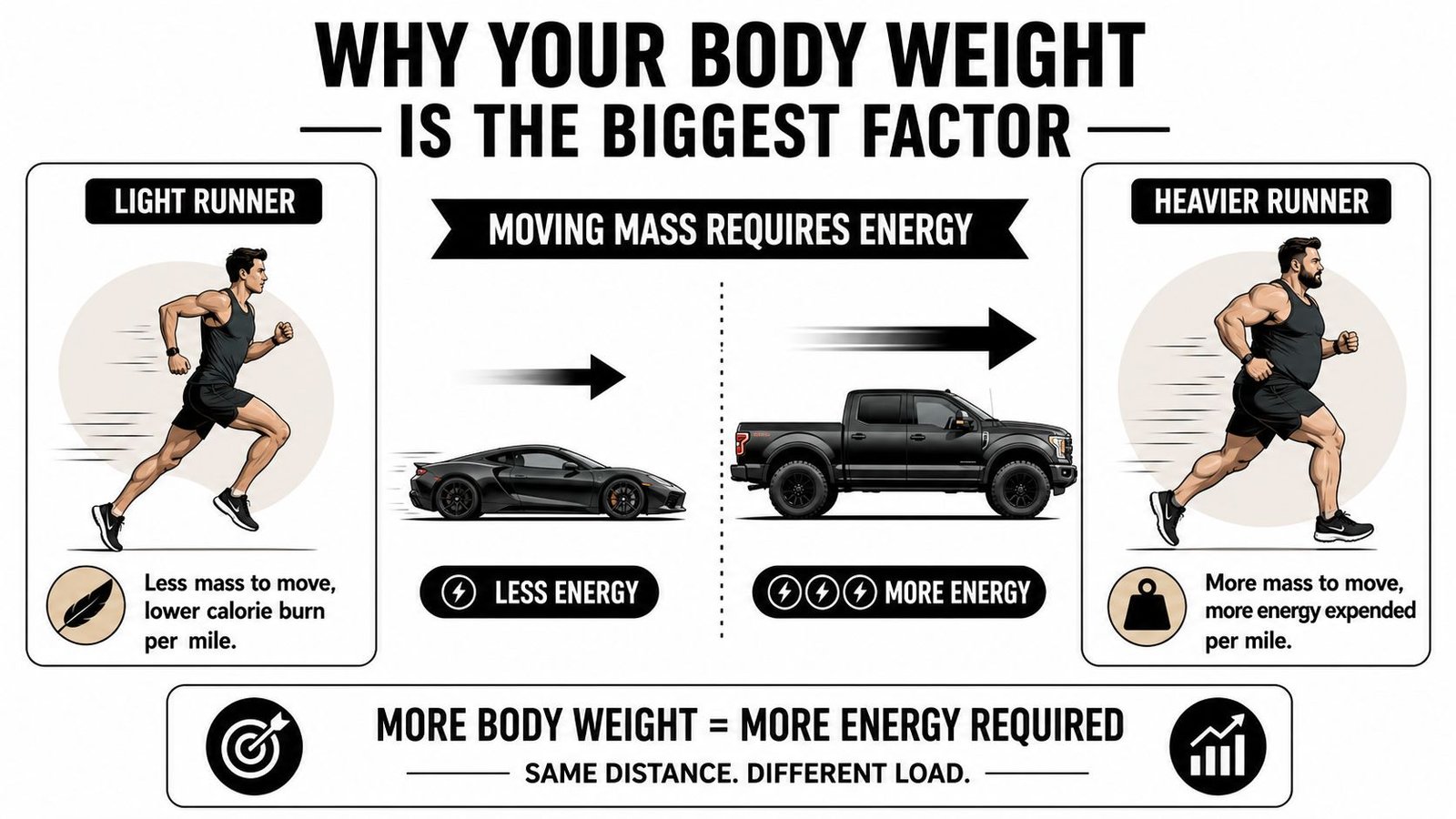
If you remember only one idea from this article, remember this one: moving more mass requires more energy.
That's the heart of the calorie equation in running. Imagine pushing a rolling office chair versus moving a loaded couch across the same room. The distance is identical. The work isn't.
What the numbers show
According to a chart from the American Council on Exercise, a 120-pound person burns about 114 calories for a 10-minute mile, while a 180-pound person burns 170 calories for the same mile, which is a nearly 50% increase caused by the extra effort of moving more body mass (American Council on Exercise data via Healthline).
That single comparison explains why the generic rule falls apart so quickly. Two people can run side by side, cover the same mile, and finish with very different calorie totals.
Why weight dominates the calculation
Your muscles don't care that the map says “1.0 mile.” They care about how much body they must carry over that mile.
Here's the plain-language version:
- A lighter runner usually spends less energy covering the same distance.
- A heavier runner usually spends more energy because there's more mass to transport.
- The gap can be substantial, not just a tiny rounding error.
This is also why tools that estimate calorie burn without enough personal data can feel off. If an app relies too heavily on generic averages, it may miss the biggest variable in the room.
If you're trying to get more precise with your health metrics, it can help to understand related body measurements too. A guide on how to understand body fat scales can add context when you're comparing weight, body composition, and activity estimates.
Where readers usually get tripped up
People often mix up rate and total.
A smaller runner and a larger runner may both run one mile at the same pace, but the larger runner generally burns more total calories for that mile. That doesn't mean the larger runner is automatically “working harder” in every training sense. It means the energy cost of moving their body over that distance is higher.
The mile is the same. The body moving through it isn't.
Once you understand that, calorie estimates stop feeling random. They start feeling mechanical, which is exactly what they are.
Your Personalized Formula for Calorie Burn
The useful answer is not “about 100 calories.” It's a number tied to your body.
A practical middle ground between a vague rule and a lab formula is this:
Calories burned per mile = body weight in pounds × 0.71
That estimate comes from research summarized here: runners burn 0.71 calories per pound of bodyweight per mile, and the ratio stays fairly steady across typical running speeds (Nutrisystem summary of the validated ratio).
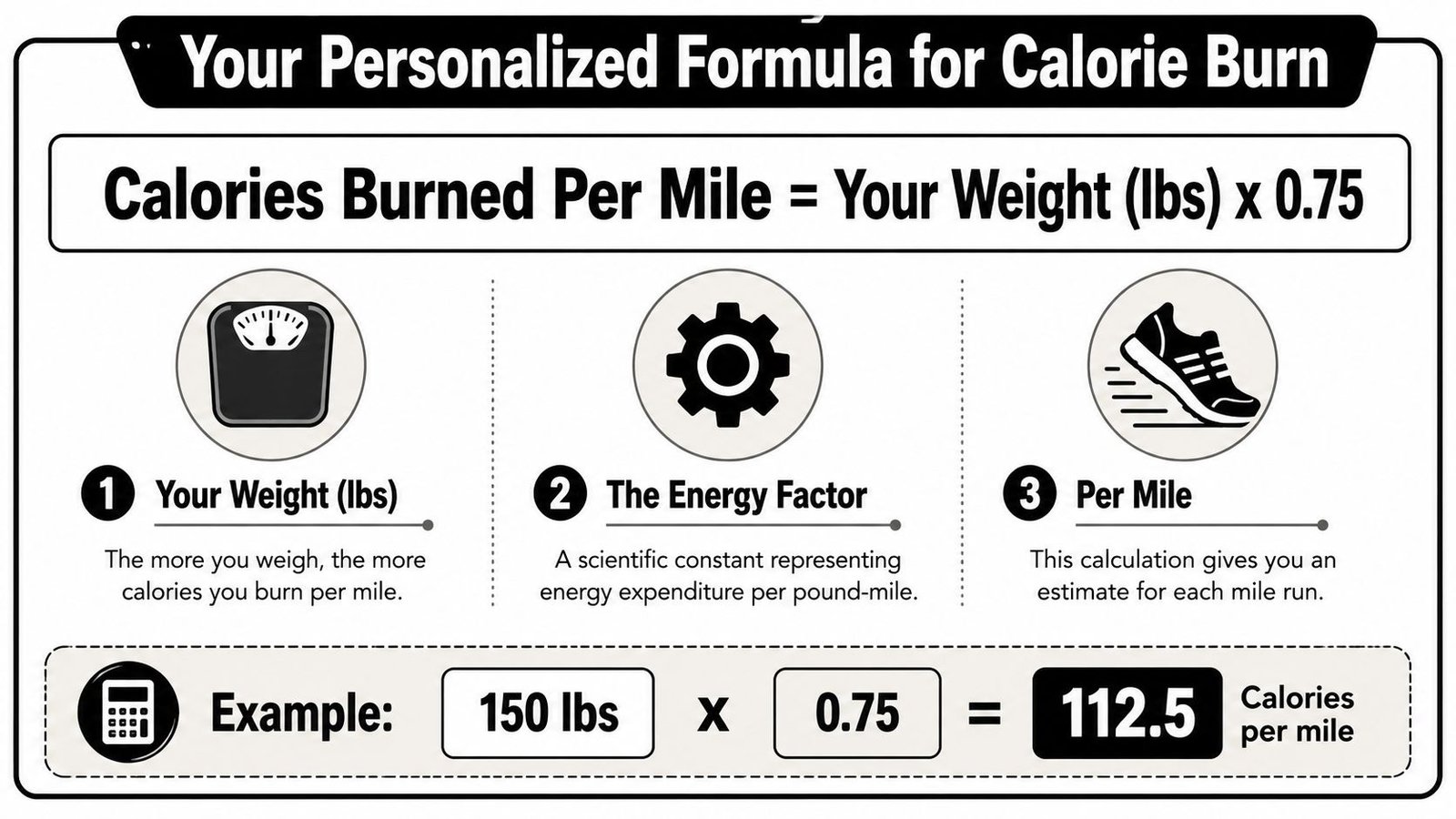
That 0.71 figure works like a price tag per mile. Your weight is the quantity. Multiply the two, and you get a baseline estimate that is simple enough for daily use and grounded enough to be more helpful than the one-size-fits-all 100-calorie rule.
How to calculate your number
Use this quick process:
- Start with your body weight in pounds.
- Multiply it by 0.71.
- The result is your estimated calories burned for one mile.
Here are a few examples:
| Body weight | Calculation | Estimated calories per mile |
|---|---|---|
| 150 lb | 150 × 0.71 | 106.5 |
| 175 lb | 175 × 0.71 | 124.25 |
| 200 lb | 200 × 0.71 | 142 |
A 200-pound runner lands at 142 calories for one mile. That makes it clear why the generic 100-calorie estimate can miss by a wide margin for some people.
If you want to place that mile estimate inside your full daily energy picture, this guide to TDEE and total daily energy expenditure connects exercise calories to everything else your body burns in a day.
A second useful lens is the way coaches and fitness educators discuss total energy output in training. These Cartwright Fitness energy insights can help if you want to understand how exercise calories fit into a bigger picture.
Here's a visual walkthrough of the basic logic in action:
A few ways to use the formula
You can scale the formula the same way you scale a grocery bill. First get the cost of one item, then multiply by how many you bought.
- For a 3-mile run: multiply your one-mile estimate by 3.
- For a 5-mile run: multiply it by 5.
- For treadmill sessions: use the displayed distance, then apply your personal number.
One caution helps here. This number is a baseline, not a perfect reading from a metabolic lab. That is exactly why it is so useful. It gets you close fast, without forcing you to wrestle with variables that usually make only a smaller difference than body weight and distance.
If you want an estimate you can use every day, this is the one to memorize.
Factors That Fine-Tune Your Calorie Burn
The formula gives you the base estimate. Real life adds a few dials.
These dials usually don't overturn the main answer, but they can explain why your watch, treadmill, and manual calculation don't always match perfectly. The biggest mistake runners make here is overreacting to those small differences. Your baseline still matters most.
Body differences and running economy
A Syracuse University study found that men burned about 105 kcal per mile while women burned 91 kcal per mile, and it also found that energy expenditure stayed roughly constant per mile regardless of speed, reinforcing that body mass is the main driver (summary of the Syracuse findings).
That doesn't mean every man burns the same amount, or every woman burns the same amount. It means physiology can shift the final number, while distance and body size still do most of the heavy lifting.
Running economy matters too. Some runners move like a smooth bicycle chain. Others bounce, brake, or waste motion with every stride. The less efficient runner often uses more energy for the same mile.
Terrain, conditions, and form
A mile on a flat road isn't the same as a mile up rolling hills, on trails, or into wind. Your body has to solve a harder movement problem in those conditions, and the calorie cost can rise.
Think of these as adjustment knobs:
- Hills and inclines: climbing adds work.
- Trail surfaces: uneven ground often makes your muscles stabilize more.
- Heat or harsh conditions: your body spends extra effort regulating itself.
- Stride mechanics: better form can reduce wasted energy.
None of that makes the formula useless. It makes the formula your baseline.
Your calculated number is the floor of understanding, not the ceiling.
Why pace confuses people
Pace is the factor people love to argue about because it feels intuitive that faster must mean far more calories burned per mile. The available evidence here says the story is more subtle. For a given mile, pace often changes calories per minute more than it changes calories per mile.
That's why two runs can feel very different but land in a similar calorie range if the distance is the same. One run may be faster, harder, and more intense. Another may be steadier and slower. Your breathing, heart rate, and effort won't match, but the total energy cost for that single mile may still be surprisingly close.
Why trackers disagree
Fitness trackers estimate. They don't measure your exact calorie burn directly.
They may weigh different inputs such as heart rate, pace, user profile, and motion data. Some lean heavily on generic models. Others adjust more aggressively based on your history. That's why your app might display a number that's a bit above or below your hand calculation.
Use your personalized estimate as a reality check. If your device gives a slightly different result, that's normal. If it gives a wildly different one, your settings or assumptions may need work.
Running vs Walking Which Burns More Calories
This is one of the most misunderstood fitness questions because people mix up per minute and per mile.
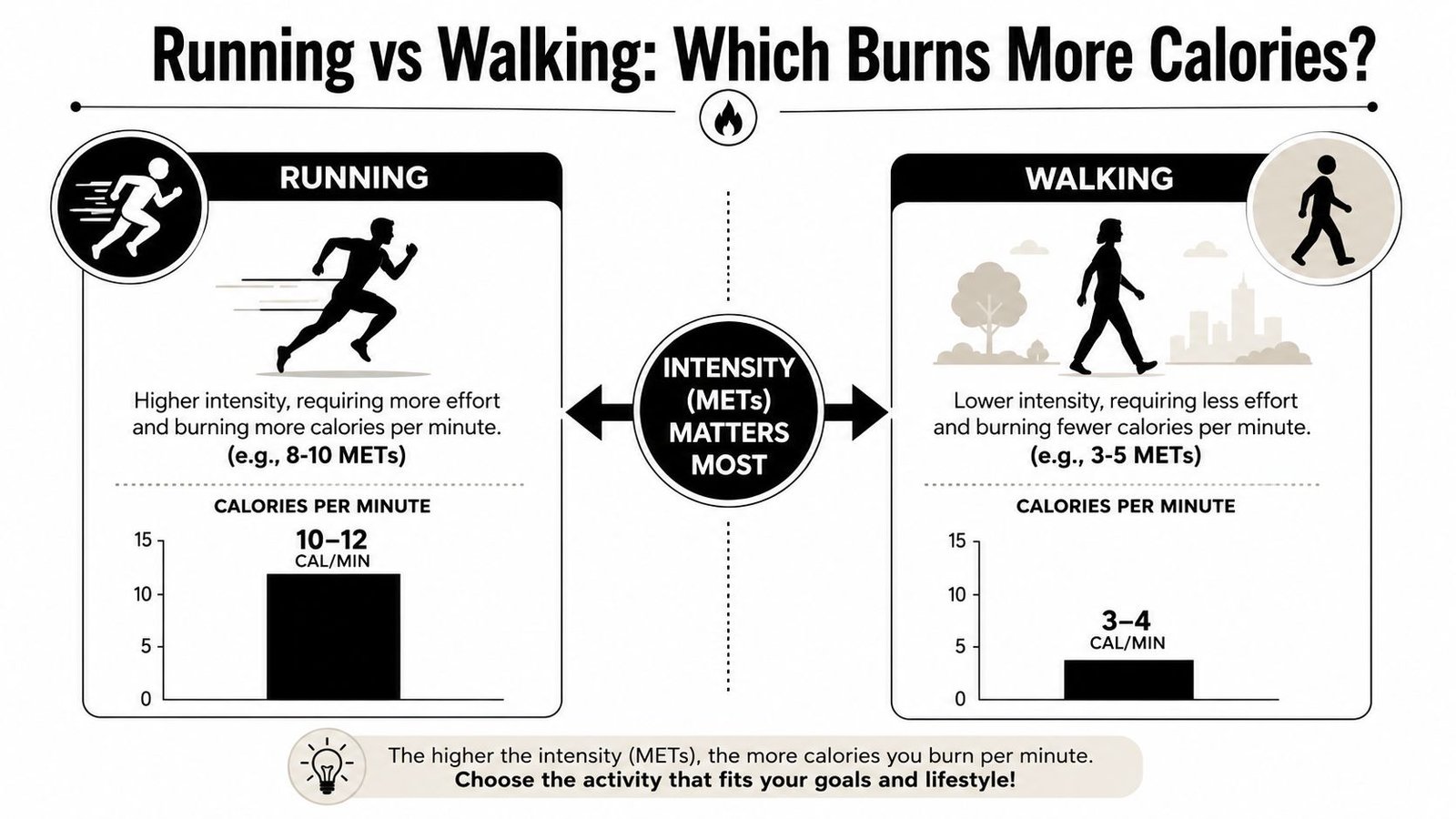
Per minute, running wins easily. Per mile, the gap is much smaller than commonly expected.
Per minute versus per mile
The American Council on Exercise states that a 160-pound person burns about 15.1 calories per minute running versus 8.7 calories per minute walking. But over the same one-mile distance, the total difference is much smaller, with running burning only about 10% to 30% more calories per mile, because walking takes longer (Runner's World summary with ACE figures).
That longer duration is the key. Walking burns fewer calories each minute, but you spend more minutes covering the mile.
Here's the cleanest way to understand it:
| Comparison | Running | Walking |
|---|---|---|
| Calories per minute | Higher | Lower |
| Time to cover a mile | Shorter | Longer |
| Calories per mile | Only somewhat higher | Surprisingly close |
What this means for weight loss
If your knees tolerate running and you like it, running is a time-efficient way to burn calories. You get more work done in less time.
If you dislike running, can't recover well from it, or need a lower-impact option, walking is much better than many people assume. The same-distance calorie gap isn't huge, and walking is easier to repeat consistently.
That's the part many people miss. The “best” exercise for calorie burn isn't just about intensity. It's also about what you can recover from and keep doing week after week.
If you're weighing low-impact cardio options, this comparison of walking versus the elliptical machine can help you decide what fits your joints, schedule, and goals.
A workout you can repeat beats a harder workout you avoid.
A practical decision rule
Choose running when you want:
- More calories per minute
- A shorter workout
- A stronger cardiovascular challenge
Choose walking when you want:
- Lower impact
- Easier recovery
- A more approachable habit
For body composition goals, consistency beats drama. Plenty of people would do better with frequent walks than with an ambitious running plan they abandon after two weeks.
Log Your Runs and Calories Burned with PlateBird
Knowing your estimate is useful. Logging it is what makes it actionable.
A lot of people do the hard part first. They learn the formula, calculate the number, feel motivated for a few days, then stop tracking because the process becomes annoying. That's usually where progress gets fuzzy. You stop seeing the relationship between your runs, your meals, and your daily energy balance.

Turn the formula into a habit
The simplest workflow looks like this:
- Calculate your per-mile estimate using your body weight.
- Multiply by the distance you ran.
- Log the result alongside your food intake.
If your estimate comes out to 106.5 calories per mile and you run 4 miles, you've got a practical exercise entry to record. It doesn't need to be elegant. It just needs to be consistent.
Some runners like planning their week before they log anything. If that's you, a workout planner calendar can make it easier to map run days, long walks, and recovery sessions so your calorie tracking reflects a real routine instead of random activity.
Why exercise logging works better with food logging
A run doesn't exist in isolation. It affects hunger, recovery, and your total daily energy picture.
That's why it helps to track training and nutrition together instead of in separate silos. When you can compare what you burned with what you ate, patterns become clearer. You might notice that your appetite spikes after harder efforts, or that your “healthy” snacks are larger than you thought, or that your easy run days don't need the same intake as your long-run days.
For runners specifically, this becomes even more useful when you build a repeatable system around training, fueling, and recovery. This guide to calorie tracking for runners ties those pieces together in a way that's practical for everyday use.
Keep the estimate useful, not obsessive
You don't need perfect data. You need a reliable method.
Use your body-weight-based estimate as your default. Let your watch or app provide supporting information, not the final truth. Then keep logging in the same way over time so your data stays comparable.
That consistency matters more than chasing an illusion of precision. A slightly imperfect log you maintain is far more valuable than a “perfect” system you quit.
If you want an easier way to track meals, macros, and the energy balance around your training, try PlateBird. It makes calorie logging fast enough to stick with, which is what turns good information into real progress.