You're probably reading this after one of three moments. You stared at a restaurant plate and thought, “How am I supposed to log this?” You skipped tracking because the food scale was in a drawer somewhere you didn't feel like opening. Or you did your best, then second-guessed every number anyway.
That's normal. Portion size estimation is a skill, not a personality trait. Nobody is born knowing what a sensible serving of rice looks like in a crowded food court or how much peanut butter fits on a spoon you grabbed half-awake.
The good news is that you don't need perfect accuracy to get better. You need a practical system. Good coaches rely on a toolkit, not one trick. Hands for fast estimates. Visual anchors for real-world meals. A plate framework for balance. Better judgment for foods that fool almost everyone. And when life gets busy, tech that helps you check your own eye instead of starting from scratch.
Your Hands Are Your First and Best Measuring Tool
If you never memorize another serving guide, learn this one. Your hand goes everywhere you go, changes very little day to day, and gives you a fast reference when a label, scale, or measuring cup isn't available.
Use your hand like a field guide
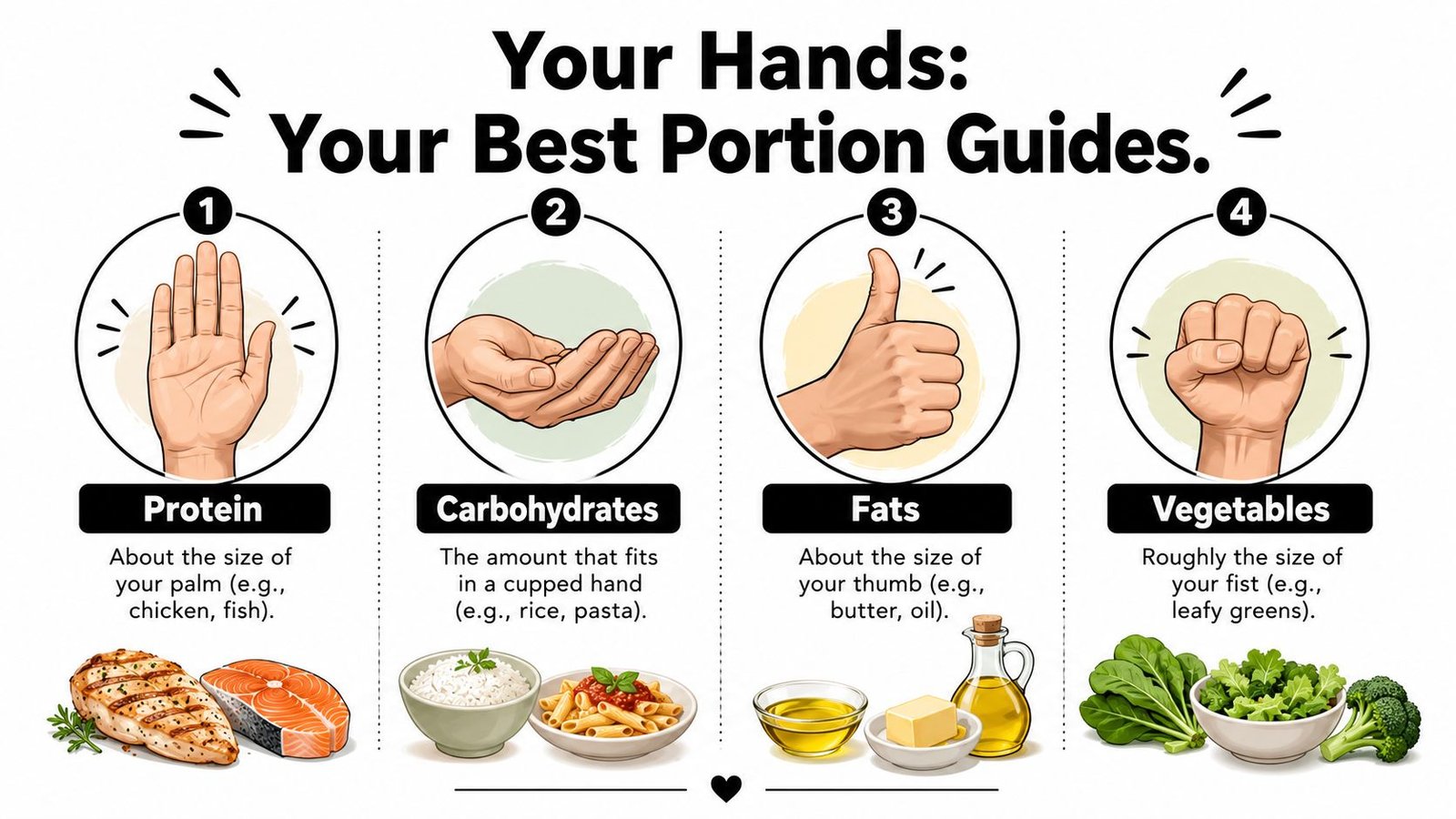
Start with four shapes:
- Palm for protein. Think chicken breast, fish fillet, lean beef, tofu, tempeh, or a burger patty.
- Cupped hand for carbs. Rice, pasta, cereal, pretzels, granola, beans, or fruit pieces fit well here.
- Thumb for fats. Peanut butter, butter, mayo, cream cheese, oil, nuts, and shredded cheese are the usual suspects.
- Fist for vegetables. A fist gives you a simple target for broccoli, salad greens, peppers, carrots, cauliflower, or roasted veg.
The reason this works is simple. It keeps your estimates proportional to you. A larger person often needs larger portions. A smaller person often needs less. Your hand gives you a built-in reference that's more useful at lunch than remembering a bunch of kitchen numbers.
What this looks like on an actual plate
A grilled chicken sandwich plate becomes easier to read when you break it down by shape instead of guessing weight. The chicken is roughly a palm. The fries might be one to two cupped hands. The mayo could be one or two thumbs if the sandwich is heavily dressed. The side salad might be a fist or more.
That's much better than pretending you know the exact gram count.
Practical rule: Estimate the main foods first. Then check the add-ons. Most tracking errors don't come from the chicken. They come from the oil, sauce, cheese, nuts, and “just a little” dressing.
A few easy calibration habits
Use these at home for a week and your eye sharpens fast:
- Match before you measure. Put rice or pasta into your cupped hand visually, then check it with a bowl or cup at home.
- Pause on fats. Thumb-sized foods are small. That's why they're easy to overshoot.
- Double vegetables on purpose. Eating too much spinach is rarely the source of struggle.
- Use the same plate often. Familiar dishes help your brain build better visual memory.
A lot of people quit tracking because they think estimation has to be exact. It doesn't. It has to be consistent enough that your week makes sense. The hand guide gives you that baseline.
Train Your Eye with Everyday Household Objects
Once your hand becomes your default measuring tool, the next step is using the room around you. Good portion size estimation gets easier when common objects start acting like visual anchors.
A client once told me restaurant meals always felt impossible to track until she started comparing food to things already on the table. Suddenly the salmon wasn't “some big piece.” It was “about a deck-of-cards-sized fillet, maybe a bit more.” The baked potato wasn't abstract either. It looked closer to a tennis ball than a softball. That shift matters.
Build a mental library you can use anywhere
A few object comparisons stick because they're easy to picture:
- Deck of cards for a cooked piece of meat or fish
- Tennis ball for a medium fruit or a rounded scoop of something starchy
- Lightbulb for a smaller mound of food like a half-cup serving
- Computer mouse for a baked potato or compact protein portion
- Dice or a fingertip for small, dense extras like butter pats or hard cheese cubes
These aren't magic. They're anchors. The point isn't to impress anyone with precision at dinner. The point is to stop your brain from calling every restaurant serving “one portion” when it's clearly more than that.
Use comparison, not perfection
At home, take a few foods you eat often and compare them to objects before you serve them. A bowl of cereal. Cooked rice. Chicken breast. Trail mix. Pasta. Then look at what those foods resemble.
If cups are still fuzzy in your head, read HYDAWAY's 1 cup guide. It's a useful visual refresher because many people know they need “about a cup” but don't have a stable picture of what that means once the food is on a plate.
The fastest improvement usually comes from repeating the same comparisons, not from collecting twenty new tricks.
In practice, this is how coaches make estimation feel lighter. You don't need to pull out measuring gear in public. You need a few visual references so your first guess is sensible.
Build a Better Meal with the Plate Method
Estimating one food at a time is useful. Building a meal that already has good proportions is even better. That's where the Plate Method earns its keep.
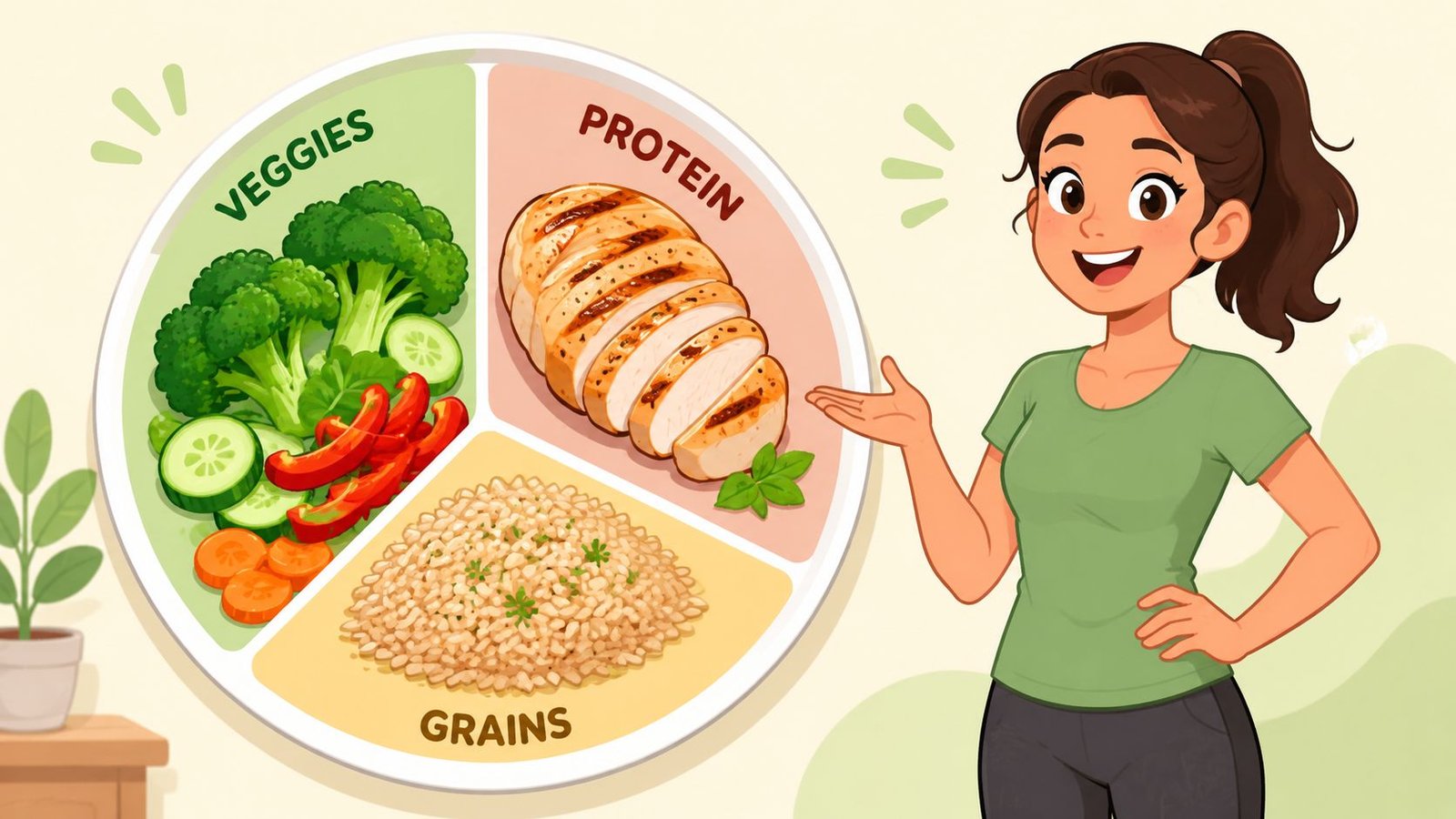
Instead of obsessing over every ingredient, you organize the plate itself. Half goes to non-starchy vegetables. One quarter goes to protein. One quarter goes to carbohydrate-rich foods. That pattern helps you control portions and improve meal quality at the same time.
Why plate structure matters
Self-reported portion estimates can go badly off track. In one research kitchen study, estimates ranged from a 43% underestimation for condiments to a 156% overestimation for pasta, and overestimation was the dominant pattern in most food groups (research summary from Penn State). That's one reason visual frameworks work so well. They reset what “normal” looks like.
The Plate Method is useful because it solves two problems at once. It protects you from oversized starch portions, and it keeps meals from turning into protein plus beige side dish with vegetables as an afterthought.
What it looks like across the day
Here's how I coach people to apply it without turning meals robotic:
| Meal | Visual build |
|---|---|
| Breakfast | Eggs or Greek yogurt for protein, fruit or oats for carbs, and a produce add-on like berries, spinach, or tomatoes |
| Lunch | Half the container with salad or cooked vegetables, one section with chicken or tofu, one section with rice, beans, or potato |
| Dinner | Roasted vegetables or stir-fry base first, then protein, then the starch instead of the other way around |
Bowls work too. You just build from volume rather than plate lines. Start with vegetables, add protein, then finish with a moderate amount of rice, noodles, grains, or beans. If you want a deeper breakdown of how these visual ratios support fat loss, PlateBird has a practical piece on plate proportions for weight loss.
Make it work in restaurants
Restaurant plates are built to look generous, not to make portion size estimation easy. A simple move helps. Mentally redraw the plate into quarters before the first bite. If the pasta or fries spill over half the plate, you already know the meal is carb-heavy. If vegetables are missing, order a side or accept that this meal won't be a textbook plate and adjust the rest of your day.
A balanced plate won't make every estimate exact, but it keeps one oversized restaurant serving from becoming your new idea of a standard meal.
How to Estimate Tricky Foods like Liquids and Pizza
Certain foods, like liquids and pizza, are harder to estimate because shape stops being useful. A latte fills a tall glass differently than a short mug. A slice can look modest and still carry far more than you expect once the crust, cheese, and angle are factored in.
This is the part of tracking where people usually get frustrated. It also happens to be where a simple system beats guesswork.
Why these foods throw people off
Research published on ScienceDirect found that portion estimation error changes by food type, with liquids producing larger errors than solids (study abstract on ScienceDirect). That fits what shows up in real food logs. Chicken, fruit, and potatoes are usually close. Soup, juice, creamy coffee drinks, oatmeal, and oil-heavy sauces are where numbers drift.
The reason is practical. These foods spread, pool, melt, or compress. Your eye has fewer clean edges to work with.
Use container logic for liquids
For drinks, soups, dressings, and sauces, estimate the vessel first and the food second. That approach is faster and usually more accurate than staring at the liquid itself.
A few coaching rules work well:
- Judge the cup or bowl size first. Small cafe cups, diner mugs, and oversized smoothie cups can differ a lot.
- Use fill level. Half full, three-quarters full, and filled to the rim are very different pours.
- Separate add-ins. Milk, cream, syrup, oil, and dressing often matter more than the base.
- Watch depth, not just width. A wide shallow bowl and a deep soup bowl can look similar from above.
Standard containers help for the same reason restaurants and meal prep companies use them. Repetition teaches your eye. If you want a visual reference for fixed-volume pots, Afida's sustainable packaging for takeaways shows the kind of containers that make sauces, dressings, and sides easier to portion consistently.
For shapeless foods, read the mound
Oatmeal, mashed potatoes, rice dishes, chili, pasta salad, and ice cream need a different approach. Estimate based on both spread and height.
A thin layer across a dinner plate is one thing. A dense, heaped bowl is another.
I tell clients to look for three cues. How wide does it spread? How high is it piled? Is it loose and airy, or packed in tightly? Those cues usually get you closer than trying to assign a number instantly.
Pizza and wedges need a quick geometry check
Pizza, pie, and cake fool people because "one slice" tells you almost nothing by itself. Width at the crust, point length, thickness, and topping density all change the portion.
A good field method looks like this:
- Check the crust edge. A wider back edge usually means a bigger slice.
- Look at thickness. Deep dish, pan pizza, stuffed crust, and heavily topped slices need a higher estimate.
- Compare it to the full pie. One eighth of a 10-inch pizza and one eighth of a 16-inch pizza are completely different servings.
- Count dense extras separately. Extra cheese, meat-heavy toppings, dipping sauces, and thick frosting can shift the total fast.
Manual skill and technology work together most effectively. Make your estimate first. Then verify it later with a photo-based tool. Over time, that feedback loop sharpens your eye, especially for foods that rarely come in tidy portions.
Restaurant meals make this harder because you rarely control slice size, glass size, or serving style. For those situations, PlateBird's guide on how to estimate calories when eating out gives a practical process you can use at the table.
Let AI Do the Hard Work with Photo-Based Tracking
Manual estimation is worth learning because it sharpens your judgment. But there's also a point where mental math becomes the reason people stop logging. That's where photo-based tracking earns a place in the toolkit.
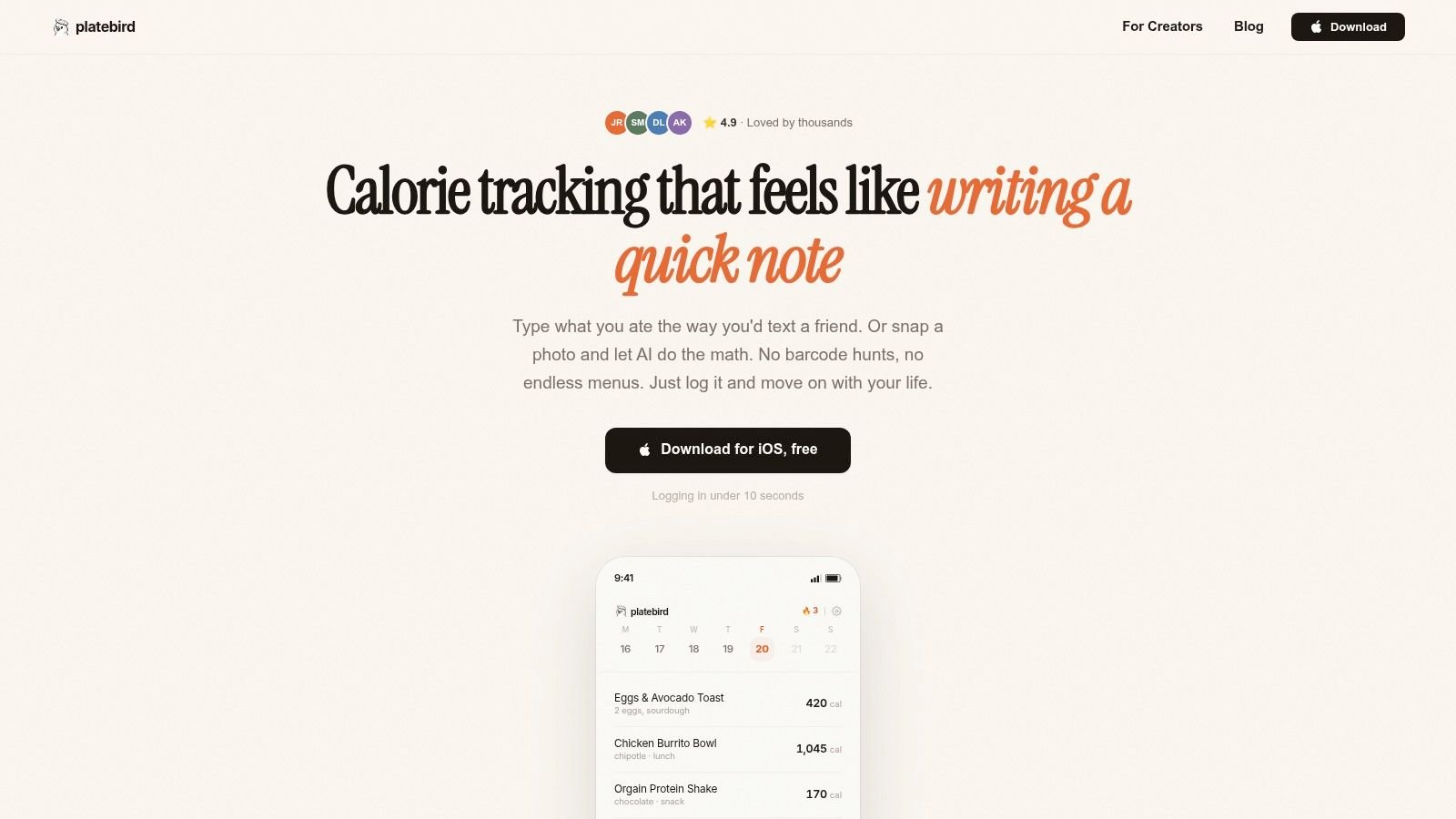
A good system doesn't replace your skill. It checks it. You estimate the meal, snap a picture, compare, and learn. Over time, that feedback loop makes your own eye better.
When typing works and when photos win
Research comparing text-based and image-based portion size estimation found that image-based PSE had a 6% overall relative error rate while text-based PSE showed 0%, and text entries placed a larger share of intakes close to true intake, although image-based tools offer major convenience benefits (study on PubMed Central). That trade-off is familiar to anyone who's tracked consistently. Text can be sharp when the food is simple and you describe it clearly. Photos help when the plate is mixed, messy, or hard to break apart.
That's why a combined system makes sense. Some meals are easy to type. Others are easier to shoot than explain. If you want that kind of hybrid workflow, PlateBird's calorie counter app that lets you take a picture of food shows how the process works in practice.
Use AI as feedback, not as a crutch
The smartest way to use photo tracking is to make a quick estimate first. Then let the app challenge or confirm it.
That habit helps with foods people commonly misread:
- Mixed plates where sauces and sides blur together
- Restaurant meals with larger default portions
- Snacks you eat casually and forget to log
- Dense extras like dressings, cheese, nuts, and spreads
If a tool saves time but teaches you nothing, you stay dependent on it. If it saves time and improves your judgment, it becomes part of your training.
Here's a quick look at the workflow in action:
The biggest win for busy people isn't theoretical accuracy. It's compliance. The easier logging feels, the more likely you are to keep doing it on the days that usually break the streak.
Common Mistakes and Your On-the-Go Cheat Sheet
You get through a long day, grab dinner out, make a quick mental estimate, and move on. Nothing looks wildly off. Then the week ends and progress stalls because the misses were small, frequent, and predictable.
That is how portion tracking usually breaks down in real life. Not from one huge cheat meal, but from the same blind spots showing up over and over. Good estimators learn to spot those patterns early, then use simple tools, including AI, to tighten them up.
The mistakes that cause the most trouble
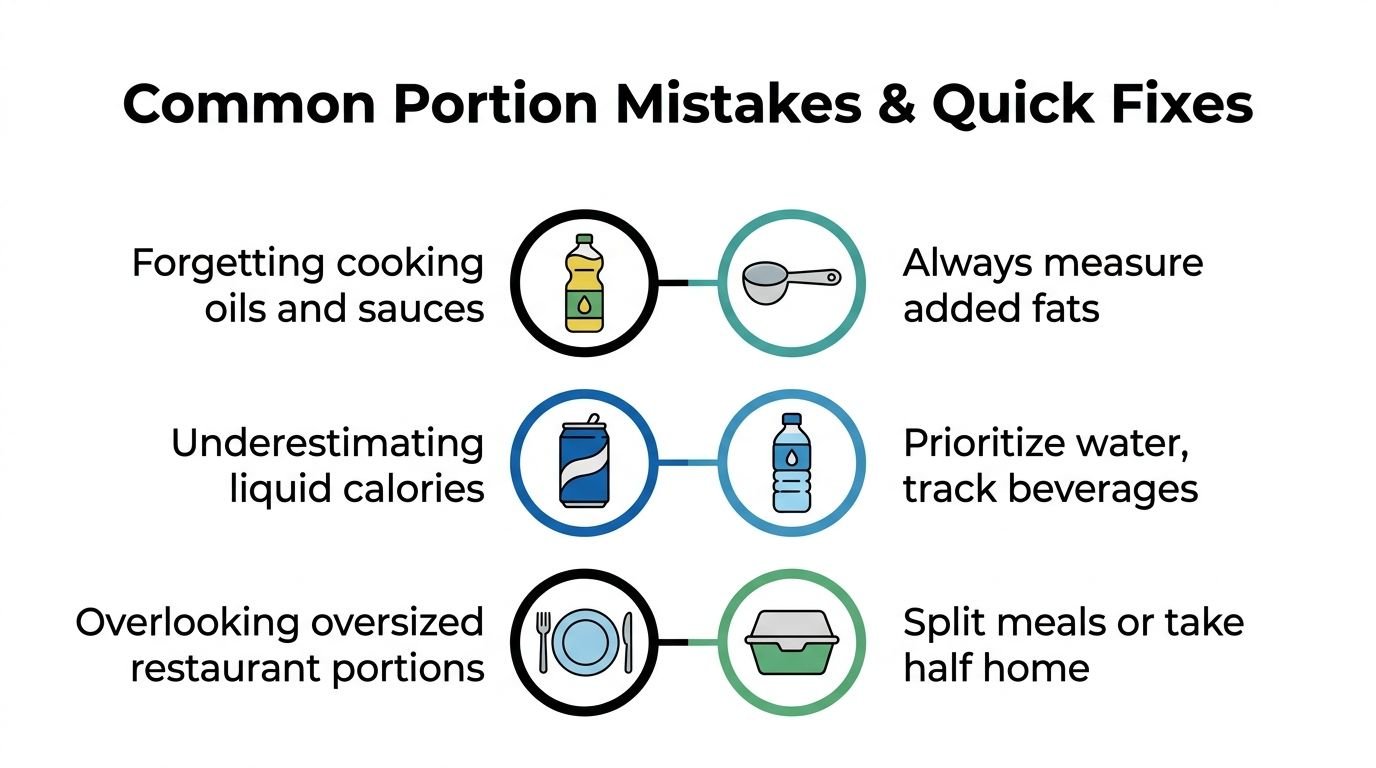
- Invisible add-ons. Oil in the pan, butter on vegetables, creamy dressings, mayo, dips, sugar in coffee, and finishing sauces can shift a meal fast without changing how "big" it looks.
- Liquid calories. Lattes, juice, cocktails, smoothies, and even healthy-looking shakes are easy to undercount because people do not read drinks with the same caution they use for solid food.
- Restaurant portions. Large plates and oversized bowls make standard servings look modest, especially when the meal comes with fries, rice, bread, or a second side automatically.
- Wedge-shaped foods. Pizza, pie, and cake still fool people because slice count alone is a weak shortcut. As noted earlier, these foods are commonly misread, so width, thickness, crust, toppings, and density matter.
- Using the wrong visual aid for the food. Researchers at Penn State found that accuracy changed based on the style of the visual aid, and results differed across groups, which is a good reminder that estimation is a skill you train, not a talent you either have or do not have (Penn State publication on 2D food profile aids).
Your quick-reference reset
Keep this mental cheat sheet handy:
| Situation | Fastest useful move |
|---|---|
| Buffet or restaurant plate | Split the plate visually before the first bite |
| Saucy or oily meal | Estimate the add-ons separately |
| Snack foods | Use your cupped hand instead of eating from the bag |
| Pizza, pie, cake | Judge width, thickness, and density, not just number of slices |
| Busy day with no patience for logging | Make your best guess first, then use a photo app to check it |
That last one matters more than people think. Manual estimation builds judgment. Photo-based tracking helps catch the misses you do not see yet. Used together, they work like a practice loop instead of two separate systems.
Consistency beats intensity
If you bake often or prep the same recipes every week, weighing ingredients still makes sense. Bakers use scales to achieve consistent bakery results, and the same principle helps at home when you want repeatable portions. Outside your own kitchen, though, speed matters. A method that is slightly less precise but easy to repeat will beat a perfect method you abandon after three busy days.
The best portion strategy is the one you still use on a rushed Tuesday.
Good portion size estimation is a stack of reps. Hands for rough checks. Household references for visual memory. Plate structure for balance. AI for fast feedback when the meal is messy, mixed, or eaten on the move. Stick with that system for a few weeks and tracking starts to feel less like logging and more like knowing.