- Why No Subscription Trackers Are Gaining Popularity
- Comparing the Total Cost of Subscription vs. No Subscription Models
- Technical Limitations You Need to Understand Before Buying
- When a No Subscription Tracker Makes Sense and When It Does Not
- Beyond GPS No Subscription Trackers for Nutrition and Daily Habits
- Advanced No Subscription Technologies Changing the Game
- How to Get Maximum Value from Your No Subscription Tracker
More than 40% of Americans pay for subscriptions they forgot about, and CNBC Select says those “ghost” subscriptions cost an average of $17 per month, which is more than $200 per year (CNBC Select). That's the backdrop for the no subscription tracker category. People aren't just hunting for a cheaper gadget, they're trying to stop adding one more recurring charge to a life already packed with them.
A no subscription tracker is any tracker that avoids ongoing billing, but that label gets slapped on very different products. Some are true GPS devices with connectivity bundled into the upfront price. Others are Bluetooth tags, RF units, offline loggers, or even software tools in categories like nutrition and habit tracking that refuse the monthly-fee model altogether.
The pitch sounds simple. Pay once, own it, and move on. But many trackers without a subscription are making a tradeoff somewhere, usually in coverage, live updates, cloud features, or convenience.
Why No Subscription Trackers Are Gaining Popularity
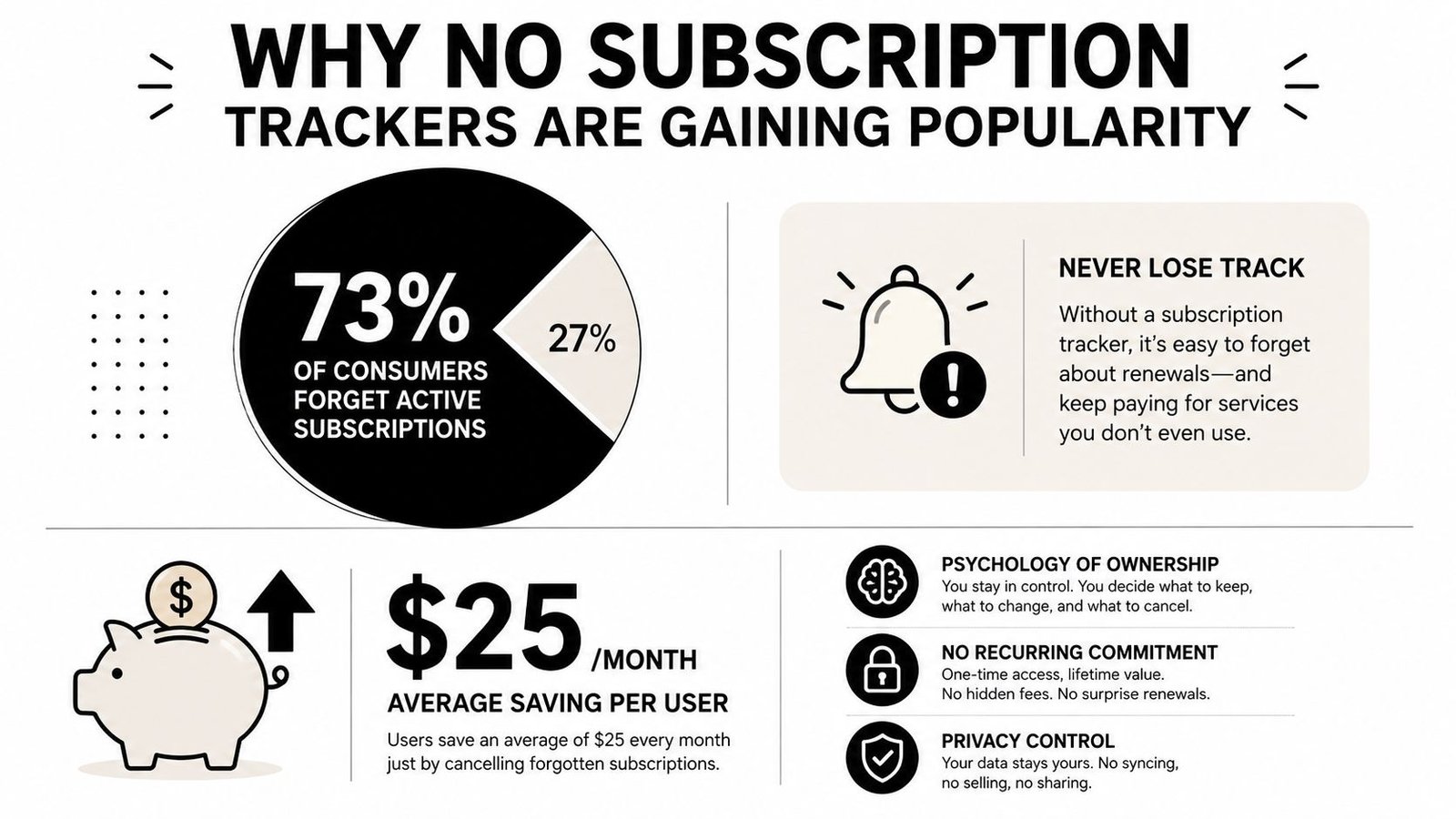
The appeal starts with billing fatigue, but it doesn't end there. A tracker with no recurring fee feels different because it behaves like a product again, not a tiny lease you have to remember to keep paying. That matters when people are already juggling subscriptions they never meant to keep.
The money problem is only half the story
The better way to think about this category is ownership psychology. A one-time purchase gives you a fixed cost and a clean decision. A monthly plan keeps the device tied to a service relationship, and that's exactly what many buyers are trying to avoid.
There's also a practical reason people look for a no subscription tracker in the first place. Once a household, pet owner, or small business already has recurring payments for software, maps, cloud storage, and mobile services, the tracker subscription becomes another line item to audit later. A no-fee model reduces that mental clutter.
The category is broader than GPS hardware. It includes GPS trackers, Bluetooth tags, RF trackers, offline data loggers, and software tools for nutrition or habit tracking that don't lock basic use behind monthly billing. That last group matters because the same frustration shows up in apps too, not just gadgets.
Practical rule: If a product's core value depends on a server, cloud history, or live alerts, expect a recurring fee somewhere. If it doesn't, the “no subscription” claim is probably more real.
A lot of shoppers also confuse “free to download” with free to use. Those aren't the same thing. A free tier that pushes the useful features into a paid plan is still a subscription product in disguise.
For readers comparing app-based alternatives in the nutrition space, the difference is easy to spot when you compare a product that's designed around simple logging to one that treats tracking as a billing funnel. One useful starting point is this macro tracking app resource, which sits in the same no-friction mindset as the hardware trackers people are shopping for.
Comparing the Total Cost of Subscription vs. No Subscription Models
A tracker's sticker price tells you almost nothing. The number that matters is what you pay after a year, then three years, then five. That is where subscription products stop looking cheap.
The simple math most buyers skip
Lightning GPS says subscription GPS trackers usually run $8 to $20 per month because they depend on cellular networks and cloud servers, while no-subscription devices avoid those recurring fees through lifetime SIM bundles, direct radio links, or internal logging (Lightning GPS). Motowatchdog's example makes the long-term gap obvious, a no-subscription cellular unit may cost roughly $100 to $150 upfront, while a $15 per month subscription device would cost about $540 in fees alone over three years before the device price is even counted (Lightning GPS).
That does not make every no-fee device the better deal. It means you need to compare total ownership cost against the period you plan to keep using it.
| Total Cost of Ownership: Subscription vs No Subscription GPS Trackers | Subscription Model ($15/mo + $50 device) | No Subscription Model ($130 upfront) | Savings with No Subscription |
|---|---|---|---|
| 1 year | $230 | $130 | $100 |
| 3 years | $590 | $130 | $460 |
| 5 years | $950 | $130 | $820 |
The table is blunt for a reason. Once you expect to keep a tracker around, monthly fees pile up fast. A higher upfront price can still win if the device keeps doing the job for years.
Hidden costs show up in the fine print
The cheapest model on paper can still be expensive in practice if it forces manual syncing, gives you weak coverage, or limits how fresh the data is. Trak-4 points out that many no-subscription devices are really Bluetooth, RF, or offline loggers, which cuts recurring costs but also cuts live visibility outside a limited radius (Trak-4). That tradeoff is the part most product pages hide behind marketing language.
If you are comparing software instead of hardware, use the same discipline. A nutrition app can look free at checkout and still bury useful features behind paid access, which is why a best nutrition tracking app guide is worth reading before you commit. The same caution applies to team tools, where browse club administration software helps you judge what a platform really costs to run, not just what it advertises up front.
Don't buy a tracker because the monthly fee looks smaller than the hardware price. Buy it because the total cost matches how long you plan to use it.
For a one-season need, subscription can be rational. For long ownership, the math usually tilts hard toward no subscription.
Technical Limitations You Need to Understand Before Buying
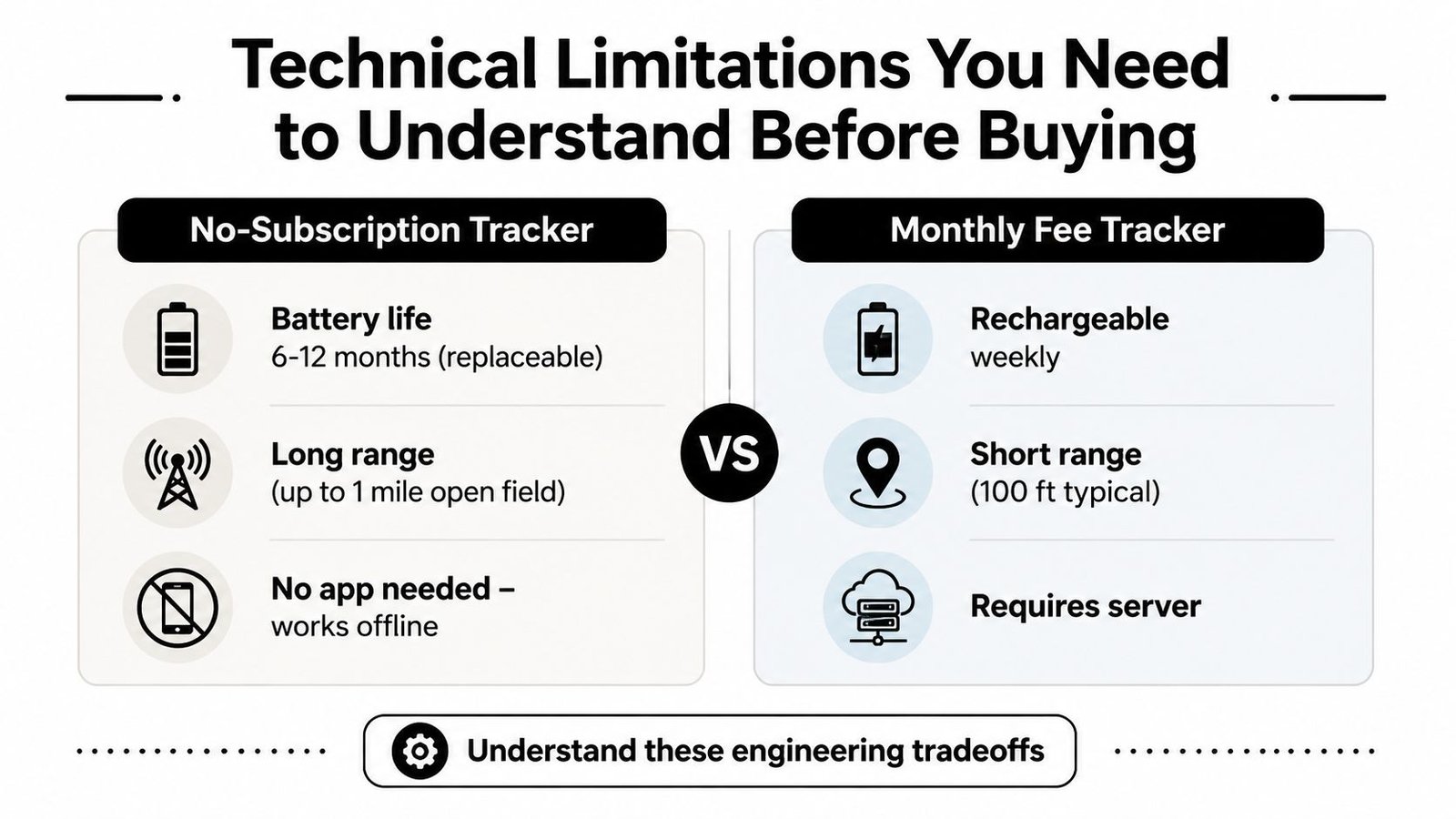
“無訂閱”常常只是行銷話術,意思是把最貴的那一部分拿掉。那一部分通常是連線能力。把行動網路服務抽掉之後,你一定得用別的方式補上,而那個替代方案一定會帶來限制。
覆蓋範圍先決定了它能做什麼
訂閱制 GPS 追蹤器的運作方式很直接,先用 GPS 衛星定位,再透過行動網路把位置送到 App 或儀表板。無訂閱追蹤器多半不是這樣。它們通常依賴藍牙、RF、離線儲存,或是無須月費但也失去廣域連線的無線系統,這正是所謂無訂閱設計的代價。(Trak-4)
所以,藍牙追蹤器在家裡找鑰匙很好用,拿來找跨城移動的車就不行。短距離無線技術在你人就在旁邊時很方便。東西一旦離開你身邊,它的價值就掉得很快。
規格表很容易誤導你
標示「無訂閱」的產品,還是可能是真正的 GPS 追蹤器,但前提是它必須有某種方式,能把資料送到你手上,而且不靠每月電信帳單。那不代表所有產品都一樣。比如說,有些機型用的是終身 SIM 或內建流量,有些則是直接無線傳輸,或先把資料存起來,之後再下載。(Lightning GPS)
判斷時要直接一點。
- 如果你需要隨時看即時位置, 優先選行動網路型或內建流量型。
- 如果你只需要本地找回, 藍牙或 RF 可能夠用。
- 如果你要的是路徑紀錄,不是即時監看, 離線記錄就夠了。
- 如果你想要長距離又不想付月費, 就去看 LoRa 系統,不要被「遠距離」這種空話帶過。
技術型無訂閱裝置不是沒有好產品,但它們的上限很明確。Nolilab 的 Loko GPS Tracker 規格展示了一種比較完整的做法,包含 LoRa P2P operation at 868/915 MHz、+20 km line-of-sight range、22 dBm transmit power、-137 dBm receiver sensitivity,以及使用 200 mAh cell、更新間隔從 1 second to 24 hours 時可達 up to 12 months 的電池表現。(Nolilab) 這些數字看起來很漂亮,但視距傳輸不等於真實世界的通勤、市區追蹤,或樹林裡的定位。
如果你是在看軟體而不是硬體,這個邏輯一樣成立。像 AI 熱量追蹤工具 這類產品,表面上可能很輕量,實際上還是得看它在資料更新、辨識準確度,和長期使用上付出什麼代價。規格寫得再好看,落到實際使用還是會露餡。
電池續航和更新頻率本來就互相拉扯
待機時間越長,通常代表回報頻率越低。回報越少,位置資料就越舊。這不是設備偷工減料,是電力分配的基本限制。
簡單原則: 如果一台追蹤器同時宣稱超長續航和非常頻繁的更新,先看它用什麼傳輸方式。這兩個條件通常不會同時漂亮。
我寧可看到清楚的限制,也不要看滿頁漂亮詞。最適合你的追蹤器,是弱點剛好符合你使用情境的那一台,不是規格欄位最多的那一台。
When a No Subscription Tracker Makes Sense and When It Does Not
A parent tracking a teen driver, a delivery manager watching a fleet, a hiker looking for emergency location sharing, and a pet owner in a rural area are all asking for different things. That's why “best no subscription tracker” is a sloppy category unless you know the job first.
The right answer depends on the scenario
A parent tracking a teen's car usually wants passive alerts, live updates, and the ability to check from anywhere. That's a subscription-friendly use case because the value is tied to automatic visibility, not just recovery after the fact.
A fleet manager usually needs reporting, multi-user access, and reliable coverage across routes. The administrative side matters as much as the device. If the system can't keep working when a vehicle crosses town or state lines, it's not a real fleet answer.
A hiker is different. If the main need is emergency location sharing or off-grid recovery, a radio or LoRa device can make more sense because cellular dead zones are the exact scenario those products are trying to solve. The same logic applies to a pet owner in a rural area who cares more about proximity recovery than cloud dashboards.
A no-subscription tracker is strongest when the use case is narrow and well-defined. It's weaker when the use case needs passive, always-on monitoring.
Time horizon changes the decision
Short-term use favors lower upfront cost, even if the monthly fee looks annoying. Long-term use favors a one-time purchase if the device still covers your actual needs. That's why people regret buying the wrong model after a year, not after the first week.
If you're tracking something that can disappear fast and far, don't choose a model that only works when you're close enough to fix the problem yourself.
Ask three questions before you buy:
- How far away will the thing be when I need it?
- Do I need live alerts, or just location recovery?
- Will I still use this device a year from now?
If the answers point to constant coverage and passive alerts, pay for subscription features. If the answers point to occasional location checks, off-grid use, or a fixed budget, no subscription is the smarter move.
Beyond GPS No Subscription Trackers for Nutrition and Daily Habits
The no-subscription idea isn't just for hardware. It's also a reaction to app fatigue, especially in nutrition tracking where too many products hide the basics behind a paywall. The promise is the same, fewer recurring charges and less friction every time you open the app.
Why the software side matters too
Nutrition and habit tracking fail for the same reason a lot of hardware trackers do, they become annoying to use. People quit when logging takes too long, when menus are bloated, or when essential features sit behind a subscription prompt. A no-subscription app has to earn attention by being faster, not louder.
That's where product design matters more than branding. An app that lets you type a meal, snap a photo, and move on without building a billing relationship is following the same logic as a tracker that works without a monthly fee. The point is reducing friction.
PlateBird fits that philosophy in the nutrition space. It focuses on quick meal logging with typing or photo capture, which makes it a useful example of the no-subscription mindset applied to daily behavior instead of location hardware. If you're comparing tools for food planning and logging, pairing that approach with a guide to choosing healthy cookbooks can help you pick a system that supports actual habits instead of adding another app to manage.
What to look for in non-GPS trackers
Not every no-subscription tool should be judged the same way. A habit app doesn't need cellular coverage, and a calorie tracker doesn't need a SIM card. What they do need is low friction, reliable core features, and a clear privacy story.
That's the crossover here. Whether you're tracking a vehicle or a meal, the question is the same, does the product help you act quickly without making you pay over and over for access to your own data?
Advanced No Subscription Technologies Changing the Game
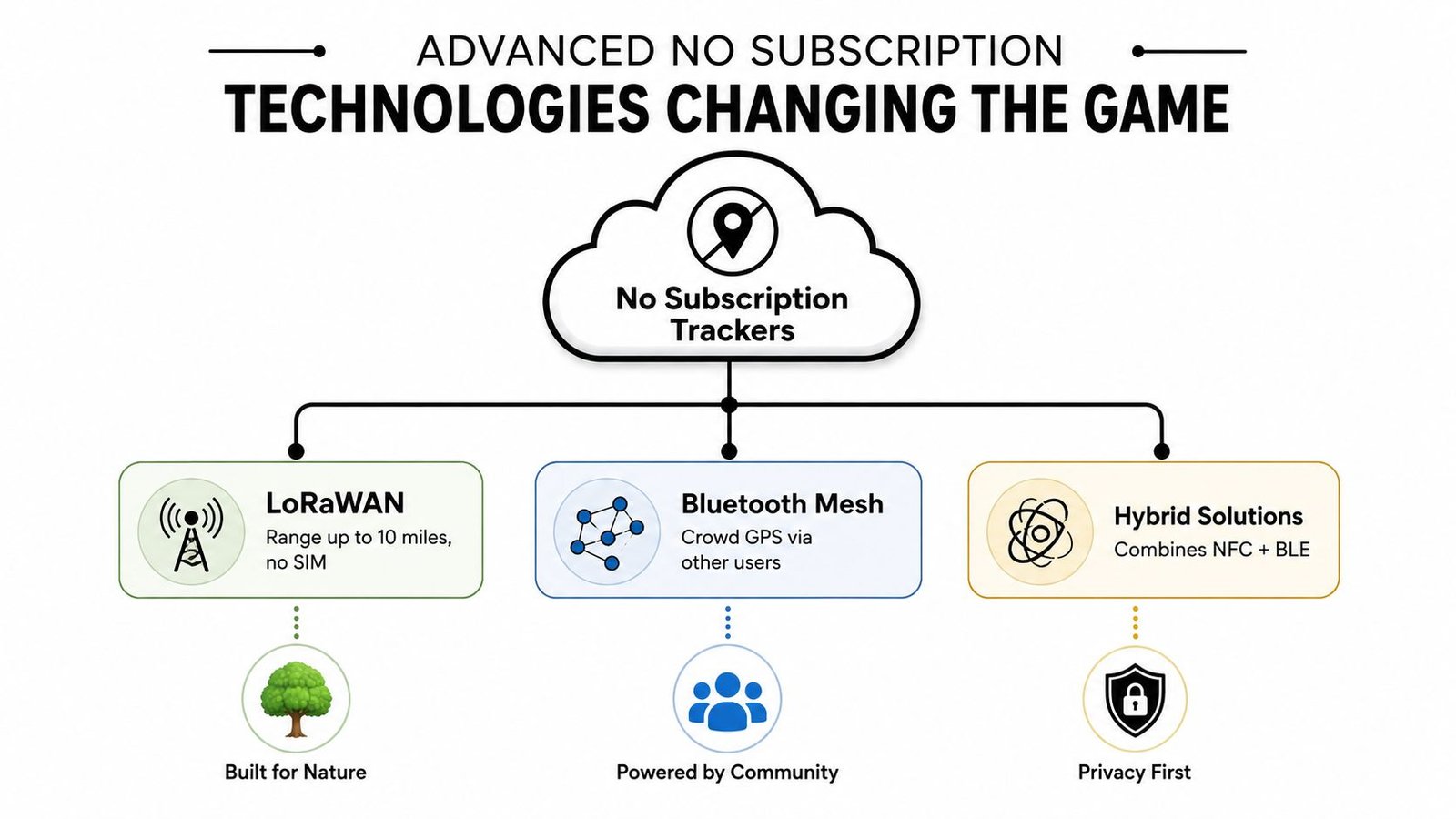
A significant shift in no subscription tracking is not a shiny app feature. It is radio design that reduces dependence on carrier infrastructure and recurring fees, while still having to respect distance, battery drain, and the environment.
What Newer Tech Delivers
LoRa is the most interesting no-subscription tracking technology right now because it changes the range equation without dragging in a carrier bill. It does not erase physics, but it gives builders a way to trade cellular dependency for long-range radio design that can make sense in the right deployment.
Nolilab's LoRa-based spec sheet is worth a close look because it shows what careful engineering can deliver. +20 km line-of-sight range, 22 dBm transmit power, and -137 dBm receiver sensitivity are the kinds of figures that matter if you need a device that can keep talking across open terrain. The up to 12 months battery life also points to a design that depends on low-duty-cycle communication, not constant chatter. See the Nolilab specifications for the full hardware details.
That still does not make LoRa a universal answer. It is a strong fit for specific jobs where periodic updates are fine and line-of-sight is doing a lot of the work.
Don't Get Distracted by Buzzwords
Mesh networking sounds smart, and sometimes it is. Bluetooth mesh can let nearby nodes relay messages through a local network, but that network has to be there and has to stay healthy. Hybrid NFC plus BLE setups are useful for proximity and short-range convenience, not for broad geographic tracking.
A diagram illustrating three advanced no subscription tracking technologies: LoRaWAN, Bluetooth Mesh, and Hybrid NFC plus BLE solutions.](https://platebird.com/wp-content/uploads/2026/08/no-subscription-tracker-tracking-technologies.jpg)
Bottom line: New radio schemes can cut recurring fees, but they do not remove the limits of range, battery, and environment.
Buy for the problem you have. If the only reason a product looks appealing is that it avoids a subscription, that is marketing, not a solution. The device still has to meet your real range, update, and reliability needs.
How to Get Maximum Value from Your No Subscription Tracker
Placement beats wishful thinking. Battery settings beat bragging rights. If you want a no subscription tracker to perform well, you have to configure it for the use case you have, not the use case in the marketing copy.
Get the basics right first
For GPS devices, mount the tracker where it has the clearest possible view of the sky. A buried device in a trunk, under metal, or deep inside a compartment is asking for weak reception. If the unit has update frequency controls, choose the slowest interval that still gives you useful visibility.
For motion-based devices, use wake-up or low-power modes whenever possible. Continuous reporting burns battery faster, and there's no prize for making a tracker work harder than necessary.
For app-based tools, clear out defaults you don't need. If the device lets you define zones, save only the areas that matter. Too many alerts turn a useful tracker into background noise.
Don't ignore the software side
If a tracker relies on periodic firmware updates, apply them. If the app supports better logging, set that up before you need it in a hurry. If a nutrition or habit tracker uses shortcuts, build them early so the app gets easier over time instead of more annoying.
The fastest way to waste money on a no-subscription tracker is to buy one that fits your use case, then configure it like a different product.
A simple decision summary helps:
- Budget-conscious buyer: Choose a one-time purchase only if the feature set is enough on day one.
- Tech-savvy buyer: Look for clear specs, update intervals, and honest range language.
- Casual user: Prioritize ease of use over clever hardware claims.
- Power user: Pay attention to coverage, battery, and data retention before anything else.
The best no subscription tracker is the one that solves your problem without inventing a new one. If you want the same no-fuss approach in nutrition tracking, PlateBird is built around fast logging, quick meal capture, and zero subscription overhead, so you can spend less time managing an app and more time sticking to your goals.