- The Grain Aisle Dilemma Choosing Between Oats and Barley
- Understanding Your Grains From Steel-Cut to Pearled
- Nutrition Showdown A Side-by-Side Analysis
- How Oats and Barley Impact Your Health
- Cooking with Oats and Barley Flavors and Techniques
- The Verdict Which Grain Wins for Your Goal
- Frequently Asked Questions About Oats and Barley
You're in the grain aisle trying to make one smart choice. Oats are familiar. Barley looks wholesome, a little old-school, and maybe more serious. If your goal is fat loss, better workouts, steadier energy, or just fewer random snack attacks in the afternoon, that choice can feel oddly high stakes.
Individuals often ask the wrong question. They ask which grain is healthier.
A better question is which grain fits what you need right now.
Both oats and barley can earn a place in a solid nutrition plan. Both can support heart health, digestion, and meal quality. But they don't behave the same in the body, and they definitely don't behave the same in the kitchen. If you're trying to lose weight, one texture may keep you fuller because you enjoy eating it. If you're training hard, one may fit better before a lift while the other works better in a meal-prep lunch. If you need stable energy through a long workday, the differences matter.
The Grain Aisle Dilemma Choosing Between Oats and Barley
A client once told me she kept buying oats because they felt like the “healthy default,” then wondered why she got bored and stopped eating breakfast altogether. Another client skipped both grains because carbs made him nervous, then ended up grabbing pastries at noon because his first meal didn't hold him.
That's usually how the oats vs barley decision goes wrong. People don't choose based on their goal, their appetite, or how they cook. They choose based on habit.
Here's the practical reality. Oats are easy, familiar, and flexible. Barley is often chewier, more savory, and better suited to meals that need staying power. Neither is automatically better.
A simple way to think about it is this:
| Goal | Oats | Barley |
|---|---|---|
| Fast breakfast | Excellent | Less convenient |
| Warm, comforting texture | Excellent | Good, but chewier |
| Savory lunches and soups | Good | Excellent |
| Blood sugar steadiness | Good | Strong edge |
| Gluten-free needs | Possible with care | Not suitable |
| Baking and blending | Excellent | More limited |
The useful question isn't “Which grain wins?” It's “What do you need this grain to do?”
Practical rule: If you want convenience and versatility, start with oats. If you want slower, steadier energy and a heartier texture, look hard at barley.
That keeps you from making a nutrition decision based on branding, trends, or whatever looked healthiest on the shelf.
Understanding Your Grains From Steel-Cut to Pearled
Oats and barley don't show up in one standard form. The version you buy changes cooking time, texture, and how filling the meal feels.
Oat forms you'll actually see
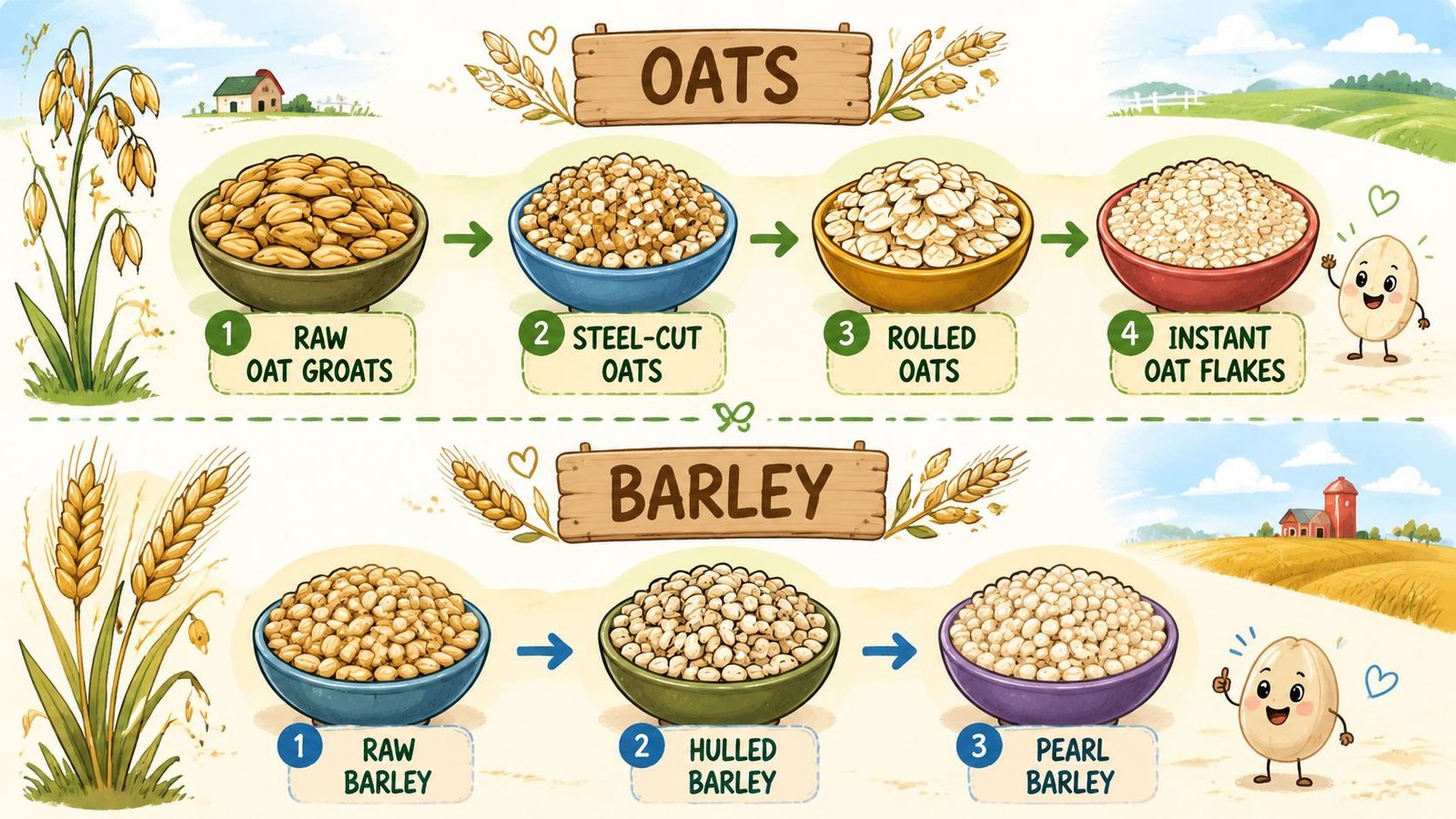
Oats start as groats. From there, manufacturers cut, steam, roll, or flake them into different products.
The common types:
- Steel-cut oats are chopped oat groats. They cook slower, stay chewy, and usually give a more substantial bowl.
- Rolled oats are steamed and flattened. They soften faster and make the classic oatmeal widely recognized.
- Instant oats are more processed for speed. They're useful when time matters, but the texture is softer and less satisfying for some people.
- Oat flour works well in baking, pancakes, and adding body to smoothies.
If someone tells me they “don't like oats,” I usually ask which kind. A person who hates gluey instant oats may love steel-cut oats.
Barley forms worth knowing
Barley also changes a lot depending on processing.
- Hulled barley keeps more of the grain intact. It takes longer to cook and has the most substantial chew.
- Pot or Scotch barley is lightly processed and still fairly hearty.
- Pearled barley has the outer bran polished away. It cooks faster and is the version commonly found in regular grocery stores.
Barley tends to bring a nuttier flavor and a firmer bite. That makes it excellent in soups, grain bowls, and cold salads where you want the grain to hold its shape.
Processing doesn't just change cooking time. It changes whether a grain feels like a real meal or just a quick filler.
What this means at the store
If you want breakfast in minutes, rolled oats are the easy play. If you want a batch-cooked grain that survives several days in the fridge without turning mushy, pearled or hulled barley usually does that better.
Many people get tripped up in oats vs barley comparisons. They compare instant oats to hearty barley and assume the grain itself is the whole story. It isn't. The format matters.
Nutrition Showdown A Side-by-Side Analysis
A nutrition label can make oats and barley look nearly interchangeable. In practice, they pull meals in slightly different directions, and those differences matter if your goal is fat loss, steadier energy, or better recovery.
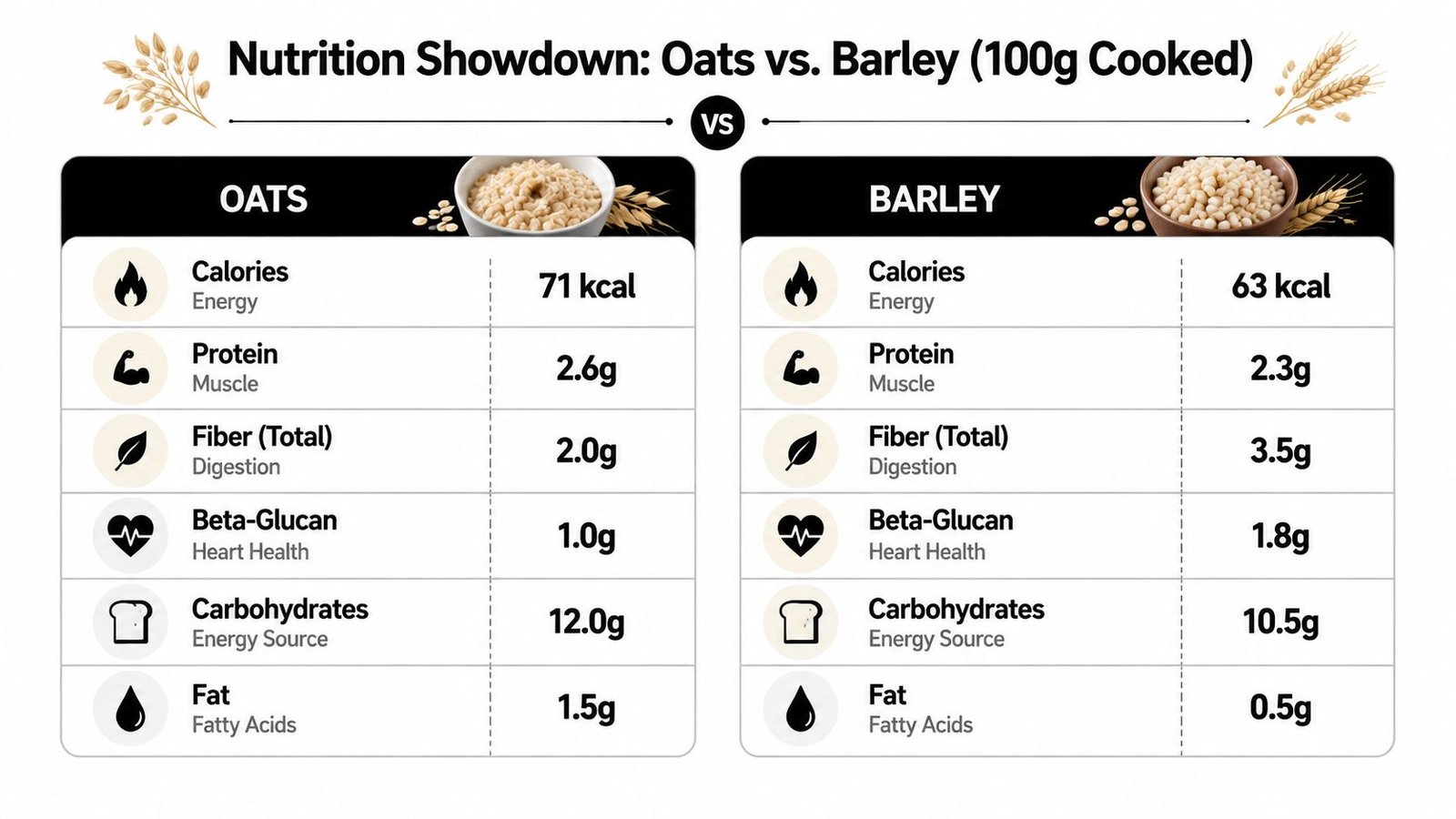
| Metric per 100 g cooked | Oats | Barley |
|---|---|---|
| Calories | 71 kcal | 63 kcal |
| Protein | 2.6 g | 2.3 g |
| Fiber | 2.0 g | 3.5 g |
| Beta-glucan | 1.0 g | 1.8 g |
| Carbohydrates | 12.0 g | 10.5 g |
| Fat | 1.5 g | 0.5 g |
The cooked numbers show the broad pattern. Oats bring a little more protein and fat. Barley brings more fiber and beta-glucan at the same cooked weight. If a client wants a grain that helps a meal stay filling with fewer calories, barley usually has the edge. If the goal is a softer, easier base for a higher-protein breakfast or post-workout meal, oats often fit better.
Protein quality is closer than people think
A peer-reviewed review found that oat protein ranged from 7.02% to 14.23% of dry matter, while barley protein ranged from 8.2% to 14.67% across different genotypes in a broad comparison published in this review on oat and barley grain composition. So if you want the higher-protein grain, the honest answer is that the gap is small.
Oats stand out a bit more on amino acid quality. The same review found oat lysine ranged from 1.35% to 3.29% of total protein, compared with 0.98% to 1.89% in barley, and in some cases oat lysine was reported as 100% higher than barley in that dataset. For muscle gain, that does not turn oats into a complete protein source, but it does make them a stronger supporting carb in meals built around yogurt, milk, eggs, whey, soy, or another protein-rich food.
That distinction matters in real meal planning. If someone is trying to add size and needs calories that are easy to eat, oats are usually simpler to pair with protein and fruit in a substantial breakfast or shake.
Carbs and fiber change how each grain feels after you eat it
Carbs and fiber shape the grain's effect after you eat it.
Barley has the advantage in the cooked comparison table for total fiber and beta-glucan, which is one reason it tends to feel slower and more substantial in a meal. Oats still belong on a list of complex carbohydrates that digest more gradually, but barley is often the better fit for people trying to stay full on fewer calories or keep hunger under control between meals.
For weight loss, that trade-off is useful. More chew, more fiber, and fewer calories per cooked serving can make barley easier to build into lunch bowls, soups, and dinners that hold you over.
The best grain is the one that supports the outcome you want and still fits the way you actually eat.
Glycemic impact separates them in a practical way
If your main priority is stable energy, barley usually comes out ahead. Its lower fiber-adjusted carb profile and higher beta-glucan content help explain why many people find it steadier over a long work block or between meals.
Oats can still work well. The difference is that oats are more sensitive to preparation and what you eat with them. Plain instant oats tend to digest faster than a bowl of oats mixed with protein, chia, nuts, or Greek yogurt. That is why oats can suit muscle gain or pre-workout meals well, while barley often makes more sense for appetite control and slower energy release.
A quick note on numbers versus outcomes
No one eats nutrients in a vacuum. People eat breakfasts before commutes, lunches between meetings, and dinners after training.
So the side-by-side comparison is most useful when you connect it to a goal. Choose barley more often if you want fullness, steadier appetite, and a grain that works well in lower-calorie meals. Choose oats more often if you want a grain that is easier to digest, simpler to combine with protein, and more convenient for higher-calorie breakfasts or recovery meals.
How Oats and Barley Impact Your Health
A lot of grain choices look similar on paper, then feel very different in real life. One bowl leaves you raiding the snack drawer by 10:30. Another gets you through a full morning with steady energy and better appetite control. That is the health difference many experience.
Blood sugar and steady energy
Barley usually does a better job with slow energy release. As noted earlier, it tends to have a lower glycemic impact than oats, which is one reason it often works better for people trying to avoid the up-and-down pattern that follows a carb-heavy meal.

That matters for weight loss, desk work, long classes, and anyone who wants lunch to hold them over without constant grazing. Oats can still fit a stable-energy plan, but they usually need more help from the rest of the meal. Add protein, fat, or seeds, and oats behave very differently than plain instant oats eaten on their own.
For muscle gain or pre-workout meals, that is not always a drawback. Faster digestion can be useful when you want a meal that is easy to eat and easy to pair with protein.
Digestion and fullness
Both grains support digestive health, but they do it a little differently in practice. Oats cook into a softer texture that many people find easier on the stomach. Barley keeps more chew, and that extra structure often makes a meal feel more substantial.
Fullness is not just about calories. Fiber type, water absorption, and texture all change how satisfied you feel after eating. If you want a quick explanation of how fiber affects calories and fullness, that principle helps explain why oats and barley can produce different results even when the serving size looks similar.
I usually steer clients with big appetites toward barley in savory meals and clients who struggle with breakfast digestion toward oats first. That is not a rule. It is a practical starting point.
If a grain digests well but leaves you hungry an hour later, it is not doing the job you need.
Gluten is a deciding factor for some people
Barley contains gluten. That makes it a poor fit for celiac disease or anyone who needs strict gluten avoidance.
Oats are naturally gluten-free, but cross-contact during processing is common. People who need to avoid gluten should look for oats that are specifically labeled gluten-free, not just assume every container is safe.
Heart health and food quality
Both grains bring soluble fiber to the table, so both can support a heart-friendly eating pattern. The bigger difference usually comes from how they replace lower-quality foods in your routine.
Oats work well if they help you stop relying on sugary cereal, pastries, or oversized cafe breakfasts. Barley works well if it helps you build better lunches and dinners instead of grabbing crackers, chips, or takeout that leaves you underfed on protein and fiber.
The better grain is the one that matches the outcome you want. Barley usually has the edge for fullness and steadier energy. Oats often win on convenience, digestibility, and easy pairing with higher-protein meals.
Cooking with Oats and Barley Flavors and Techniques
If nutrition is the theory, cooking is where oats vs barley becomes obvious fast. These grains ask for different treatment.
Oats shine when you need speed
Rolled oats are one of the easiest staples in a busy kitchen. They cook quickly, absorb flavor well, and can go sweet or savory. Steel-cut oats take longer, but they reward you with more chew and a less pasty texture.
The easiest ways to use oats well:
- Breakfast bowls with fruit, Greek yogurt, chia, nuts, or protein powder.
- Overnight oats for grab-and-go mornings.
- Baking support in muffins, pancakes, or blended oat flour recipes.
- Binding jobs in turkey burgers, meatballs, or veggie patties.
If you need a fast morning routine, oats fit naturally with other easy breakfast ideas that don't take much setup.
Barley is better when texture matters
Barley is less about speed and more about structure. It stays pleasantly chewy and holds up beautifully in batch cooking. That makes it one of my favorite grains for people who say their meal prep turns soggy or boring by day three.
Use barley when you want:
- Soup backbone in vegetable, beef, or mushroom soups
- Grain salads with cucumber, herbs, beans, feta, or roasted vegetables
- Pilaf-style sides with garlic, onions, and broth
- Lunch bowls under chicken, salmon, lentils, or roasted tofu
What usually works and what doesn't
Oats work best when you lean into creaminess. If you cook them too long without enough liquid, they can turn heavy and gluey. If you underseason them, they taste flat.
Barley works best when you treat it like a grain with personality. Season the cooking liquid. Add acid, herbs, or crunch later. Plain barley can taste worthy but dull.
Oats are forgiving. Barley is rewarding.
A useful rule in the kitchen is this: choose oats when you want the grain to disappear into the dish a bit. Choose barley when you want the grain to stay present.
The Verdict Which Grain Wins for Your Goal
If a client asks me for one winner, I usually push back. The better answer depends on what outcome they want.
For weight loss
Barley often gets the edge for people who need meals to last longer. Its lower glycemic behavior and firmer chew can make meals feel steadier and more substantial. That's especially helpful at lunch or dinner when appetite control matters.
Oats still work very well for weight loss if they prevent a breakfast skip. A high-protein oatmeal bowl is better than waiting until you're starving and raiding the office snacks.
For sustained energy
Barley is the stronger pick. If you're trying to avoid the up-and-down feeling that can happen with lighter breakfasts or snacky lunches, barley fits that goal cleanly.
This is especially true for people with long meetings, long drives, or workdays where they can't keep circling back to food.
For muscle gain and training support
This one is more nuanced. Oats are often easier to use around training because they're familiar, convenient, and pair well with protein powder, milk, yogurt, fruit, and nut butter. They also bring a useful protein profile for a grain.
Barley can still fit a muscle-building plan, especially in full meals later in the day. But if someone wants a pre-workout or post-workout carb they can prepare quickly and eat consistently, oats usually win on compliance.
A practical split looks like this:
- Before training: Oats are often easier.
- Post-workout meal prep: Either can work.
- Long-gap meals: Barley often holds appetite better.
Here's a quick visual explainer if you want another practical take on using grains in a healthy diet:
For meal preppers and busy professionals
Barley deserves more credit here. It reheats well, stays intact, and works in savory meals that don't get repetitive as fast as oatmeal can. If you batch-cook lunches, barley is often the more durable choice.
Oats are still the low-friction breakfast champion. They're hard to beat when mornings are chaotic and you want something warm, cheap-feeling in the best way, and easy to customize.
Pick the grain you'll prepare consistently, not the one that looks best in a comparison chart.
So who wins in oats vs barley?
- Choose oats if you want convenience, breakfast flexibility, easier workout nutrition, or a grain that works in both bowls and baking.
- Choose barley if your priority is steady energy, savory meal prep, firmer texture, or stronger appetite control through the day.
- Choose both if you want the best real-world strategy. Oats for mornings. Barley for lunches and dinners.
Frequently Asked Questions About Oats and Barley
Can I substitute barley for oats in morning porridge
Yes, but expect a different bowl. Barley porridge is chewier and less creamy. If you enjoy a heartier texture, it can work well. If you want classic soft oatmeal comfort, oats are still the better fit.
Which grain is usually more budget-friendly
That depends on brand, form, and store. In many supermarkets, basic oats are easier to find and often priced more aggressively. Barley is still a practical pantry staple, but selection is usually smaller.
Are oats or barley better for managing high cholesterol
Both can fit a heart-supportive eating pattern because both contain soluble fiber, including beta-glucan. If you're choosing on overall blood sugar steadiness and fiber structure, barley has a strong case. If oats help you eat a better breakfast consistently, that matters too.
Are oats or barley better for gluten-free eating
Oats can be, if they're handled carefully and sourced appropriately. Barley is not a gluten-free grain.
Can I use barley in baking recipes that call for oat flour
Usually not as a direct one-for-one swap. Oat flour behaves differently and is much more common in baking. Barley is better treated as its own ingredient, not a universal substitute.
Which grain is better for kids or picky eaters
Oats usually win because they're softer, milder, and easier to flavor with familiar foods like cinnamon, banana, berries, or peanut butter. Barley tends to appeal more once someone already likes chewy grains.
If you want to stop guessing how foods like oats or barley fit your calorie and macro targets, PlateBird makes tracking simple. You can type a meal like “oatmeal with yogurt and berries” or “barley chicken salad,” or just snap a photo, and PlateBird estimates the nutrition without the usual barcode hunt and menu scrolling. It's a practical way to connect food choices to weight loss, fitness, and meal-prep goals without turning logging into a second job.