You're out with friends. The food arrives. It looks great. Then your brain does that familiar split-screen thing. One side wants to enjoy the meal. The other side is already wondering, “How am I supposed to log this?”
That moment trips up almost everyone who's trying to lose weight, hit protein goals, or pay more attention to what they eat. A packaged snack has a label. A homemade meal has ingredients you can measure. A restaurant plate is different. It's cooked by someone else, often customized, and sometimes served with enough oil, sauce, or extras to turn a simple estimate into a guessing game.
The good news is that restaurant nutrition information isn't all-or-nothing. When official data exists, you can learn where to find it fast. When it doesn't, you can still make a solid estimate and stay consistent. That matters more than chasing perfect precision once in a while.
The Challenge of Eating Out and Staying on Track
A lot of people think the hard part of eating out is willpower. In practice, the harder part is uncertainty.
You might order a grilled chicken sandwich and side salad because it sounds balanced. Then the salad comes coated in dressing, the sandwich has a thick spread you didn't expect, and the “grilled” chicken was clearly cooked with more oil than you'd use at home. None of that means you made a bad choice. It just means restaurant meals often hide details.
Why restaurant meals feel harder to track
At home, you control the ingredients. At a restaurant, you mostly see the final performance, not the rehearsal.
That's why two meals with the same name can land very differently. A “veggie omelet” at one diner might be eggs and vegetables with a little cheese. At another place, it might be cooked in butter and packed with cheese, potatoes, and toast by default. Same label. Very different nutrition.
Eating out doesn't break progress. Losing awareness does.
Many people get discouraged, assuming that if they can't know the exact calories or macros, tracking isn't worth doing. But nutrition tracking works more like budgeting than like lab science. You don't need every number to the decimal point. You need a reliable system for making good decisions repeatedly.
The goal isn't perfection
If you've ever skipped logging a meal because you “had no idea,” you're not alone. That all-or-nothing reaction is common, especially for first-time trackers.
A better approach is simpler:
- Use official data when it exists. Chains often publish it.
- Estimate intelligently when it doesn't. Independent restaurants usually require this.
- Adjust for the obvious extras. Sauces, oils, dressings, breading, cheese, and drinks matter.
Think of restaurant nutrition information like weather forecasting. Some days you get a detailed report. Other days you look outside, check the clouds, and make your best call. You may not be perfect, but you're still prepared.
Why Some Restaurants Have Calorie Counts and Others Don't
You glance at one menu and see calories beside every burger, salad, and latte. Then you walk into a local café and get only dish names. The difference usually comes down to one rule: size and standardization.
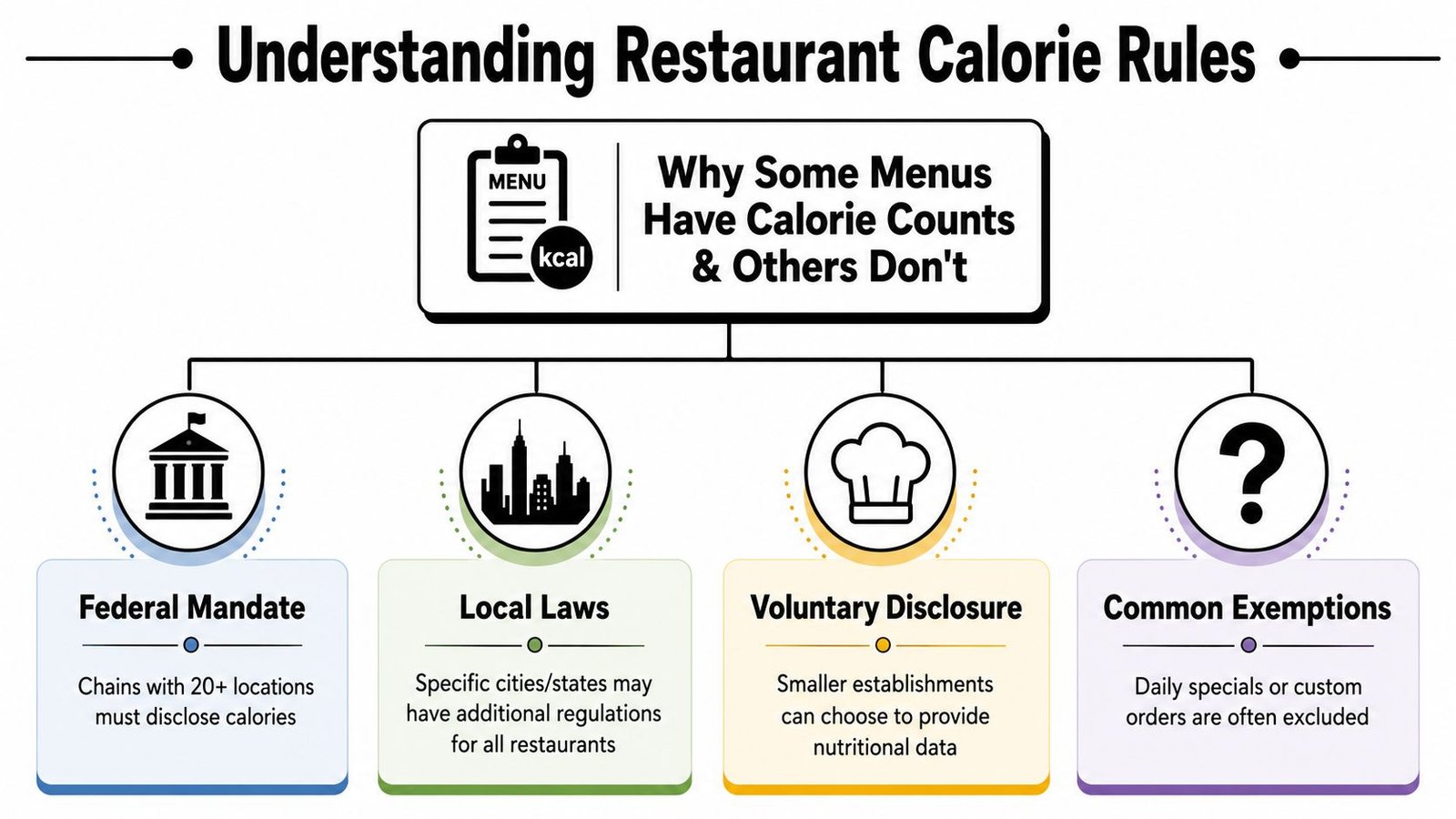
Under Section 4205 of the Patient Protection and Affordable Care Act, signed into law on March 23, 2010, chain restaurants and similar retail food establishments with 20 or more locations must provide calorie information for standard menu items, according to this overview of the federal restaurant labeling law. That is why large chains often post calories on menus, menu boards, and drive-through boards, while many neighborhood restaurants do not.
Restaurant labeling rules are different from package labeling rules
Packaged foods are built for standard labels. Restaurants often work from recipes that can shift with the cook, the portion scoop, the amount of oil in the pan, or the extras a customer adds.
The federal rule tries to create consistency where consistency already exists. If a business has many locations under the same name and sells substantially the same items, it is expected to show calories clearly. Self-service foods such as buffets or salad bars generally need calorie information near each item. Customers can also ask for written nutrition details for standard items, including fat, sodium, carbohydrates, and protein, as described in the same federal menu labeling summary.
That setup makes sense if you compare a chain restaurant meal with a packaged food. Both rely on repeatable recipes. Independent restaurants often do not.
If nutrition labels on food packages still feel confusing, it helps to review how to read nutrition labels step by step before applying the same ideas to restaurant meals.
Why the rule matters in real life
Visible calories can influence what people order. Research reviews have found that some customers buy slightly fewer calories when menu information appears at the point of purchase, and some restaurants also reformulate items over time. The effect is not dramatic for every person or every meal, but it is enough to matter in everyday circumstances, especially across repeated restaurant visits. County Health Rankings' review of restaurant nutrition labeling summarizes this pattern.
That is useful, but it only solves part of the problem.
A lot of meals happen in places that are not covered by the rule.
Why independent restaurants often have no posted data
Smaller restaurants usually are not required to post calories. Some provide nutrition information voluntarily, but many do not because recipes change, portions vary, and calculating accurate numbers takes time, software, and staff effort.
A chain burrito bowl is easier to label because the company can test ingredients once and apply that data across many stores. A local burrito shop may use a different tortilla brand next week, a heavier hand with cheese on Friday night, and a larger spoon for rice when business is slow. The meal is still real food. It is just harder to measure with the same precision.
That distinction matters because many articles stop at, "Use the posted data when available." Real life is messier. People eat at diners, family-owned restaurants, food trucks, and date-night spots with no official numbers at all. That is why a practical nutrition system needs two skills: reading official data when it exists, and estimating intelligently when it does not. Newer AI food trackers are built for exactly this gap.
A quick reference helps:
| Restaurant type | What you'll usually see |
|---|---|
| Large chain with standard menu items | Calories posted on menus or boards |
| Chain with strong nutrition systems | More detailed nutrition available online or on request |
| Independent restaurant | Little or no official nutrition data |
| Highly customized dishes or daily specials | Official labeling is often limited or absent |
Bottom line: Large chains with repeatable menu items are more likely to show formal restaurant nutrition information. Independent restaurants often leave you with less data, which is why estimation skills matter just as much as official numbers.
How to Find Official Restaurant Nutrition Data
When official numbers exist, the fastest approach is to look in layers instead of searching randomly.
Start with the obvious place. Then move outward.
Start where you order
At covered chains, calories should appear directly on the menu, menu board, or drive-through board for standard items. If you're standing at the counter or scanning a menu in your hand, check the item name itself first.
If you're ordering self-service food, look near each item rather than at the top of the station. Buffets and salad bars may place calorie information close to the tray or label card.
If you don't see more than calories, ask. Many chains keep written nutrition details in a printed handout, binder, or digital file for customers who want the fuller breakdown.
Check the restaurant's own digital channels
Restaurant chains often manage nutrition data through centralized systems tied to the USDA database, which helps them keep menu information updated and available on demand, according to this explanation of restaurant nutrition data management systems. In practical terms, that means the company website is often the next best stop after the menu itself.
Look for pages labeled:
- Nutrition
- Nutrition calculator
- Allergen and nutrition
- Menu PDF
- Interactive order builder
Online ordering can be especially helpful because it sometimes updates totals as you remove or add ingredients. If you're trying to get better at reading the numbers once you find them, this guide on how to read nutrition labels can help you make sense of calories, protein, carbs, fat, and serving size.
Use apps and ask direct questions
Third-party delivery apps sometimes display restaurant nutrition information that has been pulled from chain data. It's not always complete, but it can be useful for standard items.
A practical order of operations looks like this:
- Physical menu first. Fastest when you're already in the restaurant.
- Restaurant website second. Best for PDFs and calculators.
- Ordering app third. Helpful for convenience, but details may be limited.
- Ask staff last. Especially useful for printed nutrition sheets or standard-item details.
If a chain can tell you calories on the board, it may also have the fuller nutrient breakdown somewhere behind the counter or on its website.
One caution: custom orders can break the trail. If you swap proteins, add extra cheese, change the sauce, or combine menu items in unusual ways, official data may stop being clean and simple. That's where estimating becomes more useful than searching.
The Art of Estimating Calories for Any Meal
When no official data exists, estimation is not a backup plan for people who've failed. It's the skill that keeps tracking realistic.
Posted data usually covers standard items, not every variation, which creates a significant challenge. FDA-style menu rules don't solve the big swings created by toppings, sauces, and cooking methods, leaving a real gap for customized orders, as noted in this discussion of restaurant nutrition information gaps for modified meals.
Use the deconstruction method
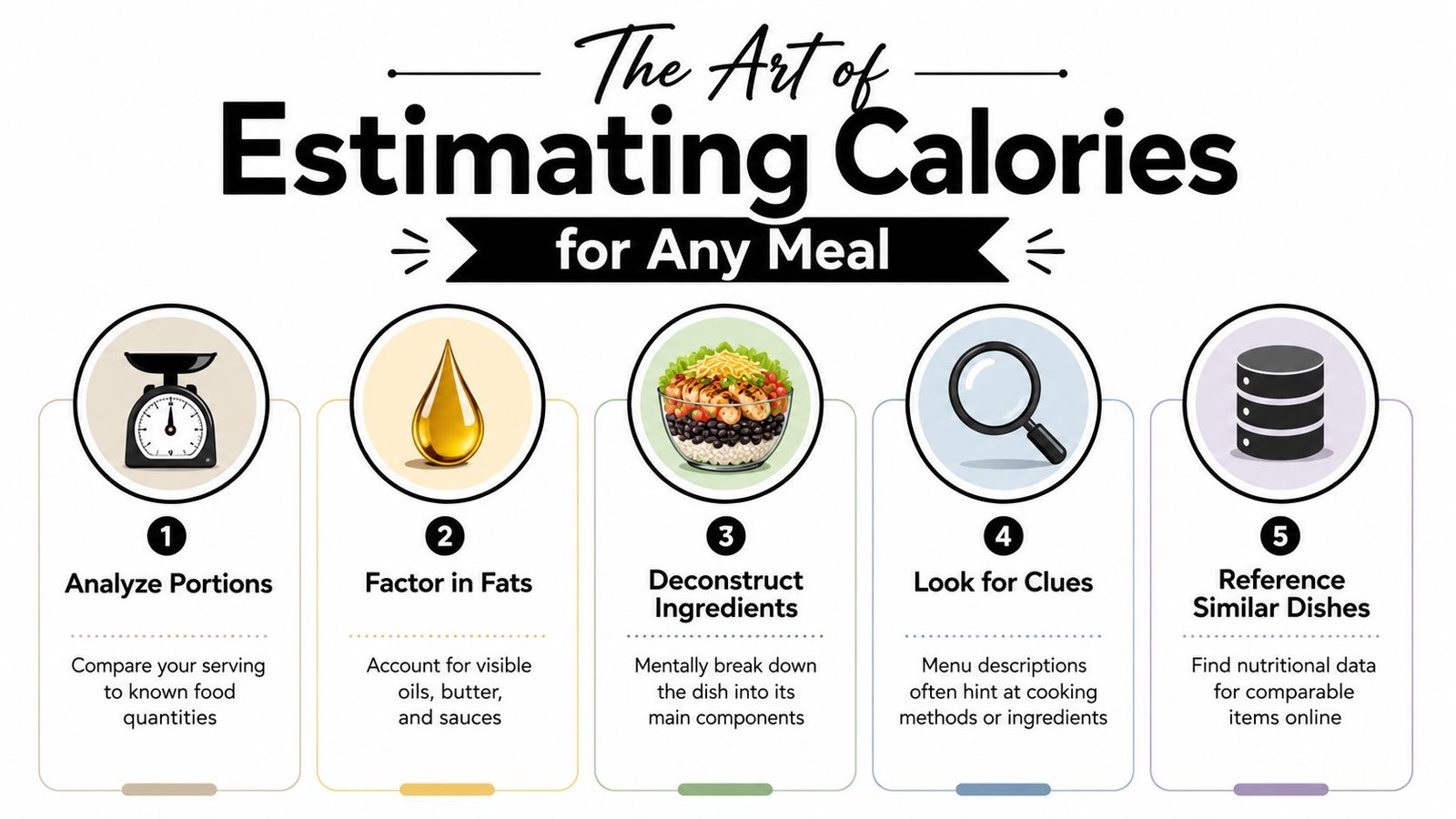
Instead of trying to log “one mysterious pasta bowl,” break the meal into familiar parts.
A plate of chicken Alfredo can become:
- Chicken breast
- Cooked pasta
- Creamy sauce
- Parmesan
- Cooking fat
- Side bread if you ate it
A burger plate can become:
- Burger patty
- Bun
- Cheese
- Sauce
- Fries
- Oil absorbed during cooking
This method works because your food tracker already knows these individual building blocks, even when it doesn't know the exact restaurant meal.
Compare it to a similar known item
If you're at an independent taco place, search for a similar taco from a major chain. If you're eating pad thai from a local Thai restaurant, use a recognizable chain or database entry as your baseline.
Then ask two questions:
| Question | Why it matters |
|---|---|
| Does this portion look bigger or smaller? | Portion size changes the total fast |
| Does this version look richer? | More oil, nuts, cheese, or sauce raises calories quickly |
That comparison won't be exact. It doesn't need to be. It gives you a starting point anchored in something real.
Look at the plate like a nutrition coach
Visual sizing helps when you can't measure. Your hand is useful because it travels with you.
- Palm-sized protein often gives you a workable estimate for meats or fish.
- Fist-sized starch helps with rice, pasta, or potatoes.
- Thumb-sized fat source reminds you that oils, butter, and creamy sauces add up fast.
- Two cupped hands of salad may still be light, unless dressing and toppings change the story.
Practical rule: Estimate the visible food first, then add a separate entry for likely extras such as oil, butter, dressing, glaze, or aioli.
That last step is where many estimates improve. People often count the chicken and rice, then forget the tablespoon-by-tablespoon effect of cooking fat and sauce.
Read menu wording like clues
Restaurant descriptions often tell you more than they seem to.
Words like crispy, breaded, smothered, loaded, creamy, alfredo, buffalo, glazed, or stuffed usually signal higher energy density. Words like grilled, steamed, broiled, roasted, or plain often make estimation easier.
If you're trying to get more confident with calories and protein together, it helps to understand how macros shape the whole meal. This primer on understanding macronutrients for weight loss is useful because it explains why two meals with similar calories can feel very different depending on protein, carbs, and fat.
For a practical walkthrough built specifically for dining out, this guide on estimating calories when eating out is a solid companion.
Consistency beats precision
A good estimate done every time is more useful than a perfect estimate done rarely.
If you usually overeat restaurant sides, track them. If sauces are your blind spot, count them separately. If your favorite local restaurant serves huge portions, log what you ate, not what came on the plate.
That's the art. Not guessing wildly. Learning to make informed, repeatable estimates.
Smart Ordering Strategies and Modern Tracking Tools
The easiest restaurant meal to track is the one you simplified before it reached the table.
This doesn't mean ordering joyless food. It means noticing where the uncertainty usually hides. For many meals, it isn't the chicken, rice, or potato that causes the biggest nutrition surprise. It's the dressing, marinade, broth, spread, or finishing sauce. The FDA requires detailed nutrient information like sodium and saturated fat only upon request for standard items, not on the main menu, which creates a blind spot for diners because those nutrients often sit in dressings, marinades, and broths, as explained on the FDA page on menu labeling requirements.
Order in a way that makes the meal easier to understand
You don't need a complicated script. A few simple requests can make restaurant nutrition information more practical, even when there's no official label.
Try phrases like:
- “Sauce on the side.” This gives you control over both calories and sodium.
- “Grilled instead of fried.” Easier to estimate, usually less oil absorbed.
- “Light dressing, please.” Helpful because salads often become high-calorie through toppings and dressing alone.
- “No extra butter.” Especially useful for vegetables, fish, and steakhouse sides.
- “Can I swap fries for a plain side?” A baked potato, fruit, or steamed vegetable is often simpler to log.
These aren't “diet” phrases. They're clarity phrases.
Build meals that are easier to track
Some restaurant formats help more than others. Bowls, plates, and simple entrees are usually easier than mixed casseroles, giant sandwiches with multiple spreads, or dishes covered in sauce.
A track-friendly plate often has:
| Easier to estimate | Harder to estimate |
|---|---|
| Grilled protein | Breaded or stuffed protein |
| Plain rice or potato | Creamy pasta or rich mixed dishes |
| Vegetables with visible seasoning | Vegetables coated in butter or sauce |
| Dressing or sauce on the side | Sauce already mixed throughout |
That doesn't mean you should never order the richer option. It just means you should know when the estimate will need a wider margin.
Where modern tools help
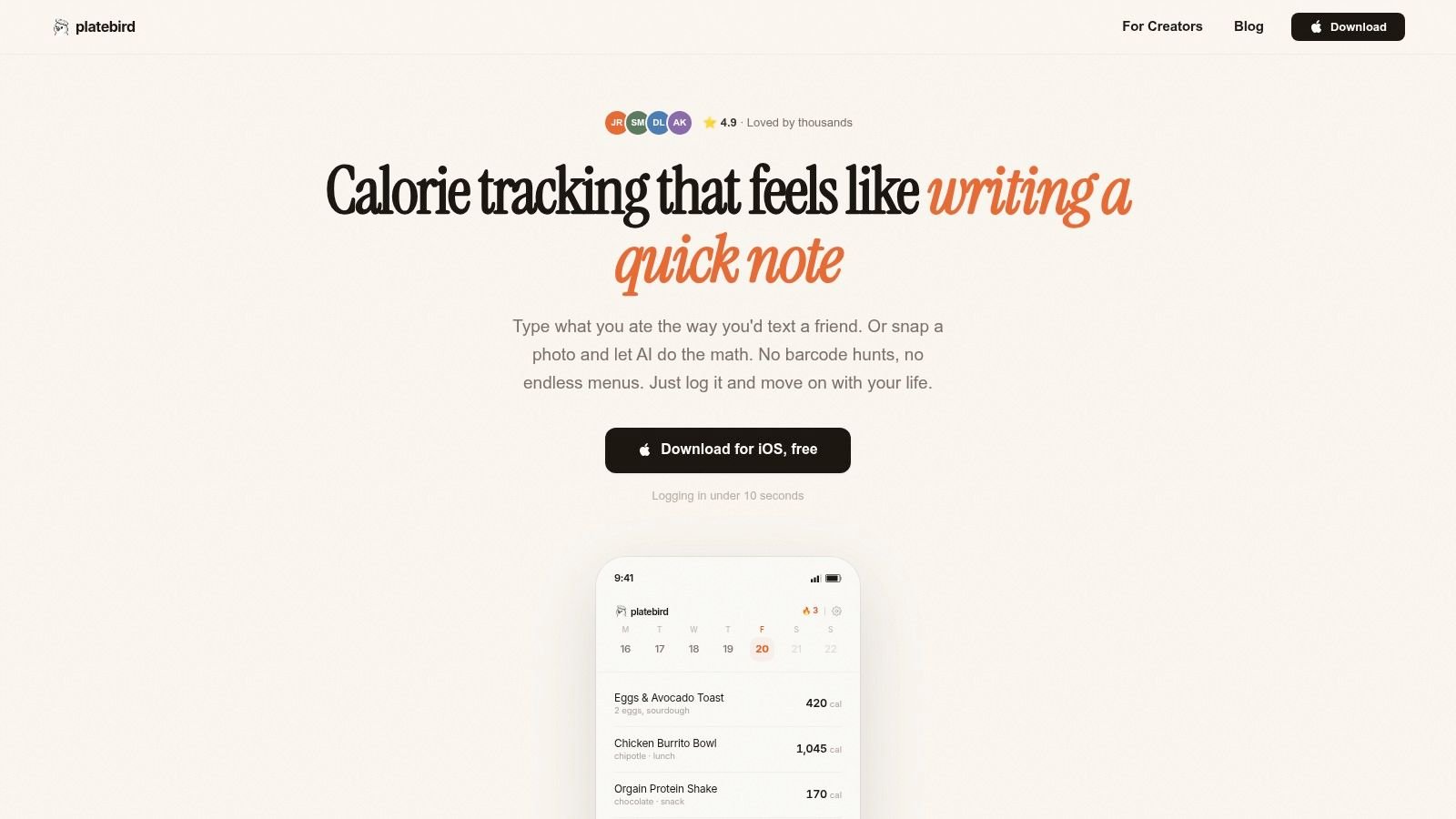
Manual logging can feel slow when you're staring at a bowl with ten ingredients. That's why newer AI-based trackers are getting attention. They reduce the friction between “I ate this” and “I logged this.”
Some tools now let you type a plain-language description of the meal or use a photo to identify likely components, then turn that into a calorie and macro estimate. That's especially useful for local restaurants, work lunches, takeout, and family-style meals where official restaurant nutrition information doesn't exist.
The best tracking tool is the one you'll still use when the meal is messy, social, and impossible to barcode-scan.
There's also a motivational side to this. Logging is easier to maintain when it connects to a visible progress habit. If you're trying to pair food awareness with a more encouraging feedback loop, this guide on how to visualize weight loss progress on your phone offers a practical perspective beyond the scale.
If you want to see how AI fits into the food-logging side specifically, an AI calorie counter gives a good example of the newer workflow. Instead of hunting for the exact restaurant listing, you describe the plate in normal language and refine from there.
The real win is lower friction
Tracking doesn't cease from a lack of concern. It stops because the process becomes annoying.
Restaurant meals expose that weakness fast. The more steps your system requires, the more likely you are to skip the meal entirely. A useful setup reduces decision fatigue, handles imperfect information, and helps you move on with your day.
That's what makes smart ordering and smart tools work so well together. One reduces the unknowns before the meal. The other helps capture what's left after you've eaten.
Building a Sustainable Habit of Informed Eating
You're out with friends, the food arrives, and no one wants to spend ten minutes turning dinner into a math problem. That moment is where a lot of tracking habits fall apart. Not because the meal matters too much, but because the process feels too hard.
A sustainable approach keeps the process light enough to use in real life.
The goal is simple: stay aware often enough that restaurant meals fit into your routine instead of knocking you off course for the rest of the week. Some restaurants hand you exact numbers. Others give you nothing at all. In both cases, the skill is the same. Gather what you can, estimate the rest, and make one reasonable entry.
A good way to remember it is to treat eating out like driving in light fog. You may not see every detail, but you can still stay on the road by using the markers you do have.
A repeatable decision rule
Use the same sequence each time you eat out:
- Look for official numbers first. Check the menu, website, app, or posted nutrition sheet.
- If nothing is listed, break the meal into parts. Protein, starch, vegetables, sauces, drinks, and extras.
- Add the likely extras. Cooking oil, butter, creamy dressing, cheese, breading, and sugary sauces raise totals fast.
- Log the closest version and keep going. Consistency matters more than chasing a perfect number you cannot verify.
That simple routine works at chain restaurants, local diners, food trucks, office lunches, and family-style spots. That broader system is what many restaurant nutrition guides miss. They stop where the official data stops. Real life does not.
Awareness changes choices
As noted earlier, calorie labeling tends to nudge choices in a healthier direction. The bigger lesson is practical. People usually eat better when they have even a rough map of what is on the plate.
That matters for habit building. You do not need perfect precision to spot patterns. If your restaurant meals are regularly heavier on fried sides, creamy sauces, and large portions, a decent estimate is enough to notice it and adjust the next order.

Keep the social side of eating intact
Restaurant tracking should make eating out feel more manageable, not more stressful.
You can celebrate, travel, grab takeout after a long day, or eat at a small neighborhood restaurant and still stay oriented. One dinner does not need to be exact to be useful. What helps is avoiding the common spiral: one uncertain meal turns into “I already blew it,” and that turns into several days of not paying attention at all.
A sustainable habit leaves room for restaurant meals, imperfect estimates, and real life.
Over time, informed eating becomes less about hunting for flawless data and more about building a calm, repeatable system. Official nutrition information is helpful when it exists. Estimation skills carry you everywhere else. Modern tools can fill in the gap, especially when a meal has no listing at all.
If you want a faster way to log restaurant meals without digging through menu databases, PlateBird is built for exactly that. You can type what you ate in plain language or snap a photo, and the app estimates calories and macros in seconds. That makes it much easier to stay consistent when you're eating at local restaurants, customizing orders, or dealing with meals that don't come with official nutrition facts.