
You're staring at a week that doesn't line up neatly with a single meal plan. Leg day leaves you flat if you under-eat, rest days feel wasteful if you keep pounding carbs, and generic calculators often spit out numbers that ignore both training and life. A carb cycling calculator helps you match food to demand, so your plan supports hard sessions without forcing the same intake on easy days.
Why Carb Cycling Works for Your Goals
Metabolic flexibility is a key factor in why carb cycling can feel more workable than a one-speed diet. On higher-carb days, you give your body enough carbohydrate to support harder training and refill glycogen. On lower-carb days, you pull intake back and let the overall pattern create a tighter calorie structure without making every day feel identical.
That matters when fat loss stalls. Many people don't fail because they lack discipline, they fail because the plan never distinguishes between a brutal workout day and a desk-bound recovery day. Carb cycling builds that distinction into the food pattern itself, which is why it often feels easier to follow than a flat calorie target.
It also fits performance goals better than rigid low-carb eating. If you lift hard, run intervals, or stack demanding sessions across the week, your body wants more fuel on those days and less on the quieter ones. That's the logic behind periodized nutrition, and it's the same reason a good gym-facing resource like the nutrition seminar playbook can be useful when you're trying to explain the method to clients or training partners.
Practical rule: fuel the work, then back off when the work backs off. That's the core idea, and it's easier to sustain than guessing at the same carb target every day.
The Essential Data You Need for Any Calculator
A good result starts with honest inputs, not aggressive guesses. If your data is off, the calculator can still produce a neat set of numbers, but they won't reflect your actual training load or body size. For the basic setup, gather your weight, height, age, gender, activity level, and your main goal.
Your weight is the easiest place to start because it anchors the baseline. Height and age help shape the estimate of energy needs, while gender matters because calculators often use it as part of the metabolic estimate. Activity level is the number frequently misjudged, especially if they have a desk job but also train several days a week. Be honest here. A person who sits most of the day but lifts hard after work is not the same as someone who moves all day on their feet.
Your goal changes the final picture. Fat loss, muscle gain, and maintenance don't use the same calorie structure, even if the calculator uses the same input screen. If you're unsure about the energy side of the process, it helps to understand what TDEE means in practice, because that number is the bridge between body stats and meal planning.
Check your weekly reality, not your self-image. Most macro mistakes start with overrating daily movement and underestimating how sedentary the rest of the day really is.
If you can estimate body fat reliably, that can sharpen the plan too, but don't let imperfect measurements stop you from getting started. Use the best data you have, then refine from real-world results.
How to Calculate Your High and Low Carb Day Targets
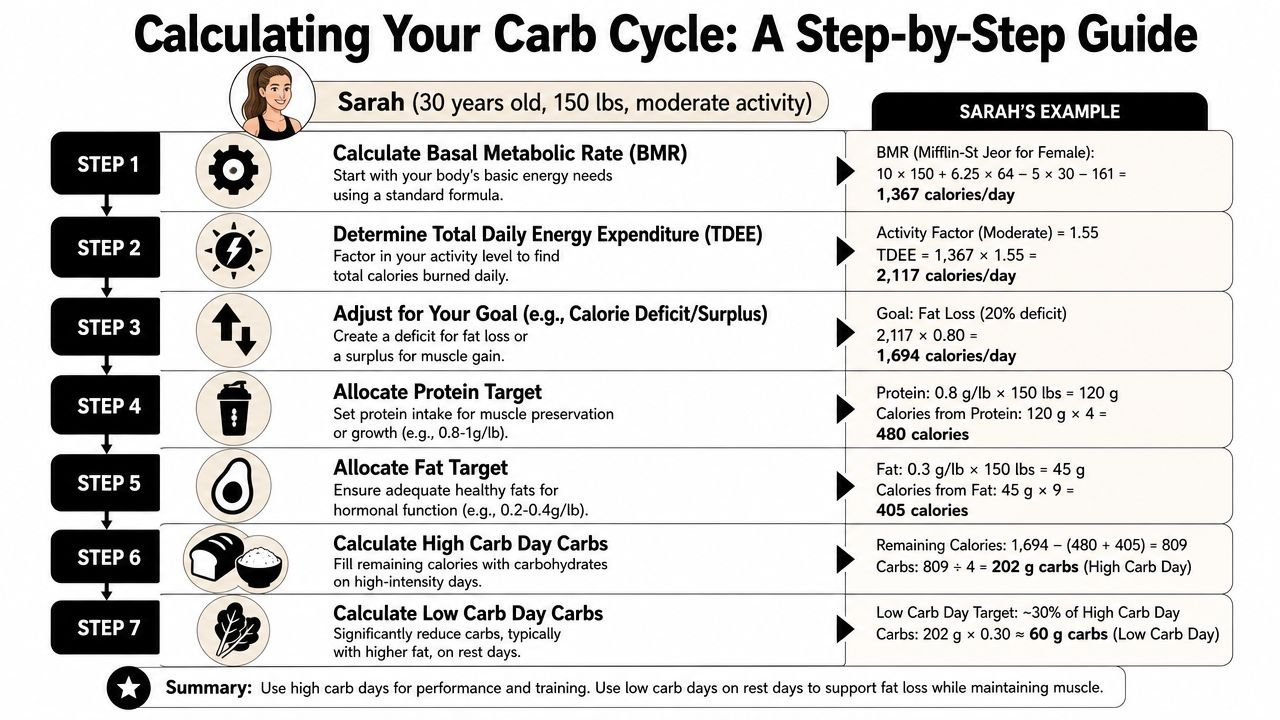
Start with your calorie foundation. A practical carb cycling calculator should estimate TDEE from BMR × activity factor, then set protein and fat first, and only then put the remaining calories into carbohydrates, following the stepwise method used by ISSA in its carb cycling guide. Once carb calories are set, divide by 4 to convert them into grams, which is the standard carbohydrate conversion used in most calculator workflows.
Say you're building a plan for a moderately active lifter. The first decision isn't high-carb or low-carb, it's what your daily calorie target should be based on your current size and activity. After that, protein comes first because you want the plan to protect lean tissue and support recovery. Fat comes next so you don't squeeze it too low. Carbs fill the rest.
Turning one baseline into three day types
The cycle itself is just a rotation around that calorie base. High-carb days land on the sessions that demand more glycogen. Low-carb days support the quieter parts of the week. Moderate-carb days sit in the middle and keep the plan flexible enough to survive normal life.
A simple way to think about it is this:
- High-carb days: best for the hardest training, especially lower-body strength work or long, demanding conditioning.
- Moderate-carb days: useful for solid training that isn't your most draining session.
- Low-carb days: better for rest, mobility, or lighter movement.
If your food needs to be fast and repeatable, pairing this setup with simple low-carb cooking solutions can make the low days easier to execute without turning dinner into a project. And if you want to connect these numbers to the rest of your macro setup, this macro guide helps keep protein, fat, and carbs in the right order.
The important part is not chasing perfect precision on day one. The important part is building a repeatable calorie structure first, then assigning carb levels in a way that matches how hard you train.
Mapping Your Carb Cycle to Your Weekly Workouts
A carb cycle only works when it fits the calendar you really live in. If your hardest session is on Tuesday, Tuesday should not be your low-carb day just because the calculator made it easy to fill in a grid. The food pattern has to follow the training pattern.
A practical weekly structure often looks like this. Put high-carb days before or on the day of your most demanding lifts, sprints, or intervals. Use moderate-carb days for upper-body training, shorter sessions, or mixed training days. Reserve low-carb days for rest, mobility, or easy aerobic work. That arrangement keeps the biggest fuel hits aligned with the sessions that need them most.
You can also think in terms of workload. A heavy squat day or a long ride deserves more carbohydrate than a light recovery jog. That doesn't mean every hard day needs the same amount, but it does mean your intake should rise when the output rises.
Here's a simple example of how that might look across a week:
- Monday: moderate carbs, upper-body strength
- Tuesday: high carbs, lower-body strength
- Wednesday: low carbs, rest or mobility
- Thursday: high carbs, intervals or hard conditioning
- Friday: moderate carbs, mixed accessory work
- Saturday: low or moderate carbs, easy movement
- Sunday: low carbs, recovery day
A good schedule doesn't just support training, it also protects adherence. If you know a higher-carb day is coming before the hardest workout, it's easier to stay consistent on the low day before it.
The video below is worth watching if you want to see how the flow changes when food is matched to actual output.
Beyond the Numbers Adjusting Your Plan for Real Results
A calculator gives you a starting point, not a final verdict. The best adjustments come from how you feel in the gym, how stable your appetite is, and whether the plan still fits your week after the first round of real meals. If low-carb days leave you drained, that's a signal to soften the drop, not to abandon the whole approach.
One issue deserves special caution. Very low-carb days below the 130 g/day adequacy reference can be a poor fit for some people, especially if the goal is still to train well and maintain energy. That number is a population-level benchmark, not a universal athlete target, and the right choice depends on training load, goal, and how long the low-carb phase lasts. Public carb cycling calculators often skip that nuance, which is why users are left wondering whether the result is safe, effective, or just mathematically neat.
Female-specific adjustments matter
Women often need more context around carb timing than generic calculators provide. Cycle phase can change appetite, recovery, and how hard a session feels, so a plan that looks perfect on paper may need a little more carbohydrate support in the luteal phase. Perimenopausal users may also notice different energy and stress responses, which makes a rigid low-day prescription less useful than a flexible one.
The useful habit is to watch patterns, not just weight. If performance drops, sleep gets worse, or cravings spike every time low days stack up, adjust the cycle before you force it. That might mean moving carbs closer to training, easing the low days upward, or shortening the low-carb phase altogether.
If the plan feels brutal, it's probably too tight. Carb cycling should feel structured, not punishing.
The smartest version of this method is responsive. It adapts to the week, the season, and the body in front of you.
Track Your Carb Cycle Effortlessly with PlateBird

The hardest part of carb cycling isn't understanding the math, it's sticking to it on a random Wednesday when dinner changes and training runs long. That's where tracking becomes the difference between a plan you designed and a plan you adhere to. If you want a cleaner way to manage the day-to-day, PlateBird's calorie and macro tracker is built for fast logging when your targets change from high to low days.
The workflow matters. When logging feels slow, people skip meals, estimate loosely, or give up on the cycle entirely. A fast input method keeps the plan practical, especially when you're trying to hit a specific carb target on one day and pull back the next. If your meals repeat often, shortcuts matter even more because they cut the friction of re-entering the same breakfast or lunch again and again.
The image above shows the kind of simple tracking view that makes this easier to manage. For carb cycling, that simplicity is valuable because the plan only works if the numbers stay visible long enough for you to act on them.
If you're ready to turn your carb cycling numbers into something you can follow all week, download PlateBird and start logging your meals today. Keep the targets flexible, keep the tracking fast, and make the plan fit your training instead of fighting it.