- Why a 5 Pound Weight Workout Is Worth Your Time
- When 5 Pounds Are Enough and When They're Not
- The Full-Body 5 Pound Weight Workout Step by Step
- Progressing Without Heavier Weights
- Circuit vs HIIT Versions of the Same Workout
- Form Mistakes That Make Light Weights Risky
- Tracking Workouts and Calories With PlateBird
You're standing in your living room with a pair of 5-pound dumbbells, wondering if they're too light to matter. That hesitation is common, and it's also the wrong first question. The key question is whether you can turn a light pair into a session you'll consistently repeat, because that's where the results start.
Why a 5 Pound Weight Workout Is Worth Your Time
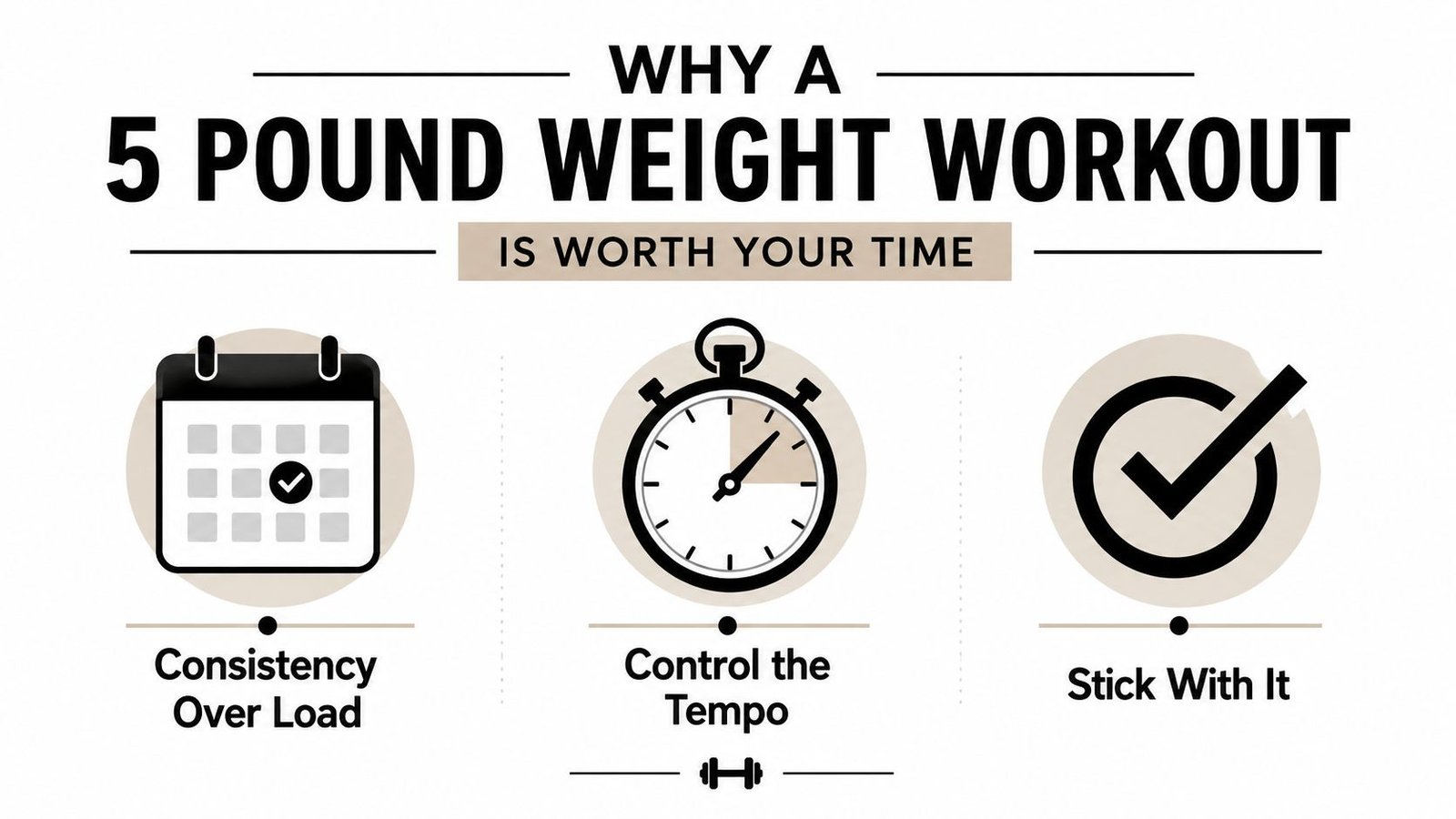
A beginner doesn't need a fancy setup to start building a real habit. A pair of 5-pound dumbbells can be enough to create a full-body routine if you use them with control, enough volume, and a plan you can repeat without dread. That matters because the public-health gap in resistance training is huge, with only 35.2% of U.S. men and 26.9% of U.S. women aged 18 and over meeting the federal muscle-strengthening guideline of at least two days per week, and participation falling sharply with age, according to a 2020 CDC analysis (CDC).
That gap is exactly why light dumbbells deserve more respect than they get. For many people, they're the easiest entry point into consistency, especially if the alternative is doing nothing because a heavier weight feels intimidating. A simple at-home routine also pairs well with recovery support, which is why some people keep a resource like Supplemynts Inc supplement store handy when they're setting up a broader home-training routine.
Why the number on the dumbbell is only part of the story
I've coached plenty of beginners who assumed a workout only “counts” if they're struggling under heavy weight. The better test is whether the session creates enough challenge to keep your form honest and your schedule realistic. A light load works when it helps you show up often, move well, and avoid the all-or-nothing mindset that kills most home programs.
Resistance training has also long been framed as a health tool, not just a physique tool. Men's Health summarized research showing that men who performed three total-body weight workouts per week for 2 months lowered blood-pressure readings by an average of 8 points, and it also cited evidence that for every pound of muscle a man loses, he gains a pound of fat (Men's Health). You don't need to chase those exact numbers to benefit from the principle, which is that regular lifting supports the habits that drive change.
Practical rule: if a light routine helps you train with better form this week than last week, it's doing its job.
A 5 pound weight workout is worth your time when it lowers the friction enough that you'll do it again on Wednesday and again the week after that. That's the key win. Not the dumbbell itself, the repeatable behavior it encourages.
When 5 Pounds Are Enough and When They're Not
A beginner often reaches for the same pair of dumbbells for every move and then wonders why some exercises still feel easy. The number on the handle matters less than the demand of the exercise, because 5 pounds may be challenging for one movement and far too light for another. The practical test is simple, the final 2 to 3 reps should feel hard while your form still stays controlled.
Where light dumbbells shine
Five pounds usually works best for smaller muscle groups, technique practice, shoulder stability, rehab-style work, and muscular endurance. That matches Peloton's strength-training guidance, which points out that lighter weights can help beginners and smaller muscle groups like the shoulders and arms, while larger groups such as the chest, legs, and back often need more load (Peloton). It also fits the common beginner problem I see in coaching, people want a hard workout, but the first real gain is often consistency, not maximum weight.
Where they stop being enough
Five-pound dumbbells usually stop pulling their weight on compound moves like squats, presses, and rows once you get stronger. That does not make them a bad choice. It means their job changes from building maximal strength to improving skill, endurance, and follow-through. For a lot of beginners, that is still the right place to start, especially if the goal is to clean up movement before loading it more heavily.
If you finish a set and feel fresh enough to repeat it without much pause, the load is probably too light for strength-focused work.
Cleveland Clinic's progressive overload guidance is the useful standard here. It recommends changing one variable at a time, such as weight, reps, session length, or rest time, and notes that a typical strength routine uses five to six exercises with three sets of 6 to 15 reps (Cleveland Clinic). That gives you a clear decision point. If 5 pounds keeps you in that range with good form, keep using it. If it does not, progress by adjusting the workout before you assume you need a new dumbbell set.
For the nutrition side of that decision, how to calculate daily protein needs is a useful read because visible change depends on both training and intake, especially if you want your workouts to show up in the mirror as well as in the gym log.
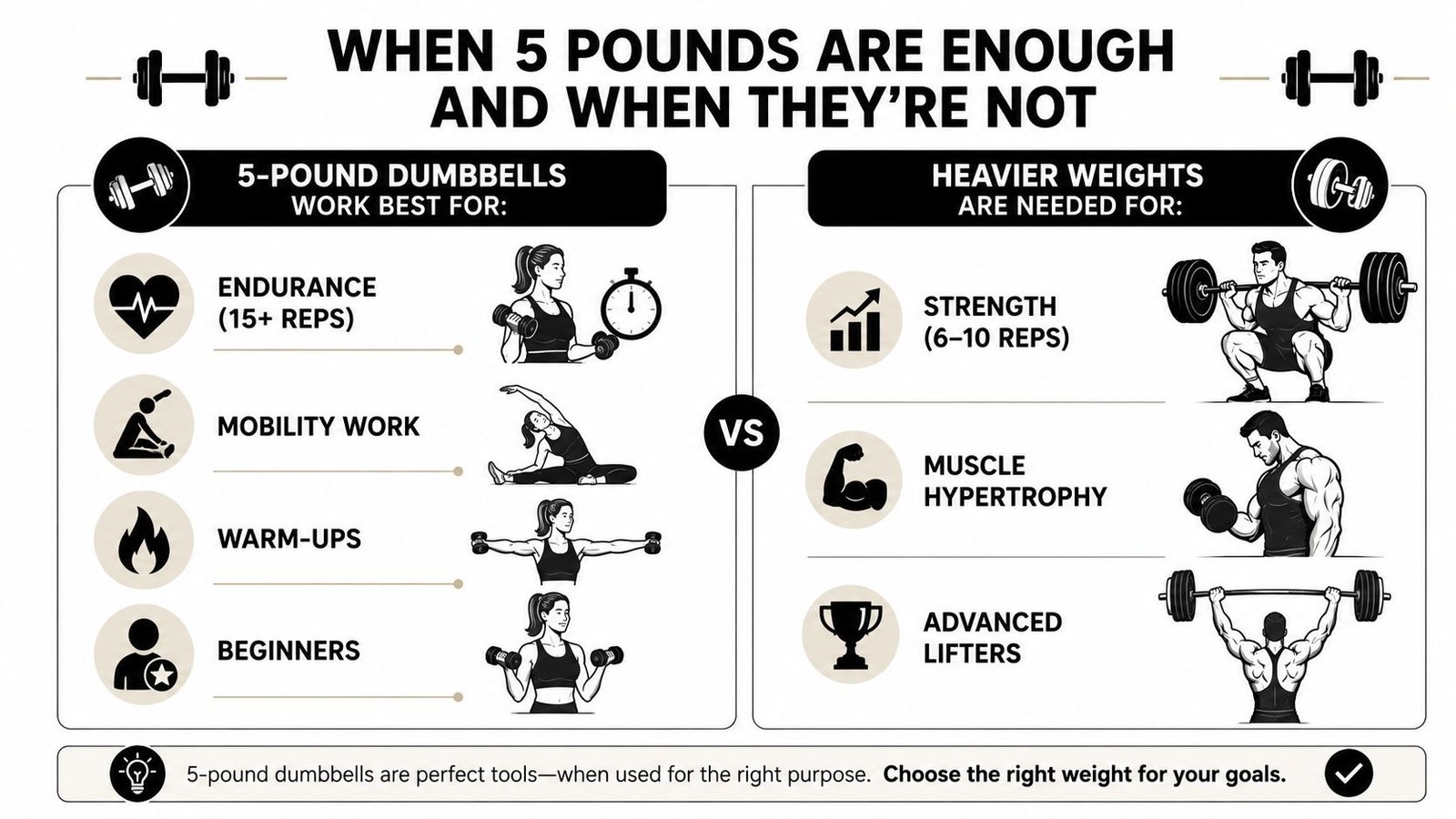
If your current goal is form, endurance, or getting back into training after a break, 5-pound dumbbells can do real work. If your goal is muscle gain on bigger lifts, they will eventually become a starting point rather than the full plan.
The Full-Body 5 Pound Weight Workout Step by Step
A good light-dumbbell session should feel controlled from the first rep. That means you warm up first, then move through a small number of exercises that cover the whole body without rushing. A classic beginner setup uses 2 to 3 sessions per week with 3 sets per exercise and a rep range that can extend upward as long as form stays tight (My Family Exercise).
Warm up before you press, row, or lunge
Start with 5 minutes of dynamic movement. Use arm circles, band pull-aparts, hip openers, and bodyweight squats. If your shoulders are cold and your hips are stiff, the workout gets sloppy fast, especially on the first pressing set.
Then move into the circuit. Keep the tempo slow enough that you can feel each phase. A practical default is 2 seconds down, 1 second up, which helps a light load feel more demanding without turning it into a swing-and-jerk routine.
The main circuit
Chest press. Lie down or brace on the floor, and keep your elbows tucked about 45 degrees from your sides. Use 3 sets of 10 to 15 reps.
Bent-over row. Hinge at the hips, keep the spine long, and pull with your back, not your hands. 3 sets of 10 to 15 reps works well here.
Overhead shoulder press. Stack wrists over elbows and keep your ribs down so you don't arch through the low back. Stay in the same 3 sets of 10 to 15 reps range.
Reverse lunge. Step back under control and keep your front foot planted. If balance is shaky, slow the descent and shorten the range slightly rather than rushing.
Glute bridge. Drive through the heels, squeeze the glutes at the top, and keep the pelvis neutral instead of overextending the back.
Standing core rotation. Rotate from the torso, not the arms, and keep your breathing steady.
Coach's cue: if the last three reps look different from the first three, the set is too long or the load is too light for that movement.
If you want a broader strength-and-fat-loss context for programming, burn fat and build muscle is a useful companion to this routine.
Progressing Without Heavier Weights
A 5-pound dumbbell workout usually feels manageable at first, then the same moves stop creating much of a challenge. That is the point where many beginners assume they need heavier weights right away. Sometimes they do, but often there is still room to progress by changing how the work is done, not just how much weight is in hand.
The basic rule is simple. Change one variable at a time so you can see what made the set harder. Slower lowering, shorter rest, cleaner tempo, and more total work all keep 5-pound weights useful longer, especially when the goal is to build control before you chase bigger loads.
The levers that make light weights harder
The first lever is the lowering phase, also called the eccentric phase. Slow that phase down and the same dumbbell demands more from the muscle. The second lever is rest. Cut it and the workout gets harder without changing the exercise itself. Those two adjustments buy beginners more time before they have to move up in weight.
You can also change the rep quality. A set of fast, loose reps is a different stimulus from a set done with steady tension and no swinging. For light weights, the cleaner version usually wins, because it exposes whether the muscle is doing the work or whether momentum is carrying the set.
For people who like a second example of small-step progression, deep abs workout progression shows the same idea in a different setting, where tighter form and small changes make the exercise feel harder without changing the movement.
Progression ladder Without Heavier Dumbbells
| Stage | Change Made | Reps | Rest |
|---|---|---|---|
| 1 | Do the base routine with clean tempo | 10 to 12 | 60 seconds |
| 2 | Add reps first | Up to 15 | 60 seconds |
| 3 | Cut rest | 15 | 45 seconds |
| 4 | Slow the tempo to 3-1-2 | 12 to 15 | 45 seconds |
| 5 | Add a second round of the circuit | 12 to 15 | 30 to 45 seconds |
The order matters. Add reps first, then reduce rest, then slow the lowering phase, then add another round. That sequence keeps the workout moving forward without forcing a load jump too early. It also gives you a clean read on the set. If the same weight only feels hard because you are rushing, you do not have a real progression problem yet, you have a pacing problem.
Use the numbers as a checkpoint, not a badge. If 15 reps with slow lowering and short rest still feels comfortable, the dumbbells are probably no longer doing enough for that movement. At that point, either increase load, change the exercise angle, or shift that lift toward endurance work while you keep the rest of the session in a strength-focused range. For readers who also want body-composition guidance alongside training, burn fat and build muscle connects the workout side with calorie tracking in a practical way.
Circuit vs HIIT Versions of the Same Workout
The same five exercises can serve two different purposes. One version is a steady circuit, the other is a harder HIIT-style session with bursts of bodyweight work layered in. Both are useful, but they suit different recovery levels and different schedules.
Choose the format by the outcome you want
Circuit format keeps you moving through the strength exercises with short rests. That's a good fit if you want a session that feels structured, controlled, and beginner-friendly. It also tends to be easier to keep technically clean because you're not trying to sprint between movements.
HIIT format pairs the strength moves with short bursts like jump squats, mountain climbers, or skaters. That version is more time-efficient and usually feels more cardio-heavy. It can be a better match when the goal is a stronger conditioning hit in the same general time window.
How I'd use each one
Pick the circuit on days when you want to focus on form and steady effort. Pick the HIIT version when you want a tougher sweat and you're not already carrying a lot of fatigue. The important part is not to pretend they're the same stimulus. They aren't.
A lot of beginners overdo the HIIT version because it feels more intense on paper, then their shoulders and elbows get irritated by the combined volume. If your joints are sensitive, stay with the circuit first and earn the right to add the faster intervals later.
Best-fit test: if you can't keep your torso from twisting or your shoulders from shrugging, choose the circuit before you choose the HIIT format.
Same exercises, different rules. That's the cleanest way to think about it.
Form Mistakes That Make Light Weights Risky
People assume 5-pound dumbbells are automatically safe. They're not. Light weights can hide bad habits because the load doesn't force an honest correction. That's why high-rep work can bother shoulders and elbows if the movement pattern is messy.
The three compensations I see most
Shrugging the shoulders. This shows up during pressing and rowing when the neck takes over. The fix is simple, pull the shoulders down before you start the rep and keep the chest broad without arching.
Arching the low back. This often appears on overhead presses and standing rows when the ribcage flares. Keep the ribs stacked over the pelvis and stop the set before you start leaning back to “finish” the rep.
Swinging the arms. This is the classic high-rep cheat. It turns the exercise into momentum work, which feels easier in the moment and does less for the target muscle.
Small fixes that protect the joints
Wrist alignment matters more than most beginners think. Keep the wrist stacked, not bent back, and hold the dumbbell firmly without crushing it. Breath matters too, because people who hold their breath too long usually start bracing in a way that turns clean reps into rigid ones.
The safest light-weight set is the one you stop before form breaks. That sounds obvious, but beginners often keep going because the weight is light and they assume nothing bad can happen. Light load plus sloppy repetition is still sloppy repetition.
Stop the set the first time you have to choose between clean technique and finishing the rep.
That mindset keeps the workout useful instead of just noisy.
Tracking Workouts and Calories With PlateBird
Light dumbbells don't show visible change by themselves. The results come from the combination of training, calorie awareness, and enough protein to support recovery. That's why logging matters, especially when the workout is simple enough that it's easy to mentally dismiss.
PlateBird fits this use case because it's designed to make food logging quick. You can type a meal like “chicken rice broccoli” and get an instant calorie and macro breakdown, or snap a photo and let the app identify the plate with computer vision before you eat. For home-workout users, that lowers the friction of tracking the fuel side of the plan, which is often what makes body-composition change visible over time. If you want the broader workflow, how PlateBird helps home workout enthusiasts track calories and macros lays out the same idea in more detail.
That matters more than people expect. A 5 pound weight workout can improve consistency, but the mirror usually responds when training lines up with what you eat. PlateBird also includes weight tracking, so you can log weigh-ins, set goals, and watch progress over time, and it syncs with Apple Health to read and write weight, nutrition, and activity data.
How to log the training itself
Keep your workout log simple.
- Sets completed: write down the actual number of sets you finished.
- Reps completed: note where you stayed in the rep range and where you fell short.
- Perceived effort: give each session a quick honesty check, easy, moderate, or hard.
- Form quality: mark whether you kept control or started cheating late in the set.
That takes seconds, not minutes. It also gives you a cleaner answer to the question, “Did this workout progress?”
A weekly calendar that keeps the plan moving
Week 1, do 3 sessions, all circuit format. Week 2, alternate circuit and HIIT. Week 3, repeat the alternating pattern and try one small progression, like more reps or shorter rest. Week 4, either deload by keeping the movements but reducing the effort, or run a checkpoint workout and see whether the same routine feels easier.
If you want something practical on the wrist while you're tracking steps and workouts, affordable Fitbit bands from Nothing But Bands are a simple add-on for people who like seeing activity data at a glance.
FAQ
How long until a 5-pound workout shows results?
Give it 4 weeks of consistent training and tracking before you judge the routine. If the session is logged, the meals are tracked, and the reps are moving better, you're on the right track.
Is 5 pounds enough for visible muscle?
Yes for some muscles and goals, especially shoulders, arms, endurance work, and rehab-style training. No for bigger strength goals on large muscle groups once you can easily finish the top end of the rep range.
What if I don't feel anything during the session?
Add reps until you hit 15, shorten rest to 45 seconds, or slow the lowering phase to 3-1-2. If that still doesn't change the difficulty, the load is too light for that exercise.
How should I combine this with cardio for fat loss?
Use 2 to 3 strength sessions a week and place cardio on the in-between days or after the circuit on lighter days. Keep the eating log running so the calorie side stays visible, because fat loss depends on the whole week, not just the workout.
PlateBird makes the nutrition side of a light-dumbbell plan less annoying. If you're trying to turn a 5 pound weight workout into something you can stick with, PlateBird gives you a fast way to log meals, track macros, and keep your training connected to visible progress.