You go in for a routine sports physical. Your resting heart rate is solid. You train hard. Your lifts are up, your conditioning is good, and your coach likes where you are physically. Then someone plugs your height and weight into a chart and says you're “overweight.”
That moment messes with a lot of athletes.
If you're a college athlete, you've probably had the same reaction I hear all the time: “How can that be true if I'm fit, fast, strong, and practicing almost every day?” That confusion makes sense. BMI looks clinical and objective, so it feels like a verdict. But for athletes, it often works more like a rough guess.
The good news is that your confusion doesn't mean you're missing something. It usually means the tool is too blunt for the job. If you've ever gone down the rabbit hole of trying to gain size for your sport or lean out without losing performance, you've probably already seen how body weight alone can mislead. That's the same reason athletes often struggle with conversations around bulking and cutting. The number on the scale doesn't tell you what kind of tissue you gained, what fuel you need, or how your body is adapting to training.
The Athlete's Paradox You're Fit But Your BMI Is High
A linebacker, sprinter, rower, and wrestler can all walk into the same clinic and get judged by the same BMI chart. That chart doesn't know who spends hours training, who carries more muscle, or whose sport rewards power over lightness. It only sees height and body weight.
That's the paradox behind BMI for athletes. The fitter you are, the more likely the chart may label you in a way that doesn't match reality.
Why that label feels so wrong
BMI is appealing because it's simple. It gives a quick category, and in large general populations that can be useful as a broad screen. But athletes aren't average sedentary adults. You're a special case because your body is adapting to a job.
A running back with thick legs, a swimmer with broad shoulders, and a thrower with a heavier frame may all score “high” on BMI for completely different reasons. None of those reasons are captured by the chart.
BMI can be a starting point. It is not your identity, and it is not a full body composition report.
What athletes usually assume
Most athletes hear “overweight” and think one of two things:
- I need to lose weight. Maybe. Maybe not. If your performance is improving, recovery is solid, and your body composition supports your sport, cutting weight could make you worse.
- BMI is useless. That's closer, but not quite right. BMI can still act as a rough flag in some situations. It just can't do the full job by itself.
That nuance matters. A high BMI in an athlete may reflect muscle, body size, or sport demands. A low BMI can also be meaningful in some athletes, especially when it reflects underfueling or low lean mass. The key isn't worshipping the chart or throwing it out completely. The key is learning when it helps and when it misleads.
Why BMI Fails to Measure Athletic Bodies
BMI is just a math equation based on weight relative to height. It does not measure body fat, muscle mass, bone density, hydration, or where your mass is carried. That's the central problem.
If I put a high-performance sports car and a heavy-duty truck on a scale, the weight alone won't tell you which one is built for speed, which one carries more load, or how each machine is designed. Athletes work the same way. Two people can share the same BMI and have very different bodies.
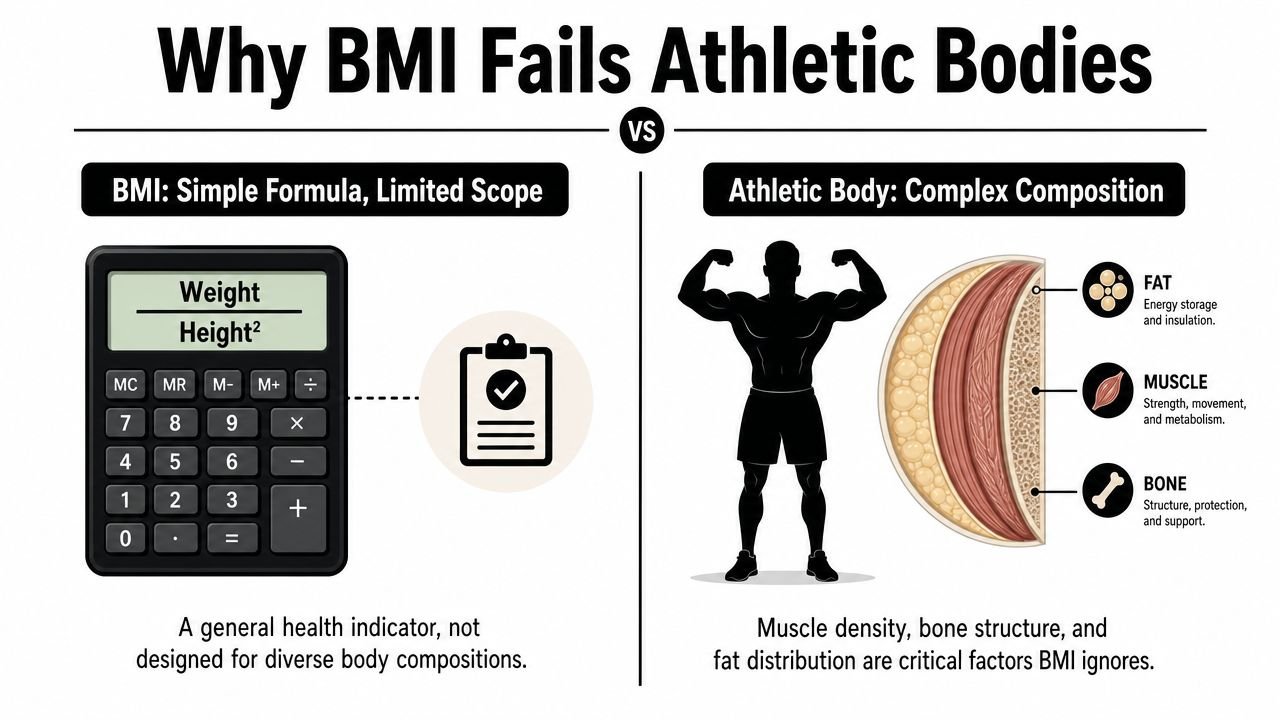
BMI sees total mass, not what makes up that mass
Muscle is dense. Bone structure differs. Training changes the body in specific ways. A rugby player, gymnast, and distance runner don't just weigh different amounts. They carry different proportions of lean tissue and fat, and they do it for sport-specific reasons.
That's why body composition matters more than body weight alone. If you want a useful primer, this guide on body composition analysis explained does a good job showing the difference between scale weight and what your body is made of.
The misclassification problem is real
This isn't just an abstract complaint athletes make. Research on adolescent athletes found that 13.31% were classified as obese by BMI percentile, but only 5.95% were obese by skinfold analysis. Among the athletes labeled obese by BMI, 62% were false positives, while the negative predictive value for non-obese BMI classifications was 0.99 in that same study (athlete BMI versus skinfold findings).
That's a huge reason athletes get frustrated. The chart can treat muscle like fat.
Practical rule: If a BMI result clashes with how you perform, recover, and look, don't argue with the number. Get better measurements.
Why colleges and clinics still use it
BMI is fast. It's cheap. Anyone can calculate it in seconds. That convenience keeps it in forms, screenings, and electronic records.
But convenience and accuracy aren't the same thing. For an athlete, BMI should be treated like a smoke alarm. It can tell you to take a closer look. It cannot tell you exactly what's happening inside the room.
Sport Specific BMI A More Nuanced Story
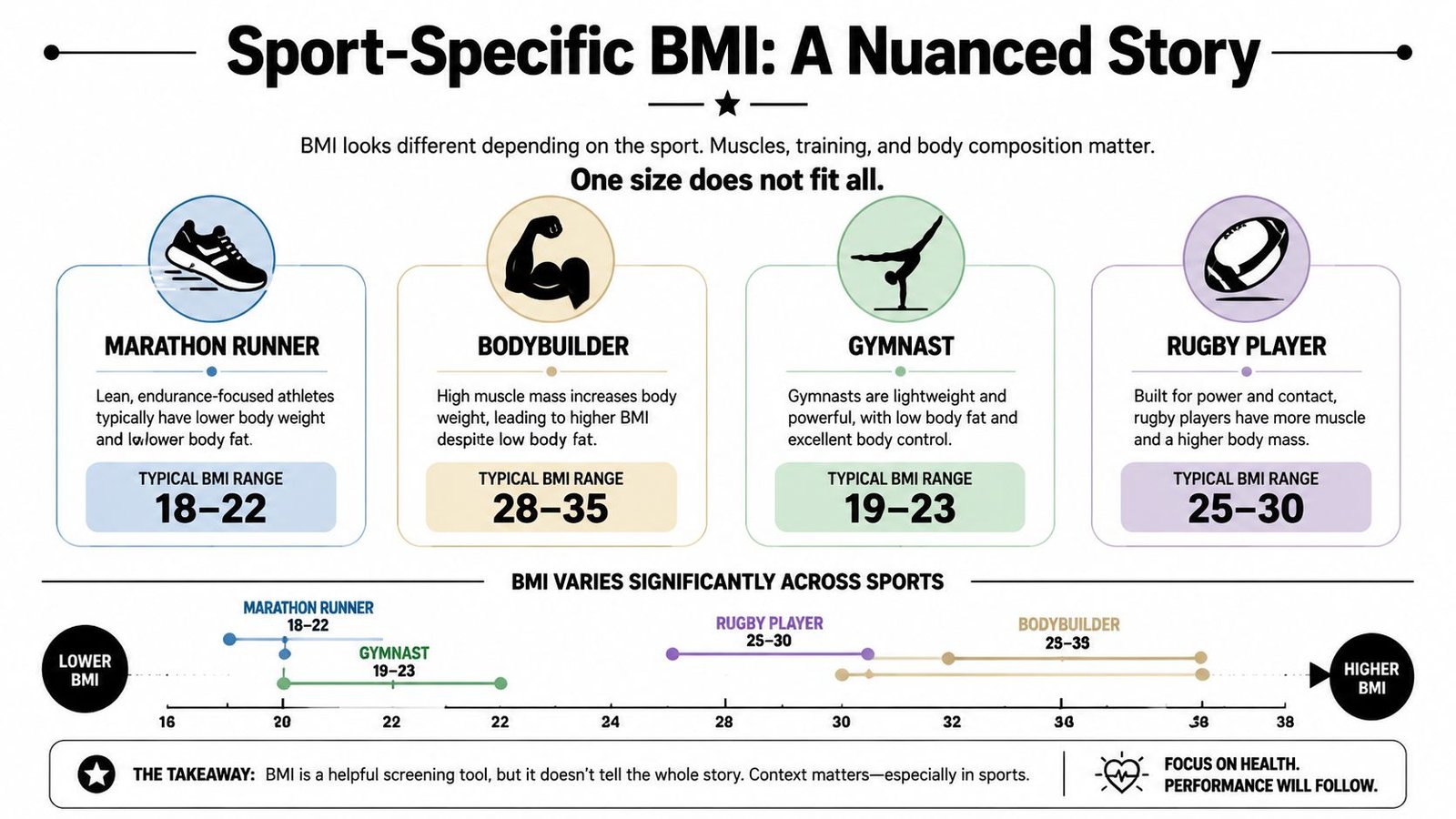
Athletes often talk about BMI as if it either works or doesn't. Real life is more interesting than that. BMI for athletes changes meaning depending on the sport, the body type that sport rewards, and the athlete's stage of training.
A marathon runner and a soccer player don't carry mass for the same reasons. One is built for long-duration efficiency. The other needs repeated sprint ability, strength, and resilience through contact and change of direction. You'd expect their bodies to look different.
What sport data tells us
A major review of master athletes found a mean BMI of 23.8 kg/m² with sport-specific values ranging from 20.8 kg/m² in endurance runners to 27.3 kg/m² in soccer players. In the same review, male master athletes averaged 23.6 kg/m² and female master athletes averaged 22.4 kg/m², both lower than controls at 26.13 kg/m². The review reported this as 9.5% lower and statistically significant at p < 0.001 (master athlete BMI review).
That matters because it shows BMI already shifts inside athletic populations. There isn't one “athlete BMI.”
Why a higher BMI may fit your sport
In some sports, more mass can support performance.
- Contact sports: Extra lean mass can help with force production and absorbing contact.
- Power sports: Strength and explosive output often improve with more muscle.
- Field and court sports: Athletes may sit at a BMI that looks high on paper because they need a blend of speed, strength, and durability.
A “high” BMI in those athletes may reflect adaptation, not a problem.
When a lower BMI deserves attention
The opposite gets ignored. Coaches and athletes spend a lot of time arguing against false “overweight” labels, but a lower BMI can also be a useful clue. In endurance, weight-class, and aesthetic sports, a low BMI may line up with underfueling, low body fat, low lean mass, or trouble recovering from training.
That doesn't mean every lean athlete is unhealthy. It means context matters. If a lighter athlete is also fatigued, getting sick often, struggling with training quality, or losing strength, the issue may not be “fitness.” It may be inadequate fuel or tissue support.
The question isn't whether a BMI category sounds good. The question is whether your body can support your sport.
Better Ways to Measure Your Body Composition
Once you stop asking, “What does my BMI say?” the better question is, “What is my body made of, and does that support performance?” That's where body composition tools help.
A newer study in young male athletes found that standard WHO BMI cutoffs of 25 kg/m² and 30 kg/m² overestimated excess adiposity and proposed athlete-specific thresholds of 28.2 kg/m² for overweight and 33.7 kg/m² for obesity. Those athlete-adjusted cutoffs showed better agreement with body-fat classification, with κ = 0.522 versus κ = 0.169 for standard WHO cutoffs (athlete-specific BMI threshold study).
That doesn't mean you need a new chart. It means even researchers are trying to push beyond one-size-fits-all BMI because direct body-fat assessment tells you more.
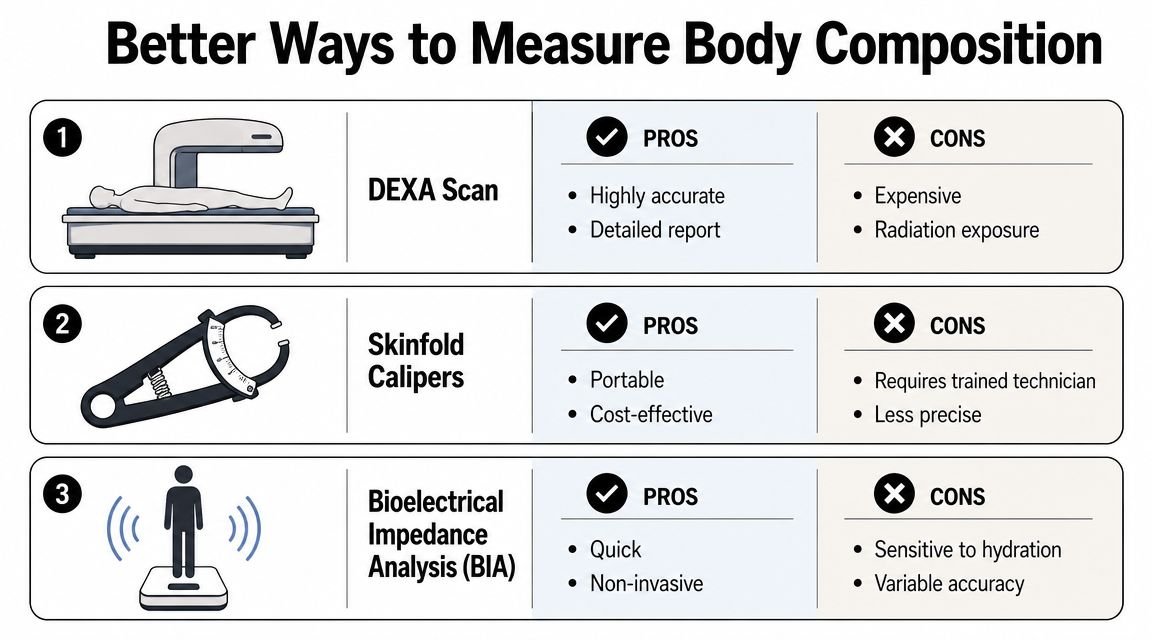
A simple comparison
| Method | Best use | Main strength | Main limitation |
|---|---|---|---|
| DEXA scan | Detailed assessments | Gives a more complete body composition picture | Less practical for frequent use |
| Skinfold calipers | Team settings, repeat checks | Accessible and useful when done by a skilled tester | Depends heavily on tester skill |
| BIA scale | Home tracking | Fast and easy | Readings can swing with hydration |
| Tape, photos, performance logs | Day-to-day context | Cheap and repeatable | Less precise for estimating body fat |
Which method makes sense for most athletes
You don't need the fanciest option. You need a method you can repeat under similar conditions.
DEXA when you need detail
DEXA is often treated as the premium option because it can show regional body composition. If you're a serious athlete working with sports medicine staff, it can be useful at key points in the year. But it's not something the general population needs every week.
Skinfolds when consistency matters
Skinfolds are still very useful in athletic settings because they're portable and practical. If the same trained person measures you the same way over time, the trend can be more valuable than obsessing over a single reading.
BIA when convenience wins
BIA scales are common because they're quick and non-invasive. They can help with trend tracking, but they're sensitive to hydration. If you use one, test under similar conditions each time.
A helpful visual breakdown sits below.
The low-tech tools athletes underrate
Don't dismiss simple tracking.
- Progress photos: Same lighting, same time of day, same poses.
- Waist and limb measurements: Useful when strength is rising and you want to know where mass is changing.
- Performance markers: Bar speed, sprint times, jump height, practice quality, recovery, and energy.
If your body composition is “improving” but your lifts stall, your legs feel dead, and your practices get worse, the metric isn't helping you. If you're trying to burn fat and build muscle, the best method is the one that shows whether your body and performance are moving in the same direction.
Your Action Plan for Tracking What Truly Matters
Once you understand the limits of BMI, the next step is simple. Stop letting a chart drive the whole conversation. Start tracking the things that affect how you play, recover, and feel.
One review suggests a BMI cutoff around 19 can be an early detector for health risks associated with low body fat or low lean mass, while a BMI over 30 can be a starting point to screen for issues like sleep apnea in certain athletes (clinical body composition screening discussion). That's a useful reminder that BMI isn't meaningless. It's just incomplete.
A better scoreboard for athletes
Use a small set of markers instead of one broad label.
Body composition trend
Pick a method you can repeat. That might be skinfolds with your athletic trainer, a periodic DEXA, or regular waist and photo check-ins.Performance output
Track what your sport rewards. Strength numbers, sprint quality, repeat effort, jump performance, practice sharpness, and recovery all count.Nutrition consistency
Many athletes encounter challenges with this. They want body composition changes without consistent fueling. That rarely works well.
Coach's note: If your intake changes wildly from day to day, your body composition data gets harder to interpret.
How to build a practical routine
You don't need a complex spreadsheet. You need repeatable habits.
- Set one performance goal: Maybe it's holding speed deeper into games, adding strength, or feeling fresher in morning lifts.
- Add one body metric: Use one body composition method and keep it consistent.
- Track your food intake: Not forever if you don't want to, but long enough to learn what supports your training.
- Review weekly: Look for patterns. Are your hardest sessions underfueled? Are you skipping protein after practice? Are weekends wiping out the structure you keep during the week?
For athletes who want an evidence-based nutrition foundation before they tinker with extras, this guide on unlocking athletic performance with supplements is more useful once the basics are already in place.
The food piece matters more than people admit
Body composition doesn't change on motivation alone. It changes when training and nutrition line up.
If your goal is adding lean mass, you need enough total energy and enough protein. If your goal is getting leaner without hurting output, you need structure so you don't cut too hard and flatten your training. Learning how to count macros can help translate vague goals into something actionable, especially during heavy training blocks.
Redefine Your Fitness Beyond the BMI Chart
A BMI chart can be useful in a broad public health sense. It is not built to explain the body of a sprinter, wrestler, midfielder, or rower. That's why BMI for athletes often creates more confusion than clarity.
If your BMI is high, it may reflect muscle, frame size, or the demands of your sport. If it's low, that might be fine, or it might be a clue that you need a closer look at fueling, recovery, or lean mass. The number only becomes meaningful when you put it next to context.
Your best move is to treat BMI as a prompt, not a verdict. Look at body composition. Look at nutrition. Look at performance. Look at whether you're recovering well enough to use the body you're building.
You're not training to win a chart. You're training to play your sport well, stay healthy, and feel strong in your own body. A better framework asks, “Can this body perform?” That's a far more useful question than whether a simple formula likes your height and weight.
If you want a faster way to connect nutrition with body composition and performance, PlateBird makes calorie and macro tracking simple enough to stick with. You can type meals like “chicken rice broccoli” or snap a photo, then use the data to support smarter fueling decisions instead of chasing a misleading BMI label.